

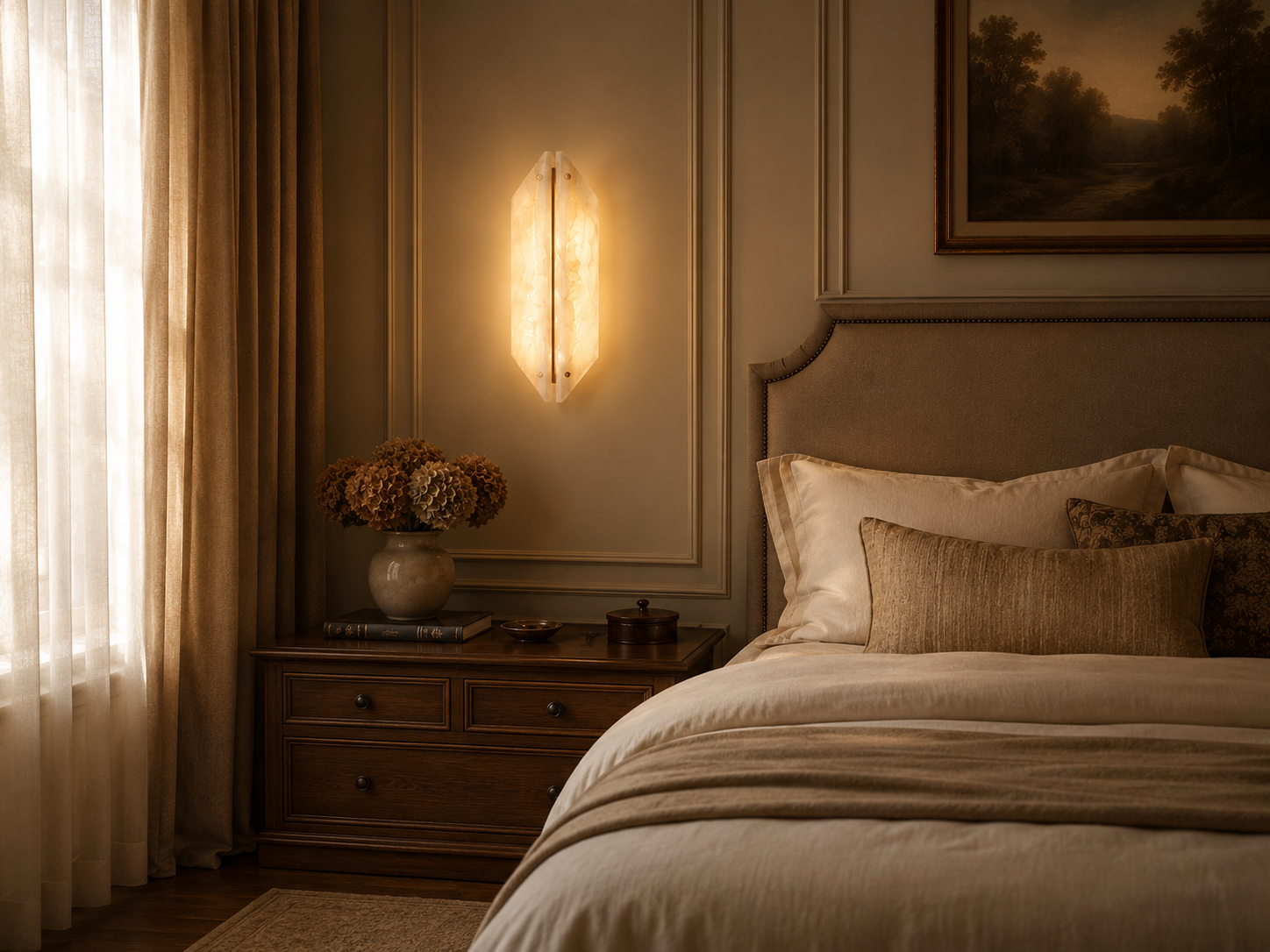

A science-informed home-lighting guide featuring two natural-stone wall sconces from Xunlu Lighting.
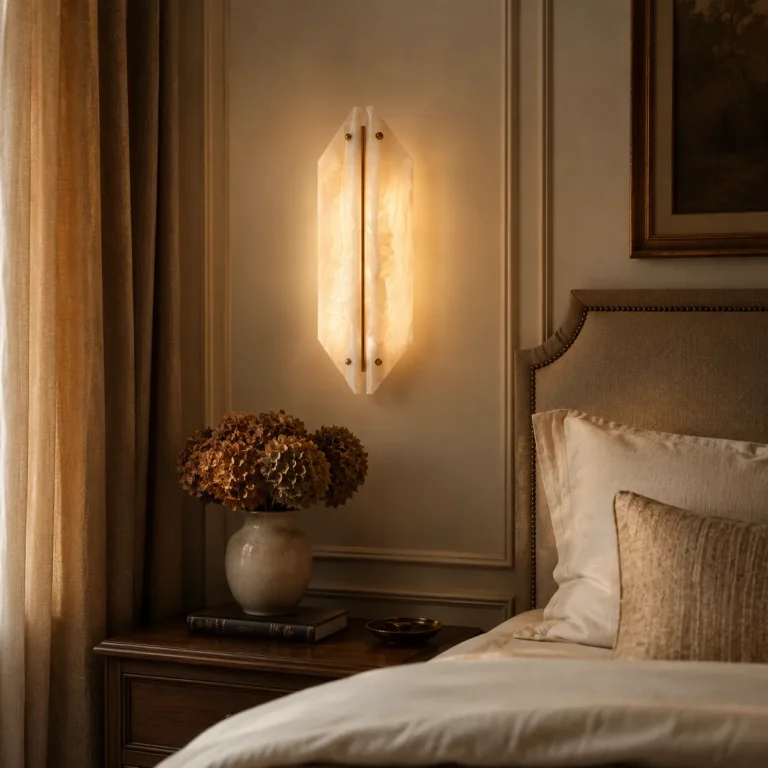
Why Natural Stone Wall Lights Feel Different
Natural stone has a visual quality that manufactured shades rarely reproduce exactly. Alabaster and marble contain subtle mineral variation, translucency, veining, and depth. When light passes through or grazes these surfaces, the fixture becomes more than a source of illumination: it becomes a luminous material object.
This article compares two Xunlu Lighting wall sconces: the Natural Alabaster Wall Light | Luxury Stone Sconce and the Marble Wall Light | Natural Stone Brass Wall Sconce. Both use real stone, but their optical character, lamp format, and decorative language are different. The alabaster model produces a broad, softly glowing stone surface; the ribbed marble model uses a more compact cylindrical form with a warmer brass accent.
The science of a softer luminous surface
Visual comfort is affected not only by how many lumens a fixture produces but also by luminance distribution: how concentrated or spread out the brightness appears to the eye. A small exposed source can feel harsh because its luminance is concentrated. A translucent stone shade increases the apparent emitting area, helping create a smoother brightness transition between the fixture and the surrounding wall.
This principle is especially useful for wall lighting because sconces are usually closer to eye level than ceiling lights. A softly luminous surface can provide useful ambient-accent light while reducing the sense of a glaring point source. Stone also introduces a second layer of visual diffusion through its internal mineral structure and surface texture.
The U.S. Department of Energy notes that light quality involves both the color appearance of the light, commonly summarized by correlated color temperature (CCT), and how accurately objects appear under that light, often described with CRI or newer measures such as TM-30. For interior lighting, DOE commonly recommends at least CRI 80, with higher values preferred when color fidelity is important.
Alabaster vs. Marble: Which Effect Fits the Room?
| Design factor | Natural Alabaster Wall Light | Marble Wall Light |
|---|---|---|
| Material | Natural alabaster stone + metal; brass hardware | Natural ribbed marble + metal body with brushed brass finish |
| Light source | 1 × G9 LED bulb, max 7W | 1 × E14 bulb; recommended 5–10W LED |
| Typical output | Approx. 500–700 lm, depending on bulb | Approx. 400–800 lm, depending on bulb |
| Recommended CCT | 3000K standard; 2700K / 4000K / 6000K optional | 3000K recommended; 4000K / 6000K optional via bulb choice |
| Dimensions | W16 × H35 × D8 cm | W10 × H35 cm; approx. 10 cm wall projection |
| Best mood | Soft, architectural, serene | Warm, tailored, decorative |
| Ideal spaces | Bedroom, living room, reading corner, hallway | Bedroom, living room, entry, corridor, boutique hospitality |
(1) Natural Alabaster Wall Light: A Calm Architectural Glow
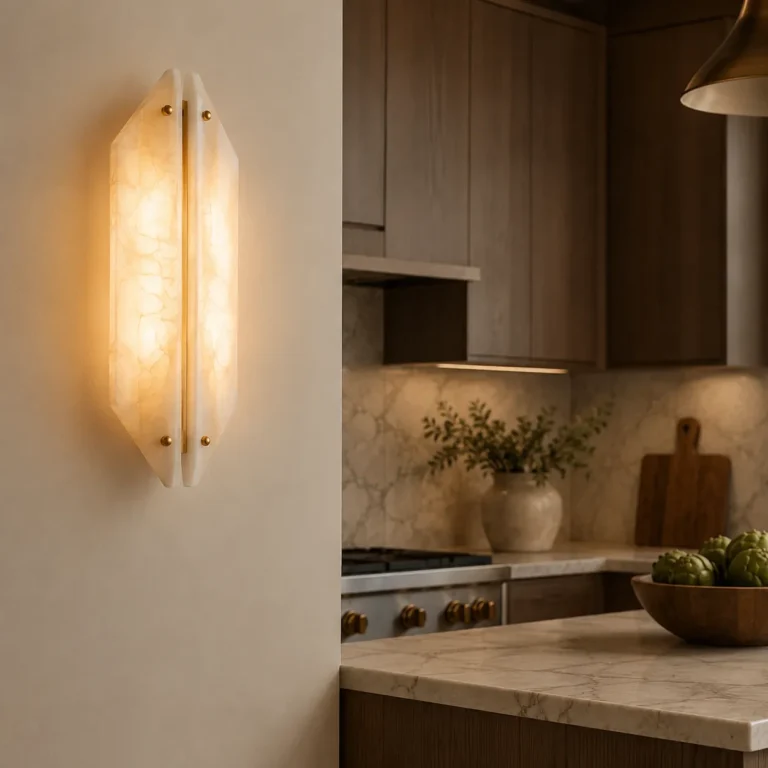
Xunlu Lighting describes this fixture as genuine natural alabaster with premium brass hardware and a metal mounting structure. The stone is naturally translucent, so its mineral patterns become more visible when illuminated. The product uses a replaceable G9 LED bulb, supports dimming when paired with compatible components, and is designed around a warm 3000K presentation.
Its approximately 16 × 35 cm face gives the eye a relatively broad glowing surface for a wall light. This is useful in bedrooms and reading corners because the fixture contributes ambience without visually dominating the room. The cream stone tone also pairs naturally with timber, warm white paint, brass, linen, wool, and other low-contrast residential materials.
(2) Marble Wall Light: Ribbed Stone With a Brass Accent
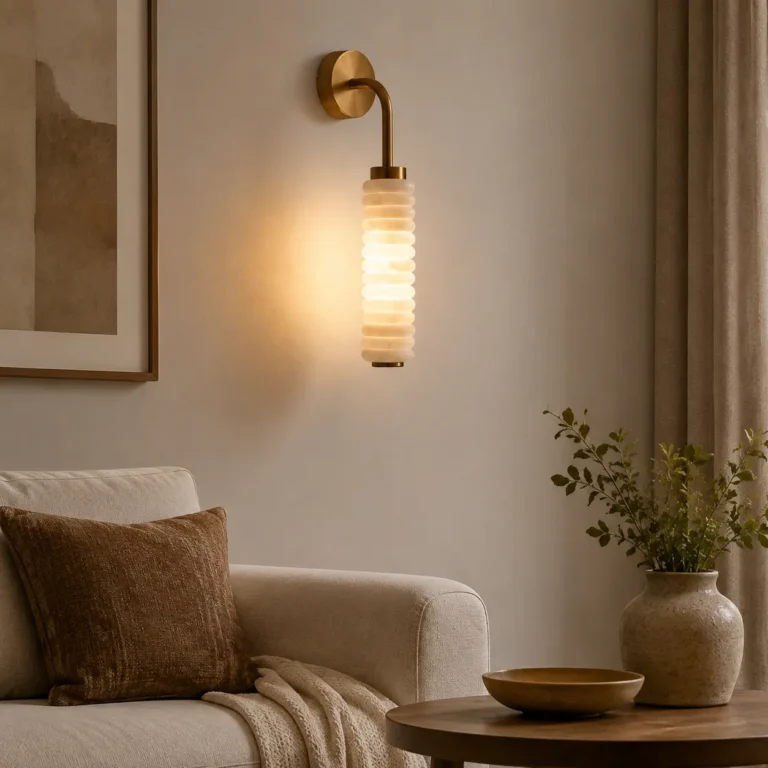
The marble model is slimmer and more linear. Its ribbed natural marble shade is paired with a brushed brass connector and an E14 socket, allowing the user to choose a compatible LED bulb. Xunlu recommends a 5-10W LED and approximately 3000K warm white for a balanced residential effect.
The ribbing adds texture even when the light is switched off. When lit, it creates a repeating rhythm of brighter and softer bands. This can make the fixture feel more decorative and tailored than a flat diffuser, which is why it suits bedside walls, living-room side walls, entry niches, and hotel-inspired interiors.
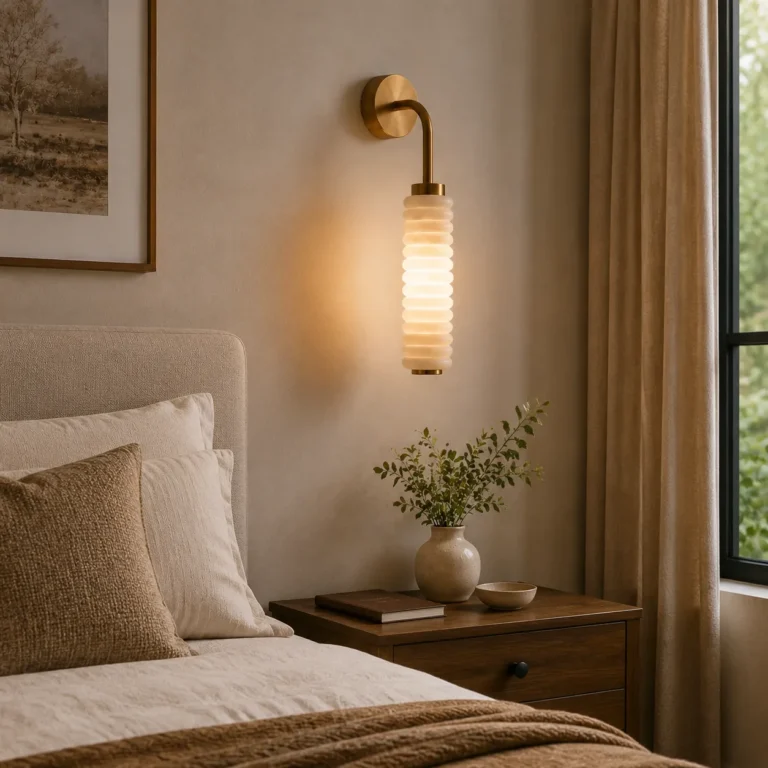
Marble Wall Light beside a bed: warm brass and ribbed stone create a quieter alternative to a conventional bedside lamp.
Color Temperature: Why Warm White Usually Works Best With Stone
CCT describes whether white light appears warm or cool. A lower CCT appears warmer; a higher CCT appears cooler. For natural stone, 2700K-3000K usually produces the most flattering residential result because it strengthens cream, honey, brass, timber, and textile tones.
• 2700K: very warm and relaxed; particularly suitable for bedrooms and late-evening use.
• 3000K: warm but cleaner; a versatile choice for living rooms, bedrooms, corridors, and hospitality-style interiors.
• 4000K: more neutral and visually crisp; useful when the space also serves dressing, circulation, or mixed daytime functions.
• 6000K: distinctly cool; generally better for task-oriented moments than for a relaxing evening atmosphere.
Research on evening residential lighting also supports using warmer, lower-impact lighting after dark. A 2026 study of household lamps reported much lower estimated melatonin suppression from warm-white sources than cool-white sources under the tested conditions. Earlier controlled studies likewise found that evening room light and blue-enriched light can suppress melatonin or increase alertness. These findings do not mean CCT alone determines circadian impact—intensity, spectrum, duration, timing, and distance all matter—but they reinforce the practical value of warmer, dimmer evening lighting.
Color Rendering Is Important Around Stone, Brass, and Textiles
Natural materials depend on spectral quality to look convincing. The delicate cream and amber variations in alabaster, the warmer undertones of marble, the sheen of brass, and nearby fabrics can all look dull under poor-quality light. CRI remains widely used, but CIE has documented limitations of the traditional Ra metric for solid-state lighting and has developed more accurate fidelity methods. For premium interiors, ask for strong color-rendering performance rather than choosing lamps by wattage and CCT alone.
Where These Wall Lights Work Best
Bedroom and bedside
Wall-mounted stone lighting frees the nightstand, reduces visual clutter, and adds a low-level ambient layer. Position the luminous stone so it is slightly above the seated eye line and not directly in the pillow-facing line of sight. For reading, add a directional task source rather than relying only on diffuse decorative light.
Living room
Use one stone sconce beside artwork, a console, or a reading chair to add vertical brightness. A pair can frame a sofa or fireplace, but symmetry is not mandatory. In contemporary interiors, one asymmetrically placed sconce can act like illuminated sculpture.
Hallway and entry
Repeated stone sconces can create rhythm and make a corridor feel more finished. Because wall light increases visible vertical brightness, it can reduce the flatness created by ceiling-only lighting. Keep spacing consistent and avoid placing the brightest center of the shade directly at average eye height.
Dining and hospitality-style spaces
Natural stone wall lights work particularly well as a background layer behind dining tables, lounge seating, or hotel-style corridors. They can add perceived warmth without competing with a central chandelier or pendant.
A Better Lighting Plan: Layer, Do Not Overload
A comfortable room usually benefits from several moderate light sources rather than one overly bright fixture. A practical evening composition might combine:
• dimmed ceiling or pendant lighting for general orientation;
• one or more stone wall lights for vertical ambient-accent glow;
• a table or floor lamp near seating;
• focused task lighting only where reading, work, grooming, or food preparation requires it.
This layered strategy improves control and gives the room more depth. It also lets the stone fixtures remain visually beautiful rather than forcing them to provide every lumen the room needs.
Product Specifications at a Glance
Natural Alabaster Wall Light | Luxury Stone Sconce
• Material: genuine natural alabaster stone + metal structure + brass hardware
• Light source: 1 × G9 LED bulb
• Maximum power: 7W
• Voltage: AC 110-240V
• CCT: 3000K warm white; optional 2700K / 4000K / 6000K
• Approx. output: 500-700 lm depending on bulb
• Dimming: supported with compatible bulb and driver
• Dimensions: W16 × H35 × D8 cm
• Approx. net weight: 1.5 kg
Marble Wall Light | Natural Stone Brass Wall Sconce
• Material: natural ribbed marble + metal with brushed brass finish
• Light source: 1 × E14 LED bulb
• Recommended LED power: 5-10W; fixture maximum 40W
• Voltage: AC 110-240V
• Recommended CCT: 3000K; 4000K / 6000K available depending on bulb
• Approx. output: 400-800 lm depending on LED bulb
• Dimensions: W10 × H35 cm; marble shade approx. Ø6 cm
• Wall distance: approx. 10 cm
• Approx. net weight: 1.5 kg
Which One Should You Choose?
Choose the alabaster model if you want a broader, softer stone surface with a calm architectural character. It is especially strong in bedrooms, refined living rooms, and spaces where the fixture should glow quietly rather than read as a decorative object first.
Choose the ribbed marble model if you want a slimmer wall light with more visible brass detailing and a stronger decorative rhythm. It is a natural fit for bedside walls, transitional living rooms, entryways, and hospitality-inspired interiors.
Both work best when the surrounding lighting plan respects the same idea: warm, controlled, layered light rather than excessive brightness.
Final Thoughts
Natural stone wall lighting succeeds because the material itself participates in the light. Alabaster reveals glowing mineral depth; marble introduces texture and a more structured decorative rhythm. When combined with warm LED light, both can make walls feel softer, rooms feel deeper, and evening interiors feel more composed.
For homeowners and designers, the practical sequence is simple: choose the atmosphere first, then select the right stone character, bulb output, CCT, color quality, and placement. A successful wall sconce should be visually interesting in daylight and genuinely comfortable after dark.