

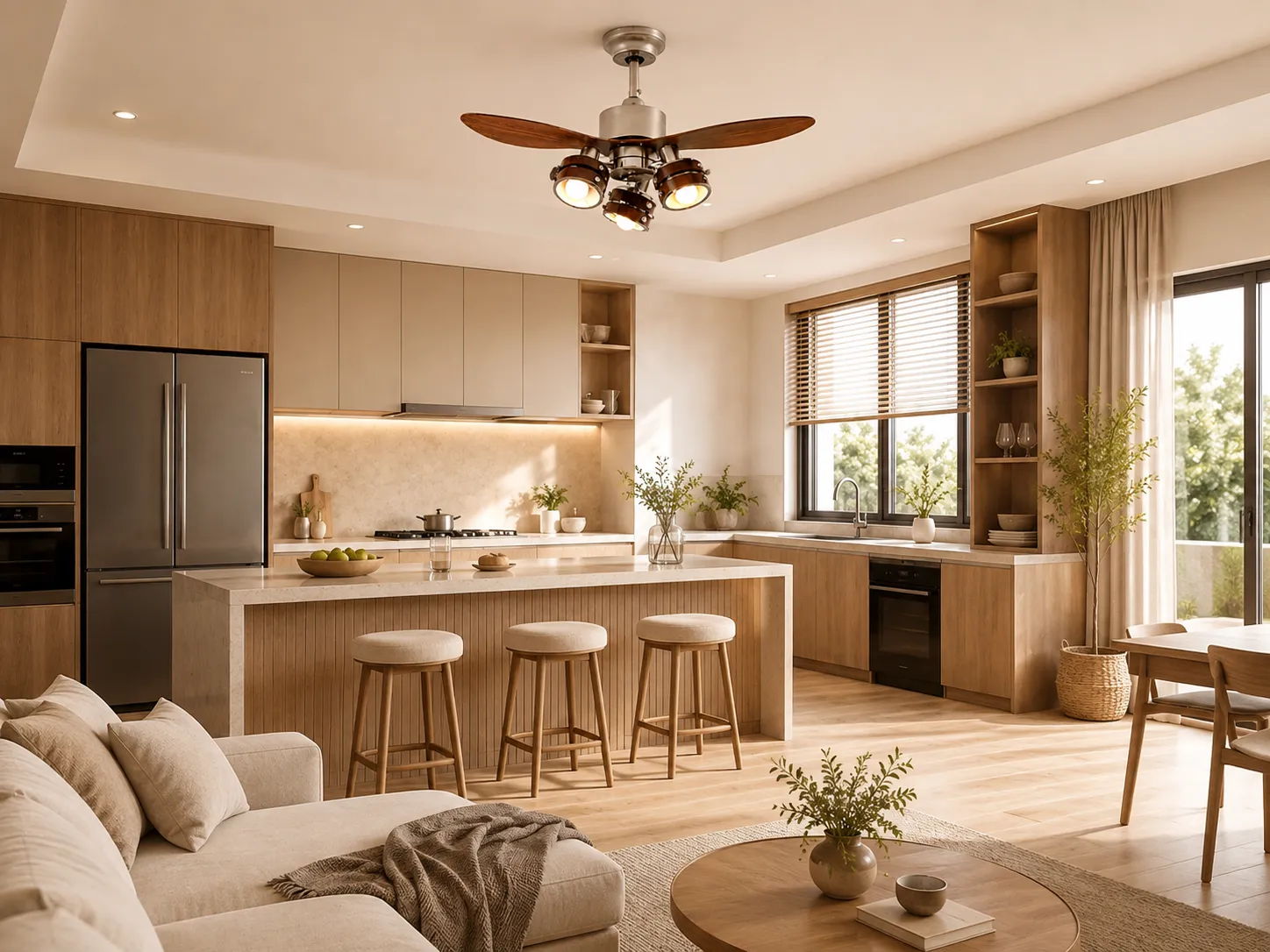

Featuring two Xunlu Lighting designs for bright, comfortable contemporary interiors
Ceiling fans are often treated as purely practical equipment, while decorative lighting is treated as a separate design decision. In reality, a well-chosen ceiling fan light can support three goals at once: visual comfort, perceived thermal comfort, and a more coherent interior composition. The key is to look beyond appearance alone and consider airflow, room proportions, light distribution, color temperature, and maintenance. This guide compares two distinctly styled Xunlu Lighting models and explains how to choose between them using established principles from building science and lighting practice.
Why Ceiling Fan Lights Can Improve Everyday Comfort
Air movement changes how warm a room feels. Research summarized by ASHRAE and the UC Berkeley Center for the Built Environment shows that elevated air speed can extend the range of temperatures people find comfortable. In warm conditions, moving air increases convective and evaporative heat loss from the body, which can make occupants feel cooler even when the room air temperature itself does not change. [1][2]
That distinction matters: a ceiling fan does not refrigerate the room. Instead, it improves comfort for people in the room by increasing air movement. For efficient operation, the fan should generally be turned off when the space is unoccupied.
Efficiency also depends on the complete fan system, not just blade size. ENERGY STAR notes that motor design, blade design, pitch, material, blade count, and blade length all influence air movement and efficiency. A larger diameter can help cover a broader occupied zone, but it should not be interpreted as the only indicator of performance. [3]
Product 1: Crystal Globe Ceiling Fan Light — 8-Light Wood Blade Design
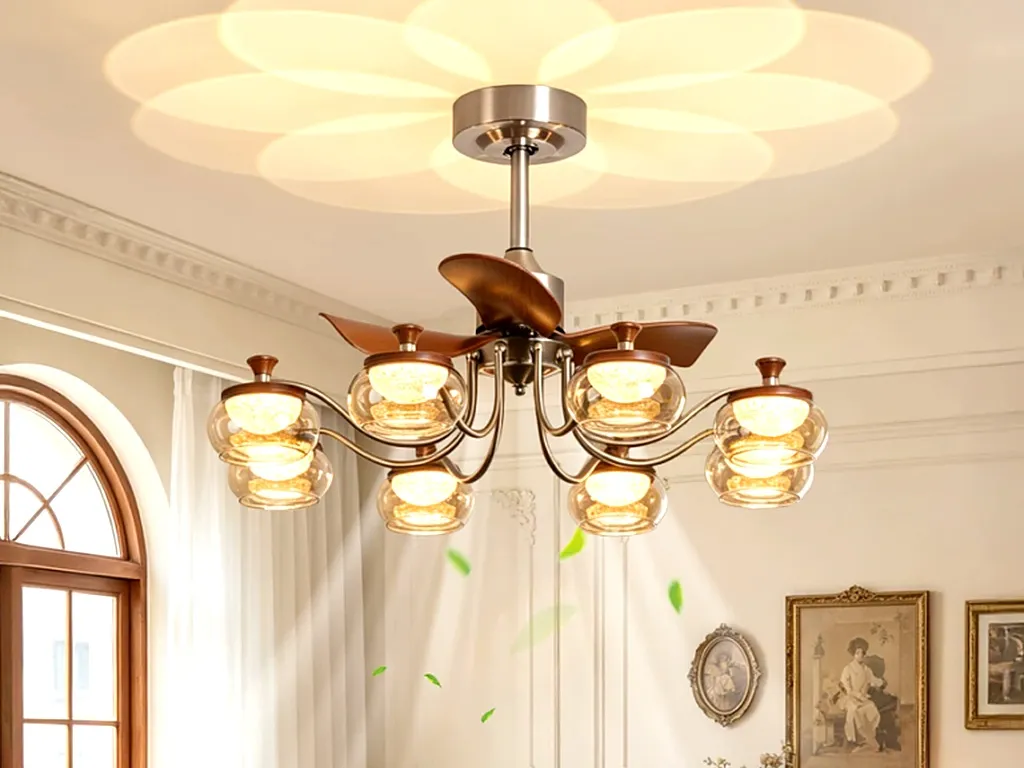
A chandelier-first aesthetic with integrated air movement
This model is designed as a decorative focal point rather than a visually quiet utility fan. Its eight-light arrangement, amber-toned outer glass, crystal-effect inner diffusers, sand-nickel body, and walnut-look blades create a layered, warm appearance. It is especially suited to rooms where the ceiling fixture is meant to be seen from several viewpoints—living rooms, dining spaces, double-aspect rooms, villas, boutique hospitality interiors, and other spaces where decorative presence matters.
Lighting characteristics
According to the product specification, the fixture uses eight integrated LED modules with a stated total lighting power of 138 W and a stated output of at least 11,040 lumens. It offers three selectable color-temperature settings: 3000 K, 4000 K, and 5700 K. That range gives the user useful flexibility: 3000 K supports a warmer, more relaxed evening atmosphere; 4000 K can feel cleaner and more neutral for everyday activities; and 5700 K produces a noticeably cooler, more energetic appearance.
The multiple light heads can also reduce the visual dominance of a single very bright source. The crystal-effect and glass layers scatter and redirect light, helping the fixture feel more decorative and dimensional. As with any bright multi-source ceiling fixture, glare still depends on viewing angle, source luminance, and surrounding surface brightness. Lighting guidance from the Illuminating Engineering Society emphasizes that high-luminance sources in the visual field can cause discomfort, so balancing the fixture with wall, floor, and accent lighting is preferable to relying on one ceiling source alone. [4]
Scale and installation
The listed overall diameter is 93 cm (36.6 in) and the overall height is 59.5 cm (23.4 in), with a 25 cm (9.8 in) downrod. The manufacturer also recommends at least 50 cm (19.7 in) of blade-to-wall clearance. Because the fixture has strong visual mass below the ceiling, it works best where there is enough ceiling height to preserve comfortable head clearance and enough surrounding space for the blades to operate freely.
Best design applications
• Large living or dining rooms where the ceiling fixture is a key decorative feature.
• Warm-neutral, transitional, light-luxury, or classic-contemporary schemes.
• Rooms that benefit from strong ambient illumination and an expressive chandelier effect.
• Spaces with pale walls, light upholstery, stone, warm wood, or brass-toned details that can reflect and soften the warm light.
Product 2: 52-Inch Wood Ceiling Fan Light — Walnut Blade 3-Light Design
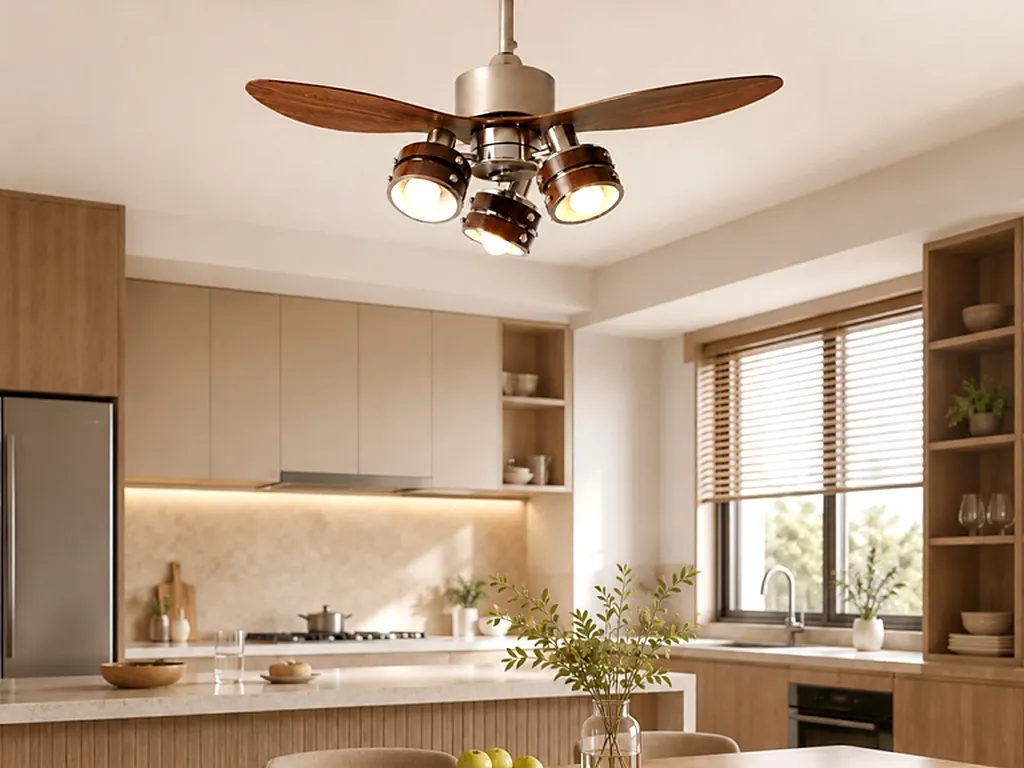
A quieter visual profile for modern natural interiors
The second design is more restrained. Walnut wood blades, a sand-nickel body, glass shades, and wood-finish trim create a natural-modern look that sits comfortably in kitchens, bedrooms, studies, dining rooms, cafés, and relaxed hospitality spaces. Compared with the eight-light model, the three-light composition leaves more negative space around the fixture, making it easier to integrate into interiors where the furniture, cabinetry, or architecture should remain visually dominant.
Replaceable bulbs add flexibility
This model uses three replaceable E27 bulbs rather than integrated LED modules. The listed configuration is 12 W × 3, for 36 W total, with an approximate stated output of 2,700–3,600 lumens depending on the bulbs selected. The product page lists 3000 K, 4000 K, and 5700 K options. Replaceable bulbs can be useful when the owner wants to alter brightness, color temperature, beam appearance, or future lamp availability without replacing the whole fixture.
Room scale and visual balance
The product page describes the fan as a 52-inch design, while the detailed specification lists a 92 cm (36.2 in) fan diameter. Because those two size statements do not match, buyers should confirm the final blade span with Xunlu Lighting before installation or specification. The listed height is 42 cm (16.5 in) with a 10 cm downrod or 52 cm (20.5 in) with a 20 cm downrod.
Best design applications
• Medium-size living rooms, bedrooms, kitchens, and dining areas where a simpler fixture is preferred.
• Japandi, organic modern, warm minimal, Scandinavian-inspired, and contemporary wood-and-neutral interiors.
• Homes where bulb replacement and future lighting customization are priorities.
• Rooms that already have strong task lighting, such as under-cabinet kitchen lights or bedside lamps, and therefore need the ceiling fixture mainly for general ambient light.How to Choose Between the Two
| Decision factor | 8-Light Crystal Globe Fan | Walnut 3-Light Fan |
|---|---|---|
| Visual impact | High; chandelier-like focal point | Moderate; cleaner and more understated |
| Lighting system | Integrated LED, 8 modules | 3 replaceable E27 bulbs |
| Stated light output | ≥ 11,040 lm | Approx. 2,700–3,600 lm |
| Color temperature | 3000K / 4000K / 5700K | 3000K / 4000K / 5700K |
| Style direction | Light luxury, warm classic, decorative | Natural modern, warm minimal, contemporary |
| Best use | Statement living/dining rooms | Everyday living, bedroom, kitchen/dining |
| Maintenance preference | Integrated LED system | Bulbs can be replaced individually |
If the ceiling fixture is intended to become the room’s centerpiece, the eight-light model is the stronger choice. If the goal is a quieter natural-material look and easy bulb replacement, the three-light design is generally the more adaptable option.
A Science-Based Way to Plan Ceiling Fan Lighting
1. Think in layers, not just total lumens
A bright ceiling fixture can provide useful ambient light, but the most comfortable rooms usually combine ambient, task, and accent lighting. A dining table may need focused light on the horizontal surface; a kitchen needs strong task lighting at worktops; a living room benefits from lower-level lamps that reduce the contrast between the ceiling source and the rest of the visual field. This approach can make a bright central fixture feel less harsh.
2. Match color temperature to time and activity
Warm white around 3000 K is widely used for evening living and dining spaces because it supports a softer visual atmosphere. Neutral light around 4000 K can be appropriate for kitchens, studies, and multipurpose rooms where visual clarity matters. Cooler light around 5700 K is visually crisp but can feel more clinical in relaxed residential settings. Because both featured products offer multiple color-temperature options, the same fixture can support different moods and tasks.
3. Use fan airflow to support—not replace—HVAC
ASHRAE guidance recognizes elevated air speed as a legitimate thermal-comfort variable, and CBE research has shown that occupants can remain comfortable at warmer room temperatures when air movement is available. In one CBE summary, fan-assisted conditions at 26–27°C were reported as equally or more comfortable than a 23°C still-air condition in an office field study. [2] The practical lesson for homes is simple: use the fan when people are present, and coordinate it with air-conditioning settings rather than assuming it lowers room temperature by itself.
4. Judge fan performance by airflow efficiency, not blade pitch alone
ENERGY STAR defines ceiling-fan efficiency in cubic feet per minute per watt (CFM/W). Its guidance also stresses that blade pitch by itself does not determine airflow; motor design, speed, blade geometry, material, number, and length all contribute. [3][5] When comparing models for cooling performance, ask for tested airflow data and efficiency rather than relying only on appearance or diameter.
5. Confirm clearances and product dimensions before purchase
Ceiling fan lights need more spatial planning than ordinary pendants. Check ceiling height, downrod length, blade-to-wall distance, nearby cabinet doors, tall furniture, sprinklers, beams, and sloped ceilings. For homes with lower ceilings, a more compact or hugger-style fan may be preferable. Final installation should follow the manufacturer’s instructions and applicable electrical and building requirements.
Styling Tips for Brighter, Lighter Interiors
Because both designs use warm wood tones, they pair especially well with bright neutral interiors. To keep the room visually light, use off-white, cream, pale greige, soft beige, light oak, limestone, travertine, and muted brass or nickel accents. Large windows, light-colored curtains, and matte wall finishes can help distribute daylight and reduce strong contrast around the ceiling fixture.
For the crystal-globe model, repeat the warm amber note sparingly—perhaps in a vase, picture frame, or small textile detail—rather than filling the room with dark brown. For the walnut three-light fan, keep cabinetry and furniture lines simple so the natural blades feel intentional rather than rustic.
Final Thoughts
The strongest reason to choose a ceiling fan light is not that it combines two products into one; it is that airflow and light can be designed together as part of the room’s comfort strategy. The Crystal Globe Ceiling Fan Light is the more decorative and luminous option, while the walnut three-light model offers a calmer profile and the flexibility of replaceable bulbs. In either case, the best result comes from matching the fixture to room scale, ceiling height, lighting layers, and the way people actually use the space.
Explore the products at xunlulighting.com and confirm final dimensions, airflow data, electrical requirements, and installation clearances before ordering.