

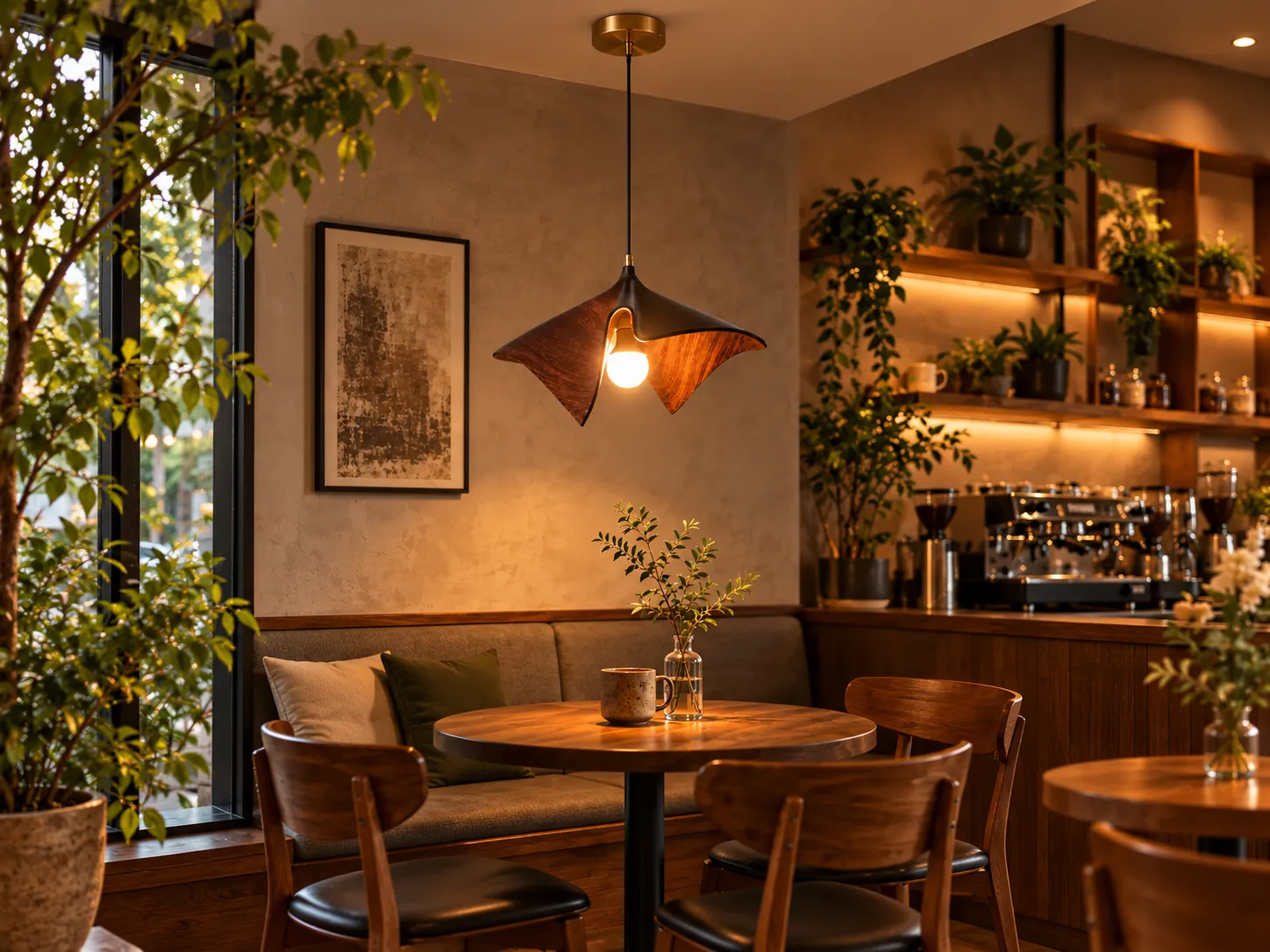

How Resin Pendant Lights Create Warmth, Visual Comfort, and Natural Character at Home
A science-informed guide to warm color temperature, glare control, layered lighting, and the role of sculptural resin shades in modern organic interiors.
Why Organic Pendant Lighting Feels Different
Lighting changes more than visibility. It shapes how materials read, where the eye settles, how deep a room feels, and whether an interior appears calm or visually restless. In warm, natural interiors, pendant lights with irregular or flowing forms can act as both illumination and sculpture: they introduce texture overhead while keeping the room visually grounded.
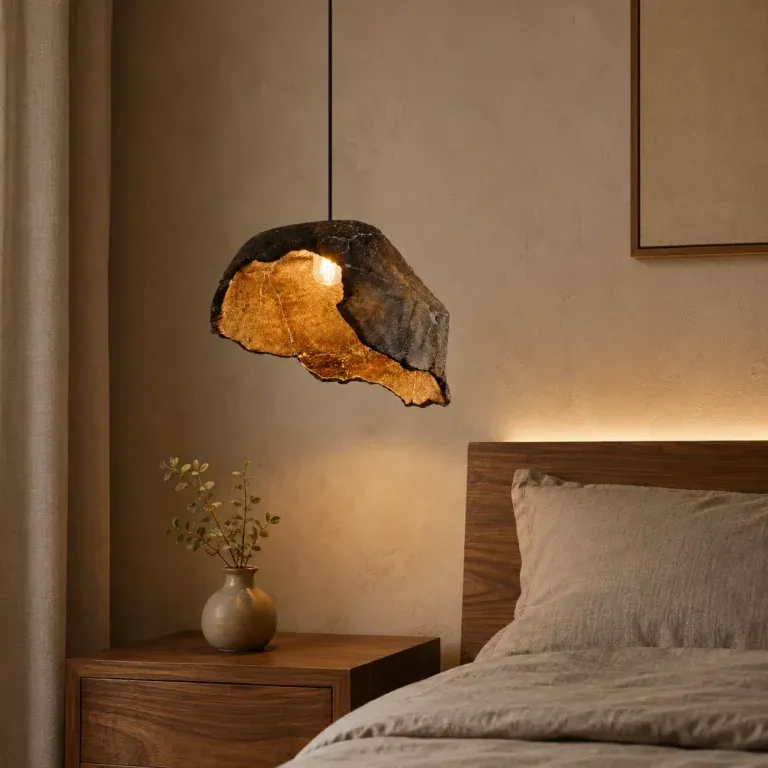
The two Xunlu Lighting designs featured here approach that idea from different directions. The Natural Stone Texture Resin Pendant Light uses a dark, irregular shell with a warm translucent interior, while the Sculptural Resin Pendant Light uses a folded, wing-like silhouette that emphasizes movement and negative space. Both use resin and metal construction with a single E27 lamp holder, making the bulb itself an important part of the final lighting effect. [1][2]
The most successful way to use fixtures like these is not to ask them to light an entire room alone. Instead, treat them as a warm focal layer within a broader lighting scheme: ambient light for orientation, task light where work happens, and accent or decorative light to create depth. That approach reduces the pressure on a single bright source and can improve visual comfort.
1. Material, Texture, and the Psychology of Warmth
Natural materials are rarely visually uniform. Stone, wood, paper, ceramic, and hand-finished surfaces all contain small irregularities that create depth under light. Resin can reproduce this tactile language while allowing forms that would be difficult to achieve with heavy natural stone. In the stone-textured pendant, the darker exterior frames a warm amber interior; in the folded pendant, the shade becomes a continuous sculptural plane around the exposed bulb. [1][2]
This matters because the eye reads surfaces through gradients, edge contrast, and reflected light. A textured shade produces more nuanced luminance patterns than a perfectly flat, highly reflective surface. The result can feel softer and more dimensional, particularly when the fixture is surrounded by matte plaster, natural wood, linen, or stone finishes.
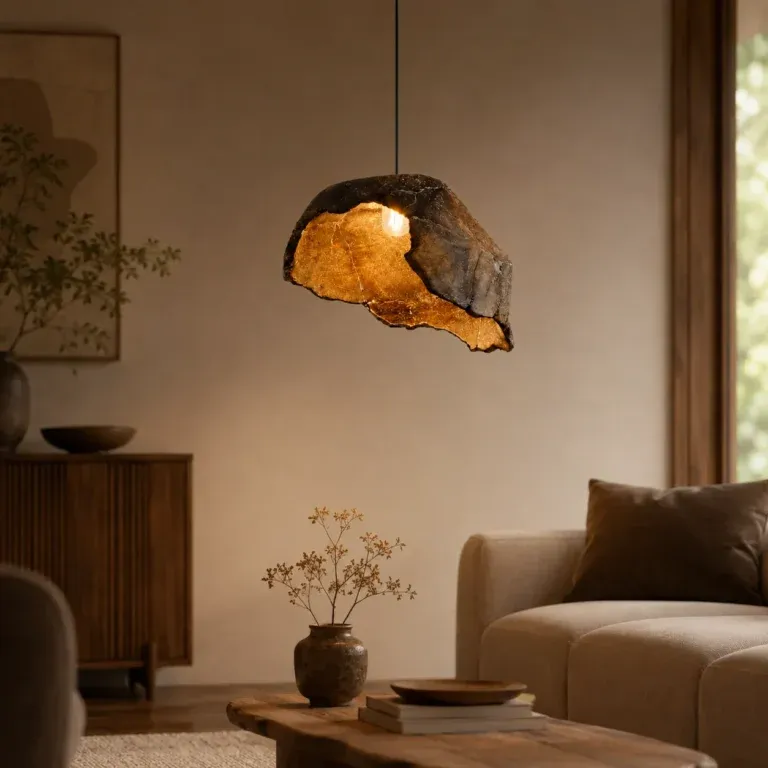
Natural Stone Texture Resin Pendant Light: A Quiet, Wabi-Sabi Focal Point
The Natural Stone Texture Resin Pendant Light is designed around an irregular, hand-finished resin shade with a dark charcoal-brown exterior and amber-gold inner glow. Xunlu Lighting specifies compatibility with one E27 LED or Edison-style bulb, recommending approximately 5-10 W LED, 2700-3000 K warm white, and roughly 400-800 lumens. [1]
Its strongest application is atmospheric rather than purely functional. Over a bedside table, reading corner, small dining table, or lounge setting, the irregular shell creates a localized pool of warm light and gives the room a crafted, one-of-a-kind character. In a larger room, it should be paired with indirect ceiling light, wall lights, or concealed LED strips so that the pendant remains visually expressive without needing to become excessively bright.
2. Warm Light, Evening Comfort, and Circadian Considerations
Color temperature is one of the most noticeable choices in residential lighting. Warm-white sources around 2700-3000 K contain less short-wavelength energy than many cool-white sources, so they usually appear more relaxed and visually compatible with wood, beige textiles, amber resin, and warm stone. More importantly, research on residential lighting shows that evening light exposure can affect melatonin and sleep timing, with higher illuminance and cooler, blue-enriched spectra generally producing stronger circadian stimulation. [3][4][5]
A 2026 study comparing common household lamps found substantially lower estimated melatonin suppression from warm-white LED sources than from cool-white LED sources. That does not mean a warm lamp is automatically ‘sleep safe’ – brightness, distance, viewing angle, exposure duration, and individual sensitivity all matter – but it supports a practical design principle: use warmer, dimmer, lower-positioned light in the hours before bed, especially in bedrooms and relaxation zones. [4]
For these resin pendants, a warm 2700-3000 K LED is therefore a sensible default. In a kitchen or work-focused environment, you can keep the decorative pendant warm while using separate under-cabinet or task lighting with higher output where visibility is essential. This separates atmosphere from performance instead of forcing one lamp to do both jobs.
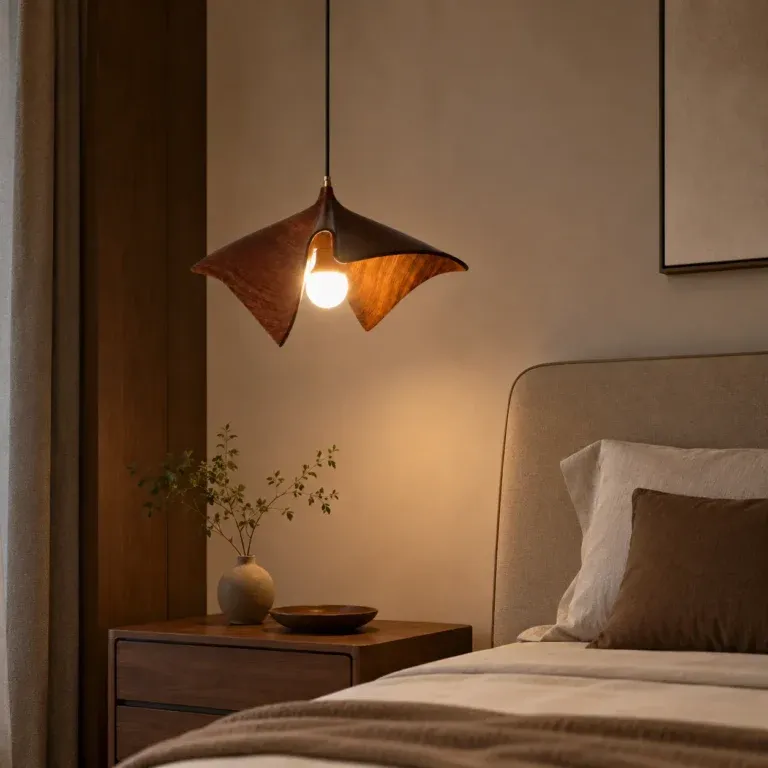
Sculptural Resin Pendant Light: Movement, Negative Space, and Modern Organic Form
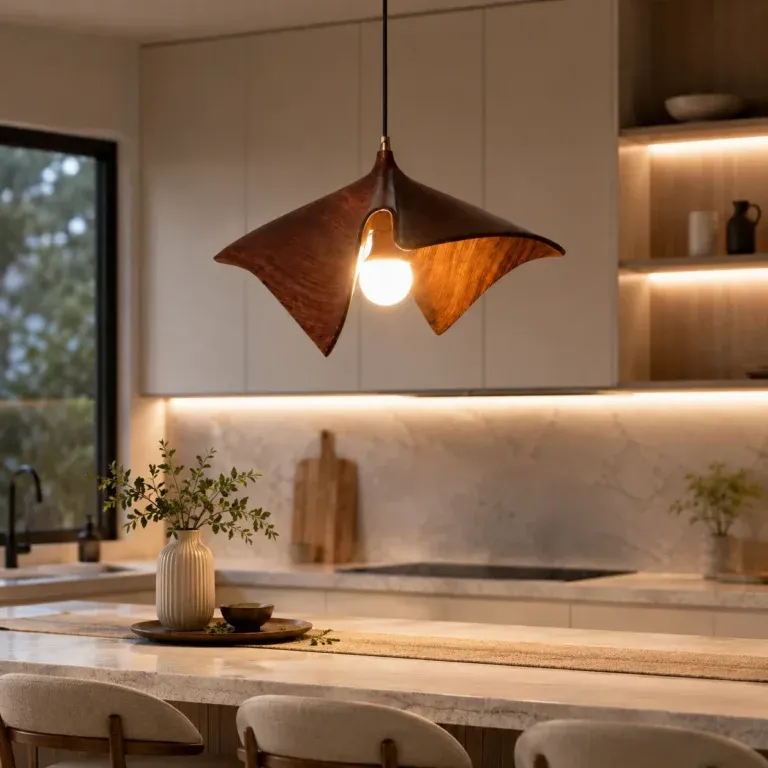
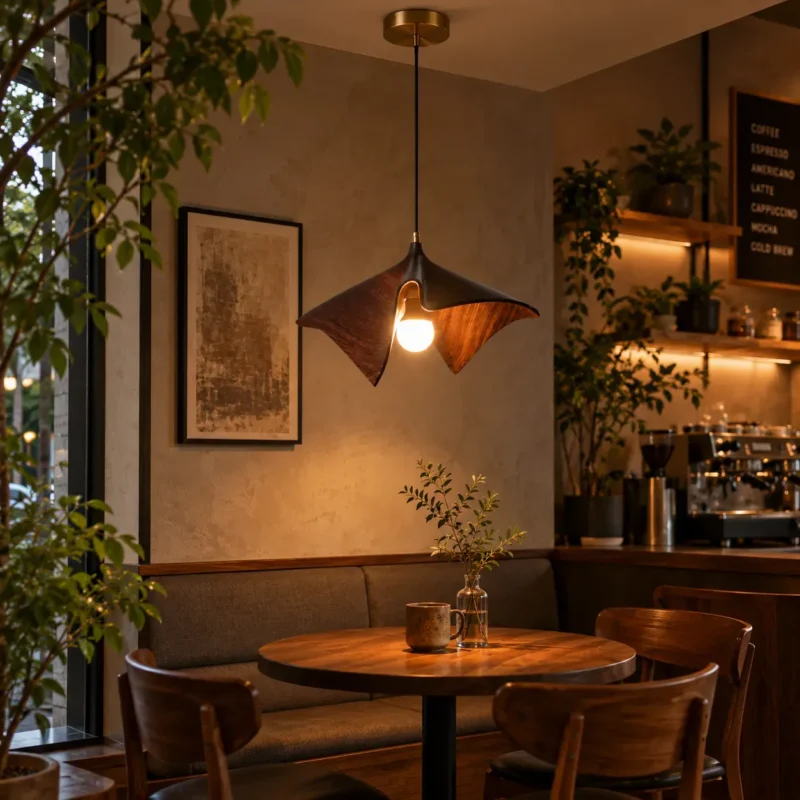
The Sculptural Resin Pendant Light uses a folded resin shade that wraps around the bulb in an asymmetrical, wing-like form. Xunlu Lighting lists resin and metal construction, one E27 socket, a recommended 5-12 W LED lamp, approximately 400-900 lumens, and a recommended 3000 K warm-white color temperature. The design is offered in wood-grain brown and matte-black finishes. [2]
Compared with the stone-textured model, this fixture feels lighter and more directional because the form opens outward. That makes it particularly effective above a bedside table, compact dining table, kitchen island corner, or café-style seating area where the silhouette can be appreciated from several viewpoints. The exposed bulb also means lamp choice strongly affects glare, color rendering, and visual comfort.
3. The Glare Question: Why Shade Geometry and Bulb Choice Matter
A decorative pendant can become uncomfortable if the bulb or a bright part of the source sits directly in the normal field of view. The Illuminating Engineering Society describes discomfort glare as depending on factors including source luminance, source size, position in the visual field, and the viewer’s adaptation level. [6] In simple terms, a small, very bright bulb in a darker room can feel much harsher than the same bulb in a brighter environment.
For an exposed-bulb sculptural pendant, choose a lower-luminance frosted or opal LED rather than an extremely bright clear filament lamp if the fixture hangs near eye level. A dimmable LED is also useful because it allows the same pendant to provide more output during early evening and a softer level later at night. For the stone-textured pendant, the shade itself hides more of the direct source and can create a gentler visual transition from bright center to darker surroundings.
- Use a warm 2700-3000 K LED for bedrooms, lounges, and relaxed dining zones.
- Prefer high color rendering (CRI 90+) when wood, textiles, food, artwork, or skin tones need to look natural; CRI describes how accurately a light source renders color. [7]
- Use dimming where possible, especially for evening settings and multifunction rooms.
- Avoid hanging an exposed bright bulb directly in a seated person’s primary sightline.
4. Layered Lighting: Let the Pendant Be the Hero, Not the Only Light
One of the most common residential lighting mistakes is relying on a single central fixture to provide every kind of illumination. A more flexible approach is layered lighting. The pendant creates identity and local atmosphere; concealed or recessed lighting supports general brightness; wall lights or table lamps soften vertical surfaces; and task lighting provides concentrated illumination where precision is needed.
This is especially important for sculptural pendants because their form is part of the design value. If the bulb must be driven at very high output simply to light the entire room, the fixture can become glary and the sculptural shade may visually disappear against the brightness. By distributing light across multiple layers, the pendant can operate at a comfortable level while still commanding attention.
5. Which Pendant Suits Which Interior?
| Design Question | Natural Stone Texture Resin Pendant | Sculptural Resin Pendant |
|---|---|---|
| Visual character | Earthy, irregular, grounded, wabi-sabi | Flowing, dynamic, modern organic |
| Light impression | More enclosed amber glow | More open and bulb-forward |
| Best room moods | Bedroom, lounge, tea corner, quiet dining | Dining, kitchen island, bedside, café-style spaces |
| Recommended color temperature | 2700–3000 K warm white [1] | 3000 K warm white [2] |
| Bulb strategy | Warm LED or decorative filament, moderate output | Frosted/opal LED preferred when glare is a concern |
| Material pairing | Stone, dark wood, plaster, linen | Walnut, oak, cream cabinetry, brushed metal |
6. Practical Placement Guidelines
The exact hanging height depends on room proportions, furniture height, sightlines, and local electrical requirements, but several design checks are widely useful. First, the pendant should feel visually connected to the furniture or zone below it. Second, the bulb should not create persistent glare for seated users. Third, the fixture should not interfere with circulation or cabinet doors. Finally, the suspension line and ceiling canopy should be aligned carefully so the sculptural shade appears intentional rather than visually tilted or detached from the architecture.
Over a bedside table or reading corner, a lower decorative pendant can free up surface space, but it should be positioned so the bright source is outside the user’s direct line of sight when sitting or lying down. Over a kitchen island, use the pendant for visual warmth and add dedicated task lighting for food preparation. Over a dining table, align the fixture with the table rather than the room center if those two centers differ.
7. Three Interior Palettes That Work Especially Well
Warm Minimalism: combine off-white plaster, pale oak, linen upholstery, and a warm 2700-3000 K lamp. The pendant becomes the strongest textural object without making the room feel busy.
Moody Wabi-Sabi: pair the stone-textured pendant with walnut, charcoal accents, handmade ceramics, and softly lit vertical surfaces. Keep overall illuminance restrained and use multiple low-level sources to avoid a single bright hotspot.
Contemporary Organic Kitchen: use the folded sculptural pendant above a pale stone or timber island, then support it with under-cabinet lighting and concealed shelf lighting. The decorative fixture supplies character; the integrated lighting supplies practical brightness.
8. What the Science Can – and Cannot – Tell Us
Lighting research supports several robust principles: light affects both vision and non-visual physiology; evening exposure to brighter and cooler light can produce stronger circadian effects; glare depends on the brightness, size, position, and adaptation context of the source; and high color rendering can improve the fidelity of objects and materials. [3][4][5][6][7]
However, there is no single universal ‘healthy’ bulb setting for every person or room. Individual sensitivity to evening light varies considerably, and the home-lighting evidence base remains heterogeneous. [3][5] The best residential design therefore combines scientific guidance with practical control: warm color temperature in relaxation zones, dimming, multiple lighting layers, daylight by day, and enough task illumination where people actually work.
Conclusion: Use Light to Reveal Material, Not Overpower It
The appeal of organic resin pendant lighting comes from the relationship between form, texture, and controlled brightness. The Natural Stone Texture Resin Pendant Light creates a more enclosed, mineral-like glow; the Sculptural Resin Pendant Light creates a lighter, folded silhouette that frames the bulb as part of the composition. Both can work beautifully when the bulb is warm, the output is appropriate to the room, and the pendant is supported by other layers of light.
For interiors built around wood, stone, plaster, linen, and calm neutral colors, these fixtures are not simply objects hanging from the ceiling. They become small pieces of illuminated architecture – shaping atmosphere, directing attention, and making natural materials feel richer after sunset.