


A science-informed guide to styling and specifying a double-light wall sconce for bedrooms, hallways, living spaces, and hospitality interiors
At a glance
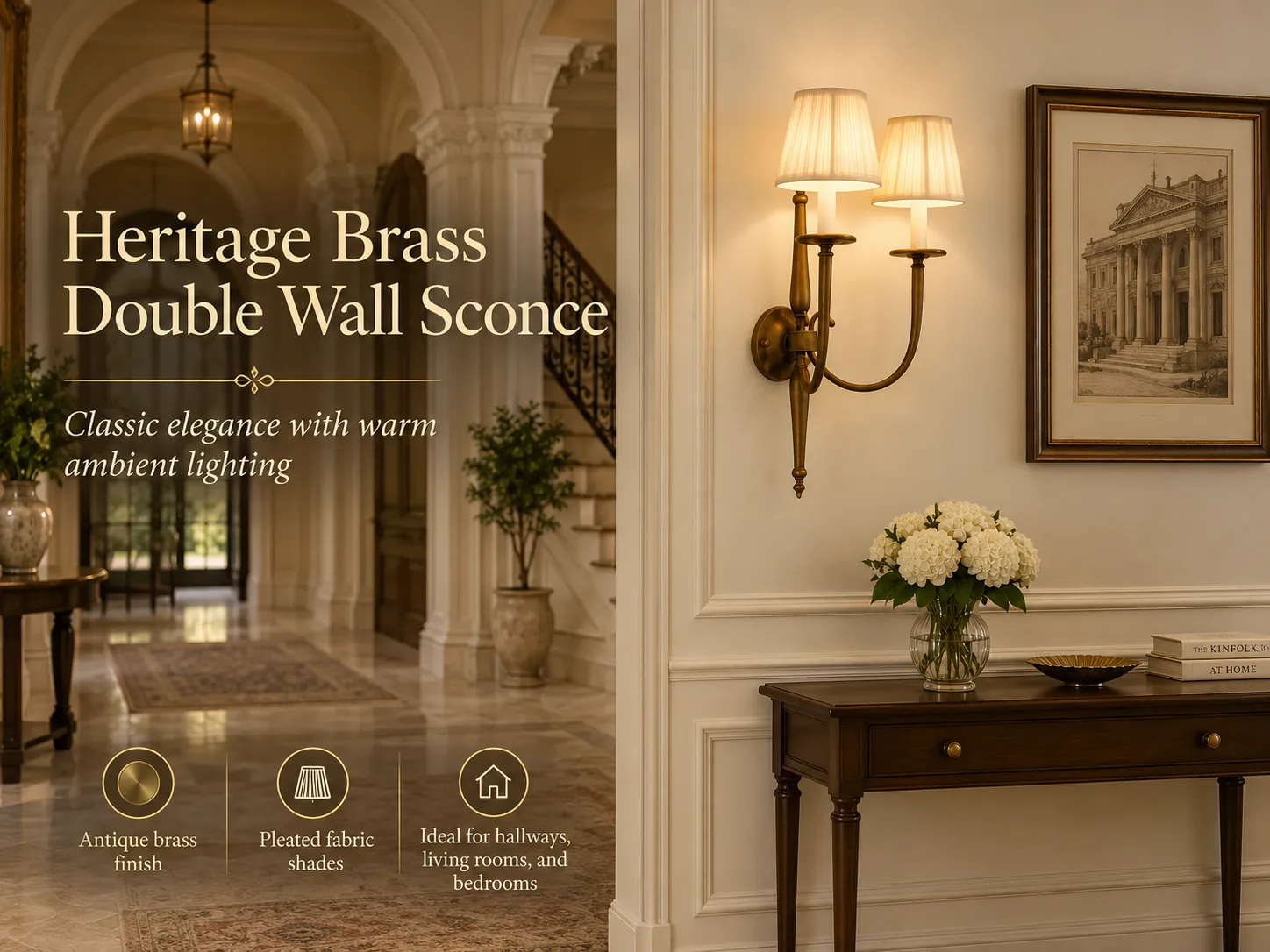
This two-light wall sconce combines an antique-brass metal frame with pleated fabric shades and two E14 LED lamps. The included 3-CCT bulbs allow 3000K, 4000K, or 6000K selection. The fixture is designed primarily as decorative and ambient wall lighting, where its shaded light can add vertical brightness, visual depth, and a warmer sense of scale than an exposed source.
Why Wall Lighting Changes a Room More Than Its Wattage Suggests
A wall sconce is easy to underestimate because it usually contributes fewer lumens than a central ceiling fixture. Yet in an interior, perception is shaped not only by total light output but also by where light appears, how bright surfaces are within the field of view, and how strongly the source itself is seen. A shaded wall light can therefore make a room feel calmer, deeper, and more finished even when it is not the main source of task illumination.
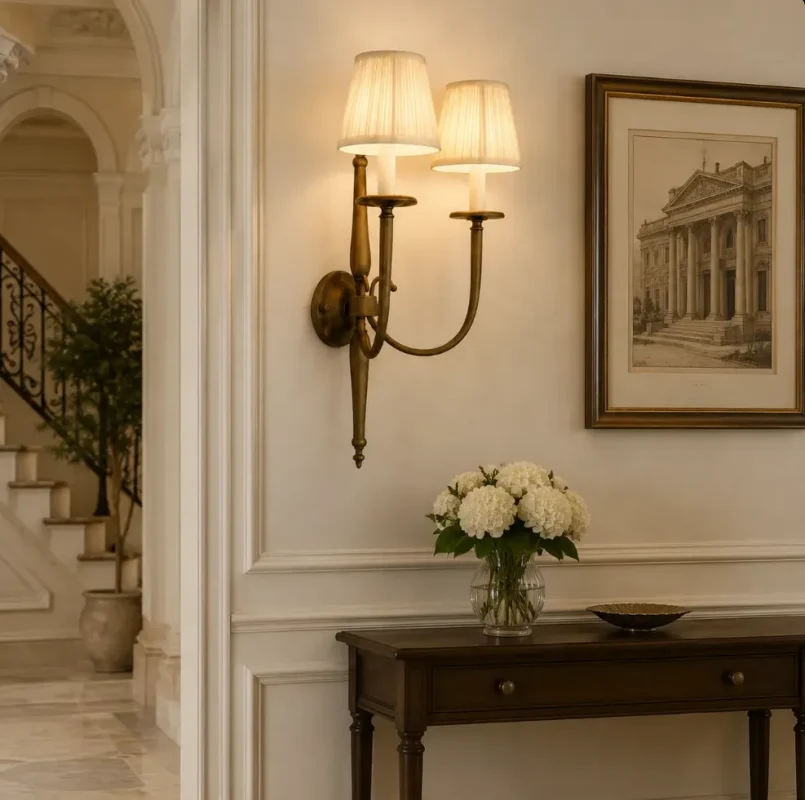
The Heritage Antique Brass Double-Light Wall Sconce is a good example of this principle. Its two upward-facing lamps sit behind softly pleated shades, while the antique-brass body gives the fixture a strong vertical silhouette. That combination places a luminous element on the wall at eye level, where people naturally notice it, rather than relying only on downlight from the ceiling. The result is a decorative layer that can support orientation, atmosphere, and material definition at the same time.
For a homeowner, designer, or hospitality specifier, the useful question is not simply whether the sconce is bright enough. It is how the sconce works within a layered scheme: what it does to the wall surface, how the shade controls glare, which color temperature suits the time of day, and how the brass and fabric interact with surrounding finishes. Those are the questions this guide explores.
Product Specification at a Glance
| Specification | Detail |
|---|---|
| Series | Heritage Antique Brass Series |
| Product type | Double-light wall sconce |
| Materials | Metal body; pleated fabric shades with PVC lining |
| Finish | Antique brass |
| Dimensions | W 22 × D 39 × H 60 cm / W 8.66 × D 15.35 × H 23.62 in |
| Wall projection | 39 cm / 15.35 in |
| Backplate | Ø 12 cm / Ø 4.72 in |
| Light source | 2 × E14 LED bulbs |
| Included bulbs | 2 × 5W, 3-CCT LED bulbs |
| Total wattage | 10W |
| Input | AC 110–240V, 50/60Hz |
| Selectable CCT | 3000K / 4000K / 6000K |
| Reference luminous output | Approx. 800–1,000 lm total |
| Recommended installation height | Approx. 150–170 cm / 59.06–66.93 in above floor level |
| Typical applications | Bedroom, bedside, study, hallway, foyer, living room, hotel guest room, club |
Product specifications are based on the Xunlu Lighting product page; actual lamp output and performance depend on the installed E14 bulbs and project conditions.
1. The Design Language: Why Antique Brass and Pleated Fabric Feel Timeless
The appeal of antique brass is not only its color. It introduces a low-gloss metallic surface that can read as warm, aged, and architectural at the same time. In traditional rooms it can echo picture frames, cabinet hardware, stair details, or decorative trim. In more transitional interiors, the same finish creates contrast against pale plaster, painted millwork, limestone, or dark wood without the mirror-like sharpness of polished brass.
Pleated fabric changes the visual character of the lamp just as strongly. Repetition in the pleats creates a fine vertical rhythm, while the fabric surface becomes luminous when the lamp is on. Instead of seeing a small, high-luminance bulb as the main visual object, the eye sees a much larger illuminated shade. That larger apparent emitting surface can feel softer and more domestic, especially in rooms where people sit or lie down and the fixture remains within the normal field of view.
The double-light configuration adds symmetry and scale. Two shades create a wider luminous composition than a single-arm sconce, which helps the fixture hold its own beside tall headboards, framed artwork, paneled walls, or broad hallway bays. The result is closer to a small piece of wall-mounted furniture than to a purely functional lamp.
2. What the Pleated Shade Does to the Light
A bare lamp filament or LED package can produce a concentrated source of luminance. When that source sits directly in the line of sight, visual discomfort can occur even if the room itself is not especially bright. A shade does not eliminate glare automatically, but it changes the geometry of the view: the bulb is partly screened, and some light is transmitted or scattered through a larger surface.
In practical terms, the pleated fabric shade on this sconce serves three related functions. First, it obscures the direct view of the lamp from many normal viewing angles. Second, it spreads light over the shade surface, which increases the apparent size of the luminous area. Third, it redirects part of the output onto the nearby wall and surrounding room, helping the fixture participate in ambient lighting rather than producing only a small bright point.
This matters most in bedrooms, corridors, sitting rooms, and hotel guest rooms—spaces where comfort and atmosphere are usually more important than maximizing illuminance. A sconce like this should still be paired with task lighting where fine visual work is required. For example, a bedside sconce may create excellent ambient light but may not place enough light on a book for every reader, depending on mounting position, bulb output, shade absorption, and the reader’s visual needs.
Lighting science note
Visual comfort depends on luminance, contrast, viewing angle, source size, and adaptation—not on wattage alone. A fabric shade can reduce direct source visibility, but the final glare performance of a wall sconce still depends on the bulb, mounting height, viewing position, and surrounding brightness.
3. The 3-CCT Bulbs: 3000K, 4000K, and 6000K Are Not Just “Warm, Neutral, and Cool” Labels
The included E14 lamps offer three correlated color temperature (CCT) settings: 3000K, 4000K, and 6000K. CCT describes the color appearance of white light; it does not directly measure brightness, color rendering, or circadian effect. Two lamps can have the same CCT while differing in spectrum, CRI, efficacy, and visual quality.
For most evening residential use, 3000K is the easiest starting point. It supports the warm tones of brass, wood, cream fabric, stone, and warm-white paint, and it generally feels less visually crisp than 4000K or 6000K. The 4000K setting can be useful when a room needs a more neutral appearance—for example during cleaning, organizing, or daytime use in a study. The 6000K setting produces a distinctly cool appearance and may be preferred for short-duration functional use, but it can feel visually out of place in a heritage-style interior dominated by warm materials.
It is important not to turn CCT into a health claim. Modern circadian lighting research emphasizes that non-visual responses to light depend on spectrum, intensity at the eye, timing, duration, and previous light exposure. CCT is only an approximate visual descriptor. For evening spaces, the more reliable design approach is to use lower light levels, minimize unnecessary bright light at the eye, and choose a warmer setting when it also suits the visual task and décor.
4. Color Rendering: The Missing Specification Many Buyers Should Check
Color temperature tells you whether white light looks warm or cool. It does not tell you whether skin, wood, textiles, flowers, artwork, or brass will look natural. That is why color rendering is a separate specification.
The U.S. Department of Energy notes that CRI 80 is a general minimum recommendation for interior lighting, while CRI 90 or higher indicates excellent color fidelity. For a decorative wall sconce placed beside artwork, upholstery, wood furniture, or skin tones, a high-quality E14 LED lamp with strong color rendering can noticeably improve the result.
The product page specifies the base type, wattage, CCT choices, and approximate total lumen output, but it does not list CRI. If color fidelity is important to the project, confirm the CRI of the supplied or replacement bulbs. Designers who require more detailed color-quality evaluation may also consider TM-30 data where available, because CRI alone cannot fully describe saturation and hue shifts.
5. Layered Lighting: Why This Sconce Works Best as One Part of the System
A comfortable home rarely depends on one fixture. Instead, effective residential lighting is layered: general light supports movement, task light supports detailed work, accent light emphasizes objects or surfaces, and decorative light contributes visual identity. One luminaire can perform more than one role, but expecting a single fixture to do everything usually creates either over-lighting or dark task areas.
The Heritage Double-Light Wall Sconce is strongest as ambient and decorative lighting. Because it sits on a vertical surface, it adds brightness within the normal field of view and can make architectural details more legible. In a hallway, that can mean better recognition of doorways, frames, and wall planes. In a bedroom, it can create a calmer visual zone around the headboard than a bright central ceiling light alone. In a living room, it can support a layered evening scene while table lamps and floor lamps handle reading or localized tasks.
The exact illuminance on a floor, book, or work surface cannot be inferred from total lumens alone. Distribution, shade transmission, wall reflectance, distance, and geometry all matter. That is why professional lighting design treats lumens as only the starting point; the real question is how much light reaches the relevant surface and from what direction.
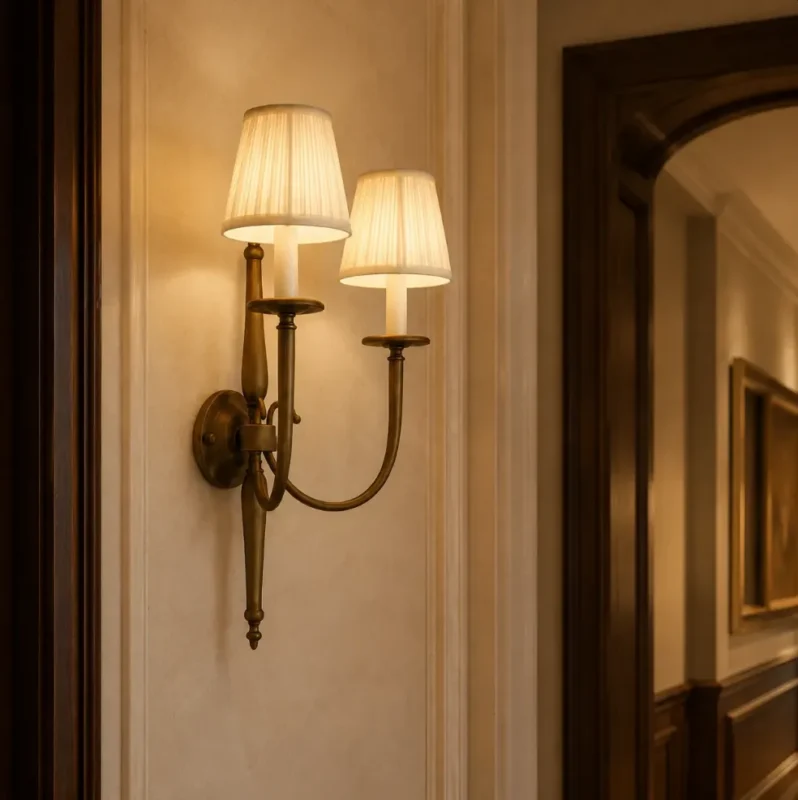
Hallway application: vertical wall lighting can add depth and orientation while keeping the source visually softer than an exposed lamp.
6. Room-by-Room Applications
Bedroom and bedside
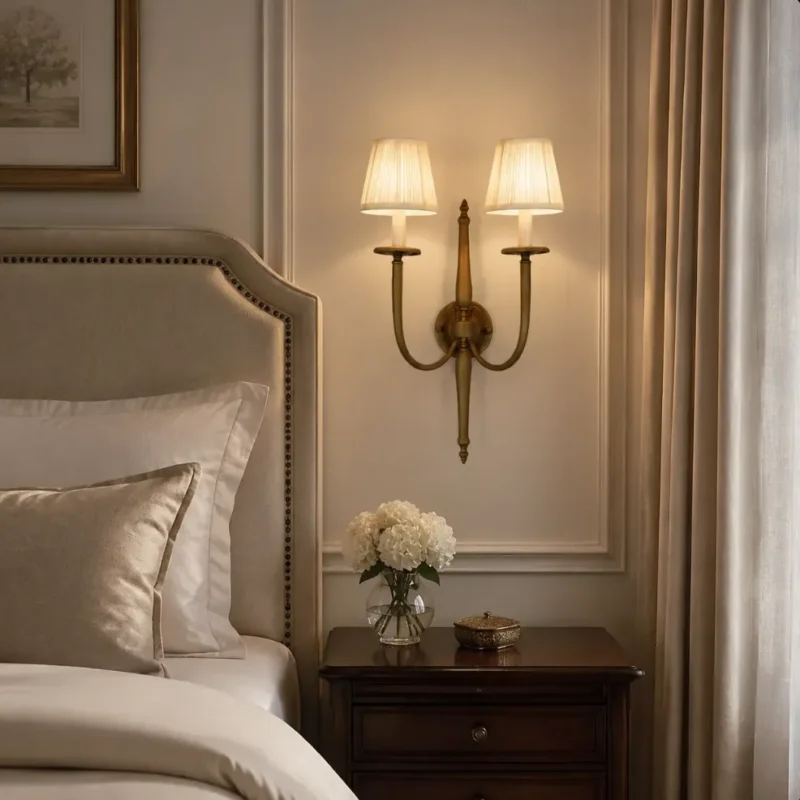
Mounting a shaded sconce near a bed can free the nightstand from a large table lamp and create a more symmetrical composition. The product page recommends an installation height of approximately 150–170 cm above the floor, but bedside placement should also consider mattress height, headboard height, seated eye level, and whether the shade could be struck when getting in or out of bed.
For evening use, 3000K is usually the most visually coherent setting for this brass-and-fabric combination. If the sconce is also expected to support reading, test the real light level on the page rather than assuming the total 800–1,000 lm fixture output will translate directly to the task surface. Shade losses and distance can be significant.
Hallway and foyer
Wall sconces are especially useful in circulation spaces because they define vertical surfaces and create a rhythm along the route. A pair flanking a mirror, artwork, or console can make an entry feel more intentional; repeated fixtures along a corridor can establish visual continuity.
The 39 cm wall projection is important in narrow passages. Before installation, verify that the fixture will not intrude into the required circulation zone or create a collision risk. In a generous foyer or stair landing, the projection gives the sconce enough physical depth to feel substantial rather than flat.
Living room and study
In a living room, the fixture can sit beside artwork, above a console, or on either side of a fireplace or built-in cabinet. Because its style is decorative, it works best when the wall around it has enough visual quiet for the silhouette to register.
In a study, the sconce can contribute ambient light but should not replace dedicated desk lighting. A task light positioned to reduce hand shadows and screen reflections will be more effective for sustained reading or computer work.
Hotel guest rooms and hospitality interiors
The combination of antique brass and pleated fabric is well suited to boutique hotels, clubs, villas, and guest rooms because it communicates a residential rather than purely commercial character. That is useful in hospitality environments where the lighting is expected to support comfort as well as brand identity.
For hospitality specifications, designers should also verify local electrical codes, dimmer compatibility, replacement-lamp availability, cleaning protocols, and fire-performance requirements for decorative materials. The 110–240V, 50/60Hz input range is broad, but final installation still needs to match the project’s electrical system and regulatory requirements.
7. Scale, Projection, and Installation Height
The fixture measures 22 cm wide, 39 cm deep, and 60 cm high. Those proportions are tall and relatively projecting for a wall sconce, which is part of its visual appeal—but also something to plan carefully.
The manufacturer’s recommended installation height of roughly 150–170 cm above the floor is a useful starting point for many general wall applications. However, the correct height is project-specific. In a bedroom, the shade should not sit directly in the normal line of sight while lying down. In a corridor, the fixture should avoid shoulder and head collision zones. Beside a mirror or artwork, the composition should be judged as a group rather than by a fixed formula.
A practical method is to tape the fixture’s 60 cm height and 39 cm projection on the wall before electrical work begins. Stand, sit, and walk through the space. This simple mock-up reveals whether the scale feels elegant, oversized, or intrusive far more reliably than judging dimensions on a product page.
8. Styling the Sconce Without Making the Room Feel “Too Traditional”
A heritage-style wall light does not require a fully traditional room. In fact, it can be more interesting when paired with a restrained contemporary backdrop. The key is to repeat one or two visual cues—warm metal, dark wood, pleated fabric, framed art, or classic trim—without copying every historical detail.
In a traditional interior, coordinate the antique brass with picture frames, cabinet pulls, or furniture hardware, and allow the pleated shades to echo drapery or upholstered textures. In a transitional room, use the sconce against warm-white walls with simple panel molding and cleaner furniture lines. In a minimalist space, one pair of ornate sconces can function as sculptural accents, provided the rest of the wall remains uncluttered.
Color temperature also affects styling. The 3000K setting strengthens warm brass and cream fabrics. The 4000K setting makes pale stone and white walls appear more neutral. The 6000K setting can make the brass/fabric palette look cooler and visually harder, which may be useful temporarily but is less consistent with the fixture’s heritage character.
9. Energy Use, Lamp Replacement, and Long-Term Practicality
With two included 5W LED bulbs, the fixture’s nominal total power is 10W. This is modest compared with older incandescent wall sconces that used two 25W or 40W lamps. Actual energy use depends on operating hours, replacement bulbs, and controls.
The use of E14 replaceable lamps is a practical advantage because the light source is not permanently integrated into the body of the fixture. If a bulb fails—or if a project later needs a different lumen output, CCT, dimming behavior, or color rendering quality—the bulb can be changed without replacing the entire sconce, provided the replacement remains within the fixture’s electrical and thermal limits.
For best results, use matched bulbs on both arms. Two lamps with slightly different CCT, lumen output, or dimming curves will be obvious because the shades sit side by side. If dimming is required, confirm both bulb and dimmer compatibility; not every E14 LED lamp is dimmable, and incompatible dimming can cause flicker, noise, or unstable low-level operation.
10. Care and Maintenance
- Switch off power and allow the bulbs to cool before cleaning.
- Dust the pleated fabric shades gently with a soft brush or low-suction upholstery tool; avoid soaking the fabric or PVC lining.
- Wipe the antique-brass metalwork with a soft, dry or barely damp cloth. Avoid abrasive pads and aggressive metal polishes unless the manufacturer specifically recommends them, because the aged finish is part of the design.
- Replace the two E14 bulbs as a matched pair when appearance consistency matters.
- Periodically confirm that wall fixings remain secure, especially in hospitality or high-traffic settings.
11. Specification Checklist Before You Buy or Install
- Measure the wall area and confirm that a 60 cm-high, 39 cm-projecting fixture is appropriate for the circulation zone.
- Confirm the electrical supply, junction box position, and local installation requirements.
- Decide which CCT will be the normal default. For evening residential use, 3000K is usually the most visually coherent choice for this material palette.
- If accurate color appearance matters, confirm the CRI of the supplied or replacement E14 LED bulbs; CRI 90+ is preferable for premium residential interiors when available.
- If the sconce must support reading or another task, test illuminance on the actual work plane rather than relying on total lumen output alone.
- If dimming is required, confirm compatible dimmable bulbs and a suitable LED dimmer.
- Check whether local codes or the room type require a particular IP rating, especially near bathrooms or other damp locations. The product should not be assumed suitable for wet or damp areas unless the rated documentation confirms it.
Conclusion: A Decorative Fixture That Works Best When the Lighting Strategy Is Thought Through
The Heritage Antique Brass Double-Light Wall Sconce succeeds because it combines three things that are often separated: a strong decorative silhouette, a soft luminous shade, and a replaceable two-lamp light source. Its brass and pleated fabric create a distinctly classic character, while the 3-CCT E14 lamps provide flexibility for different visual conditions.
Its best use is not as the only light in a room, but as a carefully placed layer. In bedrooms it can create a warm, hotel-like sense of enclosure. In hallways and foyers it can add vertical brightness and rhythm. In living rooms and studies it can support atmosphere while other fixtures handle demanding tasks. In hospitality settings it can reinforce a refined, residential identity.
The most important specification decisions happen after style selection: mounting height, viewing angle, bulb quality, color rendering, CCT, dimming, and the relationship to other layers of light. When those choices are made deliberately, a wall sconce becomes more than decoration—it becomes part of the room’s visual comfort and architectural composition.
Heritage Antique Brass Double-Light Wall Sconce with Pleated Fabric Shades | Click to view product