

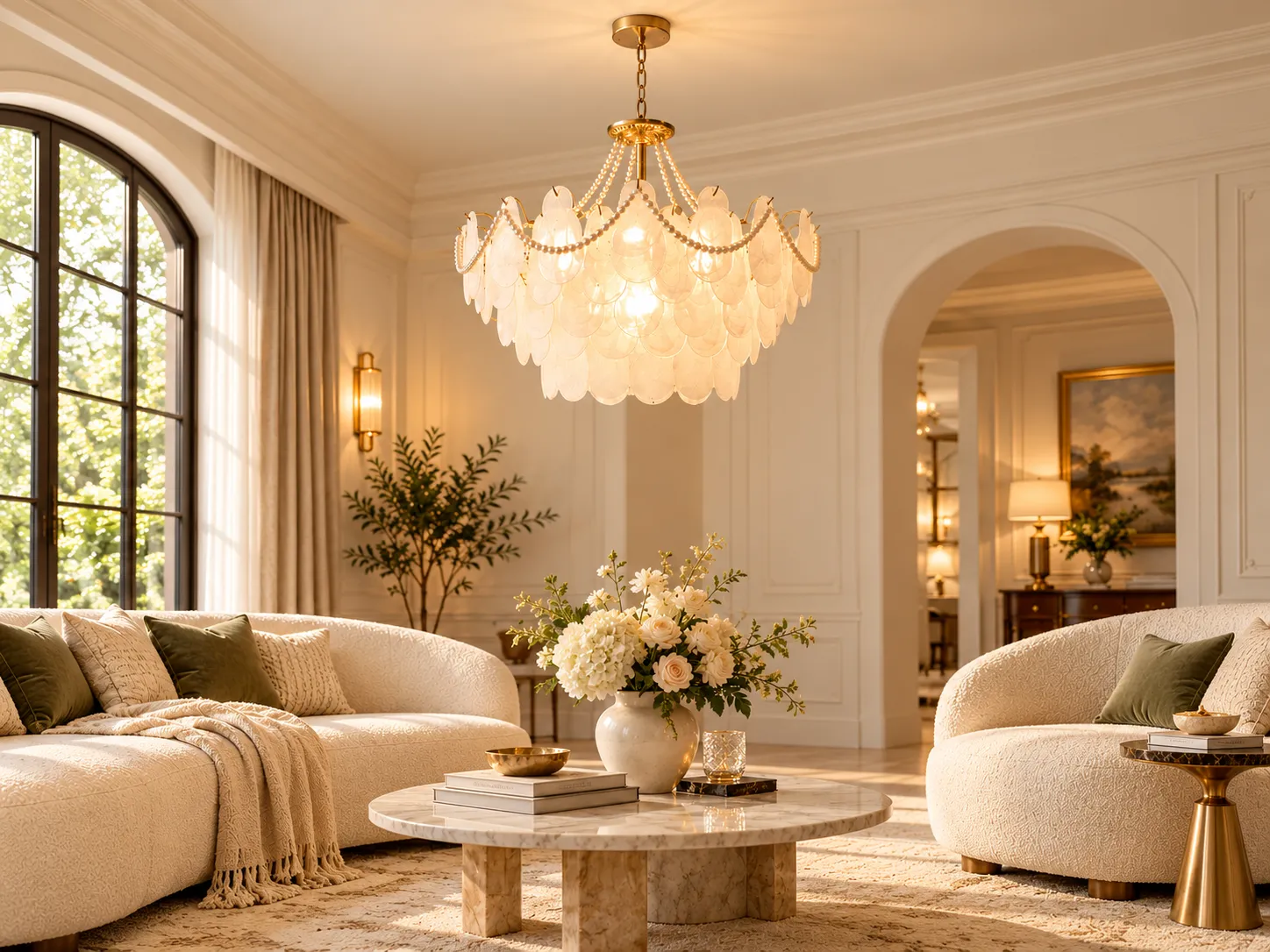

A practical guide to layered light, sizing, color temperature and placement—featuring Xunlu Lighting’s pearl-accented glass chandelier.
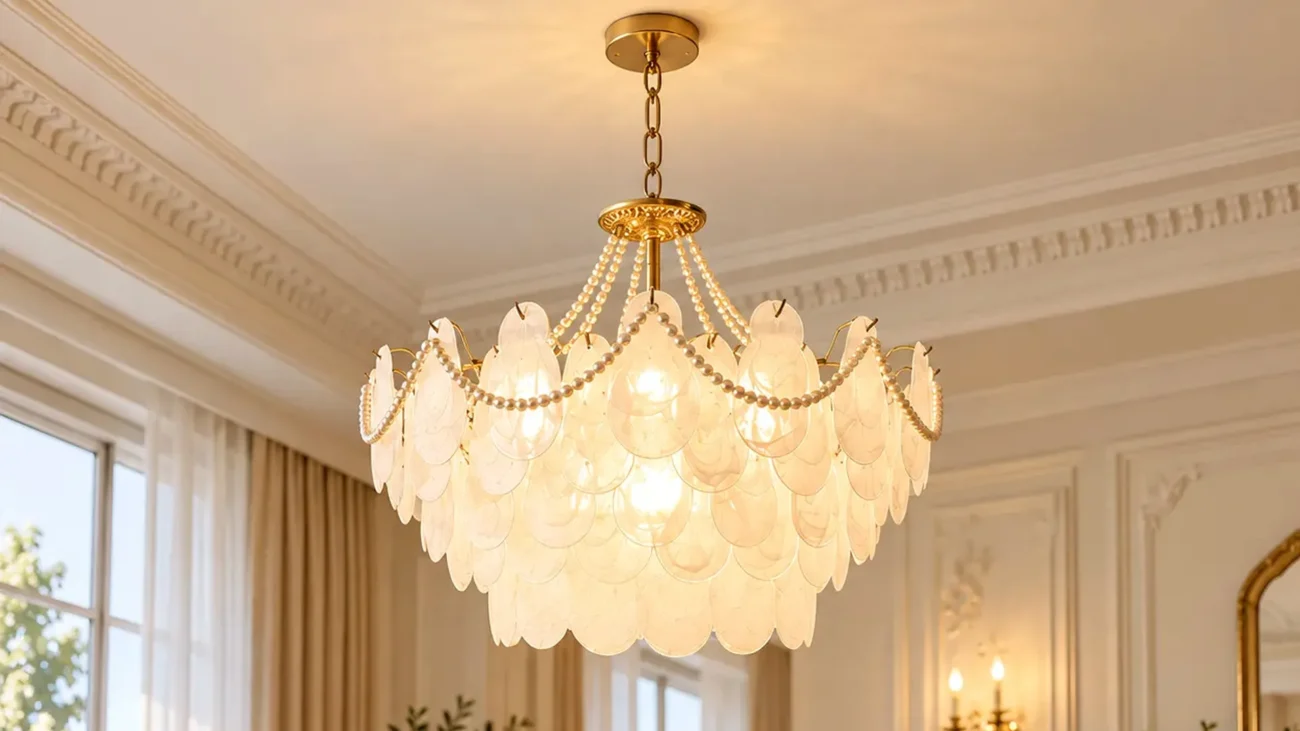
A room can be beautifully furnished and still feel unfinished after sunset. The missing element is often not another piece of furniture, but a lighting focal point that connects materials, scale and atmosphere. A well-chosen chandelier helps establish the visual center of a space while contributing to its overall illumination.
The Xunlu Lighting Pearl Shell Glass Chandelier combines translucent, shell-inspired glass pieces, pearl-bead accents and a gold-finished structure. The effect is romantic rather than ornate for its own sake: the layered forms catch light, add depth and give the room a soft visual rhythm. Below, we look at how to use that aesthetic thoughtfully—and what lighting science can, and cannot, tell us about the result. [1]
1 | Why a layered glass chandelier feels so inviting
The fixture’s texture is the first thing the eye notices. Repeating glass pieces create small variations in reflection and transmission; the gold finish introduces a warmer material accent; and the pearl-like draping gives the silhouette a jewelry-inspired outline. Together, these details complement paneled walls, stone, wood, linen, antiques and contemporary upholstered furniture.
The science: light distribution matters more than sparkle alone
A translucent material can redirect and scatter some light, helping to make the light source less visually stark than an exposed, high-brightness bulb. But a decorative shade does not automatically guarantee glare-free or uniform lighting. Real comfort also depends on lamp output, viewing angle, mounting height and the brightness of surrounding surfaces. This distinction matters: a chandelier is both a decorative feature and one part of a larger lighting plan. [2]
Material note: “pearl shell” is the product’s design name. The published specification identifies iron, glass, shell-inspired decorative glass pieces and pearl beads; it does not establish that the ornaments are made from natural oyster shell or genuine pearls. [1]
2 | Living room: create a focal point without over-lighting the space
In a French-inspired living room, place the chandelier where its shape can be appreciated from the main seating area. The fixture looks especially cohesive against soft cream walls, subtle molding and a mix of warm metals and woven textures. Give the chandelier visual space: if several strong ceiling fixtures compete for attention, its layered form can lose impact.
For comfort, use a layered approach. Let the chandelier provide ambient and decorative light, then add a table lamp beside the sofa and a focused reading light wherever books or hobbies require one. This way, the room can move from an inviting evening setting to a useful reading environment without forcing one fixture to do everything. [2]
3 | Bedroom: softness, scale and nighttime comfort
A bedroom often benefits from warm-looking light and lower light levels in the evening. Here, a chandelier becomes the visual centerpiece while bedside lamps handle close-up tasks. The gold-and-cream combination shown below pairs naturally with upholstered headboards, neutral bedding, linen curtains and pale timber.
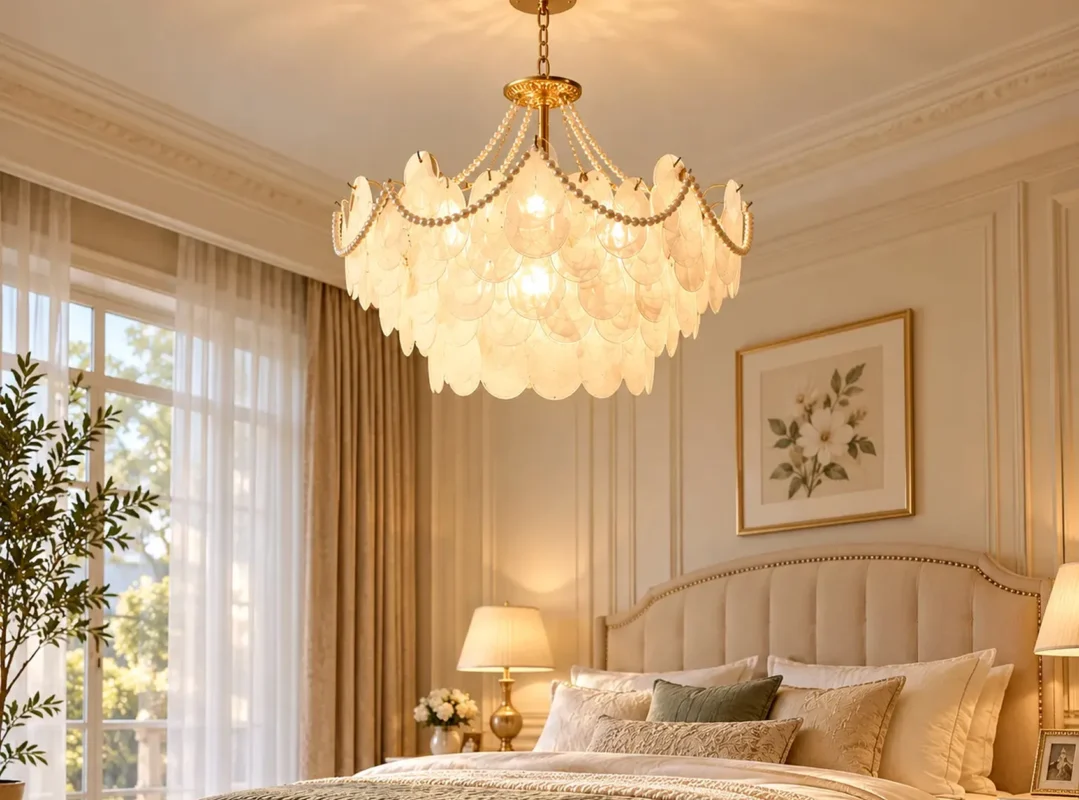
Select bulb color temperature according to the intended mood. Around 2700–3000 K is commonly described as warm white, while 4000 K appears more neutral. The lower K number does not mean “less light”; CCT describes the appearance of the emitted light, not its brightness. [3]
For rooms where the ceiling height is modest, check the complete vertical drop—not just the chandelier body. Avoid placing a low-hanging fixture where it could interfere with walking paths or door openings. Have a qualified installer verify the final height and secure ceiling support.
4 | Dining room: proportion makes the difference
Dining rooms are natural settings for statement chandeliers because the table provides a clear visual anchor. A round chandelier echoes round or oval tabletops particularly well, while the glass layers add depth above a dining arrangement without needing extra decorative accessories.
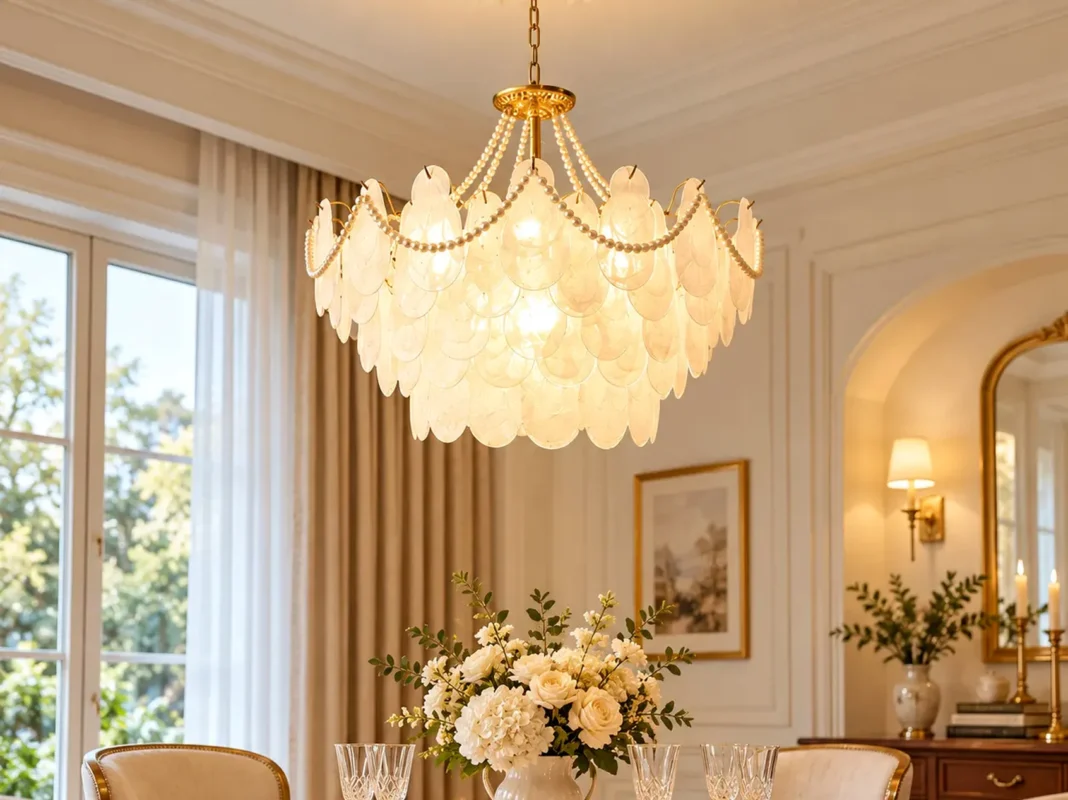
How high should the chandelier hang?
A widely used design starting point is to keep the bottom of a dining chandelier around 30–36 in (76–91 cm) above the tabletop for an approximately 8-ft ceiling. Taller rooms may call for a higher suspension. This is a visual guideline—not a universal electrical or building-code rule. Final position must account for the size of the fixture, sightlines, chain adjustment and the household’s actual table height. [4]
In open walking areas, head clearance becomes the priority. A common design guideline is roughly 7 ft (213 cm) from floor to the bottom of a hanging fixture, subject to local requirements and the specific space. [4]
5 | Choose 60 cm or 80 cm based on the room—not only the photograph
Xunlu lists two versions. The choice is not simply “small versus large”: it affects visual proportion, suspension load and the number of light sources. The manufacturer’s published dimensions and electrical ratings are summarized below. [1]
COMPACT SCALE
60 cm / 23.62 in
9 × E14 LED bulbs
STATEMENT SCALE
80 cm / 31.50 in
12 × E14 LED bulbs
| Product specification | 60 cm version | 80 cm version |
|---|---|---|
| Body size | Ø60 × H30 cm / 23.62 × 11.81 in | Ø80 × H40 cm / 31.50 × 15.75 in |
| Light sources | 9 × E14 LED bulbs | 12 × E14 LED bulbs |
| Max rated lamp power | 9 × 12 W = 108 W | 12 × 12 W = 144 W |
| Listed light output* | Approx. 7,200–8,100 lm | Approx. 9,600–10,800 lm |
| Listed lighting area* | 8–12 m² / 86–129 sq ft | 10–15 m² / 108–161 sq ft |
| Approximate fixture weight | 7–10 kg / 15.4–22.0 lb | 10–14 kg / 22.0–30.9 lb |
| Chain and rod | 50 cm chain + 20 cm rod | 50 cm chain + 20 cm rod |
Manufacturer-published figures, not independent laboratory measurements. Actual room illuminance depends on the installed bulb lumen output, optics, mounting height, room reflectance and geometry. Confirm bulb inclusion, dimmer compatibility and regional approvals before purchase. [1]
Design tip: use the 60 cm version when a lighter visual footprint is preferred, and consider the 80 cm version for a room that can support a larger centerpiece. Check the table width or room dimensions, not only floor area. Leave comfortable sightlines and sufficient clearance around the fixture.
6 | Choosing bulbs scientifically: lumens, watts, CCT and color quality
Lumens are light output. Watts are electrical power.
Watts describe electrical consumption; lumens describe how much visible light a bulb produces. A higher wattage does not, by itself, guarantee better useful lighting. The chandelier’s published 108 W and 144 W values are maximum totals based on 12 W per E14 lamp—not a requirement to operate at those levels. [1, 2]
The manufacturer also lists approximately 7,200–8,100 lumens and 9,600–10,800 lumens respectively, depending on bulbs. Those are catalogue-level figures; they are not a guaranteed measurement of illuminance on a sofa, tabletop or floor. Lux is the amount of light arriving per square meter of surface, and calculating a practical lux level requires the distribution of light throughout a real room. [1, 2]
Warm or cool white?
| Bulb CCT | Visual impression | Where it often works |
|---|---|---|
| 3000 K | Warm white | Relaxed living rooms, bedrooms, dining rooms |
| 4000 K | Neutral white | Multipurpose interiors needing a cleaner appearance |
| 6000 K | Cool / daylight-like white | Task-focused settings; less typical for relaxed evening dining |
These are design tendencies, not scientifically fixed emotional effects. The chandelier page lists 3000 K, 4000 K and 6000 K as bulb-dependent choices; the lamp’s actual appearance follows the bulbs you install. A 3000 K option is an adaptable starting point for the warm interiors pictured here. [1, 3]
CRI is helpful—but it is not the whole story
If accurate-looking food, flowers, fabrics and skin tones matter to you, examine color rendering as well as CCT. The U.S. Department of Energy notes that a CRI of 80 is a common minimum for indoor use and 90+ signals very good color fidelity, while also cautioning that CRI alone cannot describe every aspect of color rendition. For a premium interior, choosing a reputable E14 LED bulb with documented CRI of 90+ can be a useful shopping target—not a claim about this chandelier’s supplied bulbs. [2]
Dimming is another practical consideration. Only use dimmable bulbs with a compatible dimmer and wiring configuration. The product page lists a wall switch as its control method but does not independently verify a specific dimmer system. [1]
7 | Practical installation and everyday care
- Confirm the ceiling substrate and load-bearing support. The listed chandelier weights are approximately 7–10 kg or 10–14 kg, before any site-specific installation considerations. Never support a heavy chandelier only with ordinary drywall.
- Check the full hanging assembly. The page specifies a 50 cm adjustable chain plus a 20 cm suspension rod, excluding the chandelier body; agree the final drop with your installer before wiring.
- Check E14 bulb compatibility, the locally appropriate supply voltage and local electrical certification requirements. The product page lists AC 110–240 V, which is not by itself proof of approval in every market.
- Turn power off before cleaning or changing lamps. Let bulbs and glass cool, then use a soft dry microfiber cloth; avoid aggressive cleaners that may harm finishes or decorative elements.
- Consider a maintenance plan for all layered glass pieces and beads, especially in a kitchen-adjacent area where airborne grease collects.
Installation note: a qualified electrician should verify the mounting, earthing/grounding, wiring, dimmer suitability and all applicable electrical rules. Use the installation instructions supplied with the purchased fixture as the controlling guidance.
8 | Styling checklist: keep the room elegant, not overloaded
- Repeat the warm-metal tone once or twice—in a mirror frame, hardware or a side-table detail—rather than matching every metal finish.
- Use cream, stone, taupe, pale oak or muted green as a quiet backdrop for the translucent glass.
- Let the chandelier act as the principal decorative ceiling feature, and add discreet task or accent lighting at eye level.
- Choose the diameter and hanging height around people’s movement and sightlines, not only a catalog photograph.
- Photograph the room in daylight and after dark to judge both the sculpture of the chandelier and the useful light it provides.
Frequently asked questions
Does the chandelier contain real shell or natural pearls?
The current product listing describes shell-inspired decorative glass and pearl beads. It does not verify natural mother-of-pearl or genuine pearls. [1]
Is 3000 K warm white?
Yes. 3000 K is commonly classified as warm white; 4000 K is more neutral and 6000 K is much cooler in appearance. The actual result depends on the bulbs installed. [3]
How many bulbs do the two sizes need?
The Ø60 cm fixture lists nine E14 LED bulbs. The Ø80 cm fixture lists twelve E14 LED bulbs. Confirm maximum wattage per socket and whether bulbs are included before ordering. [1]
Will the chandelier be enough to light the entire room?
It may provide substantial general light with appropriately selected bulbs, but the outcome is room-dependent. Supplement it with task and accent layers when reading, cooking, navigating or detailed activities require more directed illumination. [2]
Can I install this over a dining table?
Yes, dining rooms are one of the suggested applications. Begin with 30–36 in above the tabletop as a common design guideline, then adjust for the actual table, ceiling and sightlines. Professional electrical installation is recommended. [1, 4]
A chandelier that works as a piece of interior design
The appeal of the Pearl Shell Glass Chandelier is not a claim of one magical light level. It is the way its layered glass, pearl-like detailing and warm gold structure bring visual depth to an interior—while giving homeowners flexibility to select bulbs and build a balanced lighting plan around it. Choose the right diameter, check clearances, favor dependable light quality and let the room’s architecture do the rest.
Explore the Pearl Shell Glass Chandelier at Xunlu Lighting: View the product, sizes and finishes
