

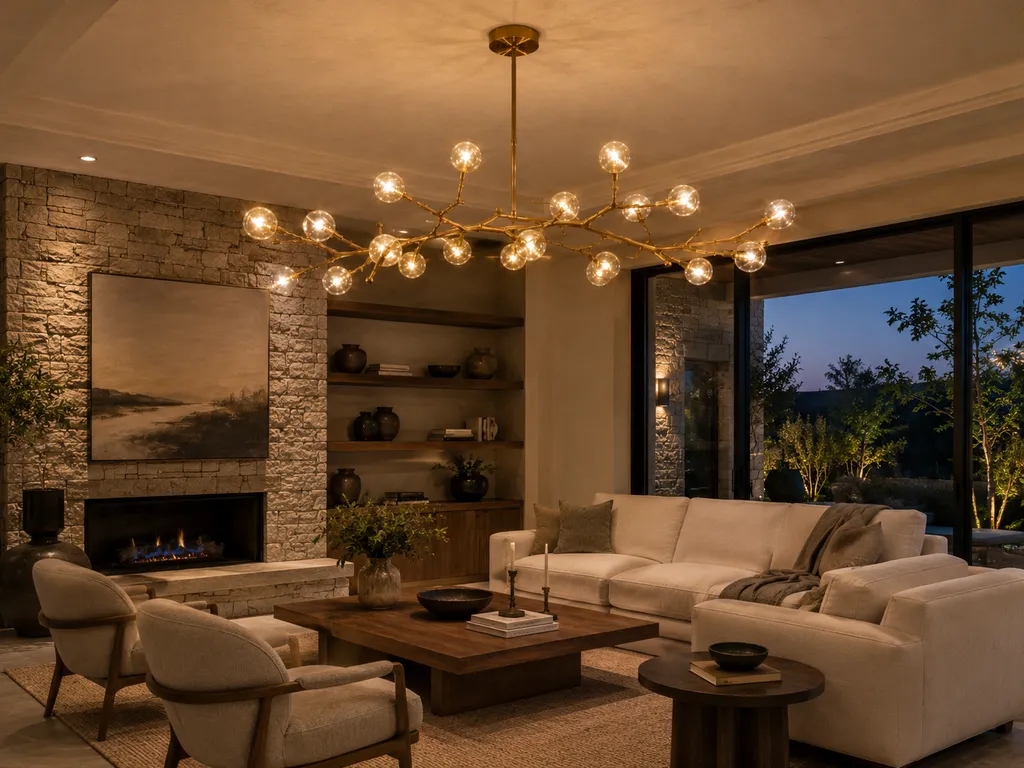

A science-based design guide featuring the Rustic Branch Chandelier LED Light from Xunlu Lighting
Nature-inspired lighting has become a strong direction in residential interiors because it can soften rooms dominated by straight walls, flat cabinetry, and hard surfaces. A branch chandelier introduces an organic silhouette while still performing the practical job of distributing light across a dining table, living area, or entrance space. The key is to treat the fixture as part of a complete lighting system rather than as decoration alone.
The featured product for this article is the Rustic Branch Chandelier LED Light | Nature Pendant Lamp from Xunlu Lighting. The current product page describes a resin-and-metal branch structure with glass globe shades, multiple pendant sizes, adjustable suspension, integrated LED lighting, and selectable 3000K, 4000K, or 6000K color temperatures.
1. Why Organic Forms Change the Feeling of a Room
Most architecture is built from vertical and horizontal lines. Cabinets, doors, ceilings, shelving, and tables are visually predictable. An irregular branch form introduces curvature, asymmetry, and repetition at different angles. These cues can make a space feel less rigid and more layered without adding more furniture.
From a lighting perspective, a branched structure can also spread luminous points across a wider visual field. When the globes are diffused, the apparent brightness of each source is reduced compared with a small exposed LED emitter, which can improve comfort in dining and social spaces.
2. Diffusion Matters More Than Raw Wattage
A high wattage number does not automatically mean better lighting. What people perceive depends on luminous flux, distribution, surface brightness, viewing angle, room reflectance, and the contrast between the luminaire and its background. Glass globes that diffuse the light can make multiple sources appear softer and more coherent.
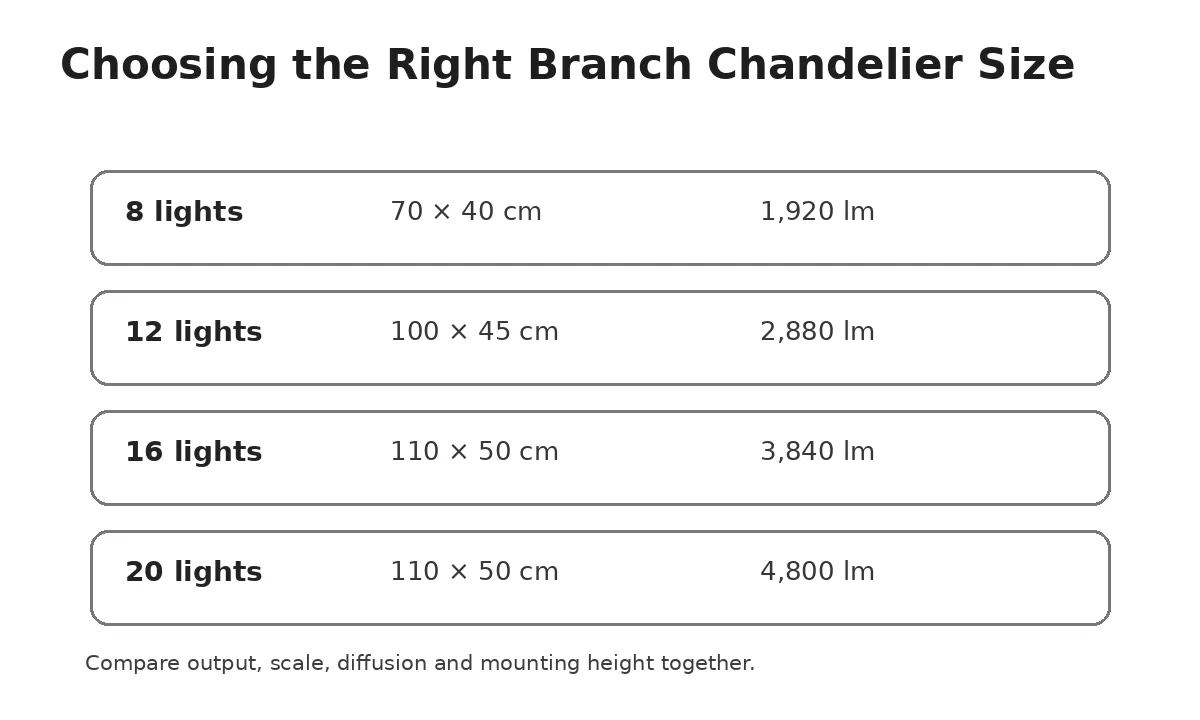
The Xunlu branch chandelier family scales from smaller configurations to larger pendant versions. For example, the listed 8-light pendant is approximately 24W and 1,920 lm, while the 20-light version is approximately 60W and 4,800 lm. Those figures are useful for comparing variants, but final comfort still depends on where the luminaire is hung and how much other light is present in the room.
3. Use Scale to Match the Architecture
A sculptural chandelier needs enough space around it to be read as a complete form. In a small dining room, an oversized branch fixture can dominate the ceiling and compress the room visually. In a large open-plan area, a fixture that is too small may look disconnected from the furniture below.
A useful design method is to match the long axis of the chandelier with the long axis of the table or seating arrangement. For long tables, the 12-, 16-, or 20-light versions create a stronger horizontal relationship than a compact central fixture. Always check clearances from walls, cabinet doors, circulation paths, and tall furniture before installation.
4. Hanging Height: Protect Sight Lines First
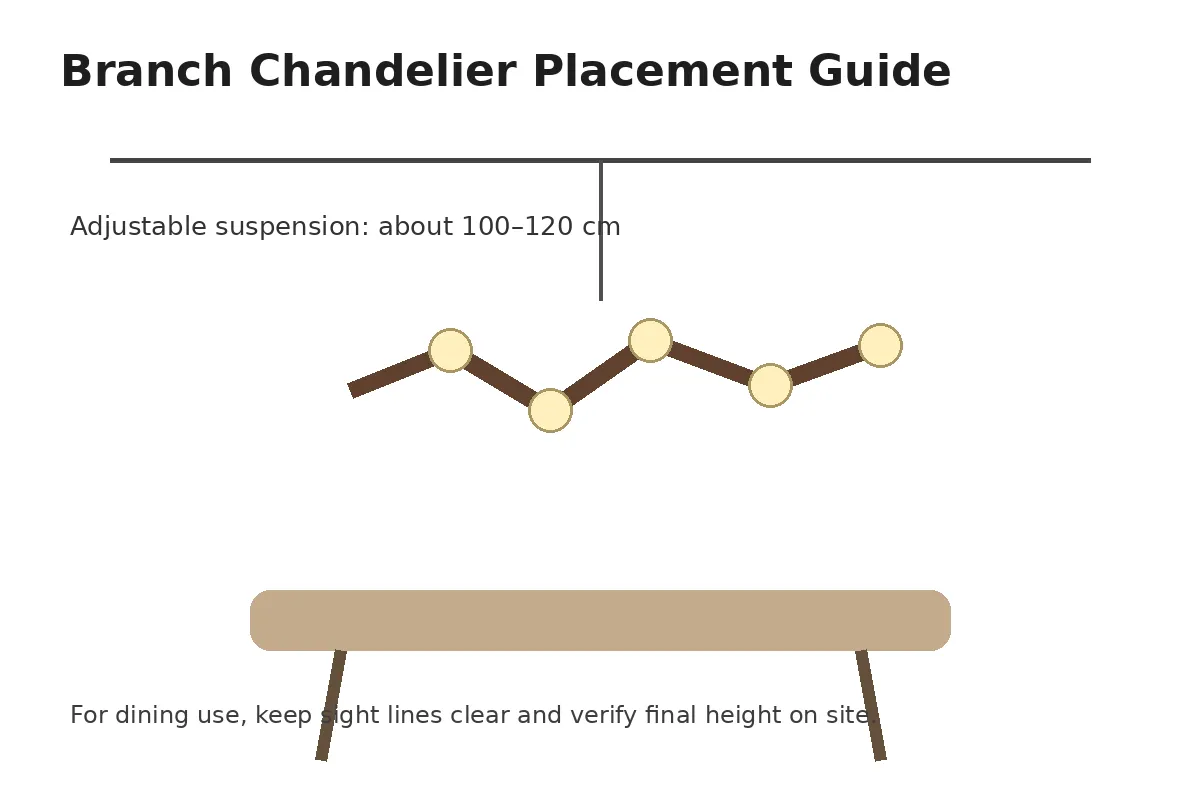
The product page lists an adjustable hanging length of roughly 100–120 cm depending on the configuration. That adjustability is useful because the correct height is determined by the room, ceiling, furniture, and normal eye positions.
Over a dining table, the lowest parts of the fixture should not interrupt conversation across the table or create direct glare at seated eye level. In a living room or entry, maintain adequate head clearance and make sure the brightest globes are not positioned directly in the main line of sight from nearby seating.
5. Color Temperature Should Follow Time and Function
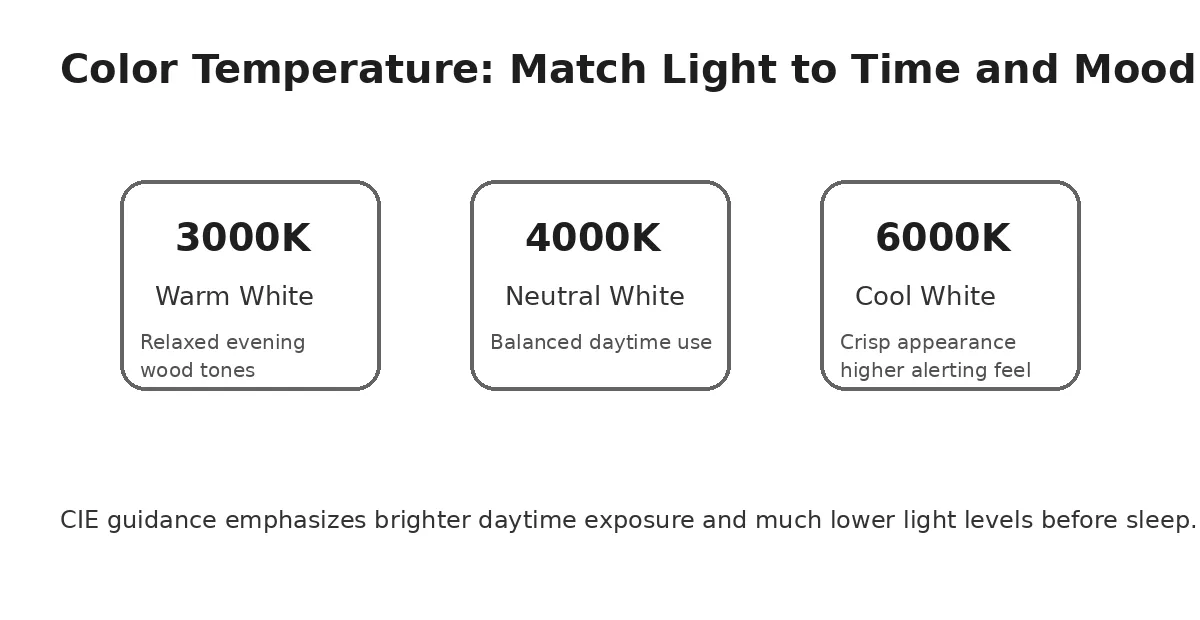
The Xunlu fixture is offered with 3000K warm white, 4000K neutral white, and 6000K cool white options. For evening dining and relaxed residential spaces, 3000K is usually the easiest match for wood tones, warm metals, cream fabrics, and other low-saturation materials. 4000K can feel clearer and more neutral during daytime use, while 6000K produces a much cooler visual appearance.
The International Commission on Illumination (CIE) notes that good integrative lighting should balance visual needs with human well-being, energy use, and architecture. Its 2024 position statement supports a daily pattern of high light exposure during the day and substantially lower light exposure in the hours before bed. In practice, that makes dimming, multiple circuits, or warmer evening lighting useful in homes used late into the night.
6. Natural-Looking Materials and Light Interaction
The branch chandelier combines a wood-like resin finish with antique-gold details and glass globes. This mix works because matte, textured surfaces and glossy translucent surfaces respond to light differently. The branch form tends to read as a darker sculptural silhouette, while the globes become luminous visual anchors.
This contrast is useful in rooms with stone, plaster, timber, or neutral textiles. Rather than adding many decorative objects, one sculptural luminaire can provide both material character and light.
7. Energy Efficiency: Compare Lumens, Not Just Watts
The U.S. Department of Energy explains luminous efficacy as light output per unit of electrical power, measured in lumens per watt. LED technology can achieve high efficacy while also supporting different color temperatures, optical designs, and controls. For homeowners, the practical lesson is simple: compare useful light output and lighting quality, not wattage alone.
Integrated LED systems can also reduce the visual clutter of exposed lamps, which suits a sculptural fixture. However, installation and driver access should be considered early, especially for larger chandeliers that may be mounted high above a table or stair void.
8. Best Rooms for a Branch Chandelier
| Room | Lighting Role | Recommended Approach | Watch For |
|---|---|---|---|
| Dining room | Decorative + ambient | Center over the table; use warm 3000K for evening meals | Sight-line glare and fixture scale |
| Living room | Statement + ambient | Pair with floor or wall lighting for layered comfort | Do not rely on chandelier alone for reading |
| Entry / foyer | Visual focal point | Use vertical volume to showcase the branch silhouette | Head clearance and ceiling height |
| Villa / open-plan space | Architectural feature | Choose larger multi-light version for proportional impact | Balance with surrounding brightness |
9. A Practical Buying Checklist
• Measure ceiling height and furniture dimensions before selecting the 8-, 12-, 16-, or 20-light version.
• Choose color temperature for the time of day the room is used most often.
• Consider 3000K for relaxed evening spaces and warmer material palettes.
• Check lumen output together with diffusion, glare, and surrounding light levels.
• Confirm that the adjustable suspension provides the correct sight-line and clearance.
• Use additional task lighting where reading, food preparation, or detailed work takes place.
• Confirm voltage, installation method, ceiling support, and electrical requirements with a qualified electrician.
10. Why This Xunlu Fixture Is Different
Many modern chandeliers use perfect rings, straight bars, or repeated crystal modules. The Rustic Branch Chandelier takes the opposite approach: its visual identity comes from irregularity. The branch-like structure, globe distribution, rustic brown texture, and antique-gold accents create a more organic centerpiece.
That makes it especially suitable for interiors that combine modern architecture with natural or handcrafted elements. It can bridge styles such as rustic luxury, modern organic, warm contemporary, vintage-inspired, and nature-led residential design without requiring the entire room to follow one decorative theme.
Scene Images for the Featured Rustic Branch Chandelier
Below are three scene images showing the featured branch chandelier in different interior applications. These images can be used directly inside the blog article or as supporting visual materials for publication.
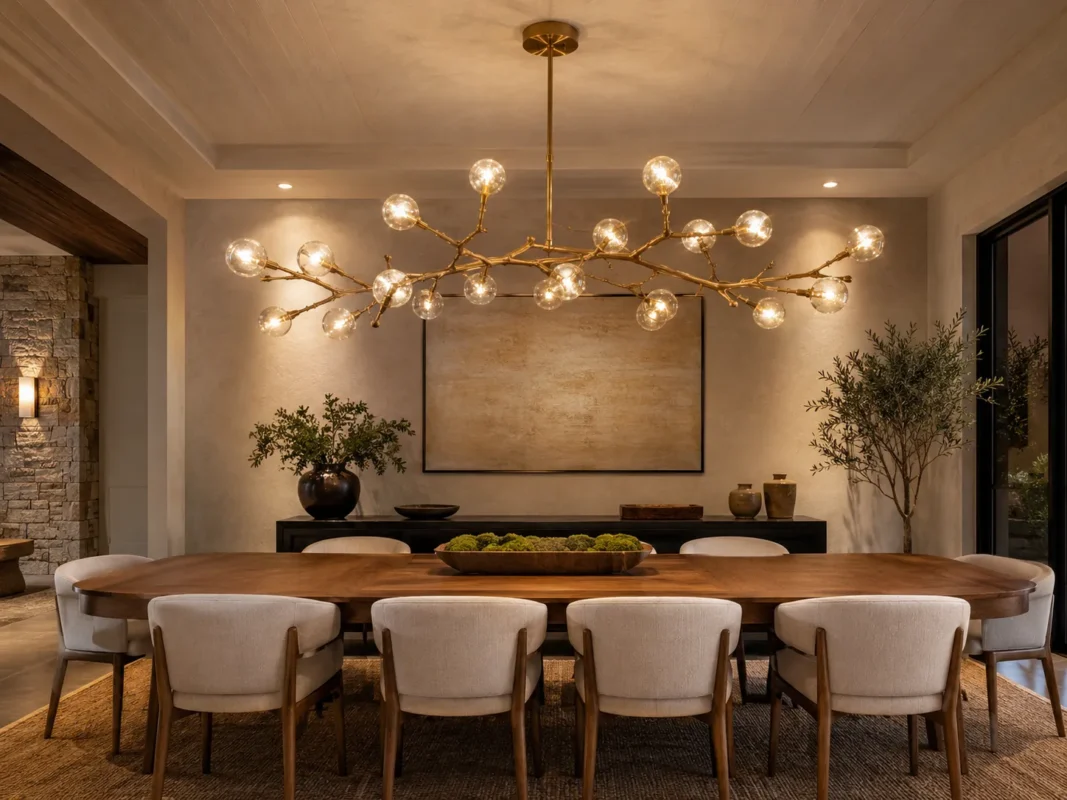
Scene 1: Rustic Branch Chandelier above a warm contemporary dining table, showing how the fixture works as a sculptural centerpiece.
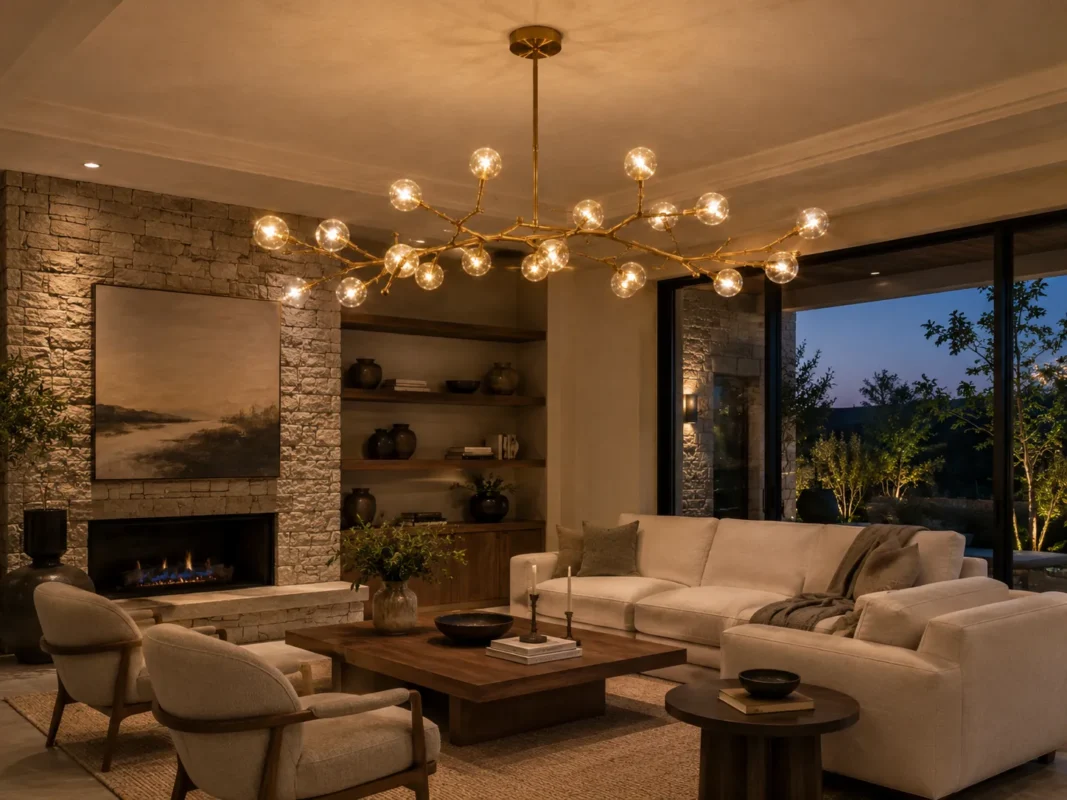
Scene 2: Rustic Branch Chandelier in a luxury living room, creating ambient warmth and visual focus above the seating area.
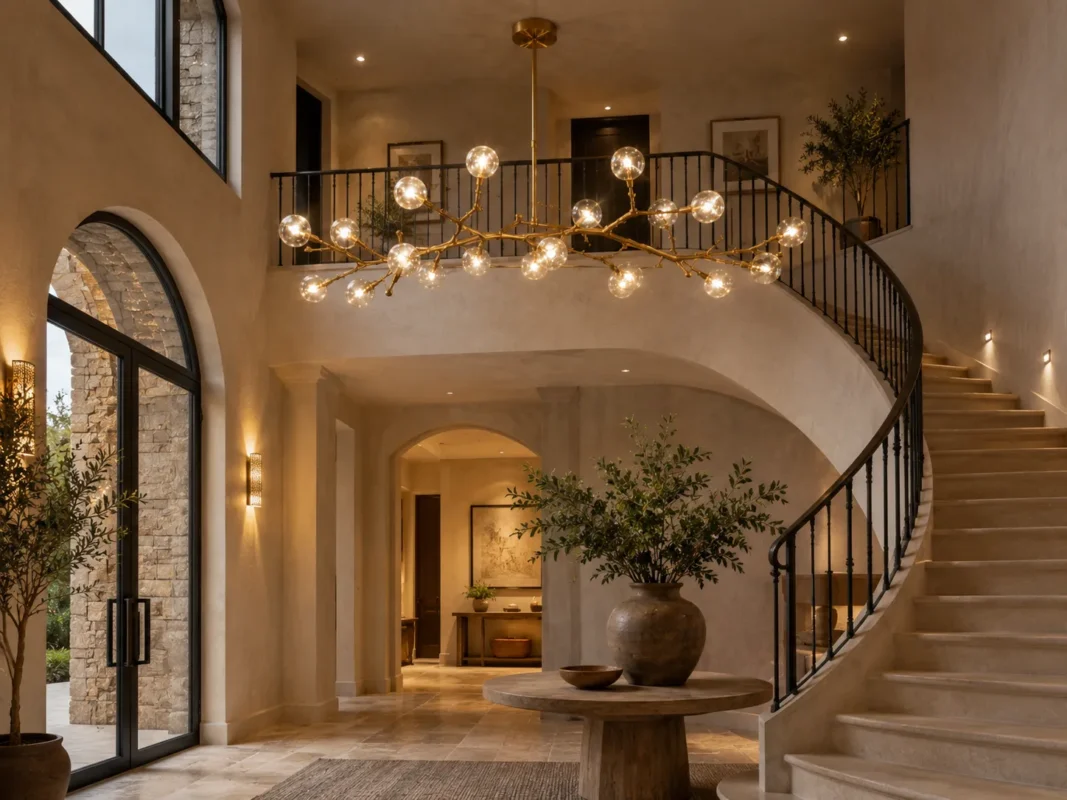
Scene 3: Rustic Branch Chandelier in a grand foyer with a curved staircase, demonstrating its suitability for tall and open interiors.
Image note: These three chandelier scene images were added to this updated Word version to support the featured product presentation.
Conclusion
A successful branch chandelier does more than imitate nature. It uses organic geometry to create visual movement, diffused globes to soften brightness, and multiple light points to establish depth. When scale, color temperature, hanging height, and surrounding lighting are considered together, a sculptural fixture can be both expressive and comfortable.
For homeowners who want a statement piece without relying on crystal or rigid geometric forms, the Rustic Branch Chandelier LED Light from Xunlu Lighting offers a distinctive alternative. The strongest results will come from treating it as one layer in a wider lighting scheme: bright enough for the space, soft enough for the eye, and warm enough to support the atmosphere you want.