


How to make circulation spaces safer, calmer, brighter and more welcoming — without overlighting them
Xunlu Lighting • August 31, 2026
Hallways, foyers and entryways are easy to underestimate because we do not usually stay in them for long. Yet these transition zones do important visual work: they help us move safely, adapt between bright and dark rooms, recognize faces and objects, find keys and shoes, read switches and steps, and form the first impression of a home. A successful design therefore needs more than a single high-output ceiling fixture. It needs balanced brightness, controlled glare, useful vertical light and a sensible relationship between daylight and electric light.
| CORE IDEA | In circulation spaces, visual comfort depends less on chasing the highest lux number and more on giving the eye a clear, even, low-glare field of view. Light the walls and landmarks, not only the floor. |
1. Why hallways need a different lighting strategy
A corridor is a movement space, not a workstation. That difference matters. In a measured daylit-corridor study, the researchers noted that an existing electric-light level of about 450 lx was roughly 4.5 times the cited recommended design value, showing how easily circulation spaces can be overlit. More light is not automatically more comfortable: excessive contrast, exposed LEDs and bright sources in the direct line of sight can make a narrow space feel harsher and may reduce perceived comfort.
Research on corridor brightness also shows that perceived brightness and uniformity depend on the luminance pattern across the whole visual field, not simply the horizontal illuminance measured on the floor. This is why wall washing, softly luminous surfaces and repeated low-glare sconces often make a hallway feel clearer than a single intense downlight.
2. Start with adaptation: avoid the ‘bright room–dark tunnel’ effect
The eye continuously adapts to the brightness of its surroundings. When a bright living room opens into a much darker corridor, details can temporarily be harder to see; the reverse transition can also feel uncomfortable. A better solution is to reduce large brightness jumps between adjacent spaces. That does not mean every room needs the same illuminance. Instead, create a gradual visual transition with modest ambient light and brighter vertical surfaces near doorways.
Daylight should also be handled carefully. CIE guidance on daylight glare explains that discomfort can come from both the total amount of light entering the eye and strong luminance contrast. A small, very bright window at the end of a dim hallway can therefore be more uncomfortable than a larger, softly shaded opening. Sheer curtains, diffusing glass, blinds or a nearby wall light can reduce the contrast without sacrificing the sense of daylight.
3. Use vertical light to make narrow spaces feel clearer
People walking through a home mostly look forward, not down. That makes vertical surfaces — walls, doors, artwork, mirrors and faces — especially important. A hallway with bright floor spots but dark walls can still feel gloomy. By contrast, a moderate amount of wall illumination increases the apparent brightness of the space, improves orientation and makes finishes and artwork easier to appreciate.
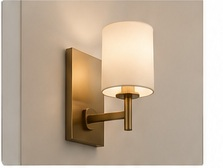
This is one reason wall sconces are so effective in entryways and corridors. They can place light closer to eye-level surfaces while keeping the ceiling visually quiet. For a long hallway, repeating fixtures at a consistent rhythm also creates visual landmarks that make the route easier to read.
4. Glare control matters more than raw output
The International Commission on Illumination defines discomfort glare as glare that causes discomfort even when it does not necessarily prevent us from seeing objects. CIE’s Unified Glare Rating framework considers source luminance, background luminance, source size and viewing position. In practical home terms, the lesson is simple: a small exposed LED can be uncomfortable if it is much brighter than its surroundings and sits directly in the normal line of sight.
Choose fixtures with diffusers, shielding, back-lighting or textured glass when the source is visible. Avoid mounting an intense bare source directly opposite a staircase landing, mirror or doorway where people naturally look. In very narrow corridors, indirect or wall-grazing light is often more comfortable than a row of high-intensity spotlights.
5. A practical lighting recipe for hallways and entryways
For most homes, the following layered approach is more useful than selecting one oversized fixture:
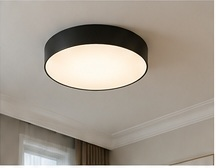
Ambient light: Provide a soft base layer from a ceiling light, concealed cove, wall wash or a small number of shielded downlights.
Vertical light: Use sconces or indirect light to brighten walls, artwork and door zones so the space feels visually open.
Orientation light: Add low-level night lighting at stairs, changes in level or long dark passages where navigation is important.
Accent light: Use a narrow beam only when there is something worth highlighting, such as art, a console table or textured wall.
Controls: Separate decorative and ambient circuits when possible; add occupancy sensing where lights are frequently left on.
6. Color temperature: keep circulation spaces visually connected
There is no universal ‘best’ color temperature for a hallway. The strongest design principle is continuity with adjoining rooms. If nearby living spaces use warm 2700–3000 K light, a 6000 K hallway can feel visually disconnected even if the measured brightness is adequate. For most residential entryways, 2700–3000 K creates a warmer, more relaxed impression; 3500–4000 K can work well in crisp modern interiors or mixed-use zones.
When one fixture offers multiple CCT settings, choose the setting that best matches the surrounding rooms rather than switching colors constantly. Consistency usually makes materials and wall colors appear more coherent from one space to the next.
7. Product ideas from Xunlu Lighting
For this article, the following fixtures were selected from xunlulighting.com because their form, diffusion and mounting style suit the design principles above. They were chosen as fresh examples rather than reusing the pendants and chandeliers featured in earlier Xunlu blog topics.
Modern Resin Wall Light — Full Spectrum LED Wall Sconce
A slim wall-mounted design with transparent resin diffusion, 3000K/4000K/6000K switching and a stated 1600–3000 lm range. Its wall-mounted format makes it especially relevant to entryways, feature walls and wider corridors.
https://xunlulighting.com/product/modern-resin-wall-light-full-spectrum-led-wall-sconce-bedroom-hallway-lighting/
Modern Slim Linear LED Wall Light Sconce
A matte-black linear sconce with backward illumination and an acrylic diffuser. The product page lists 2700K/3000K/4000K/6000K options and approximately 600–900 lm, making it suitable where a restrained architectural wall glow is preferred.
https://xunlulighting.com/product/modern-slim-linear-led-wall-light-sconce/
Modern LED Glass Wall Sconce — Copper Bedroom Wall Light
A decorative copper-and-textured-glass wall light specified at 3000 K with CRI ≥97. The textured glass and warm output suit entry consoles, short hallways and hospitality-style interiors.
https://xunlulighting.com/product/modern-led-glass-wall-sconce-copper-bedroom-wall-light/
8. Placement rules that prevent common mistakes
Do not create a runway of dots. Too many small downlights can produce scalloped pools, hard shadows and unnecessary brightness. Use fewer fixtures with better distribution.
Keep bright sources out of the normal viewing direction. At eye-level turns, landings and mirrors, choose shielded or diffused luminaires.
Light the destination. A brighter door, console or artwork at the end of a corridor improves visual orientation and gives the space a clear focal point.
Respect wall finishes. Glossy stone, mirrors and dark polished surfaces can create reflections. Test the viewing angles before final installation.
Plan night use. For routes between bedrooms and bathrooms, low-level lighting can be more comfortable than switching on the full daytime scene.
9. Energy efficiency: control time, not just watts
Because hallways are occupied intermittently, controls can save more energy than simply choosing a slightly lower-wattage fixture. The corridor daylighting research cited in this article demonstrates the value of linking electric light to available daylight. In homes, the equivalent can be simple: occupancy sensors, dim-to-low settings, timers or daylight-responsive controls near glazed entryways. The goal is to provide useful light when the space is occupied and avoid full output when it is not.
| Decision | What to look for | Why it matters |
|---|---|---|
| Light distribution | Diffuse, indirect or wall-washing | Improves perceived brightness and reduces harsh contrast |
| Glare | Shielded source / textured diffuser | Reduces direct high-luminance exposure |
| CCT | Usually 2700–3000 K in warm homes; 3500–4000 K in crisp modern schemes | Keeps visual continuity with adjacent rooms |
| Color rendering | High CRI where faces, art or finishes matter | Helps materials and colors appear more natural |
| Controls | Separate scenes, occupancy sensor, dimming | Matches light output to short periods of use |
| Placement | Emphasize walls, doors, turns and stairs | Supports orientation and visual comfort |
Conclusion
A well-lit hallway does not need to be the brightest space in the home. It needs to be legible, comfortable and visually connected to the rooms around it. Start by controlling glare and large brightness differences. Then add vertical illumination so walls, doors and faces are easy to see. Use warm or neutral color temperatures that harmonize with adjacent rooms, and rely on controls to reduce unnecessary operating time. When these principles are combined, even a narrow corridor can feel calm, polished and deliberately designed.
Scientific & Technical References
• Illuminating Engineering Society (IES). Lighting Library; includes ANSI/IES/ALA RP-11-26, Recommended Practice: Lighting for Interior and Exterior Residential Environments. https://ies.org/standards/lighting-library/
• International Commission on Illumination (CIE). CIE 117-1995: Discomfort Glare in Interior Lighting. https://www.cie.co.at/publications/discomfort-glare-interior-lighting
• International Commission on Illumination (CIE). CIE 252:2024: Assessment of Discomfort Glare from Daylight in Buildings. https://www.cie.co.at/publications/assessment-discomfort-glare-daylight-buildings
• ISO/CIE 8995-1:2025. Light and lighting — Lighting of work places — Part 1: Indoor. https://cie.co.at/publications/light-and-lighting-lighting-work-places-part-1-indoor-0
• Li, D.H.W. & Lam, J.C. (2003). An analysis of lighting energy savings and switching frequency for a daylit corridor under various indoor design illuminance levels. Applied Energy, 76(4), 363–378. DOI: 10.1016/S0306-2619(02)00121-6
• Pracki, P. & Krupiński, R. (2021). Brightness and Uniformity Perception of Virtual Corridor with Artificial Lighting Systems. Energies, 14(2), 412. DOI: 10.3390/en14020412
Editorial note: Product specifications were checked on xunlulighting.com on August 31, 2026. Recommended lighting levels vary by jurisdiction, user age, surface reflectance and task. Final electrical installation should follow local codes and manufacturer instructions.