

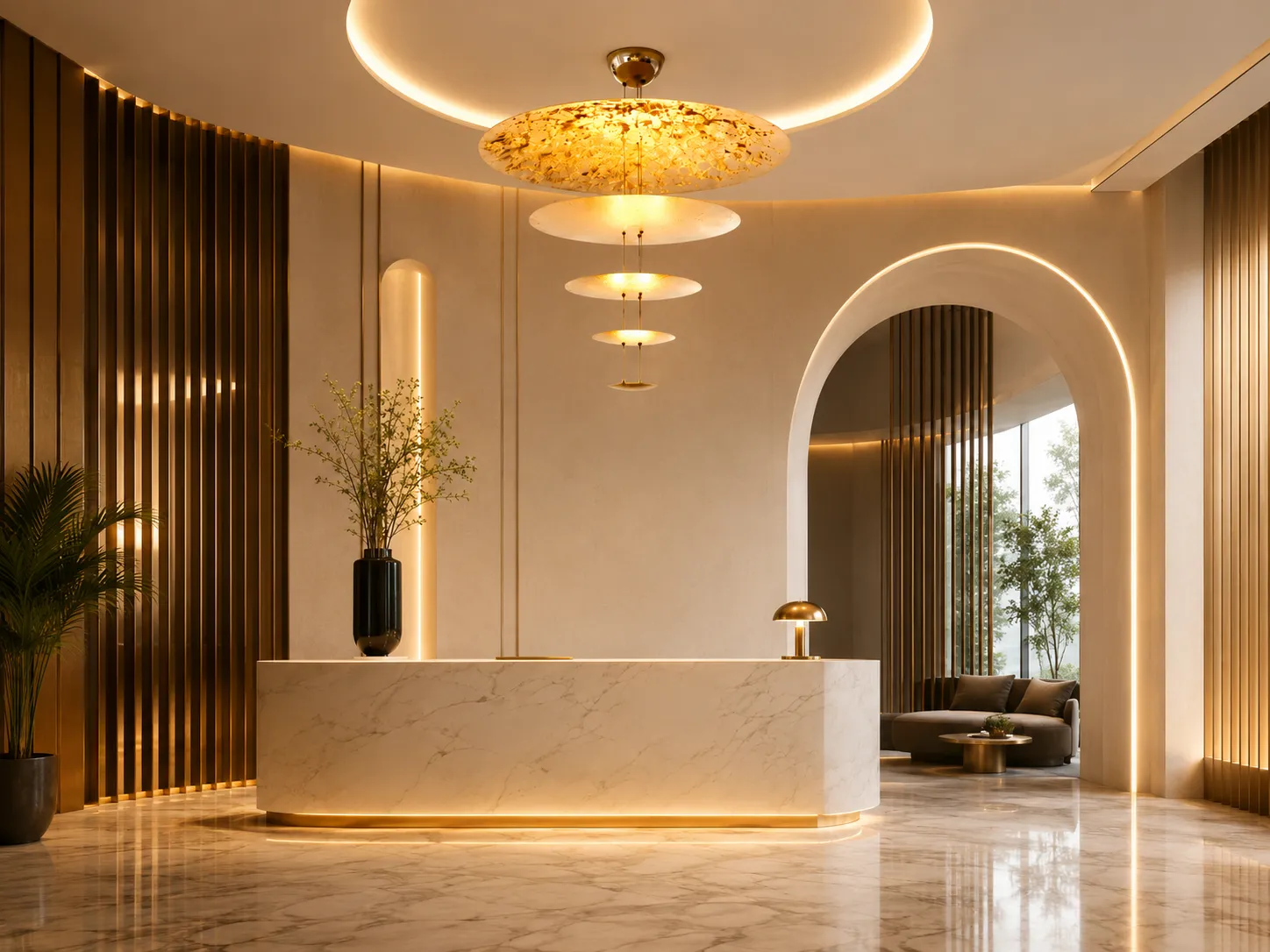

How Gold Disc and Ring Chandeliers Shape Brighter, More Comfortable Modern Interiors
Design idea: Use a sculptural chandelier as the visual anchor, then support it with softer ambient and task lighting. The goal is not simply “more light,” but a balanced field of brightness that controls glare, reveals materials, and keeps the room comfortable.
When a Pendant Light Becomes Architecture
A large pendant light can do more than illuminate a room. In a modern interior, it can define the vertical center of a space, guide the eye through an open plan, and create a hierarchy between ceiling, furniture, and architectural finishes. This is especially true of layered chandeliers, where repeated discs, rings, and translucent surfaces create depth even when the fixture is switched off.
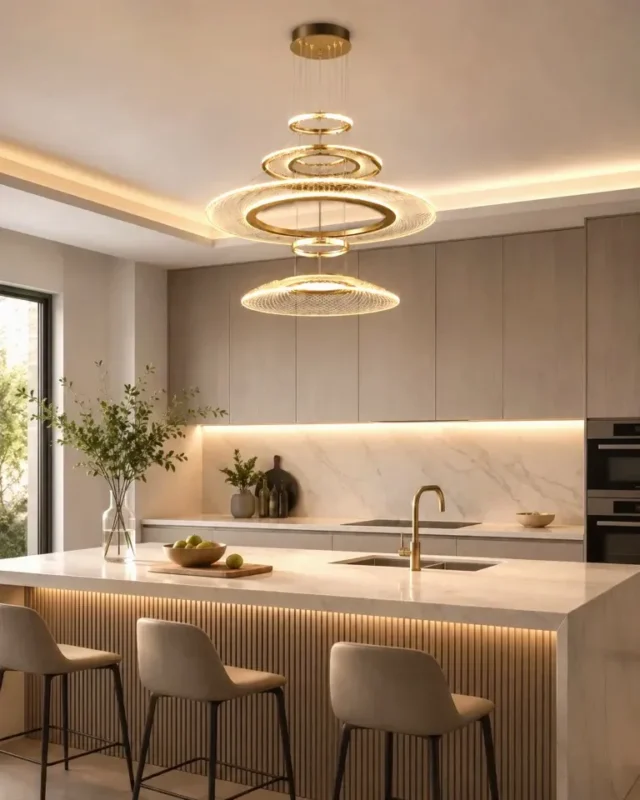
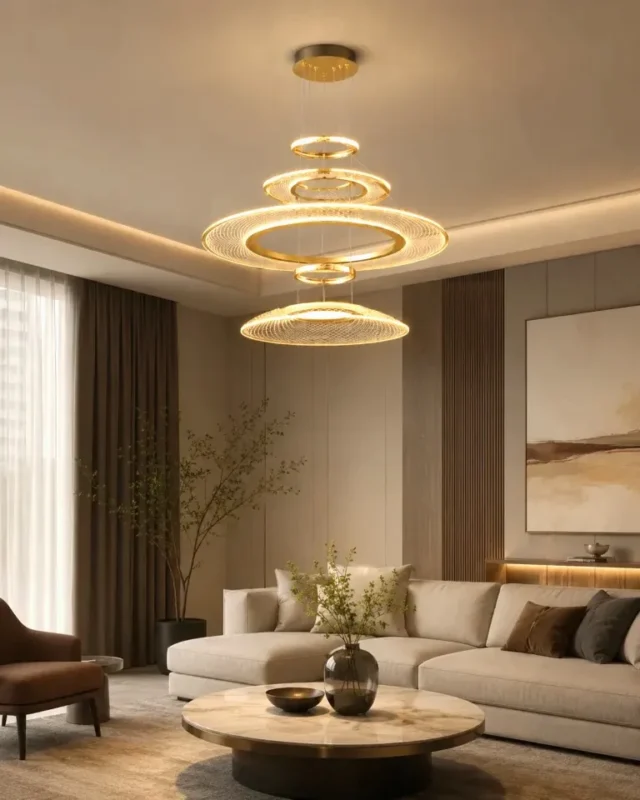
The two designs featured here approach that idea in different ways. The Modern Gold LED Pendant Light uses stacked gold-toned discs and textured acrylic to create a sculptural, cascading silhouette. The Modern Art Glass LED Pendant Light uses illuminated rings and a decorative glass-style panel to create a lighter halo effect. Both are integrated LED fixtures, but their visual character, color-rendering performance, scale, and ideal placement differ in meaningful ways.
A useful lighting plan therefore starts with three questions: How bright should the room feel? Where will people look and move? And what surfaces need to look their best? Lighting standards and research emphasize illuminance, luminance, glare control, color quality, and adaptation rather than wattage alone. That framework is valuable at home because comfort depends on the relationship between the bright fixture and the darker surfaces around it, not simply on the number of lumens produced.
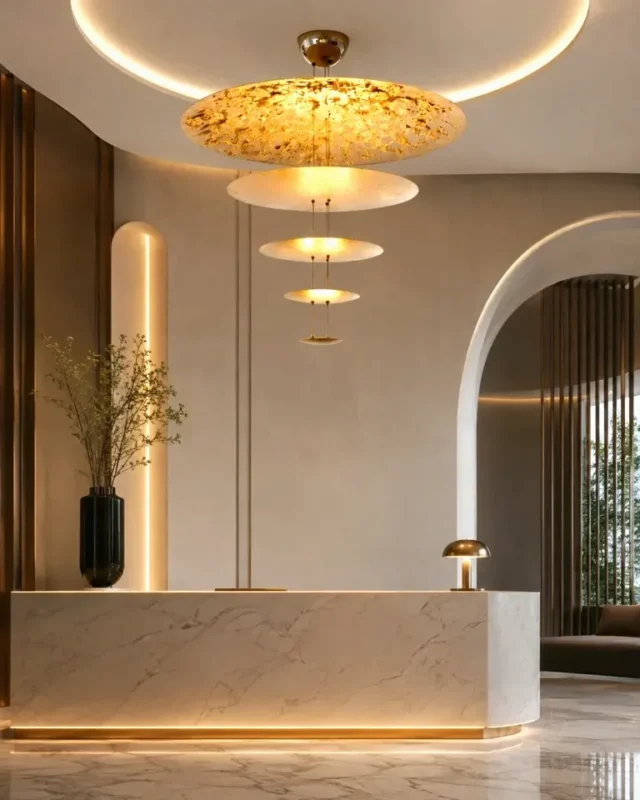
1. The Layered Disc Chandelier: Warm, Sculptural, and Architectural
The Modern Gold LED Pendant Light | Layered Disc Chandelier is built around overlapping circular elements that descend through space. According to the product specifications, the fixture combines iron, textured acrylic, gold-finished decorative metal discs, and an integrated LED module. The listed output is approximately 2,800–4,200 lumens at about 36–48 watts, with a 3000K warm-white color temperature and a color-rendering index of Ra ≥ 80.
Its most important design feature is not the raw output but the way the diffuser and disc layers spread and intercept the light. A textured acrylic surface can soften the visual impression of the LED source by increasing the apparent emitting area. In practical terms, a larger luminous surface often feels less harsh than a small, intensely bright point source at the same general viewing angle, especially when the surrounding ceiling and walls are moderately bright.
The large version is listed at approximately 64 cm (25.20 in) in diameter and 65 cm (25.59 in) in height, while the smaller version is approximately 50 cm (19.69 in) in diameter and 50 cm (19.69 in) in height. That makes the design especially suitable for spaces where the pendant can be read as a three-dimensional object: entry halls, double-height transitions, dining areas with generous ceiling height, reception zones, and living rooms where there is clear open space beneath the fixture.
Why the stacked geometry works
- Repetition creates visual rhythm: the eye reads the discs as a coordinated vertical sequence rather than as one heavy mass.
- Gold surfaces reinforce warm light, which pairs naturally with beige stone, warm white plaster, walnut, bronze, and cream upholstery.
- A layered profile adds visual depth from multiple viewpoints, making the chandelier effective in circulation spaces where people approach it from different directions.
- The 3000K light color is well suited to evening-focused residential zones where a warm, relaxed atmosphere is usually preferred.
3. The Science of Comfortable Decorative Lighting
Good decorative lighting is a balance between quantity and quality. The Illuminating Engineering Society treats lighting design as more than a target illuminance value: the visual field also includes luminance, glare, color, adaptation, and the distribution of light within the space. For homes, this means a beautiful chandelier performs best when it is part of a layered system rather than the only bright source in an otherwise dark room.
Glare depends on contrast, not brightness alone
Glare occurs when a bright source within the field of view is sufficiently more luminous than the level to which the eye is adapted. IES guidance describes discomfort glare as a sensation of annoyance and notes that source luminance, source size, position in the field of view, and the viewer’s adaptation level all matter. One practical response is to avoid a “bright chandelier in a black box” effect. Soft cove lighting, wall washing, lamps, or concealed cabinet lighting can lift the surrounding luminance and reduce the perceived contrast.
That is why both featured pendants look particularly convincing in warm, bright-neutral rooms. Pale stone, beige plaster, cream upholstery, and indirect ceiling light reflect enough illumination to keep the fixture from becoming an isolated hotspot. The result can feel luxurious and calm at the same time.
3000K creates warmth without making the room visually heavy
Both fixtures are specified at 3000K warm white. Correlated color temperature describes the general warm-to-cool appearance of white light. Around 3000K is widely used in residential and hospitality interiors because it retains a warm character while remaining cleaner and less amber than very low color temperatures. It works especially well with gold finishes, cream stone, medium wood, and neutral upholstery.
The important design point is consistency. If the chandelier is 3000K but adjacent downlights are much cooler, the room can feel visually fragmented. For a coherent atmosphere, keep nearby ambient sources close in color appearance unless a deliberate contrast is part of the design concept.
Lumens describe output; surfaces determine experience
The two chandeliers are both in roughly the 2,800–4,200 lumen class according to their product pages, but identical lumen output can produce very different room impressions. Ceiling height, wall reflectance, diffuser geometry, beam distribution, and mounting height all influence how much light reaches the task plane and how bright the fixture appears from normal viewing positions. This is why lumen values should be treated as one design input rather than a complete prediction of comfort.
4. How to Place These Chandeliers Room by Room
Living room
Use the chandelier to organize the seating zone rather than simply centering it in the room footprint. In an open-plan layout, align the fixture with the coffee table or the center of the conversational grouping. The layered disc design works especially well where the ceiling volume is generous and the fixture can read vertically. The ring chandelier is a better choice when you want a cleaner ceiling line and more visual openness.
Kitchen island
For a kitchen, visual comfort and color quality matter because people work directly beneath and around the light. The ring chandelier’s stated Ra ≥ 95 specification gives it a practical advantage when food, countertop materials, and finishes need to appear natural. However, a decorative pendant should not be expected to replace all task lighting. Under-cabinet or integrated work lighting can provide more controlled illumination on preparation surfaces while the chandelier supplies ambient and decorative light.
Dining area
Dining spaces benefit from a warm focal glow and controlled brightness on faces, tableware, and food. A ring form works particularly well over a round or compact table, while the layered disc chandelier can create a more dramatic center in a larger dining room. Keep enough clearance above the tabletop that seated sightlines remain open; final hanging height should be adjusted to the fixture scale, ceiling height, and occupants rather than following a single universal number.
Entry, stair transition, or hotel-style reception zone
These are the strongest applications for the layered disc model because the fixture can be seen from a distance and from changing elevations. A vertical composition creates a sense of arrival. In brighter interiors, use indirect light at the ceiling or walls so the chandelier remains the focal point without becoming the only luminous element in the field of view.
5. Which One Should You Choose?
| Design factor | Layered Disc Chandelier | Ring Chandelier |
|---|---|---|
| Visual character | Sculptural, layered, dramatic | Light, open, halo-like |
| Listed power / output | Approx. 36–48W / 2,800–4,200 lm | 35W / 2,800–3,200 lm |
| Color temperature | 3000K warm white | 3000K warm white; three-color dimmable function listed |
| Color rendering | Ra ≥ 80 | Ra ≥ 95 |
| Best fit | Entry, lobby, taller living room, statement dining area | Kitchen island, dining room, bedroom, living room |
| Scale | 50 or 64 cm diameter options listed | 47 cm diameter; suspension up to 150 cm |
| Design priority | Depth and sculptural presence | Color quality and visual openness |
6. A Better Lighting Strategy Than “One Fixture Does Everything”
A sculptural chandelier should usually be the room’s visual anchor, not its only source of useful light. A stronger plan combines three layers: ambient light for general brightness, task light where work happens, and accent light that reveals architecture, artwork, or materials. This approach lets the chandelier operate at a comfortable level instead of being pushed to maximum brightness simply because the rest of the room is underlit.
- Ambient layer: chandelier, soft ceiling light, or indirect cove lighting.
- Task layer: under-cabinet lighting, reading lamps, vanity lighting, or directed work lights.
- Accent layer: wall washers, shelf lighting, picture lights, or concealed architectural LEDs.
Dimming is valuable because the preferred light level changes throughout the day. The U.S. Department of Energy specifically recommends using dimmers when full light output is unnecessary, and notes that LED technology can support energy savings, long service life, and flexible controls. For integrated LED decorative fixtures, verify control compatibility with the specific driver and wall control before installation.
7. Installation and Specification Notes
Integrated LED pendants combine the light engine and decorative fixture, so the driver, heat management, optical components, and controls all work as one system. That makes correct installation especially important. The product pages list AC 110–240V compatibility, but local electrical codes, ceiling support requirements, and qualified installation practices still govern the final project.
- Confirm the ceiling structure can support the fixture weight and canopy hardware.
- Plan hanging height before final wire shortening, especially in stair, entry, and double-height spaces.
- Coordinate chandelier position with furniture, not only with ceiling geometry.
- Check dimmer or wall-switch compatibility with the integrated LED driver before purchase or installation.
- Use surrounding ambient light to reduce excessive contrast and improve visual comfort.
A Brighter, Softer Version of Modern Luxury
Modern luxury lighting does not have to mean a dark room with one dazzling object. A brighter palette—warm white ceilings, pale stone, soft beige textiles, light oak, muted bronze, and gentle indirect lighting—can make a gold chandelier feel more refined because the fixture becomes part of a balanced luminous environment.
Choose the Layered Disc Chandelier when the room needs sculptural depth and a strong vertical focal point. Choose the Ring Chandelier when you want a cleaner, airier profile and especially strong stated color rendering. In both cases, the best result comes from treating the pendant as one layer in a complete lighting composition: enough ambient brightness for adaptation, controlled task light where needed, and warm decorative light that gives the room identity.
When form, brightness, color quality, and placement are considered together, decorative lighting stops being an accessory and becomes part of the architecture itself.