

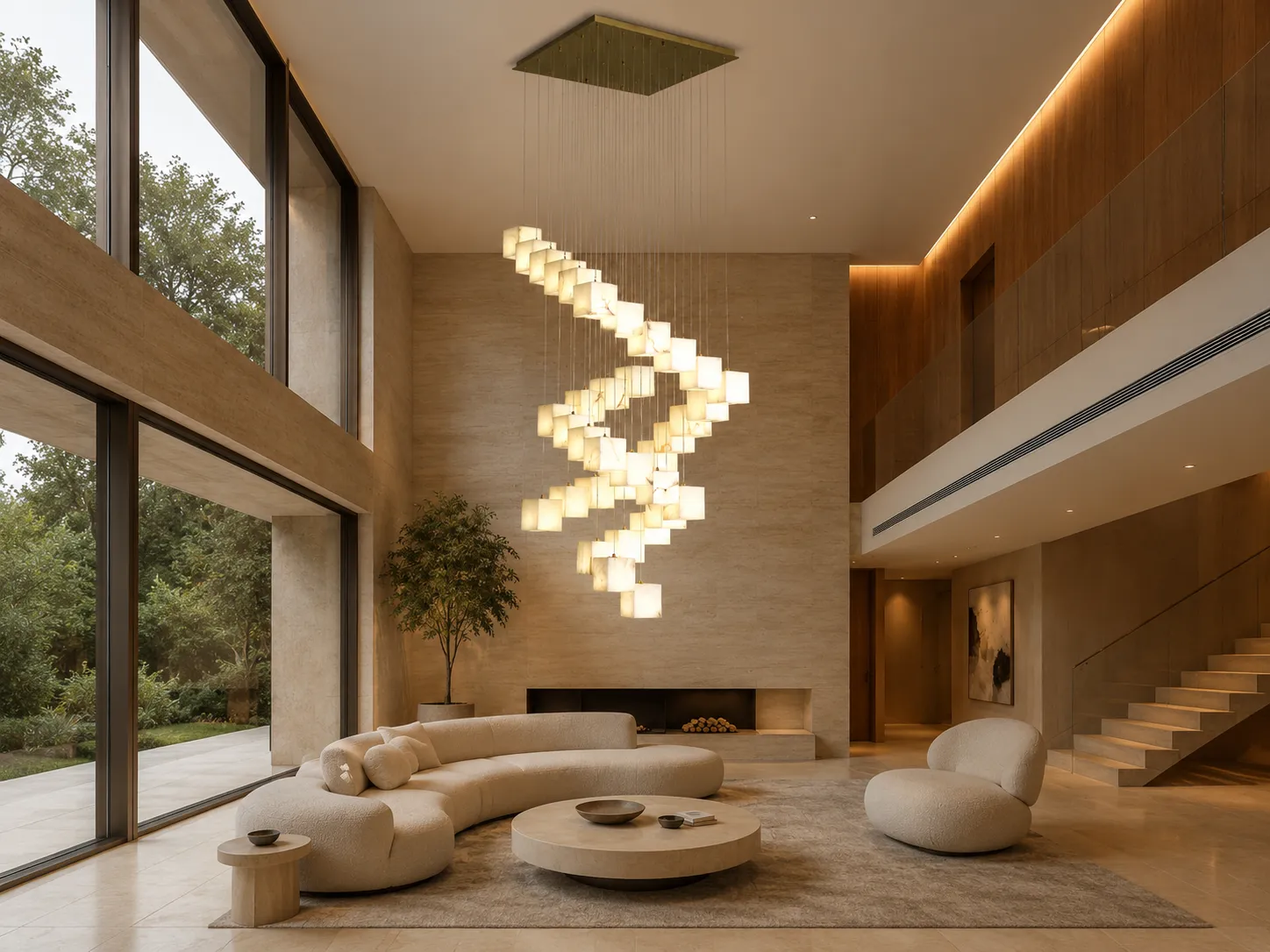

How Spiral and Tiered Alabaster Cube Cascade Chandeliers Shape Luxury Interiors
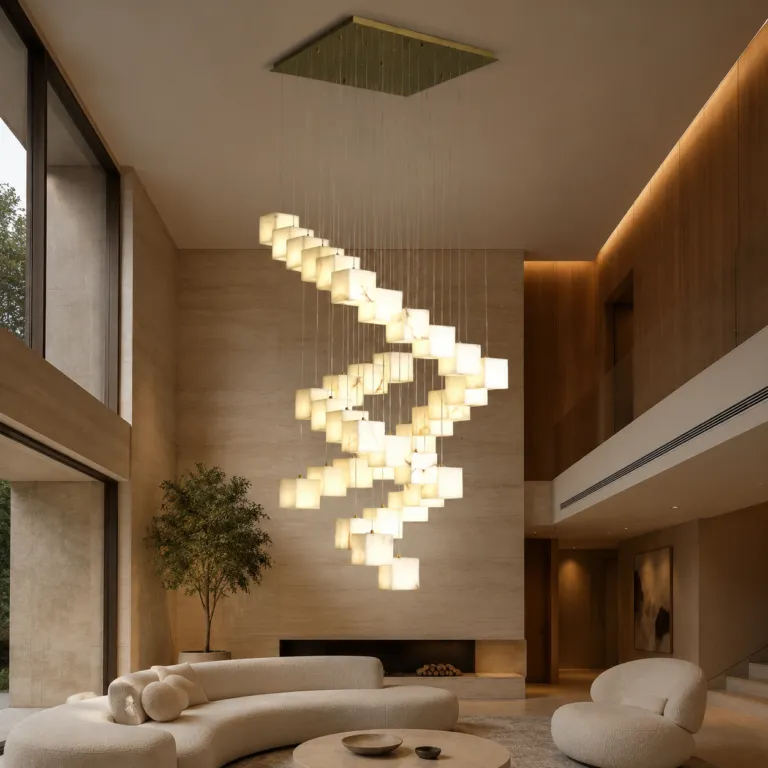
Natural stone, soft diffusion, and a deliberately composed vertical silhouette turn a chandelier from a ceiling fixture into an architectural focal point.
A chandelier can do more than illuminate a room
In a high-ceiling interior, the most successful decorative lighting does three jobs at once: it provides usable ambient light, establishes a visual center of gravity, and helps the eye understand the scale of the architecture. The Alabaster Cube Cascade Chandelier from Xunlu Lighting is designed around those three roles. Natural alabaster cubes diffuse individual G9 LED light sources, while the suspended arrangement builds a larger sculptural volume in the air.
The product is offered in multiple compositions, including a 36-light spiral and a 36-light tiered configuration. Both use the same fundamental material language—natural alabaster, a brushed-brass ceiling plate and steel suspension cables—but they create very different spatial impressions. The spiral reads as movement; the tiered version reads as order and geometry. Choosing between them is therefore not simply a question of taste. It is a question of what the room needs visually and functionally.
Why alabaster changes the character of electric light
Alabaster is valued in lighting because it is translucent rather than fully transparent. Light passing through a translucent material is scattered in many directions, which enlarges the apparent emitting surface and reduces the sensation of looking at a small, high-luminance source. In practice, that means the stone cubes can soften the appearance of the G9 lamps behind them and create a more continuous glow.
This matters because visual discomfort is strongly related to source luminance, apparent source size, location in the field of view, and the viewer’s adaptation level. The Illuminating Engineering Society describes Unified Glare Rating (UGR) as a metric for discomfort glare, while its broader guidance emphasizes that glare is influenced by both the brightness of the source and the brightness of the surrounding field. [2][3] A diffusing stone shade does not by itself guarantee a specific UGR value, but it is a sound design strategy for reducing exposed-point-source sparkle in residential and hospitality settings.
Alabaster also introduces natural variation. Veining, clouding and mineral patterns mean that no two cubes will transmit light in exactly the same way. Instead of a perfectly uniform luminous object, the chandelier produces a layered surface with subtle changes in brightness—an effect that is especially visible at warm-white color temperatures.
| Design factor | 36-Light Spiral | 36-Light Tiered |
|---|---|---|
| Visual rhythm | Continuous rotation and directional movement | Stacked, horizontal layers and stronger symmetry |
| Best architectural fit | Stair voids, double-height living rooms, curved circulation zones | Hotel-style lobbies, atriums, formal foyers, centered seating plans |
| Perceived mood | Dynamic, sculptural, expressive | Calm, ordered, monumental |
| Product dimensions | Approx. 78 × 72 cm / 30.7 × 28.3 in | Approx. 78 × 72 cm / 30.7 × 28.3 in |
| Light sources | 36 × G9 LED bulbs | 36 × G9 LED bulbs |
| Recommended total power | 108–180 W | 108–180 W |
| Standard suspension | 200 cm / 78.7 in, customizable | 200 cm / 78.7 in, customizable |
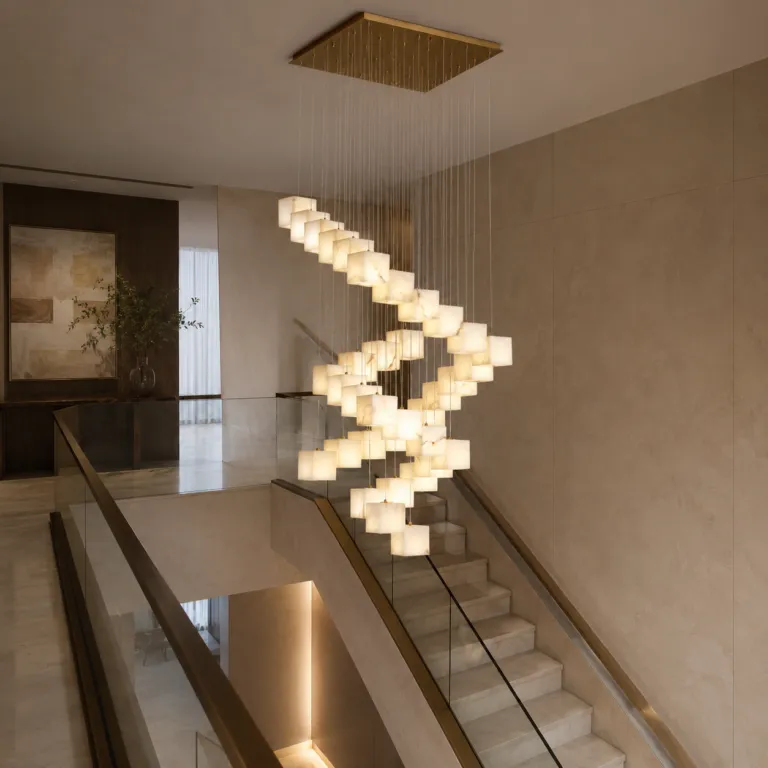
The spiral version is particularly effective where people experience the fixture while moving—on a staircase, from a mezzanine, or while entering a double-height living room. Because the illuminated cubes change position gradually around a central axis, the composition reveals itself differently from multiple viewpoints. That makes it useful in spaces where the chandelier is seen from both upper and lower levels.
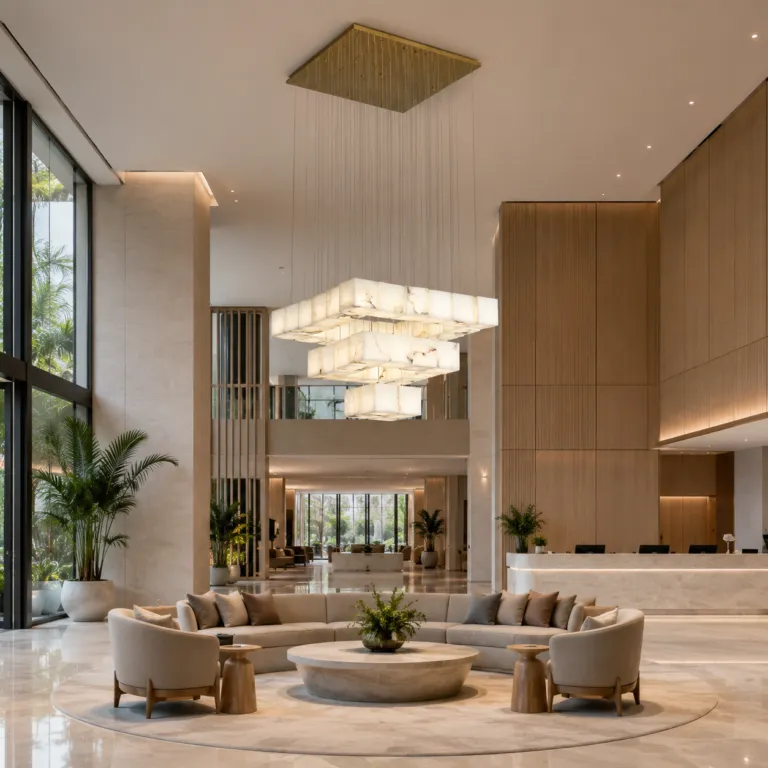
The tiered version is more frontal and architectural. Its horizontal layers visually echo floor slabs, ceiling planes, reception desks and symmetrical furniture layouts. In a large lobby, this can help the fixture feel integrated with the architecture rather than merely suspended inside it.
Light quality: warm does not have to mean dim
The specified standard color temperature is 3000K warm white, with 2700K and 4000K options available. For living rooms, hotel lounges and entrance halls, 3000K is a practical middle ground: warm enough to support a relaxed atmosphere, but neutral enough to preserve the appearance of pale stone, wood, brass and upholstery. The product specification also lists CRI ≥90, a level generally chosen when faithful color appearance is important in interior finishes and decorative materials. [1]
Color temperature should be considered together with quantity and direction of light. A dramatic chandelier should rarely be expected to perform every lighting task in a large room. Good residential and hospitality lighting is layered: decorative ambient light establishes mood and hierarchy, while recessed lighting, wall washing, floor lamps or task lights provide additional illuminance where activities require it. IES illuminance recommendations are application-specific, which is why a complete lighting plan considers the task and the room—not just the wattage of one fixture. [4]
Use the chandelier as part of a layered lighting system
For a double-height living room, use the cascade as the luminous centerpiece, then add lower-level light to balance the vertical composition. Wall washers or concealed cove lighting can brighten large wall surfaces, improving adaptation and making the chandelier feel softer to the eye. Near seating, portable lamps or discreet downlights can provide useful reading and conversation light without forcing the chandelier to operate at excessive output.
In a staircase, prioritize visibility at treads and landings separately from the decorative fixture. The cascade can shape the void and provide ambient brightness, while dedicated stair or wall lighting should handle the safety-critical task of seeing changes in level.
Proportion is the hidden key to a luxury result
Large chandeliers often fail for one of two reasons: they are too small for the volume, or they hang at the wrong height. In a double-height room, a compact ceiling fixture can look visually detached from the furniture and occupants below. A cascade solves this by extending the luminous form downward, creating a bridge between the ceiling and the occupied zone.
For the 36-light spiral and tiered configurations, Xunlu lists a fixture size of approximately 78 × 72 cm (30.7 × 28.3 in) with a 69 × 69 cm (27.2 × 27.2 in) ceiling plate. Standard suspension length is 200 cm (78.7 in) and can be customized. [1] Those dimensions make ceiling coordination essential. The fixture should be planned alongside ceiling structure, services, access panels, sprinklers, diffusers and any nearby downlights—not added as an afterthought.
Xunlu also recommends keeping the fixture edge at least 60 cm (23.6 in) from surrounding walls. [1] In practice, more clearance may be desirable in especially tall spaces so the composition can be read from a distance and so the stone cubes do not visually merge into the wall plane.
Installation planning: treat it like a suspended sculpture
The 36-light configurations have a listed reference weight of approximately 95–115 kg (209–254 lb). [1] That is far beyond the load of a typical decorative pendant, so the ceiling support and anchoring strategy must be evaluated by qualified professionals. The decorative ceiling plate should not be treated as the structural support by itself; the load path must ultimately transfer into suitable building structure.
The use of many individual suspension cables also makes alignment important. Small differences in cable length can become visually obvious when repeated across dozens of cubes. A careful installation sequence—establishing the centerline, setting reference heights, then tuning the remaining drops—helps preserve the intended geometry.
Because natural alabaster is a stone material, handling should be controlled during unpacking and installation. Support each cube securely, avoid impact at corners, and clean using methods appropriate for natural stone and the manufacturer’s instructions. For large hospitality installations, it is sensible to keep a documented lamp-access and maintenance plan so future servicing does not disturb the composition.
A note on evening light and visual comfort
Lighting at night should support the intended activity without becoming unnecessarily intense. CIE guidance on integrative lighting emphasizes that light exposure has both visual and non-visual effects and that timing matters. Daytime light exposure is important for healthy day-active adults, while evening and night lighting generally benefits from lower levels and careful control. [5][6] In a home, this supports a simple strategy: use brighter, broader light during the day and early evening when needed, then dim decorative lighting later at night.
A warm 2700K or 3000K setting can support a more relaxed visual atmosphere, but spectrum alone does not determine biological effect. Intensity, duration, timing, direction and the amount of light reaching the eye also matter. For that reason, dimming and layered lighting are usually more useful than relying only on a “warm” label.
Where each version works best
Choose the spiral configuration when the room benefits from motion: a curving staircase, a tall living room with several viewing angles, a gallery-like void, or an entrance where guests move around the fixture. Its changing profile gives the eye a reason to follow the composition vertically.
Choose the tiered configuration when the architecture is formal, axial or symmetrical: a hotel lobby, a centered reception lounge, a square atrium, or a villa foyer organized around a strong central axis. The repeated layers establish calm order and work especially well with stone floors, timber wall panels and restrained contemporary furniture.
In either case, the most convincing result comes from contrast rather than excess. Let the chandelier be the brightest decorative object in its immediate zone, keep competing ceiling fixtures visually quiet, and use architectural lighting to reveal walls and surfaces rather than fighting for attention.
Design checklist before ordering
- Confirm the exact ceiling height and the desired lowest point of the chandelier.
- Choose spiral for movement and multi-angle viewing; choose tiered for symmetry and architectural order.
- Coordinate the 69 × 69 cm ceiling plate with structure and ceiling services.
- Plan structural support for the listed 95–115 kg reference weight of the 36-light configurations.
- Keep generous wall clearance; Xunlu specifies at least 60 cm from the fixture edge.
- Select 2700K, 3000K or 4000K according to the interior palette and time-of-day use.
- Use the chandelier as one layer of the lighting plan rather than the sole source of task illumination.
- Consider dimming and circuit control so light output can change from daytime reception to late-evening ambience.
- Allow access for future lamp replacement and cleaning.
Conclusion: illumination with architectural presence
The strongest statement chandeliers are not simply oversized lamps. They are spatial instruments. The Alabaster Cube Cascade Chandelier uses translucent natural stone to soften individual light sources and uses repetition to turn small luminous cubes into a large architectural composition. The spiral arrangement introduces movement and works beautifully in stairs and multi-level spaces; the tiered arrangement introduces order and suits formal, centered interiors.
When supported by a layered lighting plan, careful structural coordination and sensible evening controls, either configuration can provide more than visual drama. It can help define the room’s scale, guide attention through the architecture and create a warm, comfortable atmosphere that remains functional after the first impression.