

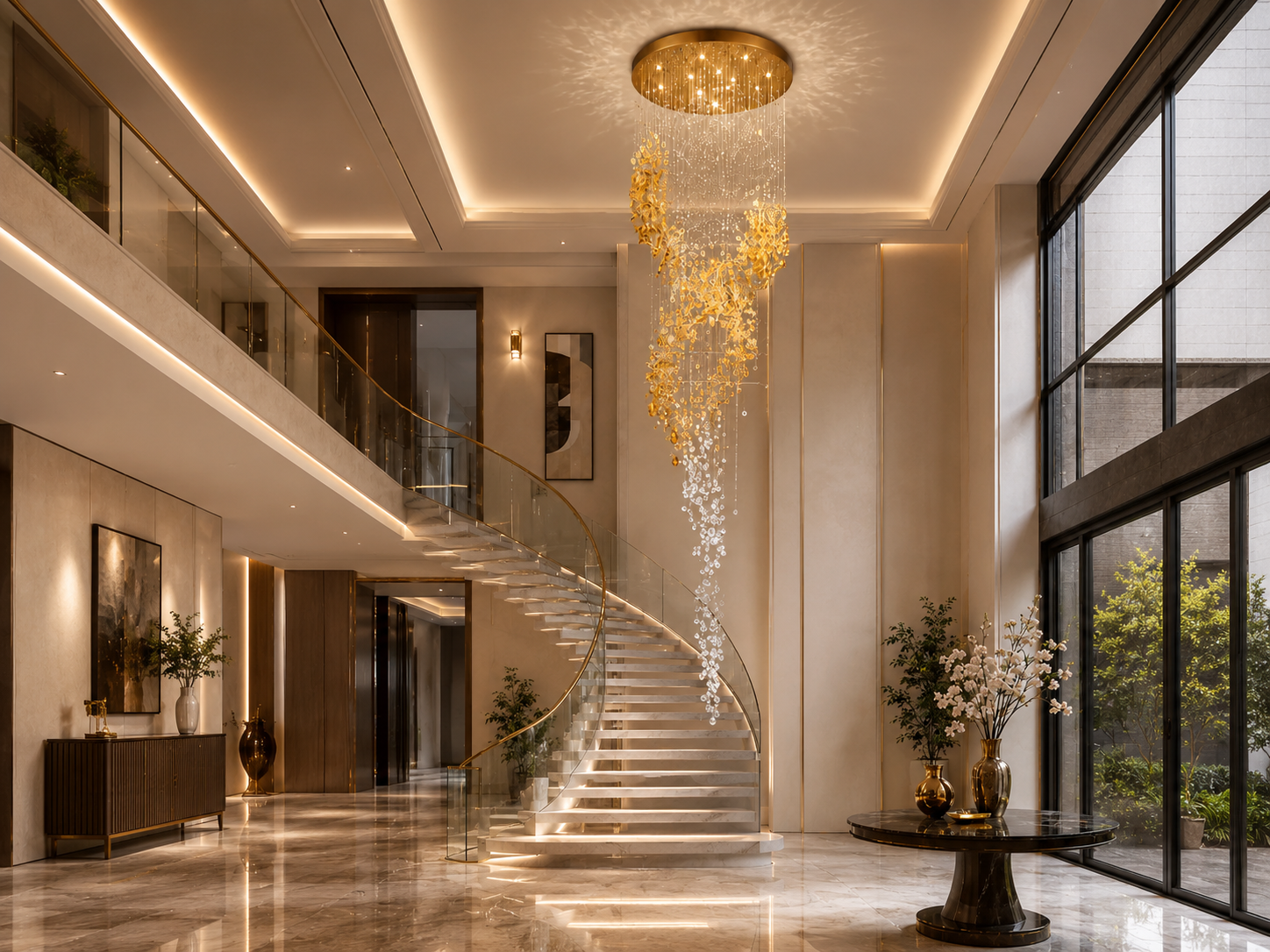

How Luxury Crystal Staircase Chandeliers Transform Double-Height Interiors
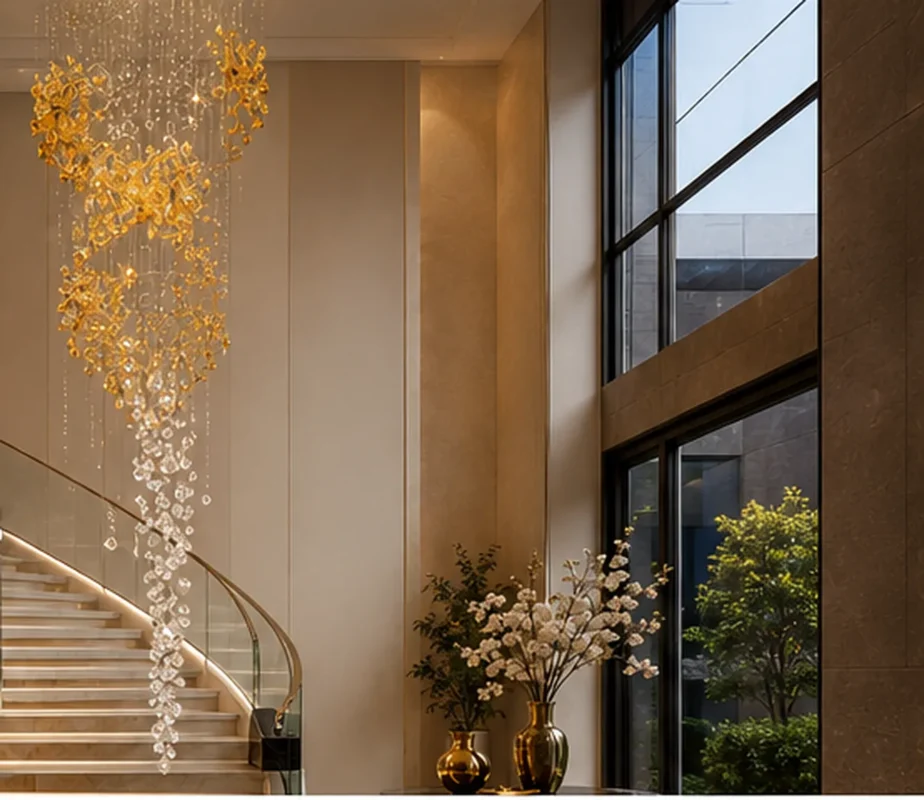
Why Staircase Chandeliers Deserve More Design Attention
A staircase is not simply a route between floors. In a double-height home, it becomes a moving viewpoint: people see the space from below, from the middle landing, and again from above. A long chandelier therefore behaves differently from a fixture above a dining table. Its scale, brightness, sparkle, suspension geometry, and reflections are experienced from several directions and at several eye levels.
This is why successful staircase lighting combines two goals. The chandelier provides identity, atmosphere, and vertical emphasis, while separate functional lighting makes the treads and landings easy to read. The Illuminating Engineering Society (IES) specifically notes that stair lighting should support visibility of the entire transition between levels and that glare and fixture placement need careful consideration. Decorative light should enhance the space, not be the only source responsible for safe movement.
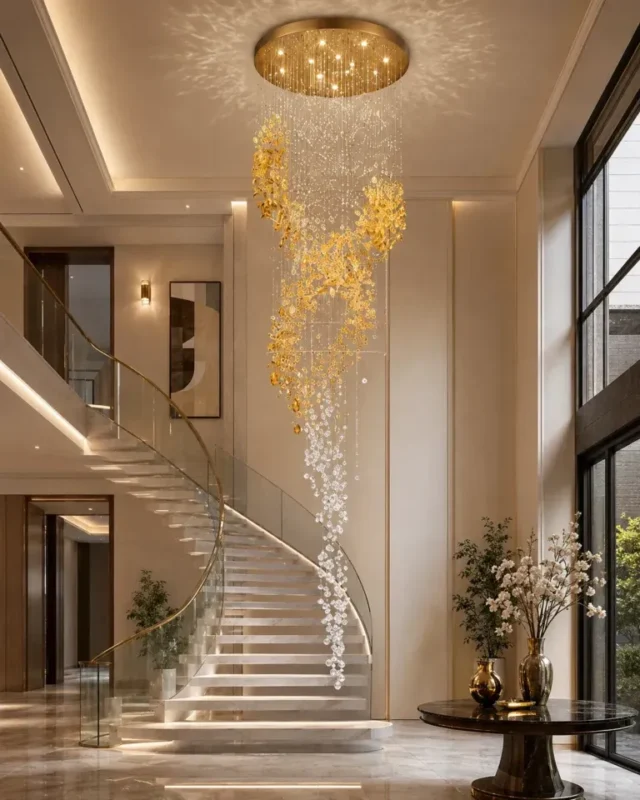
The key design principle: layer the light
A chandelier can create beautiful ambient and accent light, but staircase safety benefits from a second layer such as step lights, wall lights, recessed downlights, or concealed linear lighting. Layering reduces the need to drive the chandelier at maximum brightness and helps control contrast between the fixture, walls, landings, and stair treads.
1. The Science Behind Sparkle, Comfort, and Perceived Depth
Crystal chandeliers feel visually rich because faceted glass redirects and refracts light into many small highlights. This produces sparkle and depth, but the same visual effect can become uncomfortable when bright points sit directly in the line of sight. Glare is influenced by both the luminance of a source and the contrast between that source and its surroundings. In practical terms, a very bright chandelier against a dark landing can feel harsher than the same fixture in a softly illuminated room.
For tall stairwells, this makes background illumination important. Cove lighting, wall washing, or gentle step lighting raises the visual adaptation level of the space, so the chandelier reads as a luminous sculpture rather than a cluster of isolated bright points.
GLARE
Reduce exposed high-brightness points at landing eye level.
CONTRAST
Use soft ambient light so the chandelier is not the only bright object.
CONTROL
Dimming lets decorative sparkle change with time of day and activity.
Color temperature matters, too
For residential evening use, warm white light around 2700–3000K is commonly chosen because it visually complements brass, warm stone, timber, and low-light hospitality environments. A neutral 4000K option can feel cleaner and more architectural, especially in contemporary interiors with pale stone and large windows. Cooler 6000K light appears much crisper and is generally better treated as a specific aesthetic choice rather than the default for an intimate residential foyer.
Color rendering also affects material quality
High color-rendering light helps brass finishes, wood, art, flowers, and skin tones retain a more natural appearance. For premium residential lighting, a high-CRI source is especially useful when the chandelier is part of a visually detailed interior rather than a purely decorative object viewed from afar.
2. Product Focus: Luxury Brass Crystal Staircase Chandelier – Cascade Light
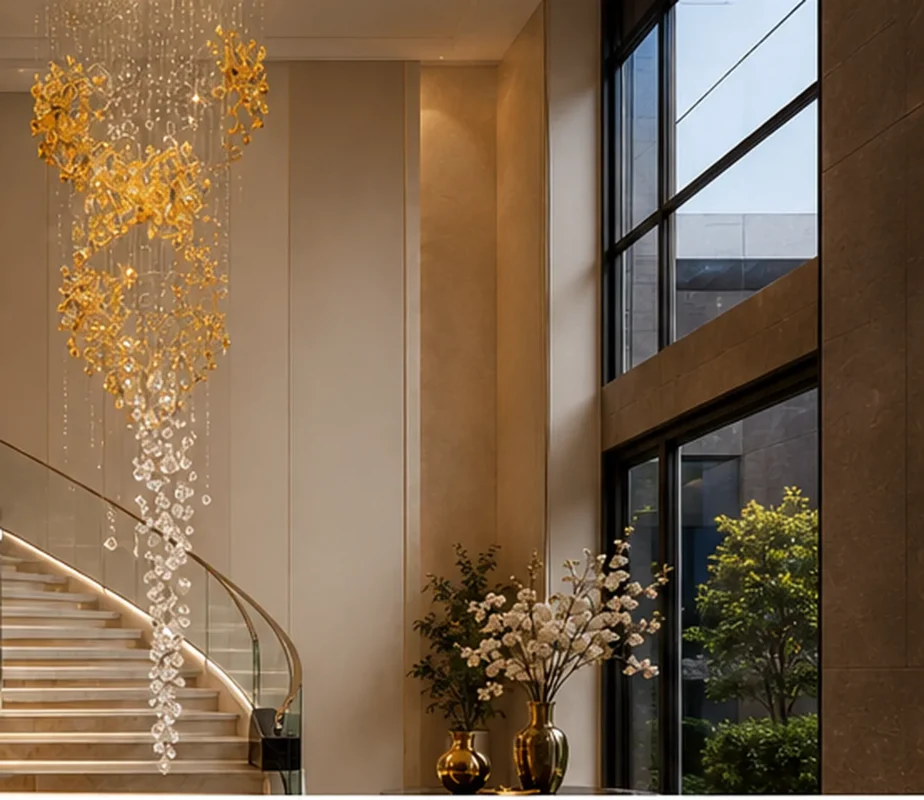
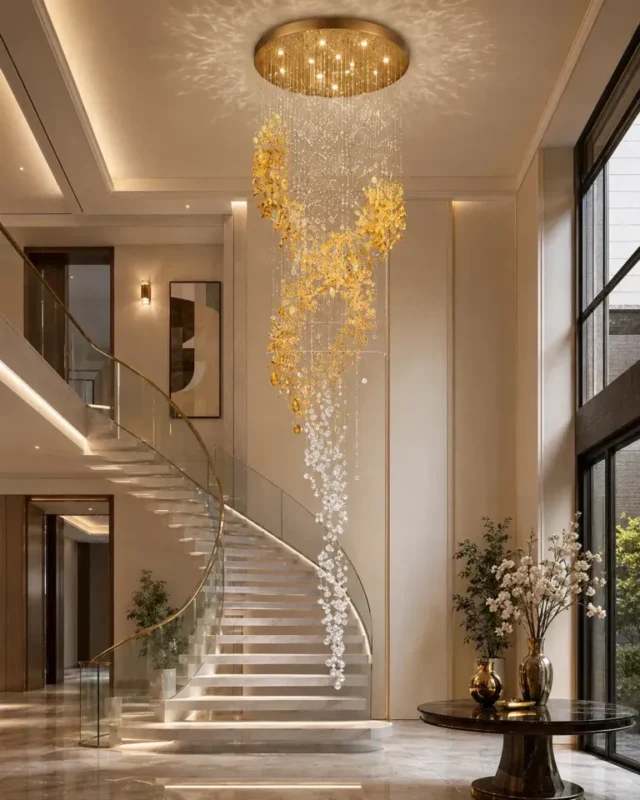
This chandelier is defined by an asymmetrical, organic cascade. Golden crystal clusters appear to sweep around the central drop, while clear crystal strands continue downward to create a gradual visual transition rather than an abrupt ending. The effect is especially appropriate when the architecture already contains curves, sweeping stair geometry, or strong vertical glazing.
Why it works in a staircase void
- The long vertical profile visually connects the lower foyer with the upper landing.
- The clustered gold elements add weight near the upper and middle portions, preventing the fixture from appearing too thin in a large void.
- Clear lower crystals keep the bottom of the installation visually lighter, which can preserve openness near the stair circulation zone.
- Warm metallic tones pair naturally with bronze handrails, beige stone, warm oak, cream plaster, and softly lit wall panels.
Best architectural pairings
Use this style in curved or helical staircases, double-height entrance halls, warm contemporary villas, boutique hotel foyers, and interiors where the chandelier needs to feel more like a custom art installation than a conventional ceiling fixture. The design is particularly effective when viewed against a relatively quiet wall surface, because the crystal silhouette remains legible instead of competing with heavy patterns.
3. Product Focus: Luxury Spiral Crystal Chandelier – Golden Cascade Pendant Light
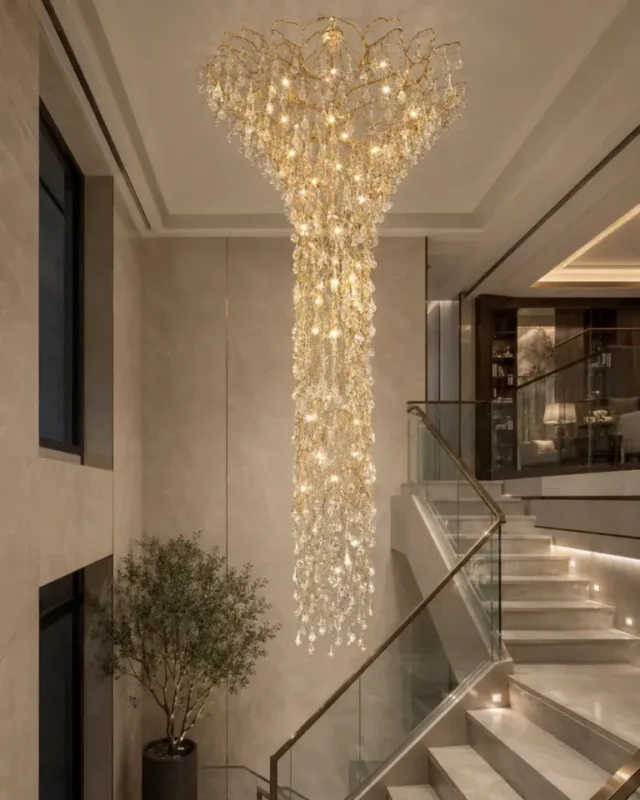
The spiral chandelier is more symmetrical and architectural. According to the Xunlu Lighting product page, it uses a gold metal structure with high-transparency K9 crystal, integrated LED lighting, and a standard large-scale configuration intended for villas, hotel lobbies, grand staircases, and other double-height interiors. The listed standard size is approximately 100 cm in diameter and 400 cm in height, with custom hanging length available.
The product page lists 3000K, 4000K, and 6000K color-temperature options, with 100W, 150W, and 200W power variants and an approximate 8,000–15,000 lumen range depending on configuration. Because this is a very high-output decorative fixture, dimming and layered lighting are especially valuable in residential settings.
4. Which Chandelier Fits Which Interior?
| Design question | Brass Crystal Cascade | Spiral Crystal Cascade |
|---|---|---|
| Overall character | Organic, sculptural, asymmetric | Formal, architectural, rhythmic |
| Best staircase shape | Curved, sweeping, irregular voids | Straight, U-shaped, symmetrical or axial voids |
| Visual weight | Stronger clustered emphasis in the upper/middle zone | More continuous vertical density |
| Interior palette | Warm stone, bronze, cream, wood | Modern marble, glass, polished metal, luxury neutrals |
| Best effect | Artistic movement and natural flow | Grand scale, symmetry, and dramatic sparkle |
| Planning priority | Keep organic clusters clear of rail and landing sightlines | Confirm diameter, total drop, service access, and viewing angles |
5. How to Size a Chandelier for a Double-Height Staircase
Do not select a staircase chandelier from ceiling height alone. The correct proportion comes from the complete three-dimensional void: ceiling height, stair width, landing position, rail geometry, nearby windows, and the locations from which people will see the fixture. A fixture that looks perfect from the ground floor may sit directly in the line of sight from the upper landing.
- Check the fixture from at least three viewpoints: lower foyer, mid-flight or landing, and upper floor.
- Keep the densest crystal or brightest LED zones away from normal eye level at the landing whenever possible.
- Preserve a comfortable circulation envelope so no part of the chandelier feels close to the stair handrail or walking path.
- Coordinate the ceiling canopy with structural support before finalizing the drop length, especially for heavy crystal fixtures.
- Plan service access: cleaning, cable adjustment, driver access, and crystal replacement should be possible without dismantling the staircase area.
6. Why the Chandelier Should Not Be the Only Stair Light
Interior stairs need clear tread edges, landings, and transitions. IES guidance emphasizes that lighting should work with the adjacent landings and vertical surfaces, and that illuminating the treads can be as important as lighting the upper landing. A decorative chandelier can contribute to general illumination, but a robust scheme adds low-glare functional light closer to the walking surface.
A practical layered scheme can use the chandelier as the decorative layer, recessed or wall-mounted lighting as the ambient layer, and step or under-handrail lighting as the navigation layer. This arrangement improves nighttime comfort and also allows the chandelier to be dimmed for atmosphere without making the stairs difficult to read.
7. A Designer’s Lighting Recipe for a Luxury Stair Hall
| Layer 1 – Statement | Cascade or spiral crystal chandelier, dimmable, selected for form and architectural scale. |
| Layer 2 – Ambient | Soft cove, wall wash, or recessed lighting that reduces high contrast around the chandelier. |
| Layer 3 – Navigation | Low-level step, riser, handrail, or wall lighting that keeps tread edges readable. |
| Color strategy | 2700–3000K for warm luxury; around 4000K for a cleaner contemporary effect when desired. |
| Control strategy | Separate circuits or scenes so decorative, ambient, and navigation lighting can be adjusted independently. |
8. Installation and Specification Checklist
- Verify ceiling structure and fixing method for the finished fixture weight.
- Confirm total drop and the lowest crystal position before production.
- Confirm the chandelier envelope from the upper landing and handrail line, not only from the floor below.
- Choose a compatible dimming system if dimming is required; check driver and control compatibility in advance.
- Coordinate 110–120V or 220–240V configuration with the destination market and installer.
- Use qualified electrical installation and follow local electrical and building requirements.
- Provide a cleaning and maintenance plan for long crystal drops, particularly above open stairs.
Conclusion: Treat the Staircase as a Vertical Room
The most successful staircase chandeliers do more than fill an empty ceiling. They organize a tall volume, create an emotional focal point, and make movement through the home feel intentional. The Luxury Brass Crystal Staircase Chandelier – Cascade Light brings an organic, flowing character, while the Luxury Spiral Crystal Chandelier – Golden Cascade Pendant Light creates a more formal architectural rhythm. Both can be powerful choices when scale, sightlines, glare, functional stair lighting, and controls are planned together.
For homeowners and designers, the goal is not simply to choose the brightest or longest fixture. It is to create a balanced vertical composition: a chandelier that looks beautiful from every level, supports the interior materials, and works as part of a layered lighting system.