

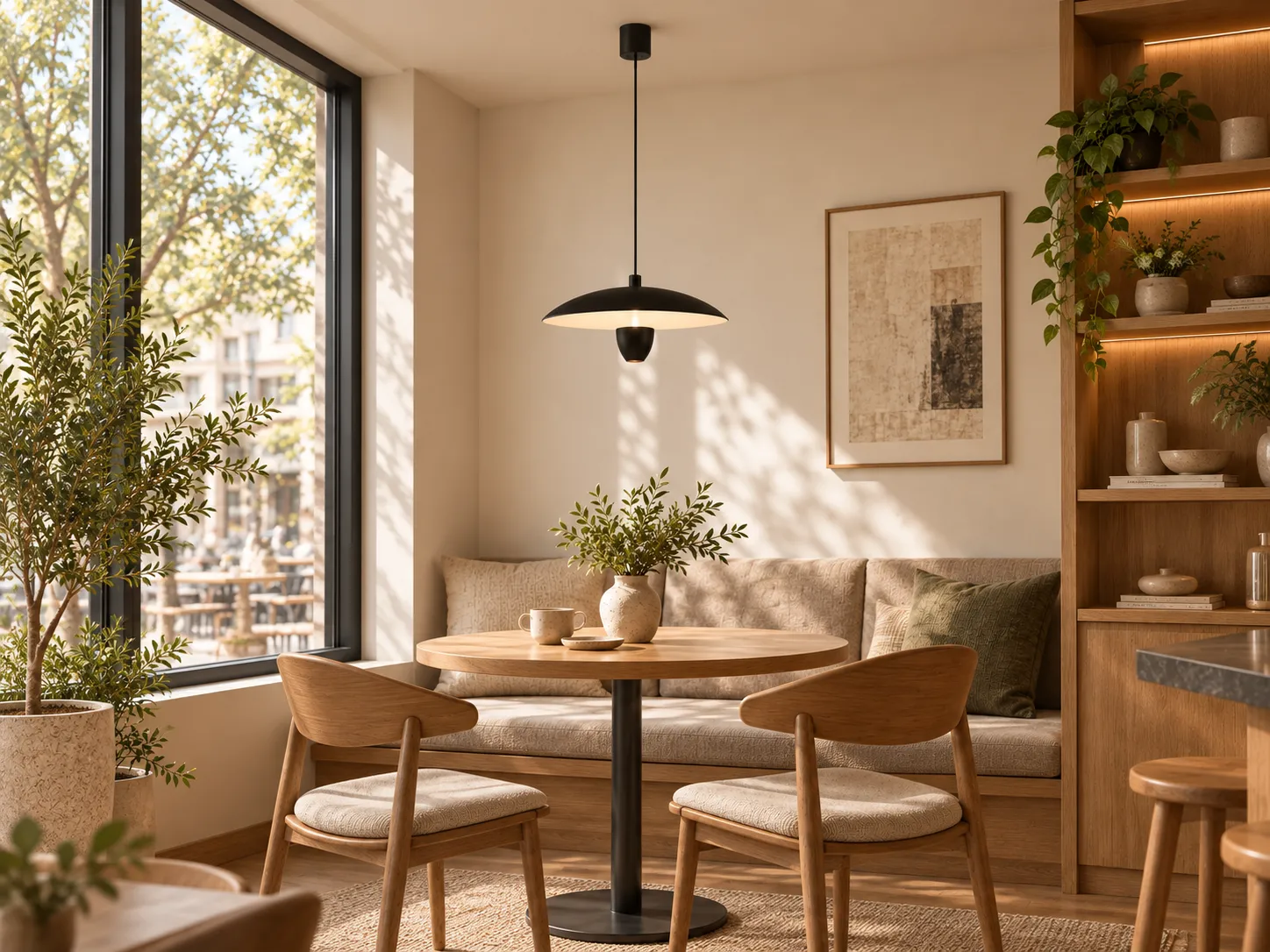

Design, visual comfort, color temperature, and practical placement for modern homes
Good decorative lighting controls brightness, defines a visual center, and supports the way a room changes through the day. This UFO pendant combines a slim black metal shade, acrylic diffuser, and switchable 3000K / 4000K / 6000K LED light in a compact architectural form.
Why this pendant works in contemporary interiors
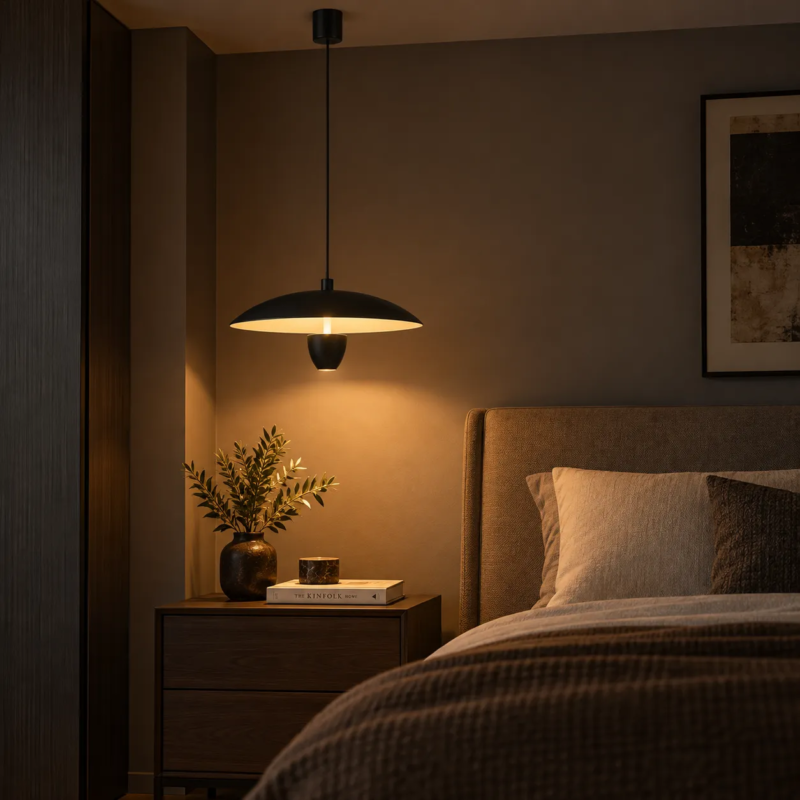
Minimalism in lighting is not the absence of character; it is the deliberate reduction of visual noise. A shallow disc silhouette creates a clear horizontal line in the room while keeping the fixture visually light. In this pendant, the matte black shade acts almost like a graphic element against pale walls, timber cabinetry, stone surfaces, and textured fabrics. The result is especially effective in interiors that rely on warm neutrals and natural materials rather than heavy ornament.
The form also has a practical advantage. By placing the light source below a broad shade and using an acrylic diffuser, the fixture directs attention downward toward the table, island, or bedside zone while softening the appearance of the LED source. A diffuser increases the apparent emitting area, which generally reduces harsh point-source contrast; however, exact glare performance depends on luminance, viewing angle, installation height, and photometric design. For that reason, comfort should be judged in the actual room rather than from wattage alone.
Product snapshot
| Shade diameter | Ø34.5 cm / 13.6 in |
| Material | Metal shade + acrylic diffuser |
| Finish | Sand-black / matte textured black |
| Light source | Integrated LED, 22W |
| Light output | Approx. 1600 lm |
| Color temperature | 3-CCT: 3000K / 4000K / 6000K |
| Suspension cord | 180 cm / 70.9 in, adjustable |
| Voltage | 110–240V |
| Net weight | Approx. 1.6 kg |
| Listed package size | Approx. 42 × 42 × 22 cm |
Three color temperatures, three different moods
Correlated color temperature (CCT) describes the visual appearance of white light. Lower Kelvin values look warmer; higher values look cooler. The U.S. Department of Energy recommends evaluating light by lumens and light appearance rather than relying on wattage alone, and notes that modern LEDs are available across a broad range of color appearances.
3000K — warm and relaxed — A warm-white setting is usually the most natural fit for dining, bedrooms, lounges, and evening use. It visually reinforces timber, beige stone, warm textiles, and food presentation while helping a space feel less clinical.
4000K — neutral and versatile — Neutral white provides a cleaner, more alert visual character without the distinctly cool cast of daylight-like settings. It is useful for breakfast, casual work at a kitchen island, reading, and mixed-use open-plan rooms.
6000K — crisp and high-contrast — A cooler setting can make white surfaces appear sharper and can suit task-focused moments. In residential interiors it is often best used selectively, because very cool light can feel visually intense in otherwise warm, low-light rooms.
The important point is that CCT changes appearance, not just “brightness.” A room can feel dramatically different at the same lumen output when the spectral appearance shifts from warm to cool. The 3-CCT function therefore gives one pendant more flexibility across different times of day and activities.
Placement: where the UFO silhouette is most effective
Because the shade is compact rather than oversized, this pendant works best when it is used to define a local activity zone. The 180 cm adjustable suspension makes it adaptable to standard ceilings as well as taller rooms, but the final hanging height should be set according to sightlines, ceiling height, table dimensions, and how people move through the space.
Over a dining table
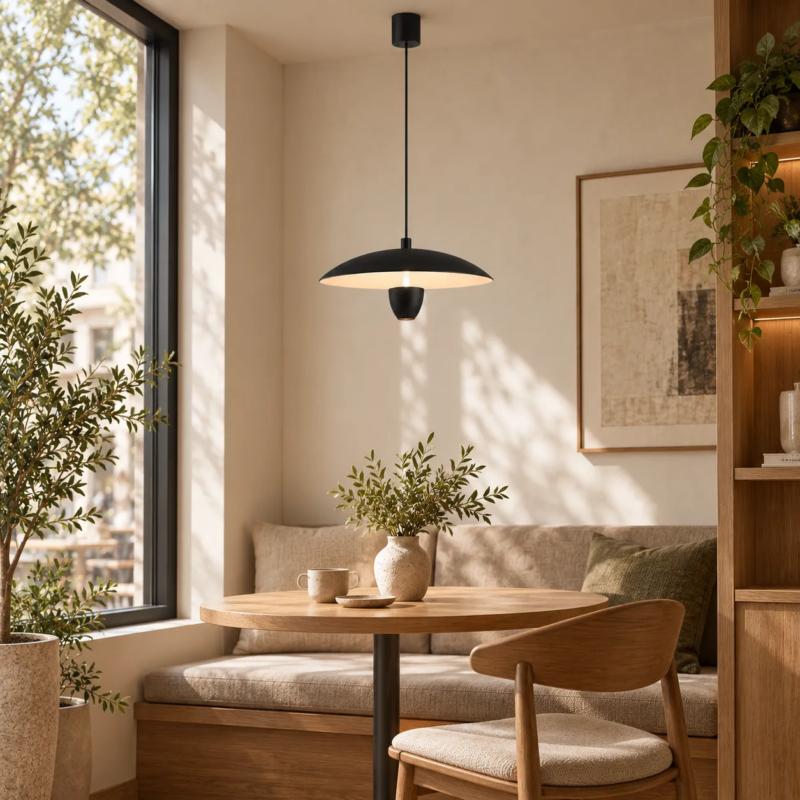
Center the pendant on the table rather than on the room whenever those axes differ. A lower position creates intimacy and keeps the shade visually connected to the tabletop; a higher position opens the sightline across the room. For a long table, repeating two or three fixtures can look more intentional than forcing one small pendant to cover the entire surface.
Above a kitchen island
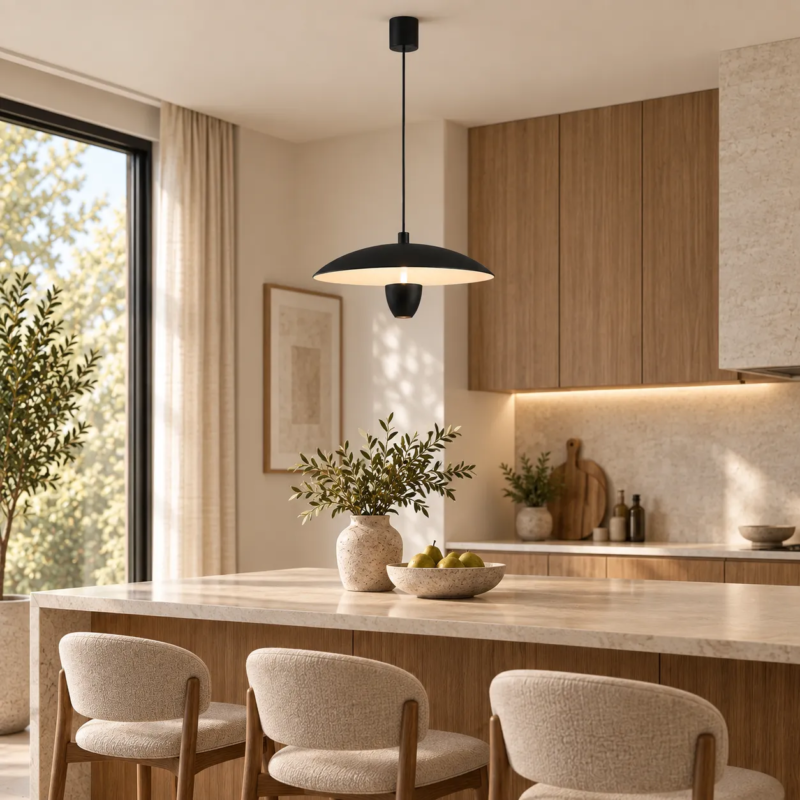
Use the pendant as a layer of task and ambient light rather than the only source in the kitchen. Under-cabinet lighting, ceiling ambient light, and daylight all affect how much illumination is actually needed on the worktop. The U.S. Department of Energy emphasizes matching light output and distribution to the application and avoiding over-lighting, which wastes energy and can reduce comfort.
Beside the bed or in a reading corner
A suspended fixture can free the bedside surface and give a compact room a cleaner composition. In this context, 3000K is usually the most visually coherent choice. Position the shade so the bright diffuser is not directly in the normal lying or seated line of sight.
In cafés and hospitality spaces
The simple profile is easy to repeat rhythmically over counters, banquettes, or small tables. Repetition also makes the lighting layout feel architectural rather than decorative. In commercial use, verify local electrical requirements, mounting conditions, and any project-specific photometric or code criteria before specifying quantities.
Lumens, watts, and what 1600 lm means in practice
Watts measure electrical input; lumens measure visible light output. That distinction matters with LEDs because different products can deliver very different amounts of light from the same wattage. Based on the manufacturer’s listed values, this pendant produces approximately 1600 lumens from a 22W integrated LED module.
A single lumen figure still does not tell you how bright a tabletop will be. Illuminance at the work surface depends on mounting height, beam distribution, shade geometry, nearby reflectances, daylight, and other fixtures in the room. This is why professional lighting design uses photometric data and illuminance calculations rather than lumen output alone. For residential styling, the practical approach is to use this fixture as one layer in a broader lighting scheme: pendant for the focal zone, indirect or ceiling light for general illumination, and localized task lighting where precision is needed.
Why matte black and an acrylic diffuser make sense
A matte black surface suppresses specular reflections and gives the fixture a crisp outline, which is one reason it pairs well with light-colored walls and natural timber. The acrylic diffuser performs a different job: it spreads the LED light across a larger visible surface. This can make the source appear softer and more uniform than an exposed LED point or strip.
There is always a design trade-off. Diffusion and optical control can reduce raw luminous efficacy compared with an exposed source, but they can improve visual integration and comfort. The U.S. Department of Energy notes that complete luminaire efficacy is influenced not only by the LED package, but also by the driver, thermal system, optics, and fixture design. In other words, the useful question is not simply “How many lumens per watt?” but “How well does the luminaire deliver the right light to the intended place?”
Interior styles that pair naturally with this pendant
The fixture is visually strongest in spaces where form, texture, and contrast are carefully edited. It works particularly well with:
- warm oak, walnut, ash, or veneer cabinetry
- travertine, limestone, terrazzo, and pale quartz surfaces
- linen curtains, bouclé upholstery, wool, and other soft neutral textiles
- Japandi, Nordic, contemporary, quiet-luxury, and restrained wabi-sabi palettes
- black window frames, dark hardware, or slim metal furniture details that visually echo the shade
A simple scene-by-scene setup guide
| Space | Suggested CCT | Design role | Practical note |
|---|---|---|---|
| Dining table | 3000K | Warm focal light | Keep sightlines clear across the table |
| Kitchen island | 3000K / 4000K | Task + decorative layer | Combine with ambient and under-cabinet light |
| Bedroom bedside | 3000K | Soft evening accent | Avoid direct view of the diffuser from the pillow |
| Breakfast nook | 3000K / 4000K | Flexible day-to-night light | Let daylight do part of the work |
| Café / bar | 3000K / 4000K | Repeatable architectural rhythm | Confirm local code and project lighting targets |
Installation and long-term use
The pendant is designed for 110–240V global use and has an integrated LED module. Installation should be carried out by a qualified electrician in accordance with local electrical codes and ceiling conditions. Before installation, confirm that the junction box or mounting point is suitable for the fixture and that the suspension length is adjusted before final tightening.
For cleaning, switch the power off and allow the fixture to cool. Dust the metal shade with a soft dry or slightly damp microfiber cloth and avoid abrasive cleaners that could alter the matte finish. Use a non-abrasive cloth on the acrylic diffuser to reduce scratching. Because the light source is integrated, serviceability depends on the luminaire design; keep purchase and product information available for future maintenance support.
A small fixture with an architectural job
The Modern Minimalist UFO Pendant Light succeeds because its visual idea is simple: a thin dark disc, a soft illuminated underside, and a vertical line connecting the light to the ceiling. That simplicity makes it unusually adaptable. It can feel intimate at a bedside, precise above a kitchen island, or rhythmic when repeated across a hospitality space.
Its 3-CCT LED system also supports a broader principle of good residential lighting: the right light changes with the activity. Warm light can make evening spaces feel settled; neutral light can support everyday tasks; cooler light can provide a crisper appearance when needed. Used as part of a layered lighting plan, the pendant becomes more than a decorative object—it becomes a tool for organizing atmosphere, function, and visual focus.
Modern Minimalist UFO Pendant Light—Click to View Product