

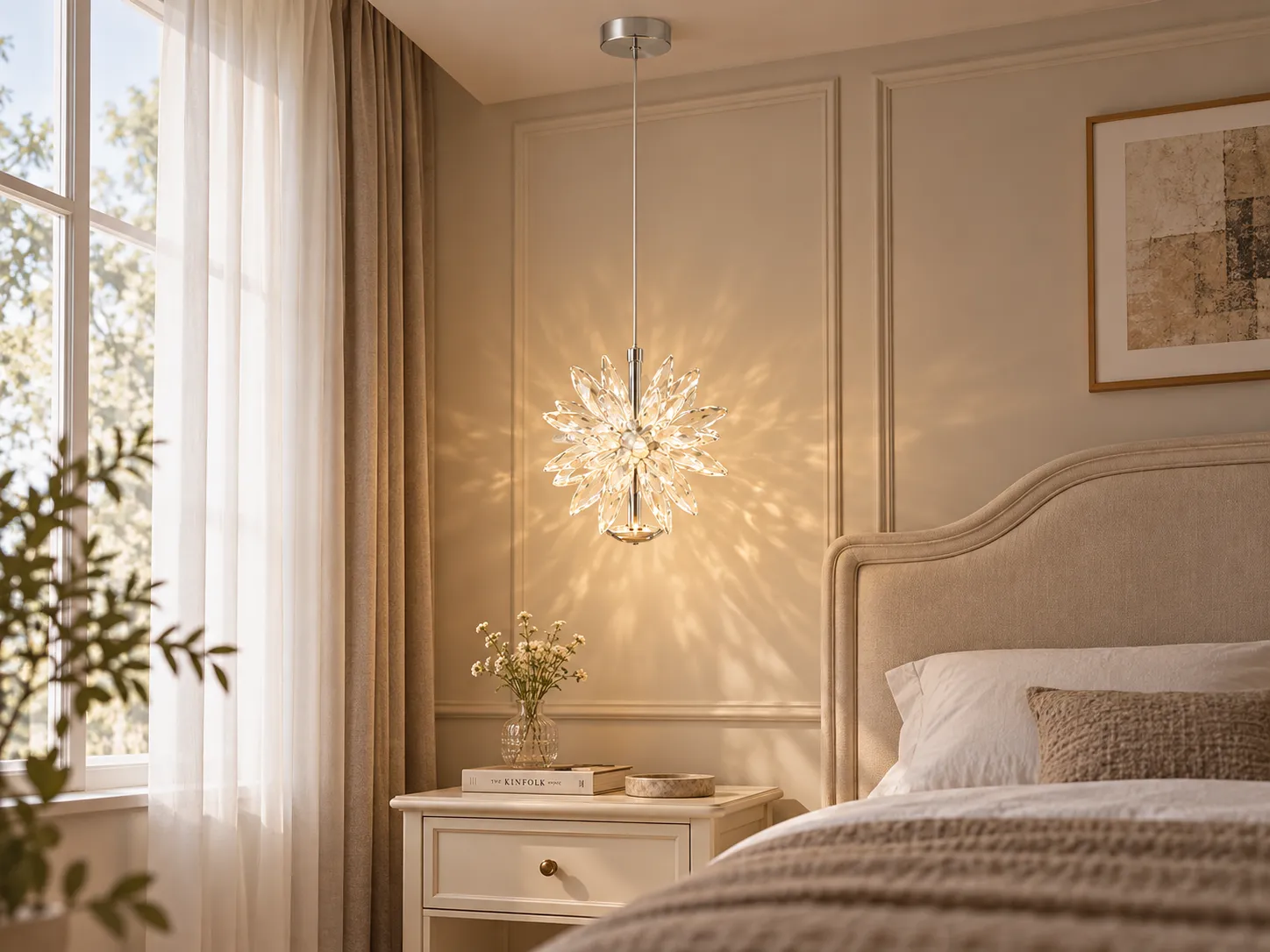

How Faceted Crystal, Layered Light and a Compact Floral Form Can Elevate Modern Interiors
A practical design guide for bedrooms, dining areas, kitchen islands, entryways and boutique hospitality spaces
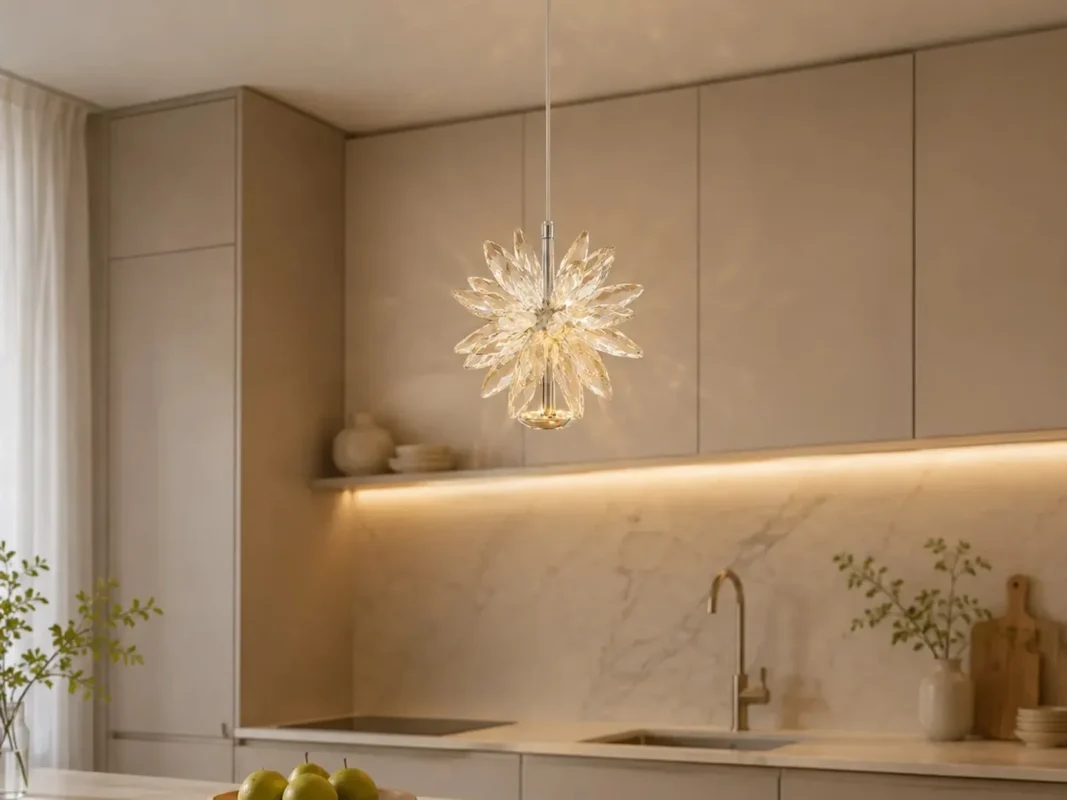
Light as Jewelry for the Interior
Small pendant lights are often treated as purely functional fixtures, but the right design can behave more like architectural jewelry. The Crystal Blossom LED Pendant Light uses a flower-inspired cluster of clear, multi-faceted K9 crystal petals around a compact integrated LED source. Instead of relying on scale alone, it creates presence through refraction, sparkle and patterned reflections.
That makes the fixture especially useful in spaces where a full chandelier would feel oversized: beside a bed, over a breakfast table, in a reading corner, above a kitchen island, in an entryway, or as a repeated series in a boutique hotel or restaurant. The polished chrome structure keeps the silhouette visually light, while the crystal adds depth without introducing a heavy opaque mass.
The product is specified at 5 W, approximately 450–550 lumens, AC 110–240 V, with selectable 3000 K, 4000 K and 6000 K color temperatures. Its compact body measures about 17 cm in diameter by 18 cm high, making it more of an accent-and-task pendant than a room-filling primary light source.
Why the Crystal Surface Changes the Experience of Light
Clear crystal does not simply transmit light. Each polished facet changes the direction of incident rays through reflection and refraction, so a small luminous source can create many bright highlights and secondary reflections. In a room, this produces the familiar sparkle associated with cut crystal and can generate subtle light patterns on nearby walls and ceilings.
This is why the fixture performs differently from a frosted-glass globe. Frosted diffusers deliberately scatter light to reduce point brightness and soften shadows. Faceted crystal preserves more directional sparkle. That gives the blossom pendant decorative intensity, but it also means placement matters: it is best used where its highlights are desirable and where the LED source is not directly in the normal line of sight for long periods.
Understanding Lumens, Watts and LED Efficiency
Lighting design should separate electrical power from visible light output. Watts describe energy consumption; lumens describe the quantity of visible light emitted. The U.S. Department of Energy explains that luminous efficacy is expressed in lumens per watt and is a key measure of lighting efficiency. LEDs can be highly efficient because they convert a greater share of electrical energy into useful light than legacy incandescent sources, while also allowing compact optical control.
For this pendant, a rated output of roughly 450–550 lumens from a 5 W integrated LED corresponds to about 90–110 lm/W on a simple output-to-power basis. In practical interiors, however, perceived brightness also depends on crystal optics, room surface reflectance, mounting height and surrounding daylight. Because the fixture is compact, it should be treated as layered light rather than the sole source for a large room.
Product Specifications at a Glance
| Specification | Product Detail |
|---|---|
| Materials | K9 crystal + metal; aluminum internal structure |
| Finish | Clear crystal with polished chrome / silver metal |
| Light source | Integrated 5 W LED |
| Output | Approx. 450–550 lm |
| CCT options | 3000 K / 4000 K / 6000 K |
| Voltage | AC 110–240 V |
| Fixture size | Ø17 × H18 cm / Ø6.69 × H7.09 in |
| Canopy | Ø10 × H2.5 cm / Ø3.94 × H0.98 in |
| Weight | Approx. 1.2 kg / 2.65 lb |
Choosing the Right Color Temperature
Correlated color temperature (CCT) describes the apparent warm-to-cool character of white light in kelvin. U.S. Department of Energy guidance describes lower CCTs as warmer/yellower and higher CCTs as cooler/bluer, and identifies 3000 K as a warm, pleasing range commonly used in homes, lobbies and restaurants.
3000 K — warm white: Best for bedrooms, dining spaces, lounges and evening hospitality settings. It reinforces warm wood, beige stone, brass, cream textiles and the golden reflections created by clear crystal.
4000 K — neutral white: A balanced choice for kitchens, dressing areas, entryways and mixed-use interiors where clearer task visibility is useful without moving fully into a cool daylight appearance.
6000 K — cool white: Produces a crisp, high-CCT appearance that can suit display, showroom or certain contemporary commercial settings. In relaxed residential rooms it may feel more clinical, especially at night.
CCT alone does not determine comfort. The Illuminating Engineering Society has noted that brightness level and color temperature interact, and that light level can be more influential than CCT in how a space is perceived. A beautiful warm source can still feel harsh if it is placed directly in view or used at an excessive light level.
Where This Pendant Works Best
Bedroom bedside pendant — Use one pendant as an alternative to a table lamp when the bedside surface is small. Position it so the crystal is visible without keeping the LED source in the direct line of sight.
Kitchen island or breakfast bar — A single pendant can mark a compact prep or breakfast zone; two or three repeated fixtures create stronger visual rhythm over a longer island.
Dining nook — The 450–550 lm output makes the fixture useful for a small table when combined with ambient ceiling or wall lighting.
Entryway or hallway — In a small foyer, crystal reflections can create a memorable arrival moment. Ensure sufficient head clearance.
Boutique hospitality — Repeated pendants can identify tables, counters or guest-room zones. Consistent mounting height and CCT keep the installation visually coherent.
Layering Light: Do Not Ask One Pendant to Do Everything
Good residential lighting works best in layers: ambient light for general visibility, task light for activities, and accent or decorative light for visual hierarchy. A compact crystal pendant is strongest in the latter two roles. In a bedroom, combine it with soft ambient ceiling or cove lighting. In a kitchen, pair it with under-cabinet task lighting. In a dining nook, let the pendant create intimacy while perimeter lighting prevents the rest of the room from falling into deep shadow.
This layered strategy also helps control contrast. Extremely bright decorative points surrounded by darkness can become visually tiring. Raising the background light level slightly reduces the apparent harshness of the brightest facets while preserving the crystal effect.
Proportion, Height and Spacing
Because the crystal body is only about 17 cm wide, it reads as a compact jewel rather than a broad chandelier. That scale makes it suitable for repeated installations. For a kitchen island or long counter, begin by dividing the usable illuminated length into equal zones and place pendants at the centers of those zones, then adjust for cabinet lines, seating positions and sight lines.
For dining applications, the pendant should be low enough to feel connected to the table but high enough to preserve clear sight lines and avoid glare. For circulation areas, prioritize head clearance. Always follow the installation instructions and local electrical requirements when adjusting cable length or mounting to different ceiling constructions.
Material and Maintenance Notes
K9 crystal is valued in decorative lighting for clarity and its ability to produce bright, faceted reflections. To preserve that effect, dust and fingerprints should be removed periodically with a soft lint-free cloth. Avoid abrasive pads or harsh chemicals that can scratch crystal surfaces or damage the polished metal finish. Clean only when the fixture is switched off and cool.
Integrated LED fixtures reduce the need for frequent lamp replacement, but they should still have adequate airflow around the driver and LED module. Excessive heat can shorten LED system life, so the fixture should not be enclosed in a way that traps heat unless the product is specifically designed for that condition.
Design Pairings That Make the Crystal Look Better
- Warm oak, walnut and cream stone: natural textures keep the crystal from feeling overly formal.
- Soft beige, greige and plaster walls: matte backgrounds make moving reflections more visible.
- Chrome, nickel and polished silver accents: these echo the canopy and internal metal structure.
- Simple furniture silhouettes: a restrained room lets the floral pendant become the decorative hero.
- Layered textiles in bedrooms: linen, boucle and wool soften the harder optical sparkle of crystal.
Is It Bright Enough for the Room?
At approximately 450–550 lumens, one pendant is best understood as focused decorative light. It can feel visually bright because the crystal creates high-intensity highlights, but that does not mean it will deliver uniform illuminance across a large floor area. A large kitchen, living room or bedroom will normally need additional ambient and task lighting. For a small bedside zone, reading corner, entry niche or compact dining table, the output can be appropriate when supplemented by the room’s other light sources.
Final Takeaway
The Crystal Blossom LED Pendant Light succeeds because it uses optical detail rather than physical bulk. Its K9 crystal petals turn a compact LED source into a decorative field of highlights, while the small chrome structure keeps the overall composition light and contemporary. Used thoughtfully, it can add a refined focal point to a bedroom, dining nook, kitchen island or hospitality setting without overwhelming the architecture.
For the most comfortable result, treat it as one layer in a broader lighting plan, choose the CCT for the activity and time of day, and position the fixture so the crystal can sparkle without placing the LED source directly in the viewer’s line of sight.
Product Details
Product: Crystal Blossom LED Pendant Light | Luxury Crystal Fixture
Product page: View product on Xunlu Lighting
