

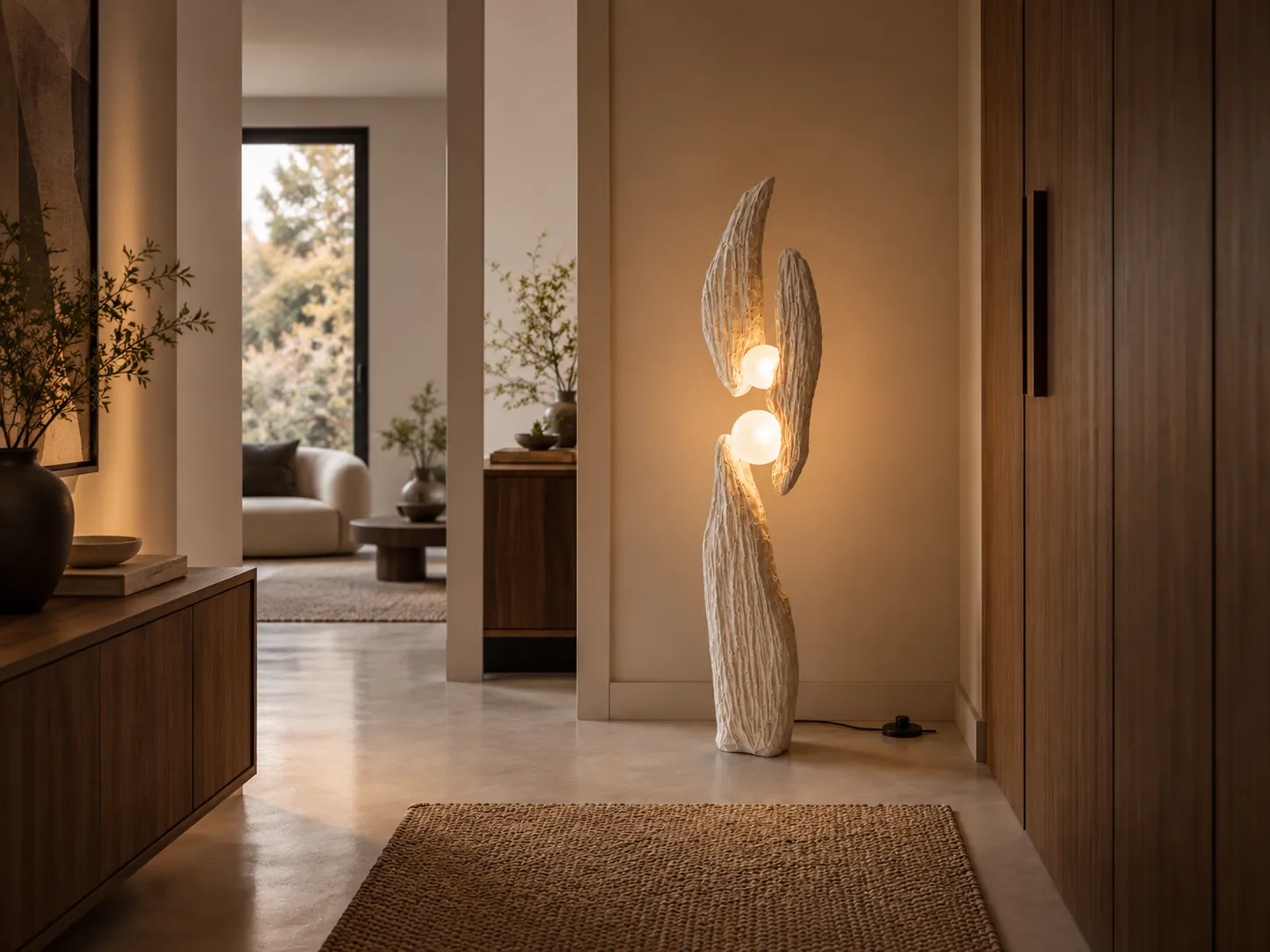

How a Cement Globe Floor Lamp Creates Warmth, Visual Depth, and Calm in Modern Interiors
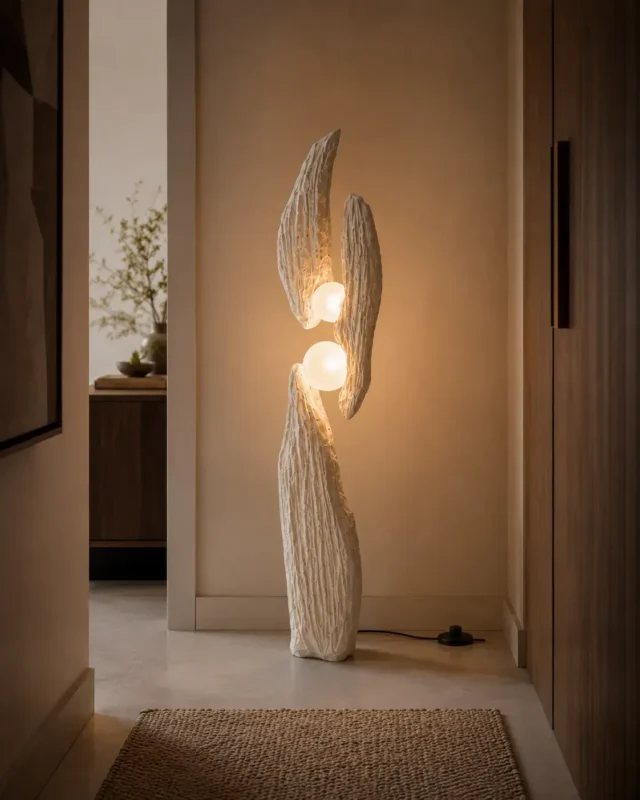
Why Sculptural Floor Lamps Matter
A floor lamp can do more than fill a dark corner. In a carefully designed room, it can become part of the architecture: a vertical focal point, a source of soft ambient light, and a material counterbalance to furniture, textiles, wood, stone, and plaster. The Sculptural Cement Globe Floor Lamp brings those roles together through an organic cement form and two opal glass globes.
Its irregular ivory surface has the visual weight of carved stone, while the rounded glowing globes soften that mass with diffuse light. The result is especially suited to modern organic, Wabi-Sabi, minimalist, Japandi-inspired, boutique-hotel, and gallery-like interiors.
1. The Material Story: Cement, Texture, and Visual Warmth
Cement is often associated with hard architecture, but a hand-textured cement composite can feel surprisingly warm when it is finished in a natural ivory or stone-beige tone. Texture matters because light does not strike a rough surface evenly: highlights catch raised areas while shadows settle into recesses. That small-scale contrast makes the lamp feel dimensional even when it is switched off.
In a room dominated by smooth cabinetry, flat walls, glass, or polished stone, the lamp can introduce tactile contrast without relying on bright color. This is useful in restrained interiors where material variation does more of the visual work than pattern.
2. Why Opal Globes Feel Softer Than Exposed Light Sources
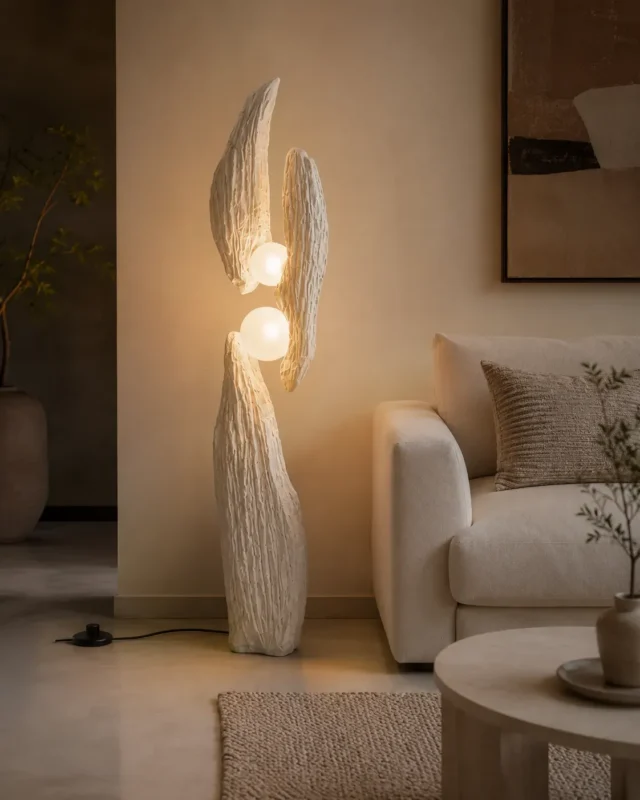
The two opal glass globes act as diffusers. Instead of presenting the eye with a small, intensely bright LED point, the luminous surface is spread across a larger area. This can reduce the impression of harshness and make the light more comfortable in peripheral view, especially in bedrooms and living rooms.
The Illuminating Engineering Society defines discomfort glare as glare that causes discomfort even when visibility is not necessarily reduced. In practical residential design, diffusing a source and avoiding direct view of very bright emitters are common strategies for improving visual comfort.
3. Light Color: Choosing 3000K, 4000K, or 6000K
This lamp is specified with three adjustable color-temperature options: 3000K warm white, 4000K neutral white, and 6000K cool white. Color temperature strongly influences how a room feels and how materials are perceived.
| CCT | Best use | Typical visual effect |
|---|---|---|
| 3000K | Bedrooms, living rooms, lounges | Warm, relaxed, flattering to wood and beige finishes |
| 4000K | Reading zones, multi-use rooms, display areas | Cleaner and more neutral |
| 6000K | Task-oriented or very crisp visual settings | Cooler, brighter-looking, higher visual contrast |
For most evening residential settings, 3000K is the safest starting point because it supports a warmer atmosphere. The U.S. Department of Energy describes 2700K–3000K light as warm or soft and commonly associated with homes, hospitality, and other relaxed spaces. A cooler setting can still be useful during cleaning, organizing, or task-focused periods.
4. Brightness and Layered Lighting
The product specification lists a total power of 12W and an approximate luminous output of 900–1100 lumens. That is enough to make a meaningful contribution to ambient light, but a sculptural floor lamp should usually be part of a layered scheme rather than expected to replace ceiling lighting.
A balanced room typically combines several roles: ambient lighting for general orientation, task lighting for reading or work, and accent lighting for walls, art, texture, or atmosphere. This lamp is strongest in the ambient-and-accent layer. Its soft glow can reduce the contrast between a bright ceiling fixture and dark corners, making the room feel more visually coherent.
5. Placement Ideas That Make the Sculpture Work
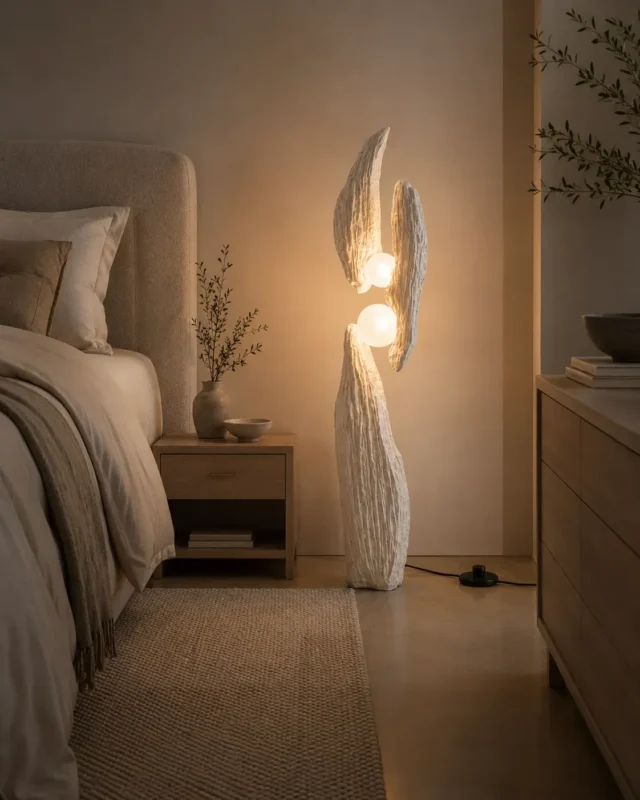
Because the lamp is approximately 170 cm (66.93 in) tall and only about 35 cm (13.78 in) wide, it has strong vertical presence without taking the footprint of a large lounge chair or side table. That makes it useful in spaces where you want visual height but limited floor occupation.
• Living-room corner: Place it beside a sofa or lounge chair, leaving enough breathing room around the silhouette so the sculptural outline remains visible.
• Bedroom: Use it near a dresser, reading chair, or opposite the bed. A 3000K setting helps maintain a softer evening atmosphere.
• Hallway or entrance: Treat it as a luminous art object. The vertical form can make an otherwise transitional space feel intentionally designed.
• Boutique hotel or villa: Use pairs only when the architecture calls for symmetry; otherwise a single lamp often feels more gallery-like and relaxed.
• Gallery or display zone: Position it near textured plaster, natural stone, timber panels, or quiet artwork so the lamp’s rough surface can interact with the surrounding materials.
6. Scale, Proportion, and Viewing Distance
The lamp’s narrow footprint makes it easy to place, but it still needs visual space around it. Crowding the form between furniture can make the composition feel accidental. A practical approach is to preserve a small zone of negative space around the upper sculptural elements so their asymmetry reads clearly.
From seated eye level, the two opal globes should remain comfortable to look toward. If the lamp is placed very close to a low chair, rotate or reposition it so the brightest areas are not directly in the normal line of sight.
7. Why LED Integration Makes Sense Here
LED technology is well suited to sculptural fixtures because it can deliver useful light from compact sources while producing less waste heat than traditional incandescent lighting. The U.S. Department of Energy notes that LED performance depends on the complete luminaire design, including the source, driver, thermal management, and optical system—not simply the LED chip itself.
For this lamp, the integrated LED format allows the light to remain visually subordinate to the sculptural cement and glass elements. There is no exposed decorative bulb competing with the form, which helps preserve the clean, gallery-like appearance.
Product Snapshot
| Specification | Details |
|---|---|
| Product type | Sculptural LED floor lamp |
| Main material | Water cement composite with internal metal structure |
| Shade | Opal glass |
| Finish | Handcrafted rough stone texture |
| Color | Natural ivory / warm stone beige |
| Size | 170 × 35 × 25 cm / 66.93 × 13.78 × 9.84 in |
| Net weight | Approx. 6.5 kg / 14.33 lb |
| Light source | Built-in LED, 2 globe lights |
| Power | 12W total |
| Output | Approx. 900–1100 lm |
| Color temperature | 3000K / 4000K / 6000K adjustable |
| Voltage | AC 100–240V, 50/60Hz |
| Installation | Freestanding, indoor use |
8. Styling Combinations That Work Especially Well
The lamp’s strongest combinations are based on material harmony rather than matching color. Try pairing it with oak or walnut, linen, bouclé, wool, travertine, limestone, limewash, matte plaster, blackened metal, and warm neutral rugs. These materials repeat the lamp’s natural and tactile language without making the room look overly coordinated.
If the room already contains many sculptural objects, keep nearby accessories simpler. One ceramic vessel, a low stack of books, or a restrained branch arrangement is often enough. The lamp itself already carries substantial form and texture.
9. Practical Care and Long-Term Use
• Dust the textured cement surface with a soft, dry brush or microfiber cloth; avoid saturating the surface with water.
• Clean the opal glass only when the lamp is switched off and cool, using a soft cloth and a mild glass-safe cleaner applied to the cloth rather than sprayed directly.
• Keep the foot switch and cord clear of walking paths where possible.
• For residential placement, avoid very damp areas unless the fixture is specifically rated for that environment.
Final Thoughts
The strongest feature of this floor lamp is not a single specification—it is the relationship between material, form, and light. The rough cement texture gives it architectural weight; the two opal globes add softness; and the adjustable LED light allows the atmosphere to shift from warm to neutral or cool as the room changes.
For interiors that value calm composition, tactile materials, and a small number of expressive objects, it can function as both a practical light source and a piece of illuminated sculpture.
Featured product: Sculptural Cement Globe Floor Lamp | Modern LED Lighting
