

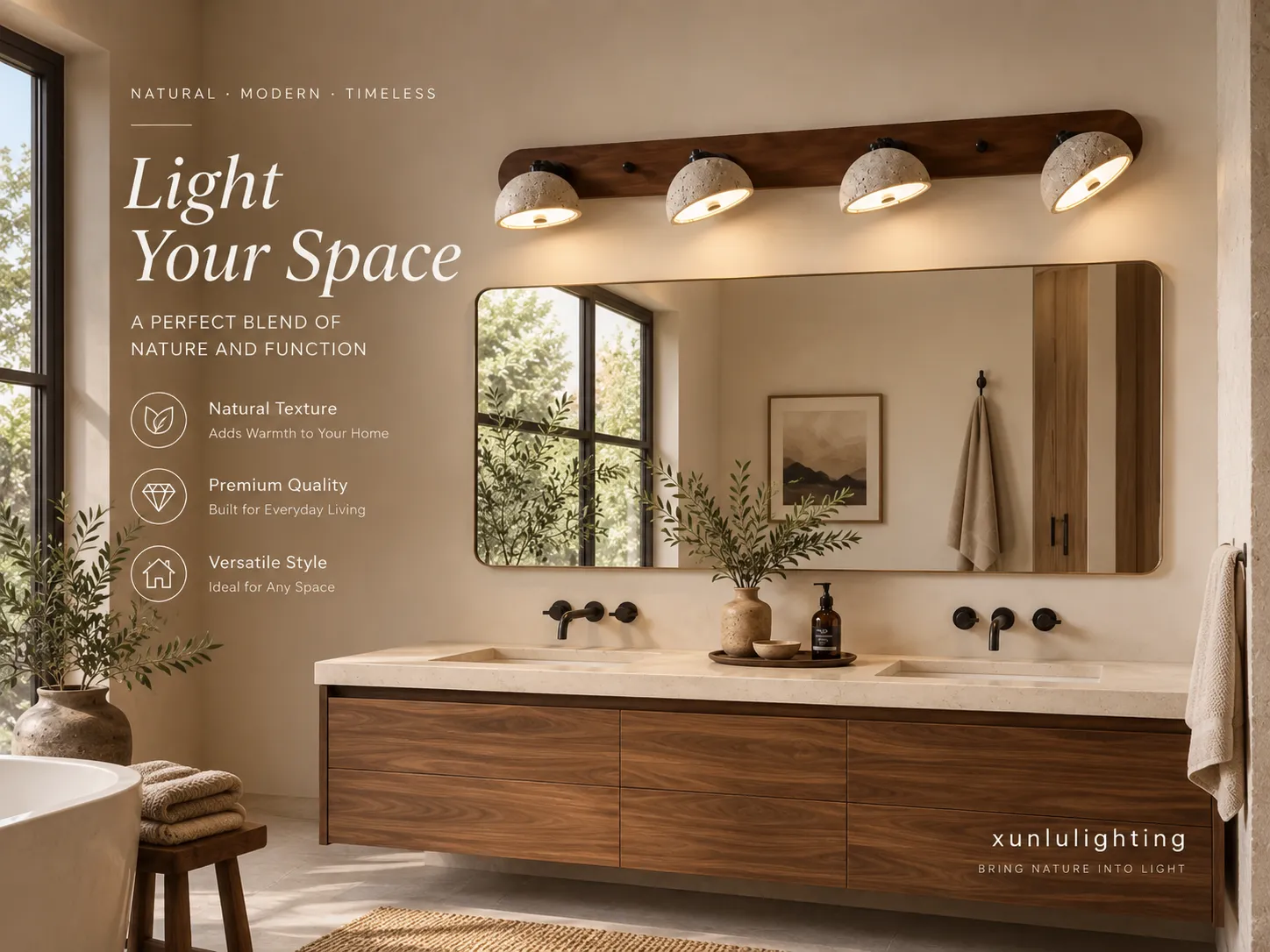

How an Adjustable Travertine Dome LED Vanity Light Brings Warmth, Direction, and Visual Comfort to Modern Bathrooms
A Vanity Light That Works Like Part of the Interior
Bathroom lighting is often treated as a purely functional decision, yet the mirror zone is one of the most visually demanding areas in a home. It is where people shave, apply makeup, style hair, and check color and detail at close range. That makes light quality, glare control, and direction especially important.
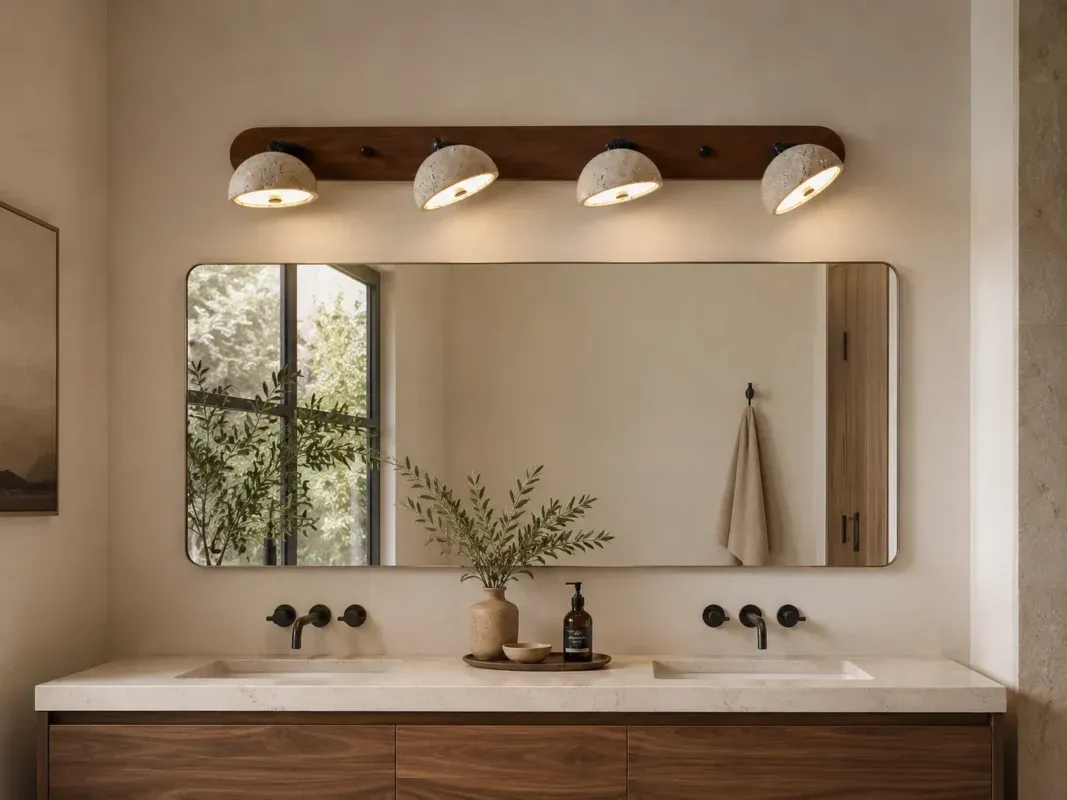
This adjustable vanity light combines three materials with distinct visual roles: natural yellow travertine for texture, walnut wood for warmth, and black metal hardware for contrast. Its adjustable dome heads allow the beam to be aimed more deliberately than a fixed decorative sconce, while integrated 2700K LED light keeps the atmosphere warm and residential.
1. Why Travertine and Walnut Feel Naturally Balanced
Travertine is a porous limestone with visible pits, tonal variation, and mineral character. Walnut, by contrast, has a linear grain and deep brown color. Pairing them creates a useful material balance: stone adds weight and texture, while wood adds visual warmth and softness.
In neutral bathrooms, these materials can prevent the space from feeling overly clinical. They work particularly well with warm white walls, cream stone counters, brushed black fixtures, oak cabinetry, microcement, limewash, and matte porcelain finishes.
2. Adjustable Heads Improve Lighting Flexibility
Fixed vanity lights send light in one predetermined direction. Adjustable heads allow you to aim each source toward the mirror surface, the countertop, or slightly outward into the room. This matters because glare and useful illumination depend heavily on geometry: the same lamp can feel comfortable or uncomfortable depending on its angle relative to the viewer.
The U.S. Department of Energy notes that glare is influenced by the brightness of the source and its position within the field of view. In practice, tilting a dome so the bright interior is not directly visible can improve comfort while still placing useful light where it is needed.
• For grooming: Aim the heads so light reaches the face through the mirror zone rather than pointing straight into the viewer’s eyes.
• For ambient use: Tilt the outer heads slightly outward to broaden the perceived pool of light.
• For artwork or texture: A modest downward angle can accent the travertine backsplash or wall texture without relying on additional accent fixtures.
3. 2700K Warm Light: Why It Works in Residential Bathrooms
The fixture uses integrated 2700K LED light. Correlated color temperature, or CCT, describes whether white light appears warmer or cooler. The U.S. Department of Energy classifies approximately 2700K as warm white and associates it with friendly, residential environments.
A warm 2700K source is particularly effective in bathrooms connected to bedrooms because it creates less visual contrast with warm bedside lighting and evening ambient light. It also tends to complement walnut, beige stone, cream tile, and skin tones more gently than very cool white light.
4. Mirror Lighting Is About Vertical Illumination, Not Just Brightness
A bathroom can feel bright overall and still perform poorly at the mirror. The reason is simple: ceiling light mainly illuminates horizontal surfaces, while the face is primarily vertical. The Illuminating Engineering Society highlights that inadequate light at bathroom mirrors is a recurring problem in hospitality spaces, particularly for shaving and makeup.
This is why a dedicated vanity luminaire is useful. Mounted above the mirror, the adjustable heads can be directed down and forward to increase useful light in the facial zone. In larger bathrooms, the best result usually comes from combining the vanity light with general ceiling light rather than relying on either source alone.
5. Choosing Between 2-Light, 3-Light, and 4-Light Versions
The product is available in three lengths, which allows the fixture scale to better match the mirror and vanity width. The goal is not to make the light exactly the same width as the mirror, but to create visual proportion and useful distribution across the grooming area.
| Version | Fixture size | Total power | Best suited to |
|---|---|---|---|
| 2 lights | 32 × 6 × 17 cm / 12.6 × 2.3 × 6.7 in | 10W | Compact single vanities and small mirrors |
| 3 lights | 51 × 6 × 17 cm / 20.1 × 2.3 × 6.7 in | 15W | Standard single vanities and medium mirrors |
| 4 lights | 70 × 6 × 17 cm / 27.6 × 2.3 × 6.7 in | 20W | Wide mirrors and double-vanity compositions |
6. Placement and Proportion Guidelines
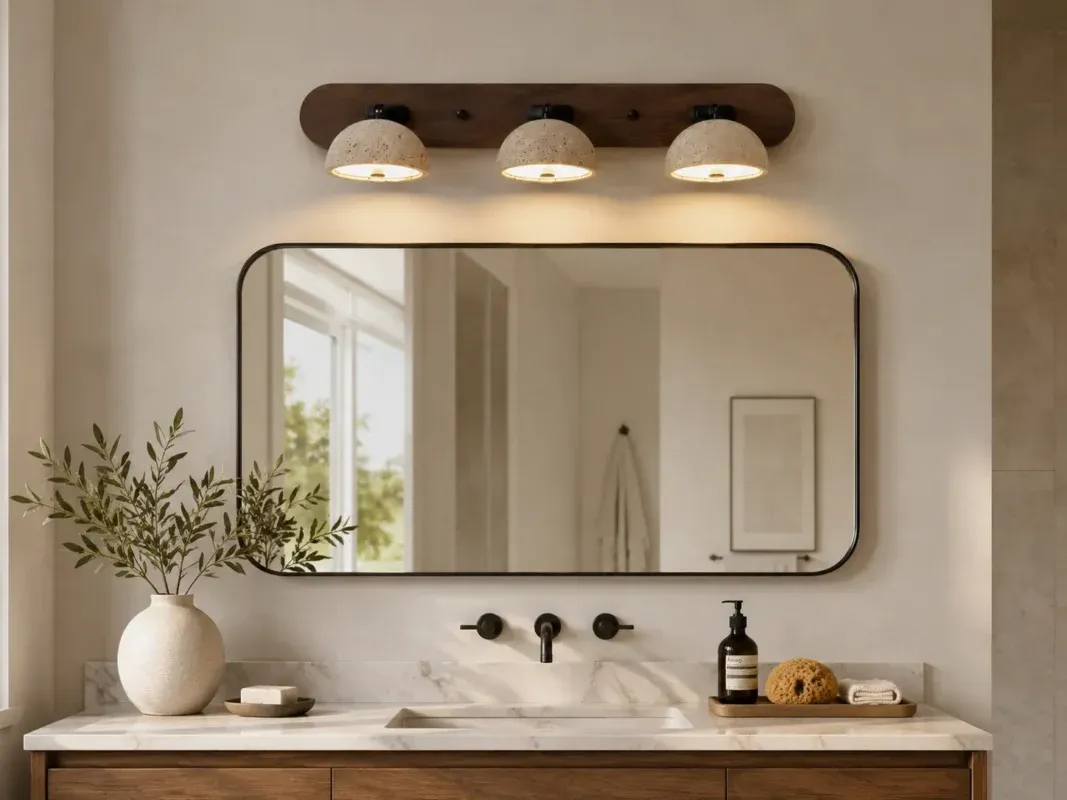
The fixture projects approximately 17 cm (6.7 in) from the wall. Because the dome heads are adjustable, leave enough clearance above the mirror so the shades can tilt without visually crowding the frame.
• Above a compact mirror: Center the backplate over the mirror and keep the fixture visually connected to the vanity rather than the ceiling.
• Above a wide mirror: Use the longer 3- or 4-light version so the beam pattern is distributed more evenly across the width.
• With a double vanity: The 4-light version can create a unified composition; however, very wide double vanities may still benefit from supplementary side lighting.
• With dark walls: Expect stronger contrast around each pool of light. On pale walls, the reflected light will appear softer and more expansive.
7. Important Bathroom Safety: IP20 Means Dry Indoor Areas
The product is rated IP20. That makes it suitable for dry indoor areas but not for locations exposed to water spray, steam-heavy wet zones, or direct splash. Bathroom electrical zones and code requirements vary by country and jurisdiction, so final placement should always follow local electrical regulations and the installer’s guidance.
8. Why Integrated LED Fits This Design
Integrated LED allows the dome shades to remain compact while avoiding the visual bulk of a replaceable decorative bulb. LEDs can provide high efficacy, long service life, and flexible optical control, but DOE guidance also emphasizes that actual performance depends on the complete luminaire design, including the driver, thermal management, optical system, and operating temperature.
In this fixture, each light head is rated at 5W. The 2-, 3-, and 4-light versions therefore use 10W, 15W, and 20W total respectively. For a vanity fixture, that modest power level is best understood as part of a layered lighting plan rather than as a substitute for all ambient bathroom lighting.
9. Interior Styles That Suit This Fixture
• Modern organic: Use warm plaster, pale stone, oak or walnut, linen, and soft-edged mirrors.
• Wabi-Sabi: Let the irregular travertine texture contrast with simple cabinetry and imperfect natural finishes.
• Japandi: Pair the warm wood backplate with light neutral walls, restrained black hardware, and minimal accessories.
• Natural luxury: Combine with veined stone, fluted wood, bronze or matte-black fittings, and generous negative space.
• Boutique hotel: Use symmetrical styling, high-quality towels, stone counters, and a large mirror for a calm hospitality feel.
Product Snapshot
| Specification | Details |
|---|---|
| Product type | Vanity light / bathroom wall light / adjustable LED wall light |
| Style | Modern minimalist / Wabi-Sabi / natural luxury |
| Materials | Walnut wood / natural travertine / black metal |
| Shade | Natural yellow travertine dome |
| Light source | Integrated LED |
| Power | 5W per light head |
| Voltage | AC 110–240V |
| Color temperature | 2700K warm light |
| Wall projection | Approx. 17 cm / 6.7 in |
| IP rating | IP20 — dry indoor areas |
| Versions | 2-light, 3-light, 4-light |
| Recommended spaces | Bathroom dry area, vanity, mirror area, dressing table, bedroom, hallway |
Final Thoughts
This vanity light succeeds because it combines functional adjustability with materials that already belong in warm, natural interiors. The travertine shades add tactile depth, the walnut backplate visually softens the wall, and the directional LED heads make the light more adaptable than a fixed decorative bar light.
For a modern bathroom, bedroom dressing area, or hallway mirror, it works best when treated as one layer in a broader lighting plan: use it to shape the mirror zone, preserve visual comfort, and add material character rather than simply chasing maximum brightness.
View product: Adjustable Travertine Dome LED Vanity Light with Walnut Wood Backplate
