

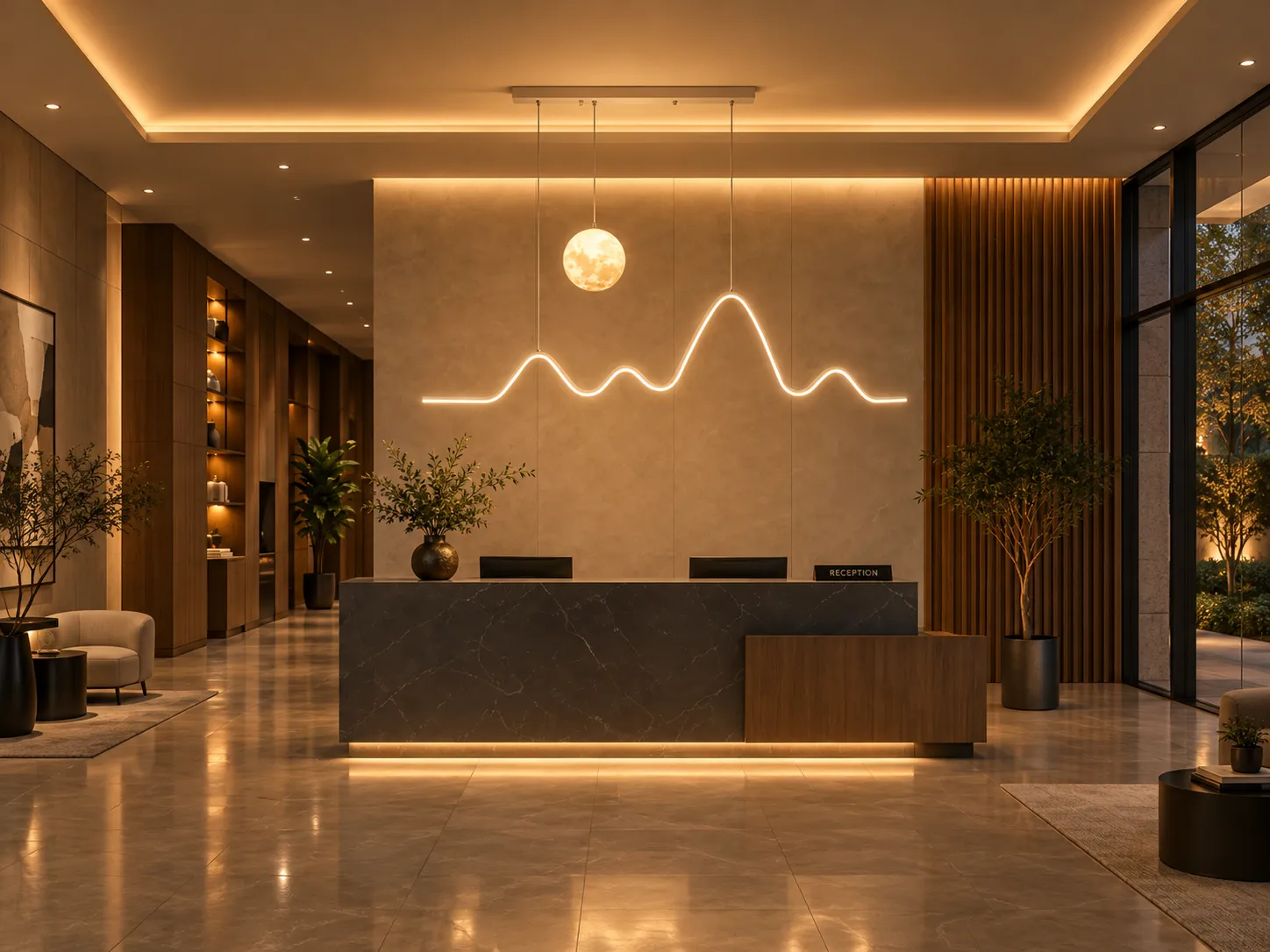

The Residential Lighting Design Logic Behind the Moon Wave LED Linear Pendant Light
A Complete Guide to Luminous Flux, Illuminance, Color Temperature, Glare Control, Dining Tables, Kitchen Islands, and Reception Areas
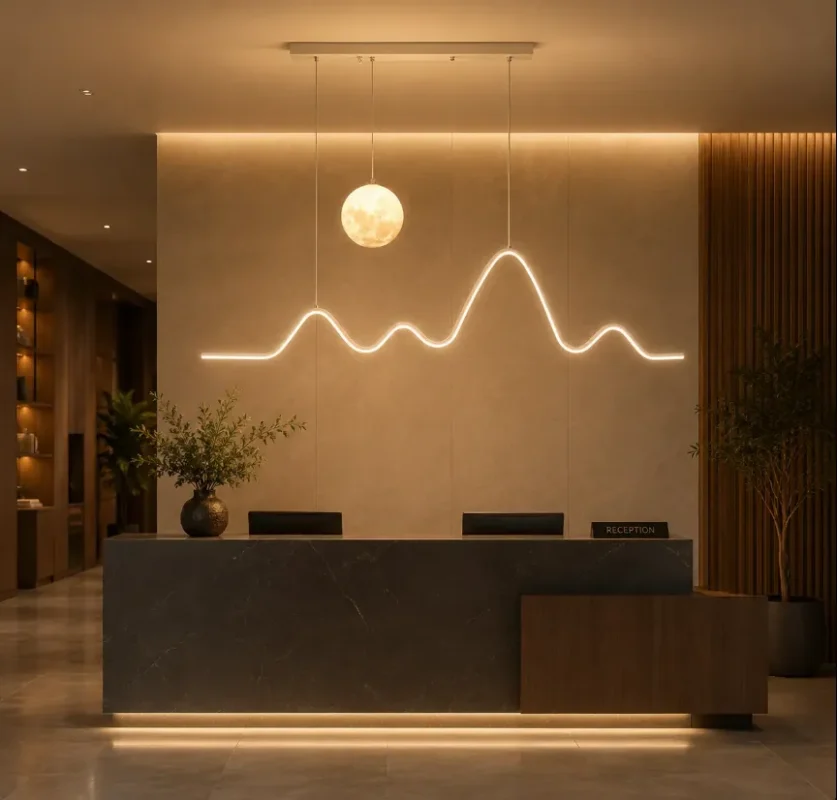
Hero Image | Moon Wave in a modern reception area: the wave-shaped light line and moon-textured glass globe create a rhythmic focal poin
1. Start with the Product: Why It Is More Than a Sculptural Pendant
The defining feature of the Moon Wave LED Linear Pendant Light is the combination of a continuously undulating linear light source and a glass globe with a moon-like surface texture. Unlike a conventional pendant made from several lamp heads and shades, Moon Wave turns the luminous element itself into a continuous spatial line. Viewed from the front, the fixture can read as both an elongated light wave and as a moon suspended above a glowing horizon.
According to the product page, the published specifications include a body size of approximately 120 × 25 cm (47.2 × 9.6 in), a 40 W integrated LED, around 3200 lm (±10%) of luminous flux, selectable 3000 K / 4000 K / 6000 K color temperatures, a 220–240 V input, and primary materials including aluminum alloy, acrylic, glass, and metal. The fixture is available in black and white, with suspension cables adjustable up to about 150 cm. [1]
| Item | Published Specification | Design Implication |
|---|---|---|
| Dimensions | 120 × 25 cm | Well suited to long dining tables, kitchen islands, bars, and reception counters |
| Power | 40 W integrated LED | Continuous integrated light source without exposed replaceable bulbs |
| Luminous flux | Approx. 3200 lm ±10% | Can serve as one major lighting layer in medium-sized dining and social spaces |
| Color temperature | 3000 K / 4000 K / 6000 K | Supports atmosphere, everyday use, and higher-alertness task scenes |
| Main materials | Aluminum alloy + acrylic + glass + metal | Balances structure, diffusion, and decorative character |
| Suspension | Adjustable up to approx. 150 cm | Can be tuned for different ceiling heights and sightlines |
2. The First Principle of Lighting: Lumens Do Not Equal “How Bright the Table Feels”
A common lighting mistake is to treat lumens (lm) as if they directly describe room brightness. Lumens measure the total amount of visible light emitted by a source, while illuminance, measured in lux, describes how much light actually reaches a surface. The two are related, but the result at the table or work plane also depends on beam distribution, diffusers, mounting height, wall and floor reflectance, room size, and lumen depreciation over time.
Moon Wave is rated at about 3200 lm. As a deliberately simplified upper-bound calculation, 3200 lm distributed perfectly and uniformly across 10 m² would equal 320 lx; across 12 m², it would equal about 267 lx. Real rooms never deliver all luminous flux to the work plane without optical losses or uneven distribution, so measured table illuminance will be lower than this mathematical ceiling. That is why rigorous lighting design relies on on-site measurements or professional lighting software, rather than product lumens alone.
3. 40 W and 3200 lm: Interpreting LED Efficiency in Practice
Using the published values, 3200 lm ÷ 40 W ≈ 80 lm/W. This can be understood as the approximate nominal efficacy of the complete luminaire. The U.S. Department of Energy notes that LED efficacy is commonly expressed in lm/W, but the practical efficacy of a complete fixture is lower than that of an individual LED package because of driver, electrical, thermal, and optical losses. [4] For fair comparisons, it is therefore better to compare total fixture lumens against total fixture watts rather than relying on LED-chip specifications.
For a residential interior, 40 W of integrated LED does not automatically mean the light will feel harsh. Visual comfort depends heavily on luminous area and diffusion. Moon Wave spreads its output along a long acrylic diffuser, which helps distribute luminance over a larger apparent surface. Compared with a small, exposed, high-luminance point source, a continuous diffused line is generally easier to use within or near the normal field of view.
4. Why the Acrylic Diffuser Matters: Glare Is About Luminance Contrast, Not Simply “Too Much Light”
Glare is often caused not by the room being globally too bright, but by a very bright source appearing against a much darker visual field. Dining pendants are especially sensitive to this issue because they sit above and in front of seated occupants. If LED chips or small high-luminance points are directly visible, the eyes must repeatedly adapt between the bright source and the darker background.
A high-transmission acrylic diffuser helps remix discrete LED points into a more continuous luminous surface while softening abrupt changes in edge brightness. It cannot eliminate every form of glare, but it can reduce the risk associated with directly viewing individual LED points. When installed at an appropriate height, Moon Wave is therefore more likely to read as an evenly illuminated architectural line than as a sequence of intense LEDs.
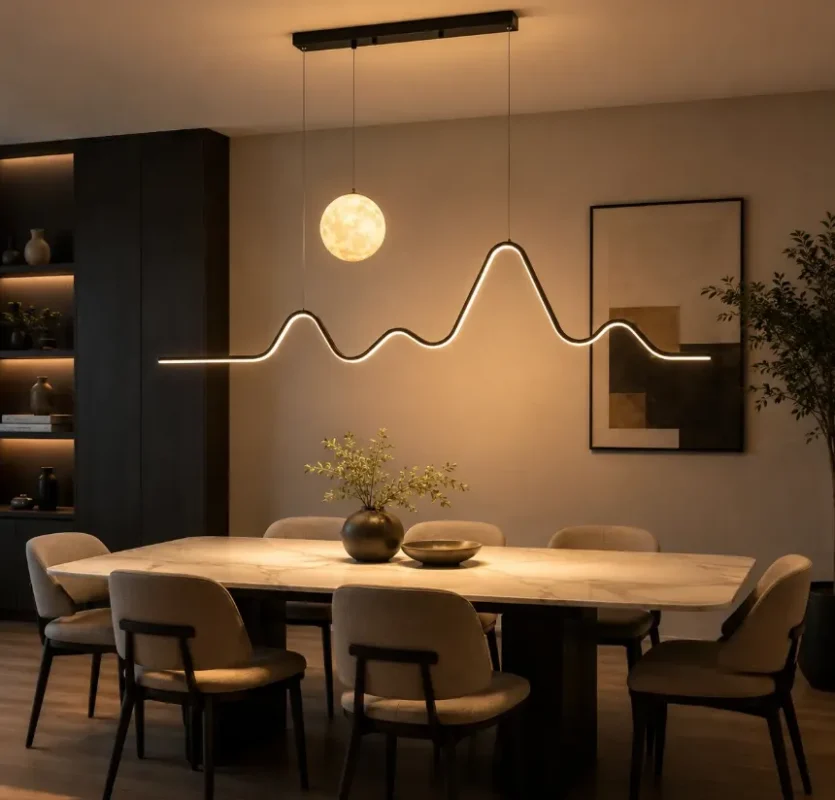
Figure 1 | Dining-room application: aligning the linear wave with the long table creates one coherent axis for light, furniture, and space
5. The Dining Room Is Its Most Natural Setting: Align the Fixture with the Table, Not the Room
The primary design reference for a dining pendant should be the table and the people using it; the geometric center of the room comes second. A common installation error is to center the light on the ceiling plan while ignoring the actual table position. The luminaire may look centered in the room, but once people sit down, the offset between the fixture and table becomes visually obvious.
At 120 cm wide, Moon Wave works naturally with rectangular dining tables, kitchen islands, and bars. For a common 180–240 cm long table, a 120 cm fixture occupies roughly 50%–67% of the table length. This is not a mandatory rule, but it often creates a useful balance: the light feels clearly tied to the table without visually filling the entire span. Installation should begin from the table centerline, then be fine-tuned around seating and sightlines.
For spaces used mainly for dinner and socializing, 3000 K usually supports a more relaxed and intimate atmosphere. If the dining table also functions as a daytime desk, craft surface, or study area, 4000 K can make paper, details, and contrast feel clearer. 6000 K is a cooler white associated with a crisp, alert visual impression; in most homes, it is not necessary as the default evening setting.
6. Color Temperature Is More Than “Warm vs. Cool”: Evening Light Also Interacts with Circadian Biology
The visual effect of correlated color temperature (CCT) is easy to recognize. Around 3000 K, wood, leather, warm stone, and food tend to appear softer and more inviting. Around 4000 K, the light feels more neutral and task-friendly. Around 6000 K, the space takes on a distinctly cool-white appearance. Beyond aesthetics, however, nighttime light exposure – especially its spectrum and intensity – can also affect the human circadian system.
Recent research on residential lighting indicates that higher-CCT evening light, which generally contains a stronger short-wavelength (blue) component, can have greater melatonin-suppression potential than warmer light. In one study examining common home light sources, cool-white LEDs were estimated to suppress melatonin more strongly than warm-white LEDs; another real-home study found substantial person-to-person physiological variation in response to evening household lighting.
The practical value of Moon Wave’s multiple color temperatures is therefore not merely the ability to change appearance for photographs. It allows lighting to follow the rhythm of the day: 4000 K for daytime activity and practical tasks; 3000 K for dinner, conversation, movies, and pre-sleep routines; and 6000 K reserved for short periods when a cooler, clearer visual condition is genuinely useful, especially in some commercial settings.
| CCT | Visual Impression | Best Time / Task | Residential Guidance |
|---|---|---|---|
| 3000 K | Warm white, relaxed, makes materials feel richer | Dinner, conversation, evening ambience | Preferred for most evening use |
| 4000 K | Neutral, clear, natural | Daytime, work, housework, general use | Highly versatile |
| 6000 K | Cool white, crisp, stronger contrast | Short high-alertness tasks, some commercial applications | Avoid prolonged high-brightness evening use |
7. Kitchen Islands: Do Not Ask a Decorative Pendant to Provide Every Layer of Task Lighting
A kitchen island is often both a social hub and a working surface. A pendant can provide the visual focal point and a significant share of the local light, but if the island is used for chopping, recipe reading, food preparation, or other detailed tasks, relying on a decorative pendant alone is rarely the best solution. A layered approach is more robust: Moon Wave provides the main visual and ambient/task layer above the island, while under-cabinet lights, recessed downlights, or track lighting supplement vertical surfaces and high-precision work areas.
Layered lighting also solves a less obvious problem: excessive brightness contrast. If the island is very bright while the surrounding walls and floor remain dark, the eye has to adapt repeatedly and the room can begin to feel theatrical. Adding gentle ambient light to walls, cabinetry, or the background reduces this contrast and helps the wave-shaped pendant read with greater depth.
8. Reception Areas: Why the Wave Form Is Designed to Be Seen
In hotel receptions, club lobbies, boutique retail spaces, and other hospitality interiors, the role of a pendant is different from that in a private dining room. It is not only there to illuminate; it also contributes to the first visual memory of the space. The wave form has a strong directional rhythm and, when placed against stone, timber, microcement, or other relatively calm surfaces, can become a continuous visual signature.
From a compositional perspective, a continuous curve is often perceived as one recognizable whole more readily than a collection of small, separate lamp heads. The round “moon” globe adds a clear focal node to the long line. This “line + circle” relationship naturally creates a visual center above a reception counter while preserving the negative space that modern minimalist interiors depend on.
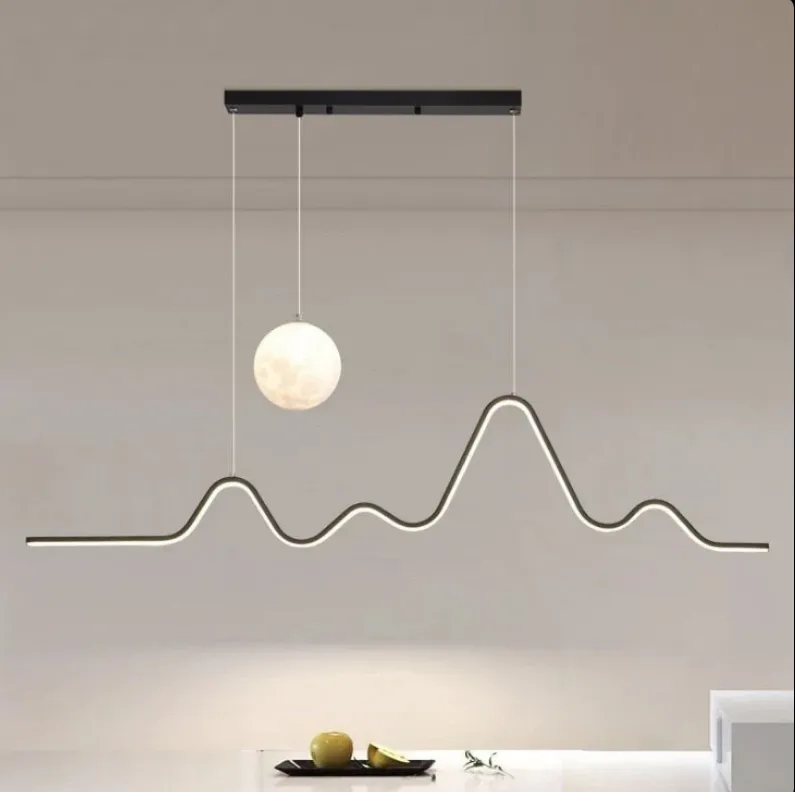
Figure 2 | Product composition: the continuous wave-shaped LED line, moon-textured glass globe, and linear canopy create a strong horizontal order
9. Mounting Height: Solve the Sightline First, Then Refine the Floating Effect
There is no single mounting height that works for every pendant and every room. Three questions should come first: Will a seated person look directly into a high-luminance surface? Does the fixture obstruct the face of someone sitting opposite? And is the table or work surface receiving enough light with reasonable uniformity?
Moon Wave’s adjustable suspension gives the installer room to tune the result on site. Over a dining table, establish the final table location and seating height first, then adjust the pendant so that seated users can appreciate the form without staring directly into the brightest emitting surface. A high ceiling does not mean the fixture should automatically be raised as far as possible; too much height weakens table illuminance and visually disconnects the light from the furniture. In lower rooms, head clearance and visual comfort take priority.
10. Materials and Color: Where Black and White Versions Work Best
The black version creates a stronger graphic outline. Against warm gray, microcement, pale stone, or wood, the dark body becomes an architectural line and works especially well in modern minimalist, contemporary luxury, wabi-sabi, and boutique-hotel interiors. The white version blends more easily into pale ceilings and walls, allowing the emitted light to dominate over the hardware – a useful choice for creamy neutral interiors, all-white minimalism, and homes seeking a lighter visual presence.
Because the moon-textured glass globe is already a strong decorative element, the surrounding material palette does not need to compete with it. If the wall already contains heavy texture, metal screens, or complex paneling, limit the number of additional decorative fixtures so Moon Wave can remain the primary visual element.
11. Use One Fixture to Build “Scenes,” Not Just One On/Off State
Contemporary residential lighting increasingly focuses on scenes rather than a single brightness level. For a linear decorative pendant like Moon Wave, the best result comes from placing it within a complete lighting hierarchy instead of using it in isolation. A well-designed dining or living-dining area can include at least three layers: the main pendant, background ambient light, and local task/accent light.
• Dinner with guests: use Moon Wave at 3000 K and a medium brightness level; keep wall or cabinet indirect lighting lower so the table becomes the visual center.
• Everyday dining: use 3000 K or 4000 K at a level that clearly reveals food, tableware, and facial expressions.
• Desk work or crafts at the table: use 4000 K and add a local task source; raise work-plane illuminance rather than making the entire room uniformly bright.
• Evening relaxation: use 3000 K, reduce overall brightness, and minimize cool-white, directly visible light sources.
12. Energy Efficiency: The Advantage of LED Is Not Just Lower Wattage
The U.S. Department of Energy’s residential lighting guidance notes that lighting represents a meaningful share of household electricity use and that efficient LEDs, appropriate dimming, and demand-based operation can reduce long-term energy consumption. For an integrated fixture such as Moon Wave, energy performance is not only about the 40 W rating. It also depends on whether one well-distributed luminaire can replace multiple inefficient decorative sources, and whether dimming and layered lighting reduce unnecessary full-output operation.
Integrated LED fixtures also have different maintenance considerations from replaceable-bulb luminaires. Before purchase, it is worth checking driver quality, LED module serviceability, and after-sales support. In installation, adequate thermal management and a suitable environment for the driver are often more important to service life than simply choosing a higher wattage.
13. What Types of Homes and Projects Suit This Fixture?
If your space has a clearly defined long dining table, kitchen island, bar, or reception counter, and you want the main luminaire to become part of the architectural composition without resorting to a traditional crystal chandelier, branching chandelier, or multi-head pendant cluster, Moon Wave is a strong modern linear option. It is especially suited to interiors with relatively clean wall and furniture lines where one fixture is intended to create a memorable focal point.
By contrast, if the ceiling is very low, the table position changes frequently, or the room requires very high levels of specialist task lighting, a decorative linear pendant should not be expected to do everything alone. Its strongest role is “primary visual feature + one major lighting layer,” not a replacement for every ambient, task, and accent source in the room.
| Space | Recommended Approach | CCT Tendency | Additional Lighting? |
|---|---|---|---|
| Dining room | Align with the table axis; emphasize the table and faces | 3000 K / 4000 K | Background ambient light recommended |
| Kitchen island | Run parallel to the island; keep working sightlines clear | 4000 K | Task lighting recommended |
| Living room / tea room | Use as a decorative main light with floor or wall lighting | 3000 K | Layered lighting recommended |
| Hotel reception / club lounge | Use as a visual signature against the feature wall | 3000 K / 4000 K | Add downlights or wall-washing based on room size |
14. Eight Checks Before Purchase and Installation
Confirm whether the 120 cm fixture length is proportionate to the actual dining table or island.
• Confirm ceiling load capacity, canopy position, and the electrical feed location.
• Confirm that AC 220–240 V is compatible with local electrical conditions and use a qualified electrician for installation.
• Based on evening habits, prioritize 3000 K or a selectable-CCT version for residential use.
• Confirm whether dimming is required and whether the dimmer is compatible with the LED driver.
• Confirm finer-quality metrics such as CRI, especially for dining, art, retail, or material-display applications.
• Fine-tune suspension height on site to avoid direct view of the highest-luminance emitting surface from a seated position.
• Do not rely on one central pendant for every task; plan separate ambient and local task-lighting layers.
15. Frequently Asked Questions
Q1: Is 3200 lm too bright?
Not necessarily. 3200 lm is total luminous flux. Actual illuminance at the table depends on mounting height, optical distribution, room area, and surface reflectance. In a dining room, color temperature, dimming, and layered lighting can all be used to control the experience.
Q2: How should I choose between 3000 K, 4000 K, and 6000 K?
For most homes at night, 3000 K feels more natural and relaxed. 4000 K works well for daytime and multi-purpose spaces. 6000 K is distinctly cool white and is better reserved for short-duration high-clarity tasks or selected commercial settings.
Q3: Can this fixture light a kitchen island by itself?
It can provide the island’s main visual feature and an important lighting layer, but food preparation and other precision tasks are better supported by additional task lighting.
Q4: Why is the diffuser so important?
Because exposed linear LEDs can create high-luminance points and increase glare risk. A diffuser blends individual LEDs into a continuous light line and generally improves visual comfort.
Q5: Is black or white the better choice?
Black emphasizes the outline and architectural character; white feels lighter and blends more easily into pale ceilings. The right choice depends on how much contrast the room needs and whether you want the fixture body itself to be visually prominent.
Conclusion: A Good Decorative Light Should Solve Both “Spatial Relationships” and the “Lighting Environment”
The value of the Moon Wave LED Linear Pendant Light lies in the way it combines three decorative dimensions with practical lighting performance. Its 120 cm horizontal scale establishes a spatial axis; the wave-shaped light line creates visual rhythm; and the moon-textured globe provides a memorable focal point. At the same time, the 40 W integrated LED, approximately 3200 lm output, and multiple CCT options give it genuine residential-lighting capability rather than making it merely a sculptural object.
A high-quality installation does not end when the fixture is mounted. Color temperature, brightness, suspension height, the wall behind the luminaire, and the surrounding lighting layers should be designed together. A dining room needs comfortable rendering of food and faces; an island needs task illuminance; a reception desk needs visual identity; and an evening home should also consider circadian effects. When these factors are coordinated, a luminaire becomes part of the space rather than simply an object placed inside it.
Moon Wave LED Linear Pendant Light | Click to View Product