

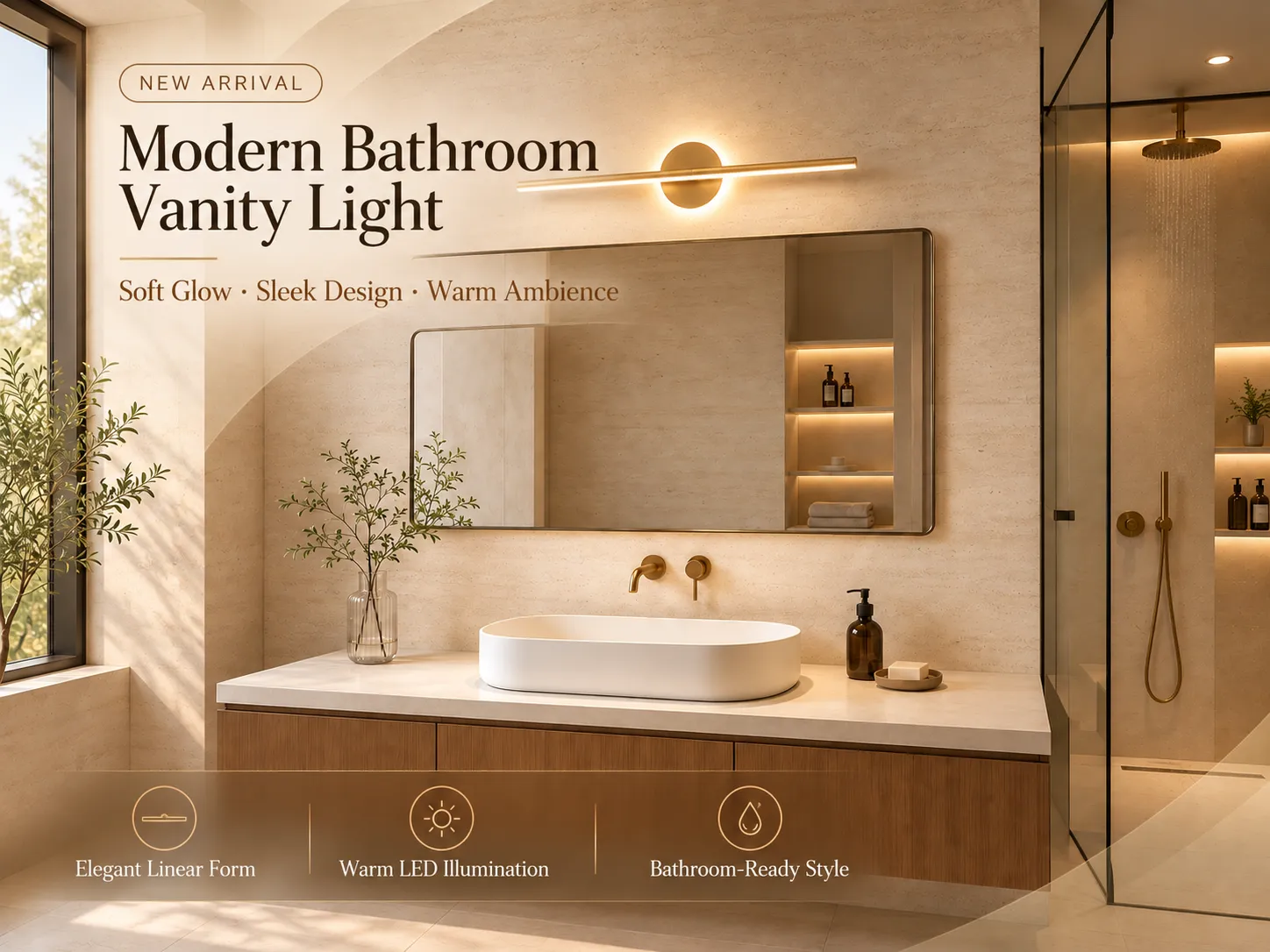

Modern Halo LED Vanity Wall Light: A Practical Guide to Better Bathroom Mirror Lighting
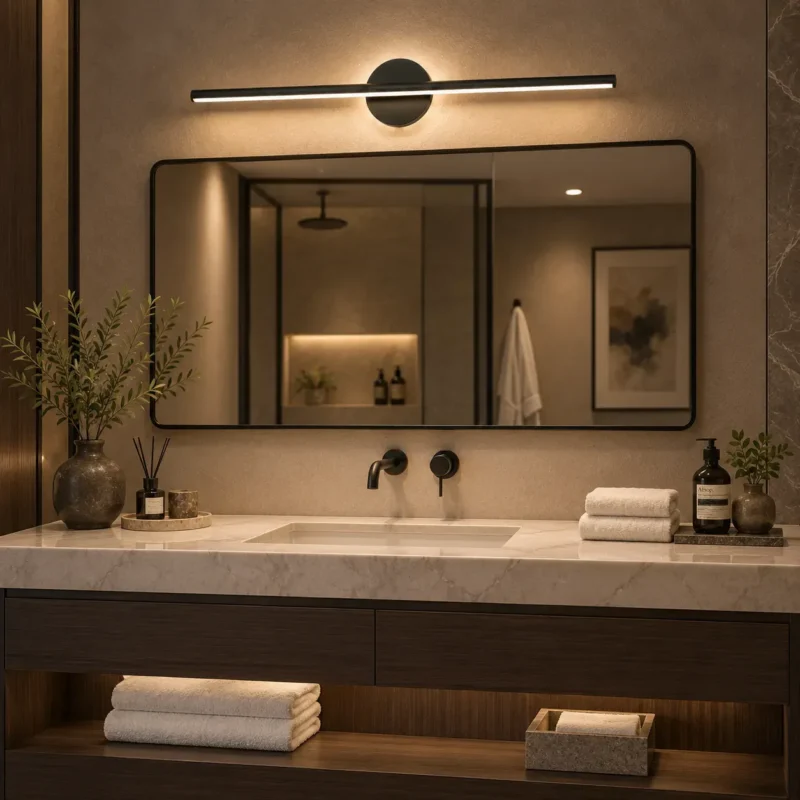
A slim halo-style vanity light adds a clean horizontal light source above the mirror while keeping the wall composition visually balanced.
Product Snapshot
This halo-style LED vanity wall light combines a slim horizontal light bar with a circular center plate. The geometry is simple enough for minimalist bathrooms, while the illuminated bar provides a broad source above the mirror for everyday grooming and general mirror use.
| Specification | Typical Product Data |
|---|---|
| Type | Integrated LED vanity / mirror wall light |
| Design | Linear bar with circular halo-style center |
| Approx. Length | 60 cm / 23.6 in |
| Power | About 13 W |
| Light Output | About 900–1100 lm |
| CCT Options | 3000 K / 4000 K / 6000 K |
| Color Rendering | CRI 80+; higher-CRI options are preferable for color-critical grooming |
| Finish | Black or warm metallic / gold tone |
| Recommended Use | Bathroom vanity, powder room, dressing area, hotel bathroom |
1. Why Mirror Lighting Is Different from General Bathroom Lighting
A bathroom can feel bright overall and still have poor mirror lighting. The reason is geometry: the face is a vertical surface, while many ceiling lights mainly illuminate horizontal floors and countertops. When most light comes from above, the brow, nose, and chin can cast stronger shadows.
A horizontal source positioned above the mirror spreads light across a wider area than a small point source. For best results, it should be part of a layered scheme rather than the only light in the room. General ceiling light handles circulation, while the vanity fixture concentrates useful light near the face and mirror.
2. The Halo Form: Decorative Geometry with a Lighting Purpose
The circular center creates a visual anchor, while the long bar aligns naturally with the width of the mirror. This combination works especially well with rectangular, rounded-rectangle, and circular mirrors because it introduces a simple contrast between straight and curved shapes.
The wall glow around the center can also reduce the visual contrast between the bright LED bar and a darker wall. That softer transition is particularly useful in evening settings, where an isolated bright strip may otherwise feel harsh.
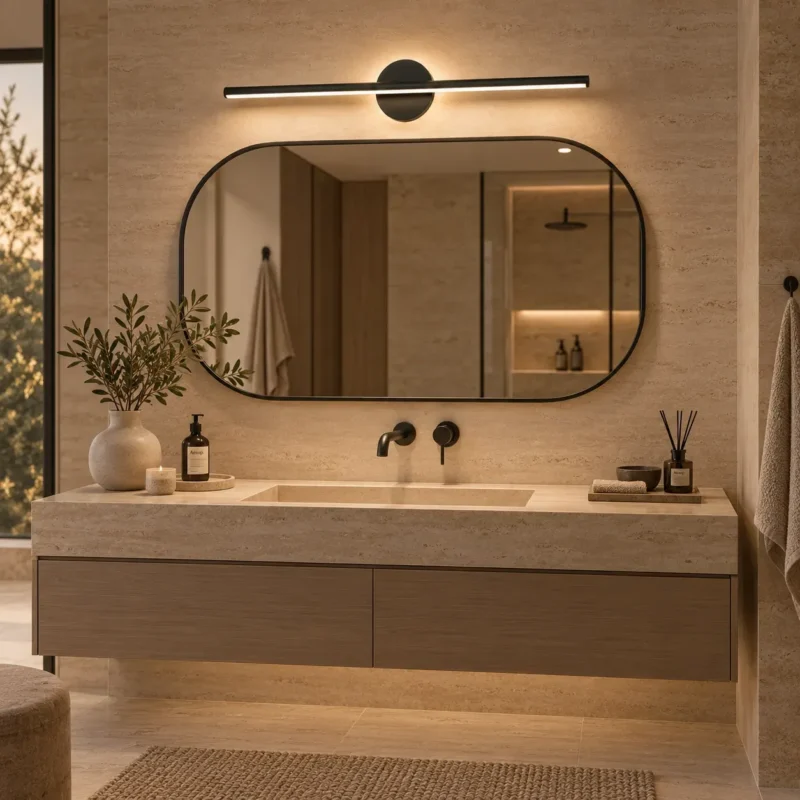
Placed above a rounded mirror, the horizontal bar adds width while the central circle creates a clear focal point.
3. Understanding Lumens, Watts, and Useful Light
Watts measure electrical power; lumens describe visible light output. A 13 W fixture producing roughly 900-1100 lumens has a system efficacy of about 69-85 lm/W. Actual performance depends on the LED package, driver, thermal design, and optical losses through the diffuser.
For a vanity, raw lumen output is not enough to judge quality. Direction and distribution matter just as much. A well-diffused source aimed toward the mirror zone can provide better facial visibility than a brighter fixture that sends much of its light away from the user. The U.S. Department of Energy similarly emphasizes that LED performance depends on both source efficacy and luminaire design.
4. Choosing 3000 K, 4000 K, or 6000 K
Color temperature changes the visual character of a bathroom. Around 3000 K feels warm and relaxed, making it a natural match for wood, beige stone, brass, and evening use. Around 4000 K appears more neutral and is often a comfortable middle ground for grooming. Around 6000 K is much cooler and can feel crisp, but it may be less relaxing in residential spaces.
If the fixture offers selectable CCT, choose the setting that works with the room rather than judging the light in isolation. Large differences between the vanity light and nearby ceiling lights can make skin tones and finishes appear inconsistent.
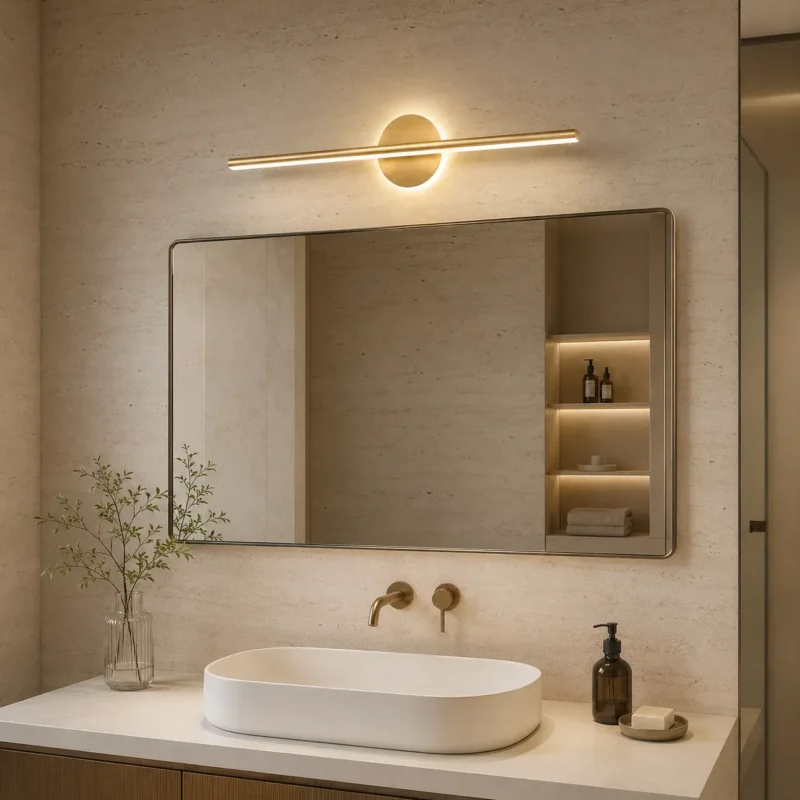
Warm metallic finishes and warm-white light can reinforce the natural color of cream stone, wood, and brass bathroom details
5. Color Rendering and Skin-Tone Accuracy
Color rendering affects how naturally skin, cosmetics, towels, and stone surfaces appear. The U.S. Department of Energy notes that CRI 80 is commonly acceptable for interior lighting, while CRI 90 or higher indicates excellent color fidelity. For makeup, skincare, and other color-sensitive routines, a higher-fidelity LED is preferable when available.
CRI is useful but incomplete. The Illuminating Engineering Society developed TM-30 to evaluate color rendition with additional measures such as fidelity and gamut. For a homeowner, the practical lesson is simple: do not choose a mirror light by brightness alone; light quality matters too.
6. Diffusion, Glare, and Visual Comfort
Acrylic or other translucent optical covers help hide individual LED points and spread the emitted light into a smoother line. This can reduce harsh sparkle and improve comfort when the source is visible in the mirror or peripheral vision.
Glare is also influenced by mounting height, viewing angle, wall reflectance, and total room brightness. A fixture that looks comfortable in a bright showroom may feel much more intense in a dark bathroom at night. Layered ambient light and sensible brightness levels help keep contrast under control.
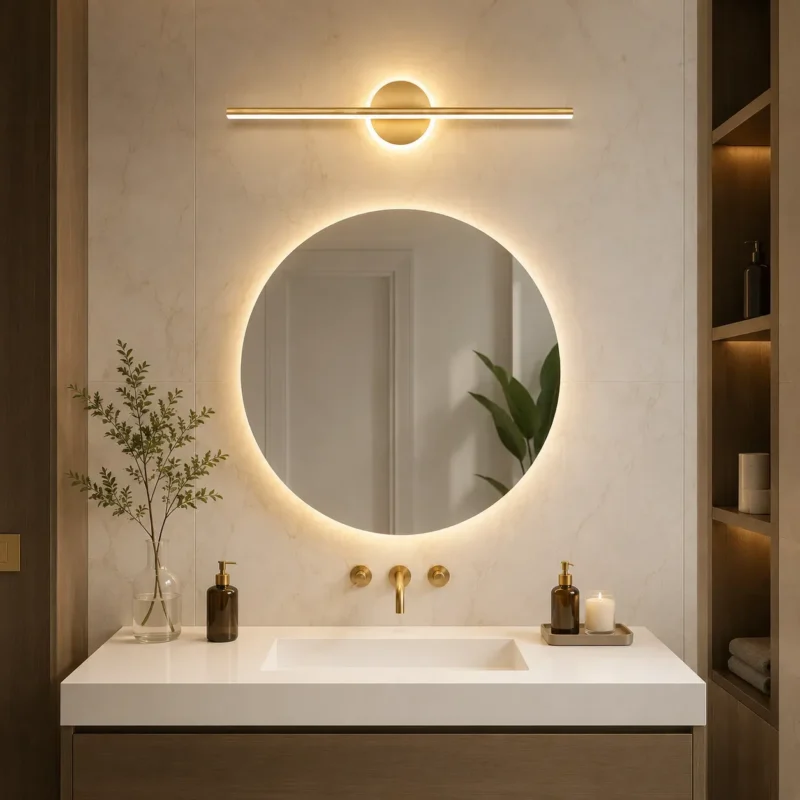
A warm, layered bathroom scheme uses the vanity light for the mirror zone while wall and cabinet lighting provide softer background illumination.
7. Placement and Proportion
Center the fixture on the mirror unless the design intentionally calls for asymmetry. For a medium-width vanity, a 60 cm bar generally looks balanced above mirrors in roughly the 60-100 cm range, although the final proportion depends on frame thickness, wall width, and mirror shape.
Mount the light close enough to the mirror to support the face, but high enough to avoid direct discomfort at normal standing height. There is no universal mounting dimension because users, mirrors, and ceiling heights vary. The best installation considers sightlines, mirror size, and the fixture’s actual beam pattern.
8. Finish and Interior Styling
Black creates a crisp architectural line and coordinates easily with black shower frames, faucets, and mirror edges. A warm gold or champagne finish reflects warm light and pairs naturally with oak, walnut, travertine, cream marble, and brass hardware.
The light does not need to match every metal finish in the room exactly. Repeating the finish in two or three visible elements is usually enough to make the palette feel intentional.
9. Bathroom Safety and Installation
Bathroom luminaires must be selected and installed according to local electrical rules and the fixture’s certified ingress-protection rating. Do not assume a decorative wall light is suitable for direct splash or shower zones unless its documentation explicitly confirms that use.
Integrated LED fixtures should also have adequate heat dissipation. The metal body helps move heat away from the LED module, but the luminaire should not be covered or installed in a way that blocks the intended thermal path. A qualified electrician should verify wiring, mounting strength, and local bathroom-zone requirements.
Conclusion
A modern halo LED vanity wall light works best when it is treated as part of a lighting system rather than as a decorative object alone. Its long luminous bar supports the mirror zone, the circular center gives the fixture a clear visual identity, and selectable white-light settings allow the atmosphere to shift from warm and relaxed to neutral and task-focused.
For a successful bathroom installation, prioritize comfortable distribution, suitable color temperature, good color fidelity, proportional sizing, and safe placement. These factors have a greater effect on everyday experience than maximum brightness by itself.
Modern Halo LED Vanity Wall Light for Bathroom Mirror | Click to View Product