

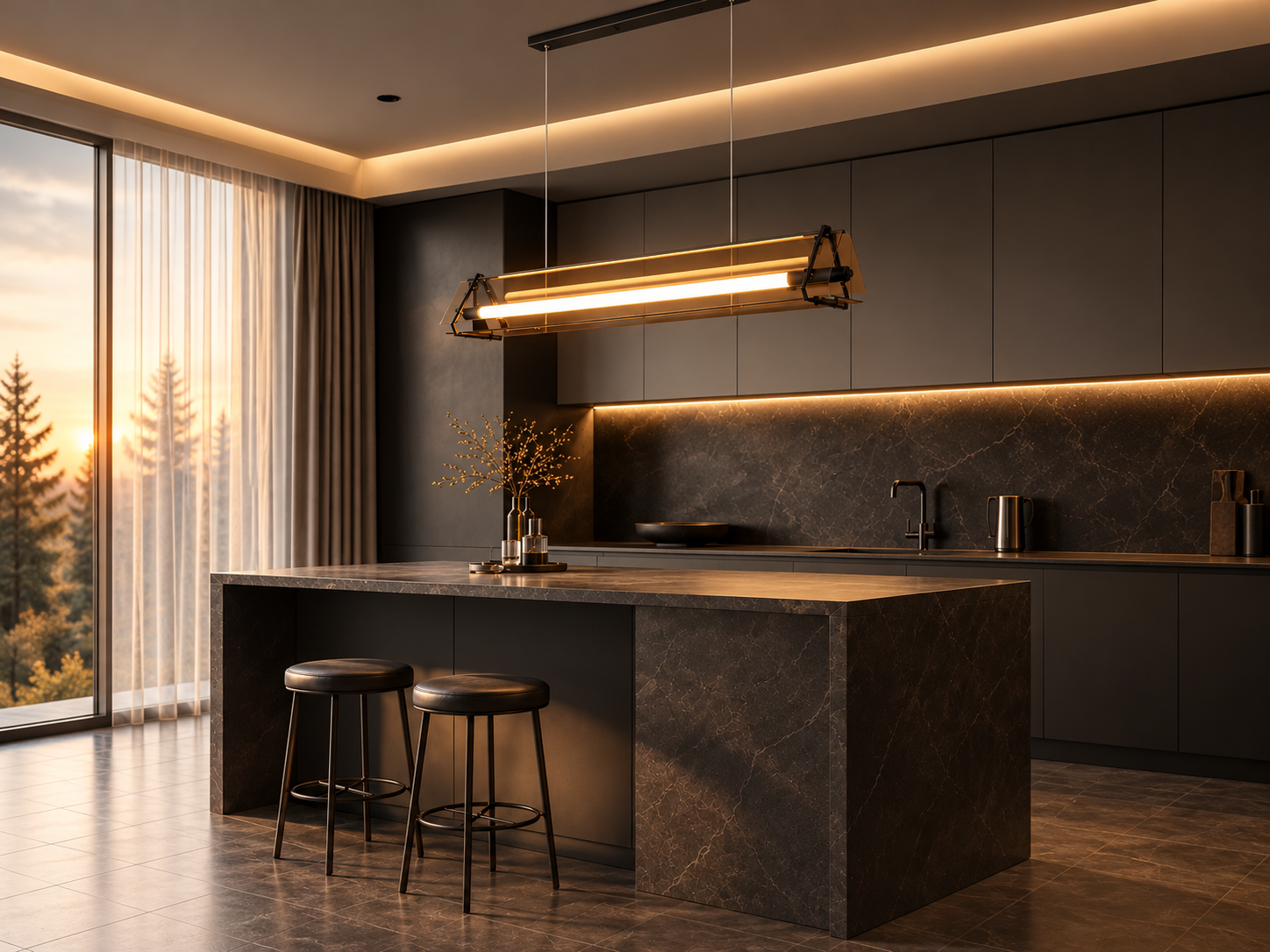

How to style an amber-toned linear pendant over kitchen islands and dining tables

Modern Linear Pendant Lighting: A Warm, Architectural Statement for the Home
Lighting does more than make a room visible. It helps define how a space feels, where attention naturally falls, and how comfortably people can prepare food, share a meal, or spend time together. A modern linear pendant brings these roles together: its long horizontal form relates naturally to islands and dining tables, while its illuminated center and warm amber-toned outer panels introduce a distinctive architectural detail.
The pictured design pairs a slim, dark suspension structure with a translucent amber-colored shade and a continuous linear light source. The contrast is especially effective in interiors that combine pale stone, natural wood, warm neutral walls, or darker contemporary cabinetry. Rather than relying on ornate decoration, the fixture makes an impact through proportion, material contrast, and a controlled line of light.
1. Why a Linear Pendant Works So Well
A linear pendant visually echoes the shape of a kitchen island or long dining table. This creates a sense of order: the fixture reads as part of the room’s architecture instead of an unrelated object suspended from the ceiling. When centered over the surface, it can help establish a visual axis and make the island or table feel like the heart of an open-plan space.
The amber-toned translucent panel adds a second layer of visual interest. When the light is switched on, the shade can appear warmer and more dimensional; when it is off, its transparent or tinted surface still contributes a subtle material accent. The dark frame gives the overall shape definition against a pale ceiling and complements black faucets, cabinet pulls, window frames, or other dark details.
2. Choose the Right Place: Kitchen Island or Dining Table
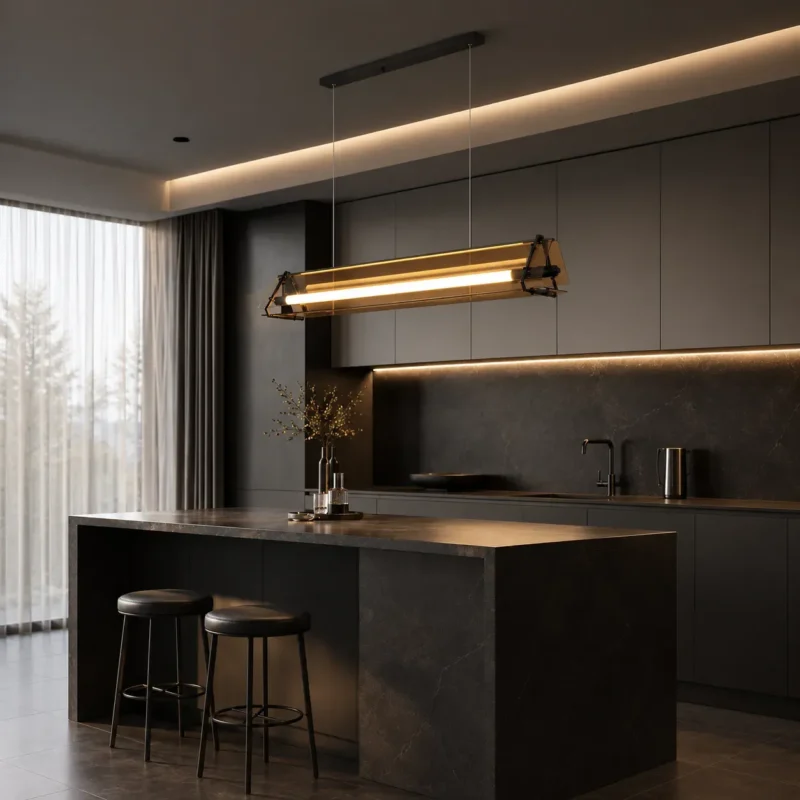
Over a kitchen island
A linear pendant is a natural choice above an island used for breakfast, casual meals, food preparation, or conversation. Position it along the island’s long axis and center it over the usable worktop rather than over the walkway beside it. The fixture should feel proportionate to the island: a very short light can look lost over a long surface, while an oversized one may visually crowd a compact kitchen.
In a working kitchen, the pendant should be part of a wider lighting plan, not automatically the only source of light. Under-cabinet lighting can brighten counters and reduce shadows from wall cabinets, while ceiling lighting can provide general illumination. This layered approach is consistent with residential lighting guidance that distinguishes ambient lighting from task lighting.
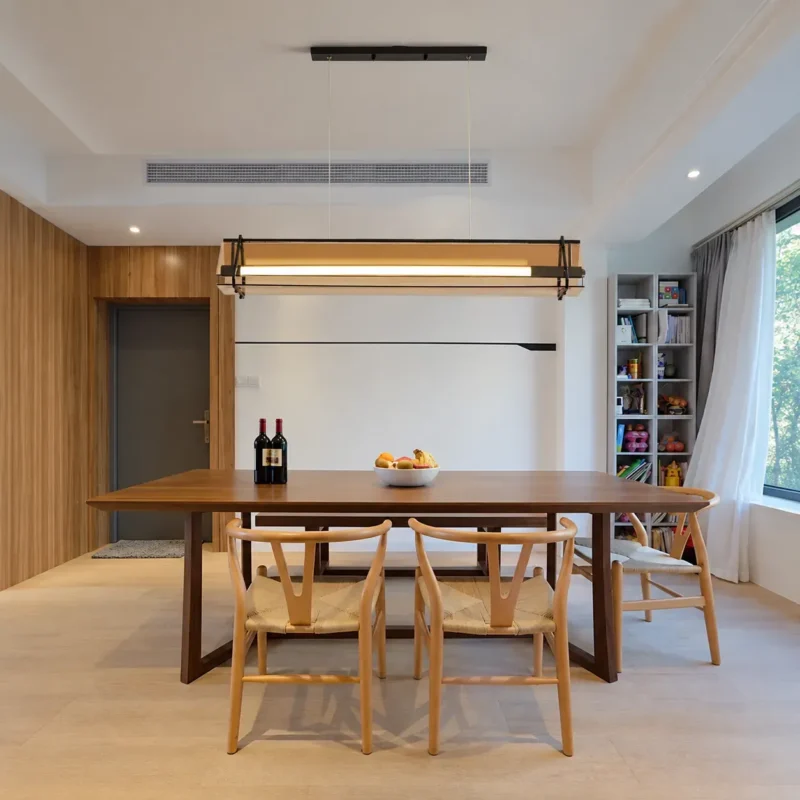
Over a dining table
Above a dining table, the pendant can define the gathering area in an open-plan room. Its long profile works particularly well with rectangular tables and benches, while the warm material palette pairs easily with walnut, oak, beige upholstery, stoneware, and linen. A dark frame can add contrast without requiring the rest of the room to be dark.
For comfortable conversation, check sightlines from seated positions before finalizing the suspension height. The light should feel connected to the tabletop without blocking views across it. A useful starting point for many dining pendants is roughly 30–36 inches (76–91 cm) above the tabletop, but this is a design starting point rather than a universal rule. Fixture height, ceiling height, shade depth, brightness, and the users’ sightlines all matter; adjust the position on site.
3. The Science of Comfortable Home Lighting
Color temperature changes the visual mood
Correlated color temperature (CCT) describes whether a light source appears warmer or cooler, and is measured in kelvins (K). Lower values generally look warmer and more yellow; higher values tend to look whiter or bluer. The U.S. Department of Energy explains this distinction in its consumer guidance on energy-efficient lighting. For dining and relaxed residential settings, warm-white light is often chosen because it supports a welcoming visual atmosphere. Always confirm the actual CCT options for the specific product before specifying it.
Lumens describe light output; watts describe power
Watts indicate electrical power consumption, whereas lumens indicate the amount of visible light emitted by a source. A higher wattage does not automatically mean a brighter fixture, especially when comparing different LED products. To evaluate whether a pendant can meet the needs of an island or table, check its stated lumen output and light distribution, then consider the size, surface finishes, daylight, and other fixtures in the room. Avoid choosing a light on wattage alone.
Diffusion and glare matter
A luminous line can be visually striking, but bright sources within the normal field of view can be uncomfortable. Shade and diffuser design, mounting height, viewing angles, and surrounding surface reflectance all affect visual comfort. In a kitchen, polished stone or glossy cabinetry may also reflect the fixture. Review the light from standing and seated positions, and use dimming only if the product is confirmed to support it.
Use layers instead of asking one fixture to do everything
A practical home lighting plan typically combines ambient light for the overall room, task light for specific activities, and accent or decorative light for emphasis. The pendant can be the visual centerpiece and contribute useful illumination over the island or table, while recessed or ceiling lights support the broader room and under-cabinet lighting supports detailed kitchen work. The Illuminating Engineering Society’s residential guidance and kitchen-lighting education emphasize selecting and placing lighting according to how the space is used.
4. Styling Tips for a Cohesive Interior
- Repeat one or two finishes. Echo the pendant’s dark frame in a faucet, cabinet hardware, window frame, or dining-chair detail.
- Balance warm and cool materials. Amber-toned surfaces sit comfortably beside oak, walnut, cream stone, beige textiles, and muted taupe.
- Keep the countertop visually calm. A linear fixture already creates a strong horizontal feature, so a simple vase or bowl is often enough.
- Consider the ceiling and room scale. Check that the canopy, suspension wires, and fixture length sit comfortably within the ceiling composition.
- Plan for cleaning and maintenance. Confirm the manufacturer’s cleaning instructions and whether the light source or driver is replaceable.
- Check dimming compatibility before purchase. Do not assume every integrated LED pendant can be dimmed or that every wall dimmer is compatible.
5. Installation and Planning Checklist
Before installation, confirm the exact fixture dimensions, total weight, suspension range, power supply requirements, light output, color temperature, dimming compatibility, and any applicable safety certifications from the product listing or supplier. The room photos illustrate styling ideas; they are not substitutes for the manufacturer’s installation instructions.
- Center the fixture over the island or table, not simply in the middle of the room.
- Check clearance from doors, tall users, upper cabinets, range hoods, and other overhead equipment.
- Evaluate the light at seated eye level to avoid an uncomfortable direct view of the bright source.
- For food preparation, test whether additional task lighting is needed at the countertop and sink.
- Have hardwired electrical installation performed by a qualified professional in accordance with local codes.
- Do not install the fixture in damp or wet locations unless its verified rating explicitly permits that use.
6. A Modern Pendant That Connects Function and Form
A carefully chosen linear pendant can bring structure, warmth, and visual continuity to a contemporary home. The amber-toned shade and dark frame shown here work particularly well where natural wood, pale stone, and clean cabinetry form the interior palette. Its strongest role is to establish a focal point above a kitchen island or dining table while contributing to a thoughtfully layered lighting plan.
For the best result, combine the fixture’s design with measured planning: select light output for the task, confirm color temperature and dimming options, check glare from everyday viewing angles, and coordinate installation height with the furniture below. Good lighting is not simply about adding brightness; it is about putting the right light in the right place.
Modern Amber Glass Linear Pendant Light-Click to view the product