

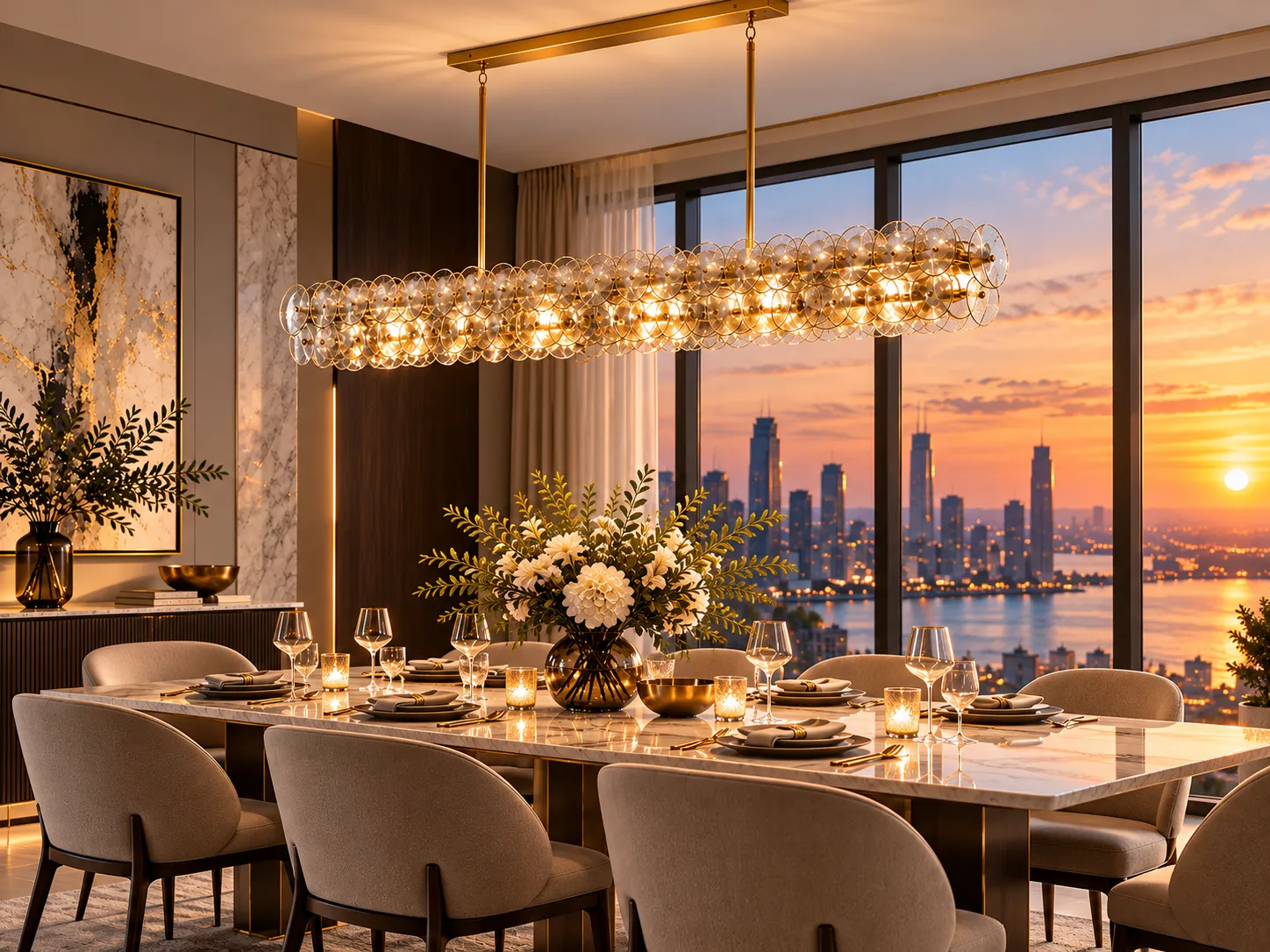

A practical, research-informed guide to reflective glass, warm light and graceful proportions
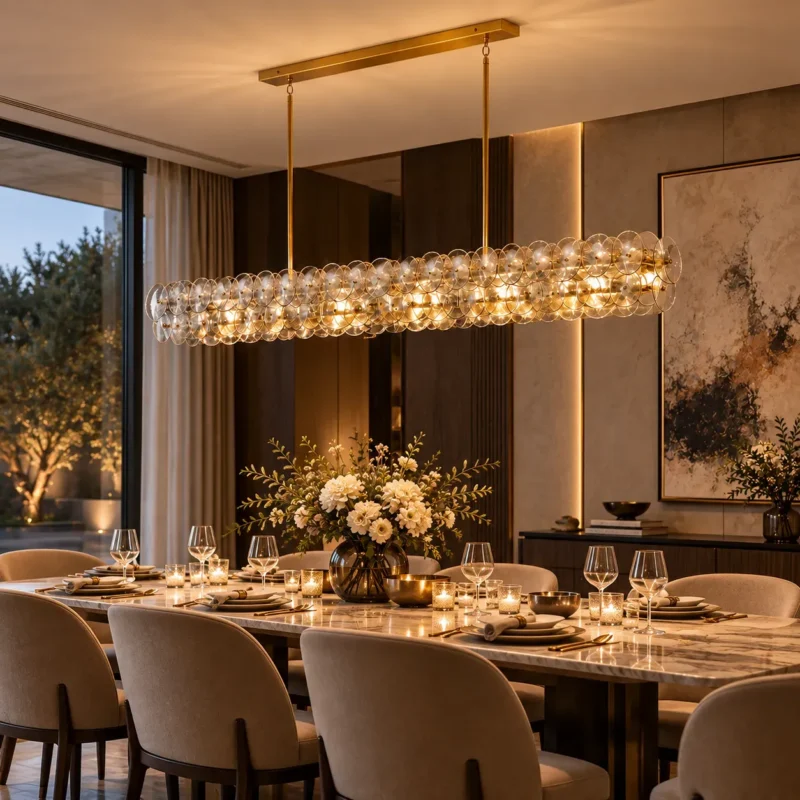
A chandelier that makes light part of the architecture
Some pendant lights quietly disappear into a room. Others shape its entire atmosphere. The Modern Disc Glass Linear Pendant Light belongs to the second category: a long, gold-toned framework surrounded by rows of overlapping glass discs that catch, reflect, and transmit points of warm-looking light. Seen above a dining table or kitchen island, its repeated circular elements introduce rhythm without overwhelming the horizontal architecture below.
The photographs highlight the design’s visual character rather than verified performance specifications. This guide explores why that visual approach works, how to install a linear statement light thoughtfully, and which lighting metrics matter before you buy. It distinguishes general lighting science from features that still need confirmation on the product’s technical sheet.
1 | The appeal of sculptural disc glass
Repeating translucent discs create depth, layered highlights, and constantly changing reflections as people move through a room. A narrow pendant made from a single opaque bar tends to read as one flat line; the glass-disc silhouette reads as a richer three-dimensional composition. The warm metallic support can visually connect with brass faucets, gold-framed artwork, and bronze furniture accents. This is a design interpretation of the images, not a claim about a specific glass treatment or manufacturing process.
Because glass is optically reflective as well as transmissive, individual elements may produce sparkling highlights. That sparkle can be attractive in a dining setting, but brightness at eye level should always be assessed in person. A decorative fixture can be visually beautiful and still need supplementary, lower-glare lighting elsewhere in the room.
2 | Design a dining room around the pendant
A rectangular dining table is an intuitive partner for a linear chandelier: their parallel shapes create an ordered focal point. Center the fixture over the table, not automatically over the ceiling or the overall room. Leave enough visual margin at both table ends so the chandelier looks intentionally proportioned. The exact margin depends on the table width and length, fixture dimensions, ceiling height, and the scale of adjacent furniture.
A commonly used starting range is approximately 30–36 in (76–91 cm) from tabletop to the lowest part of the fixture for many dining pendants. This is a planning heuristic, not a universal safety code or a manufacturer-specified mounting requirement. Check the seated sightline, possible contact with tall centerpieces, and whether sparkling elements appear uncomfortably bright when viewed across the table.
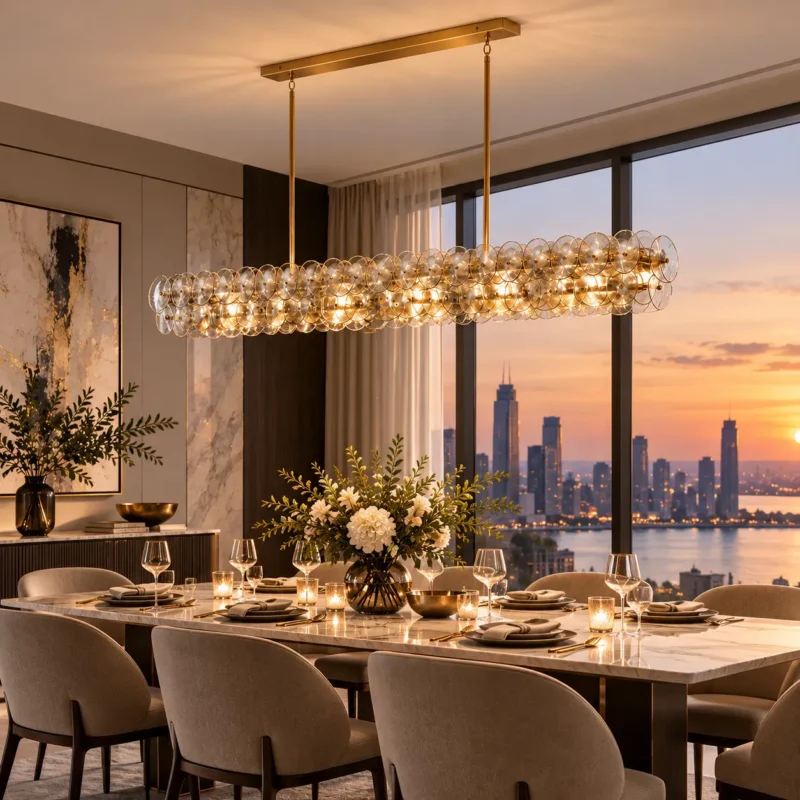
For a cohesive palette, pair the pendant with warm off-white upholstery, soft brown wood, and restrained gold details. Glass and metal contrast nicely with matte textiles. Where the tabletop is polished marble, test reflected highlights at different seating positions; a reflective surface can send bright images of the fixture toward diners.
3 | What lighting science says about warmth, brightness and glare
Color temperature is not the same as the color of the shade
Correlated color temperature (CCT) is expressed in kelvins (K). The U.S. Department of Energy explains that lower Kelvin values look warmer or more yellow, while higher values look cooler or bluer [1]. Warm-white sources—often approximately 2700–3000 K—are a common design choice for residential dining spaces. However, a golden glow in a photograph cannot verify this pendant’s actual CCT; confirm the offered lamp or LED specification before purchase.
Lumens and watts measure different things
Lumens describe light output, whereas watts describe electrical power use. Two luminaires using the same number of watts may produce different amounts of useful light because of differences in efficiency and optical design [1]. For a dining surface, the decisive questions are how much light reaches the tabletop, how evenly it is distributed, and how the result looks from seated positions—not simply whether a product has a high wattage.
Glare control is essential with decorative glass
Glare is affected by the brightness of the visible source, viewing direction, surrounding brightness, and reflective surfaces. Layered glass elements may scatter and repeat highlights, making it especially useful to inspect the pendant from seated and standing positions. Diffusion, shielding, appropriate height, and compatible dimming (if supplied) can all help. Never assume a particular product is dimmable without confirming its driver and control compatibility.
Good dining light comes in layers
Research and practice discussed by the Illuminating Engineering Society emphasize the relationship between table illumination, visual contrast and perimeter or ambient light [2]. A chandelier can establish the focal point while recessed lighting, wall washes, or cabinetry lighting softly support the background. Aim for a comfortable, usable setting rather than a dramatic but underlit table. The IES also discusses how layered light improves residential and hospitality environments [3].
4 | Bring the look into the kitchen
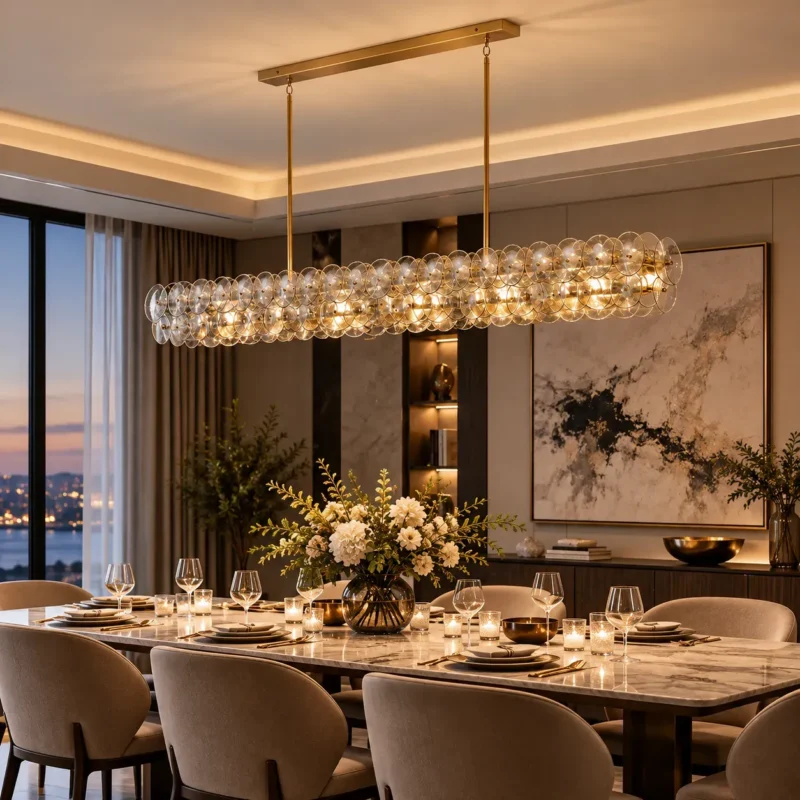
In an open kitchen, the same pendant can echo the length of an island while complementing brass fixtures, warm stone and quiet cabinetry. Center it over the island’s principal seating or preparation zone, making sure its body does not interfere with cabinet doors, range hoods, or circulation. If the kitchen is used for chopping, measuring or reading recipes, task lighting should be planned alongside the feature light.
Kitchen lighting benefits from combining daylight, task sources and ambient light rather than relying on a single decorative luminaire. An IES educational program on evidence-based kitchen lighting specifically addresses placement, lighting layers, and performance [4]. It is sensible to keep food-preparation task lighting controllable separately where the electrical design allows.

5 | Before buying: a practical specification checklist
- Confirm the exact fixture length, width, overall height, minimum and maximum suspension height, and canopy dimensions.
- Check total weight, ceiling attachment requirements, and whether the ceiling structure can support the load.
- Ask for verified wattage, total lumens, correlated color temperature (K), and color rendering metrics if available.
- Confirm whether light sources are replaceable, integrated, included, and compatible with the intended voltage.
- Check dimmability and the specific type of compatible dimmer; visual photos alone cannot establish this.
- Confirm the glass component material, cleaning instructions, warranty and replacement-part availability.
- Ensure the fixture is rated for the installation environment and installed by a qualified electrician under applicable codes.
6 | Easy styling formula: sparkle without visual clutter
Let the glass discs be the main decorative element. If using a stone table, choose low-profile ceramics, textured linen, and a restrained floral centerpiece. Repeat gold in small doses—a vase rim, cutlery, or one picture frame—rather than in every object. For a darker interior, wall lighting or subtle ceiling coves can create a luminous backdrop that balances the high sparkle of the pendant.
In daylight, the gold-toned frame and the transparent layers act as a design object. At night, the pendant becomes a visual anchor. This day-to-evening shift is one of the strongest reasons to choose a sculptural statement piece: it contributes architectural interest even when switched off.
Frequently asked questions
Is a disc-glass chandelier suitable for a rectangular table?
Yes. A linear silhouette often complements rectangular dining tables because the shapes share an orientation. Match dimensions to the furniture and room rather than selecting by style alone.
Can this fixture be the only light in a kitchen?
It should not automatically be treated as the only kitchen light. Dedicated task lighting and general illumination are often necessary to support food preparation and comfortable navigation.
Will the glass discs create glare?
They can create visible highlights, depending on the light source, fixture design and viewing angle. Verify the fixture in its intended mounting position and consider supplementary, lower-glare lighting.
Is the pictured warm color definitely 3000 K?
No. Photography, editing, exposure and surrounding finishes affect apparent color. Ask for the actual CCT specification.
Final thoughts
The Modern Disc Glass Linear Pendant Light brings an elegant architectural rhythm to dining rooms and kitchen islands. Its layers of circular glass and gold-toned framework complement both soft neutral rooms and more dramatic evening interiors. The strongest results come from pairing expressive aesthetics with a carefully designed lighting plan: thoughtful proportions, comfortable sightlines, adequate task light and verified product specifications.
Modern Disc Glass Linear Pendant Light -Click to view the product