

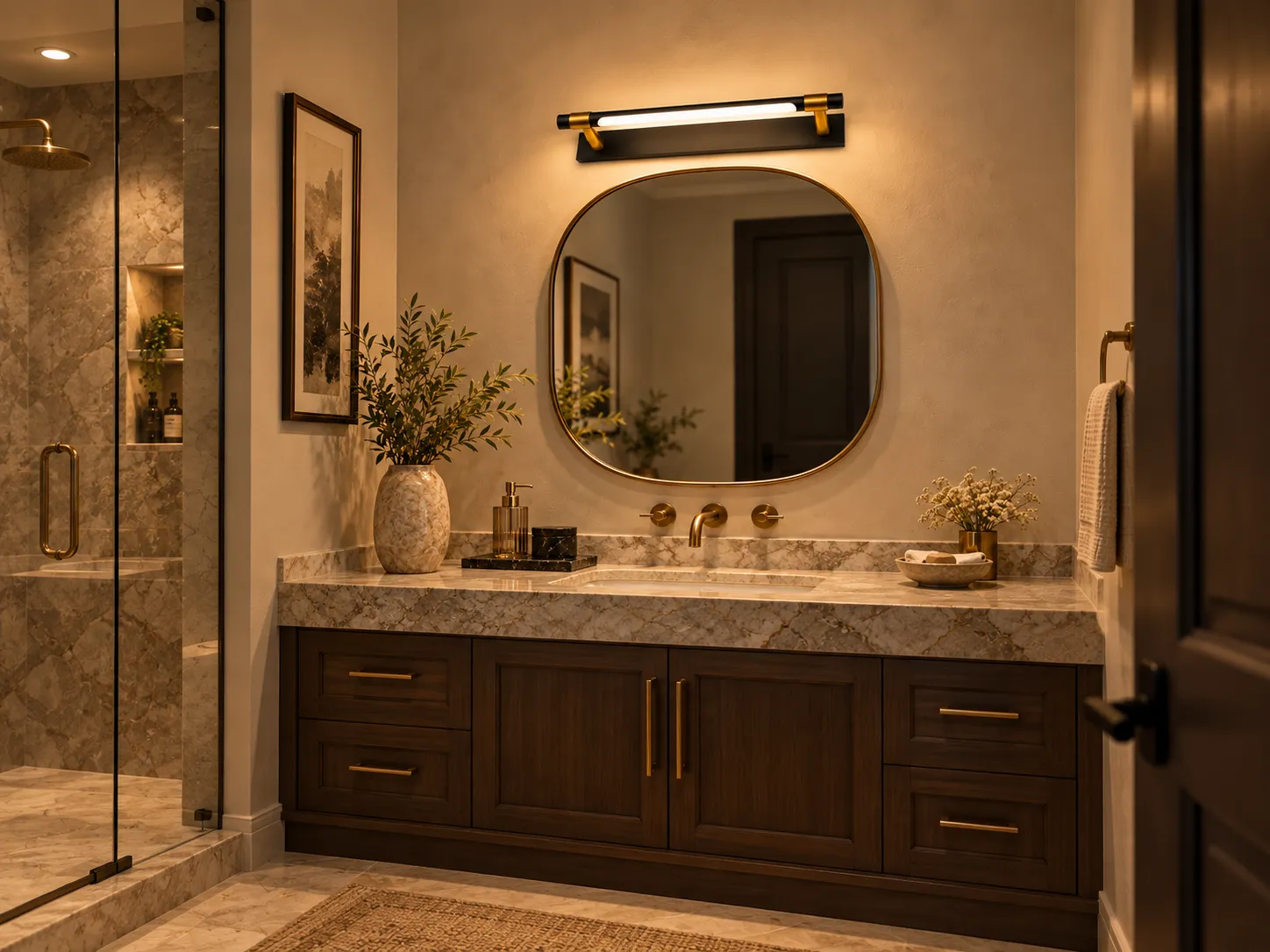

Black and Gold Linear LED Mirror Wall Light: A Practical Guide to Modern Bathroom Vanity Lighting
How proportion, color temperature, diffusion, glare control, and layered lighting work together around the bathroom mirror
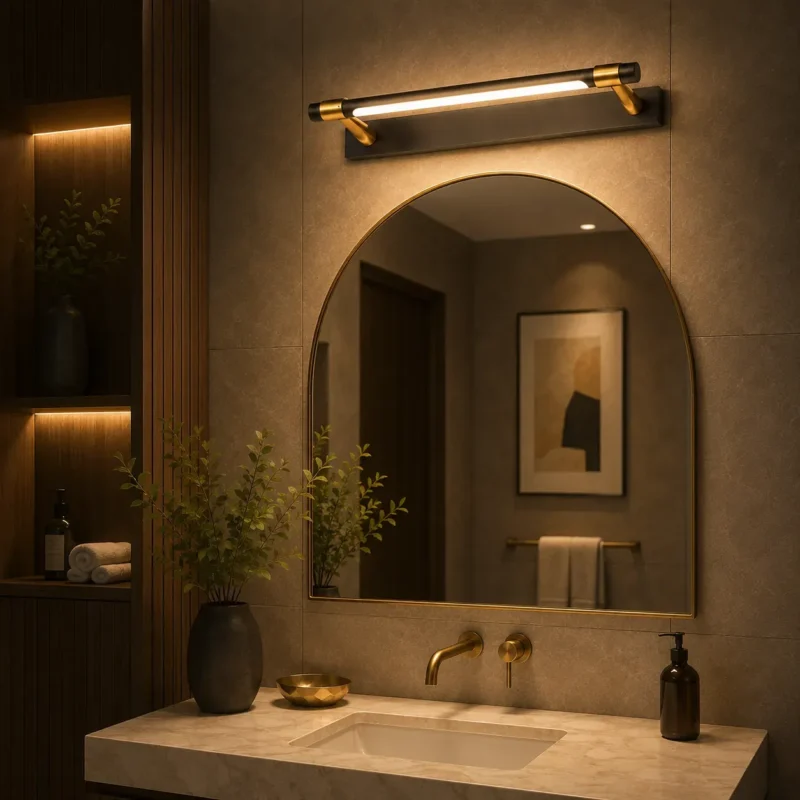
A black-and-gold linear LED mirror light used as the primary visual focus above a warm contemporary vanity.
Product Snapshot
| Fixture Type | Linear LED mirror / vanity wall light |
| Finish | Matte black with brushed gold accents |
| Main Material | Iron metal body |
| Diffuser | Acrylic |
| Length | 48 cm / 18.90 in |
| Projection from Wall | 10 cm / 3.94 in |
| Integrated Light Source | LED module |
| Rated Power | 8 W |
| Input Voltage | AC 110–240 V |
| Color Temperature | 3000 K warm white |
| Approx. Luminous Flux | 500–700 lm |
| Typical Applications | Bathroom mirror, washbasin, bedroom, hallway, hotel and apartment interiors |
Introduction: Why Vanity Lighting Deserves More Attention
The bathroom mirror is one of the most visually demanding areas in the home. People use it for shaving, skincare, hair styling, makeup, contact lenses, and other close-range tasks that depend on clear perception of facial detail. Yet mirror lighting is often selected primarily for appearance. A fixture may look attractive on the wall but still produce unhelpful shadows, excessive glare, or an uneven pool of light.
A well-designed vanity light addresses these issues by combining appropriate light output with good optical control and sensible placement. The black-and-gold linear LED wall light shown here is a useful example because its form is simple, its light source is integrated, and its warm metallic detailing allows it to function as both a technical lighting tool and a decorative object. The long horizontal profile also makes it naturally suited to the geometry of mirrors and washbasin counters.
The key principle is that bathroom lighting should be evaluated as a system rather than as a single product. The fixture, mirror size, wall color, ceiling lighting, daylight, and the user’s position all influence the final result. In other words, a vanity light is most successful when it is chosen as part of a complete lighting strategy rather than as an isolated accessory.
Design Language: Why Black and Gold Works in Contemporary Bathrooms
Black and gold is a high-contrast material pairing that can feel both modern and classic. Matte black visually anchors the fixture and gives it a crisp architectural outline, while brushed gold introduces warmth and connects naturally with brass faucets, mirror frames, cabinet hardware, and decorative accessories.
This combination is especially effective in bathrooms with stone, marble, warm beige plaster, dark tile, walnut cabinetry, or oak. Against pale walls, the black body creates definition; against dark surfaces, the gold details prevent the fixture from visually disappearing. Because the fixture itself is narrow and linear, the color contrast adds presence without making the light appear bulky.
The linear form also brings order to compositions that include round or arched mirrors. A straight horizontal luminaire above a curved mirror creates a controlled contrast between geometry types. This is why the same fixture can work with circular, pill-shaped, arched, or rectangular mirrors: the lamp establishes a clear horizontal axis while the mirror contributes the larger visual shape.
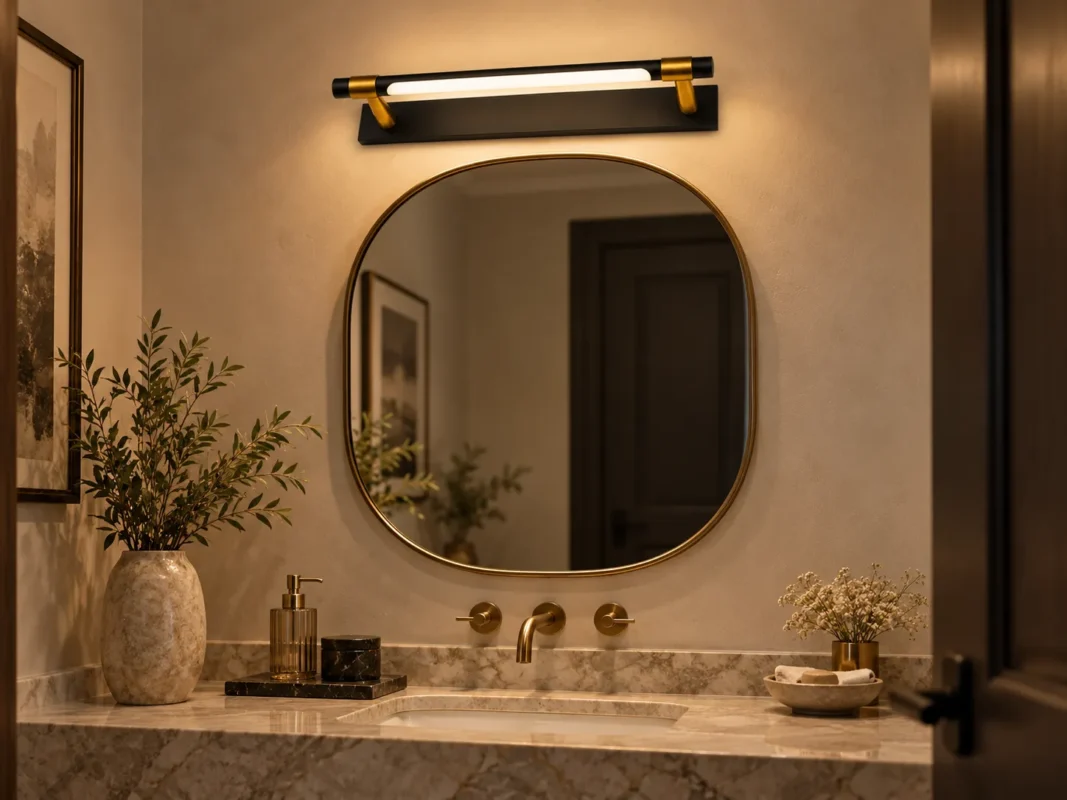
The black structure adds visual definition, while gold accents coordinate with warm metal hardware and mirror frames.
Lighting Science: What 3000 K Actually Means
Color temperature describes the visual appearance of white light and is expressed in kelvins (K). A 3000 K LED source is generally perceived as warm white. It is warmer than neutral office lighting around 4000 K and much warmer than daylight-like lighting above 5000 K.
In residential bathrooms, 3000 K is popular because it supports a calm, hospitality-inspired atmosphere and works well with skin tones, wood, stone, bronze, and brass finishes. The important point is that color temperature is not the same as color rendering. Two lamps can both be 3000 K yet render colors differently. Color quality depends on the spectral characteristics of the LED and should be considered separately.
The U.S. Department of Energy notes that modern LEDs are available in a wide range of color qualities and that CRI values of 80 or higher are common for interior lighting, while values of 90 or higher indicate very good color fidelity. For a vanity area, better color fidelity is especially useful because users often judge subtle differences in complexion, cosmetics, fabrics, and finishes at close range.
Color Rendering: CRI Is Useful, but It Is Not the Whole Story
CRI, or Color Rendering Index, has long been used to describe how faithfully a light source renders colors compared with a reference source. It remains familiar and useful in the lighting industry, but current color science recognizes that CRI alone does not describe every aspect of color quality.
The International Commission on Illumination (CIE) has recommended broader color-fidelity methods for scientific evaluation and has encouraged adoption of newer metrics alongside traditional CRI. This matters because a vanity fixture is not just illuminating walls and counters; it is illuminating human skin, makeup colors, hair tones, and reflective materials.
For practical residential specification, a buyer does not need to become a color scientist. The useful takeaway is simple: where appearance is important, select an LED product with good color rendering and avoid judging quality by color temperature alone. If detailed photometric data are available, CRI, R9, and newer color-fidelity metrics can provide a more complete picture.
Light Output: Why Lumens Need Context
This fixture is listed at approximately 500-700 lumens with an 8 W integrated LED source. Lumens describe the total quantity of visible light emitted, but they do not tell us where the light goes. A compact downlight and a linear vanity lamp may produce the same lumen value while creating very different visual conditions.
For mirror lighting, distribution is particularly important. A long source spreads light across a wider area than a point-like source, which can reduce localized brightness and create a more even appearance. The acrylic diffuser also helps soften the apparent LED source so that the user sees a continuous luminous strip instead of individual LED points.
The wall and mirror also participate in light distribution. Pale finishes reflect more light into the room, while dark tile absorbs more. This explains why the same fixture can feel brighter in a light bathroom and more intimate in a dark one. Lumen output should therefore be evaluated together with room reflectance, fixture position, and supporting ambient lighting.
Why Diffusion Matters Around a Mirror
Acrylic diffusers are commonly used with LED luminaires because they can hide individual diodes, blend their output, and reduce sharp brightness transitions. This does not eliminate glare automatically, but it can make the luminaire visually softer and more comfortable.
Near a mirror, uncontrolled brightness can be especially distracting because the luminaire may appear directly in the field of view or be reflected in polished surfaces. A diffused linear source reduces the contrast between the bright emitter and the surrounding wall, helping the eye adapt more comfortably.
The design goal is not simply to make the diffuser as opaque as possible. Excessive diffusion can lower optical efficiency. Good luminaire design balances transmission, diffusion, brightness, and geometry so that enough light reaches the task while the source remains visually comfortable.
Vertical Illumination and Facial Shadow Control
For grooming, light that reaches the face from the front is generally more useful than light that arrives only from above. Strong overhead lighting can create shadow under the brow, nose, and chin. This is why lighting guidance frequently emphasizes soft vertical illumination around vanity zones.
A horizontal fixture above the mirror can provide useful frontal light when it projects forward from the wall and directs a portion of its output toward the user. The 10 cm projection of this fixture helps move the source away from the wall plane, which can improve the angle of illumination compared with a very shallow decorative strip.
For demanding grooming tasks, the best arrangement may include side lighting as well. The Illuminating Engineering Society has specifically discussed the value of soft vertical illumination at vanity areas because it supports visibility for shaving, makeup, and hair styling. In a home bathroom, this can be achieved through side sconces, a lighted mirror, or well-designed ambient lighting that fills shadows created by the top fixture.
Layered Lighting: Why One Fixture Should Not Do Everything
A successful bathroom is rarely lit by one fixture alone. Layered lighting combines different sources for different purposes. Ambient lighting provides general visibility, vanity lighting supports tasks at the mirror, and accent lighting creates depth or highlights materials.
In a small powder room, a linear mirror light may contribute a large share of the total illumination. In a larger bathroom, it should usually be supported by ceiling lights, cove lighting, shelf lighting, or daylight. This improves flexibility: bright layers can be used during morning routines, while a reduced combination can create a calmer atmosphere in the evening.
Layering also prevents a common design problem in which a beautiful vanity wall is bright while the rest of the room remains visually flat or excessively dark. The goal is not equal brightness everywhere; it is a deliberate hierarchy of light that supports navigation, grooming, and mood.
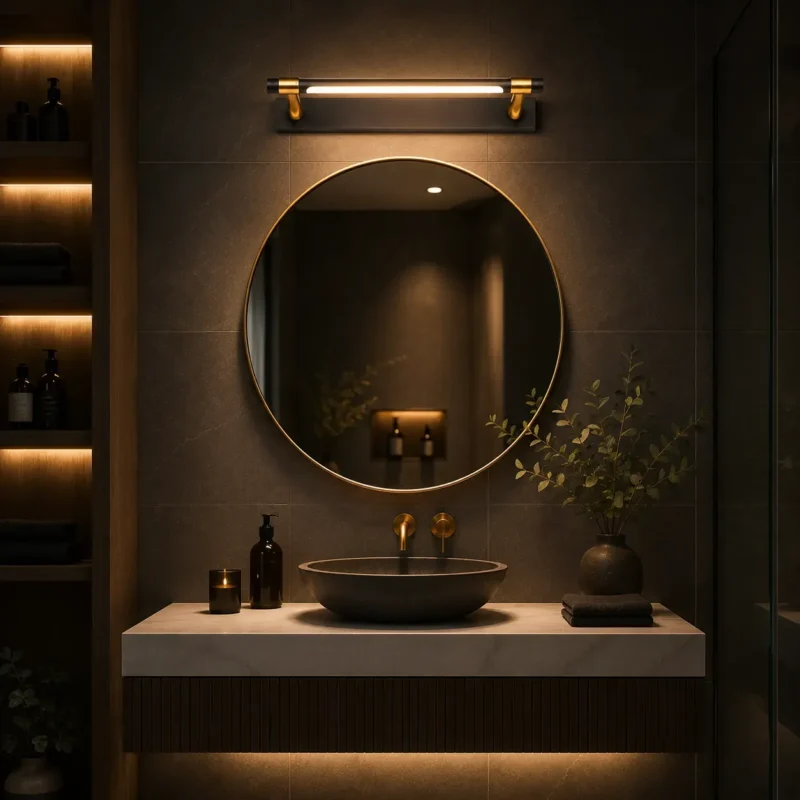
In darker bathrooms, the vanity light works best as one layer within a broader lighting composition.
How to Size a Linear Vanity Light for the Mirror
There is no single universal fixture-to-mirror ratio, but proportion is important. A fixture that is too short can look visually weak above a wide mirror, while a fixture that is nearly as wide as the mirror can dominate the composition.
With a 48 cm fixture length, this model is well suited to many single-basin vanities and medium-size mirrors. Above a compact round mirror, it can create a strong horizontal accent. Above a wider rectangular mirror, it may be centered as a focused decorative element rather than attempting to span the entire mirror width.
When sizing, consider three dimensions together: mirror width, vanity width, and fixture length. The visual centerline of the fixture should generally align with the mirror and basin unless the bathroom has an intentionally asymmetrical design.
Warm Light, Dark Surfaces, and Material Perception
Warm 3000 K light is especially effective with black, brass, bronze, beige stone, walnut, and cream marble because it reinforces their warm undertones. In darker bathrooms, warm light also creates a dramatic hospitality effect, particularly when paired with concealed shelf lighting or under-vanity lighting.
However, a very dark room can absorb a significant portion of the emitted light. This is visible in moody bathrooms with charcoal tile or dark cabinetry: surfaces appear rich and dramatic, but more total light may be needed to reach the same perceived brightness as a pale room.
Designers can respond by adding indirect light, increasing ambient output, or using higher-reflectance surfaces near the vanity. The mirror itself also helps redistribute light because it reflects both the room and the luminous environment.
Installation Height and Positioning
Installation height should be chosen according to mirror size, user height, ceiling height, and fixture geometry rather than by following one rigid dimension. The light should sit high enough to avoid blocking the mirror but low enough to direct useful light toward the face and counter.
Before installation, place the mirror and mark its centerline. Then test the visual relationship between the fixture, mirror, basin, and faucet. The wall should provide enough clear space for the backplate and electrical box. Because this fixture projects approximately 10 cm from the wall, it should also be checked against tall medicine cabinets, shelves, or architectural details.
Electrical work in bathrooms should follow local electrical and building codes. Wet and damp locations can require specific ratings, zones, and wiring practices. Product suitability should always be verified for the intended installation location rather than assumed from appearance alone.
Energy Efficiency and LED Lifetime
An 8 W integrated LED fixture can provide useful vanity illumination while using relatively little power. This is one of the major advantages of LED technology: high light output can be achieved with lower electrical input than older incandescent technologies.
The U.S. Department of Energy notes that good-quality white LED products can have useful lives in the tens of thousands of hours. LED life is typically described in terms of lumen maintenance rather than sudden failure. For example, an L70 rating refers to the point at which output has declined to 70 percent of its initial level.
The actual service life of an integrated LED fixture also depends on driver quality, thermal management, operating temperature, switching cycles, and manufacturing quality. Long LED chip life does not guarantee that every electronic component will last equally long, so fixture construction and driver reliability remain important selection factors.
Where This Fixture Works Best
The combination of a compact linear profile, warm 3000 K light, matte black body, and brushed gold details makes this type of fixture especially appropriate for contemporary bathrooms with warm materials.
It can work above a single-basin vanity, in a powder room, in a hotel guest bathroom, above a dressing mirror, or even as a decorative wall light in a hallway or bedroom. The visual character leans modern and slightly industrial, but the gold accents soften that industrial quality and allow it to work in transitional interiors as well.
In hospitality environments, the black-and-gold palette can coordinate with dark wood, smoked glass, brass hardware, and stone. In residential spaces, it can become a small but effective focal point that ties together faucets, handles, and mirror trim.
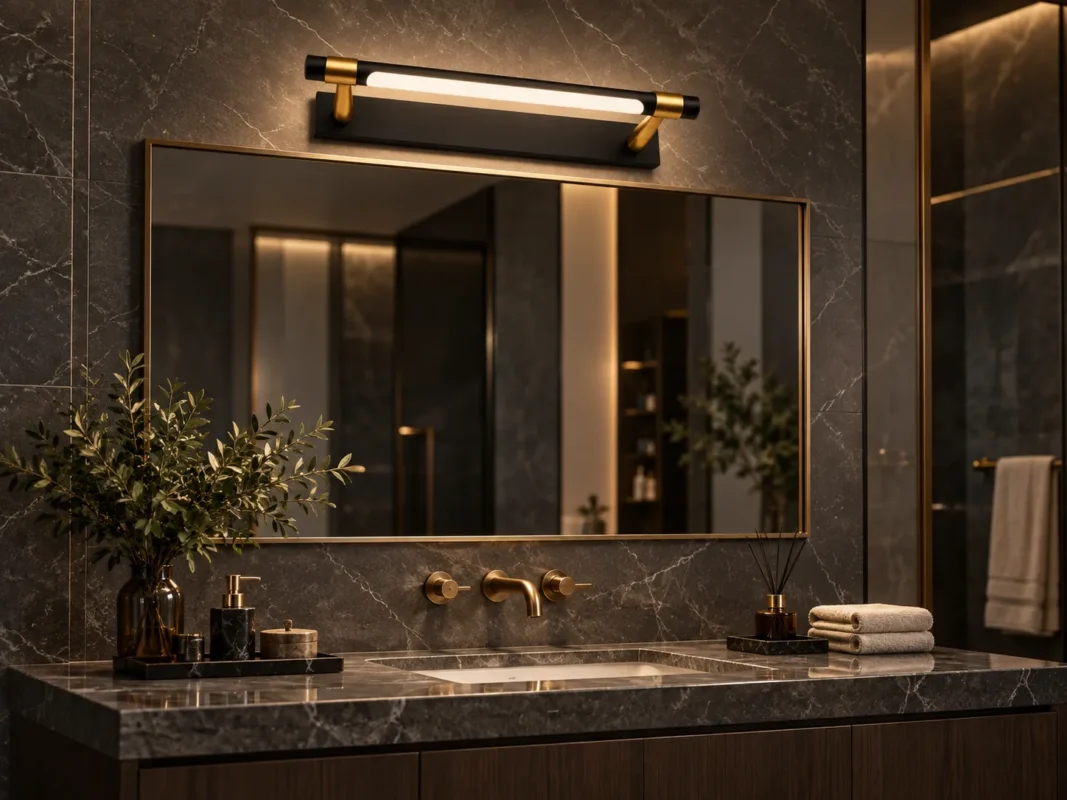
The linear fixture can also anchor larger, more luxurious bathroom compositions when coordinated with dark stone and warm metallic details.
Practical Selection Checklist
Before choosing a vanity wall light, review the following points:
– Confirm the fixture dimensions against the mirror and vanity width.
– Check the listed wattage and lumen output, but also consider light distribution.
– Choose color temperature to match the desired atmosphere; 3000 K is warm and residential in character.
– Look for good color rendering when facial appearance and cosmetics are important.
– Verify whether the product is rated for the intended bathroom location.
– Confirm voltage compatibility with the local electrical system.
– Consider whether the integrated LED and driver are serviceable or replaceable.
– Plan additional ambient or side lighting if the bathroom is large or visually demanding.
– Coordinate black and gold finishes with faucets, handles, mirror trim, and other hardware.
– Use a qualified installer where required by local regulations.
Conclusion: A Small Fixture with a Large Design Role
A vanity light occupies relatively little physical space, but it has a major influence on the bathroom experience. It sits directly in the primary field of view, interacts with the mirror, affects how faces and materials are perceived, and often becomes one of the strongest decorative accents in the room.
The black-and-gold linear LED mirror wall light succeeds because it combines a clear architectural form with warm visual character. Its 48 cm length, 3000 K light, acrylic diffusion, integrated LED source, and restrained black-and-gold palette make it suitable for many modern bathrooms where the goal is both practical illumination and a refined atmosphere.
The broader lesson is that good vanity lighting is not about selecting the brightest fixture. It is about choosing the right combination of output, distribution, color quality, position, proportion, and supporting light. When those elements are considered together, the mirror zone becomes more comfortable to use and more visually complete.
Black and Gold Linear LED Mirror Wall Light for Modern Bathroom | Click to View Product