

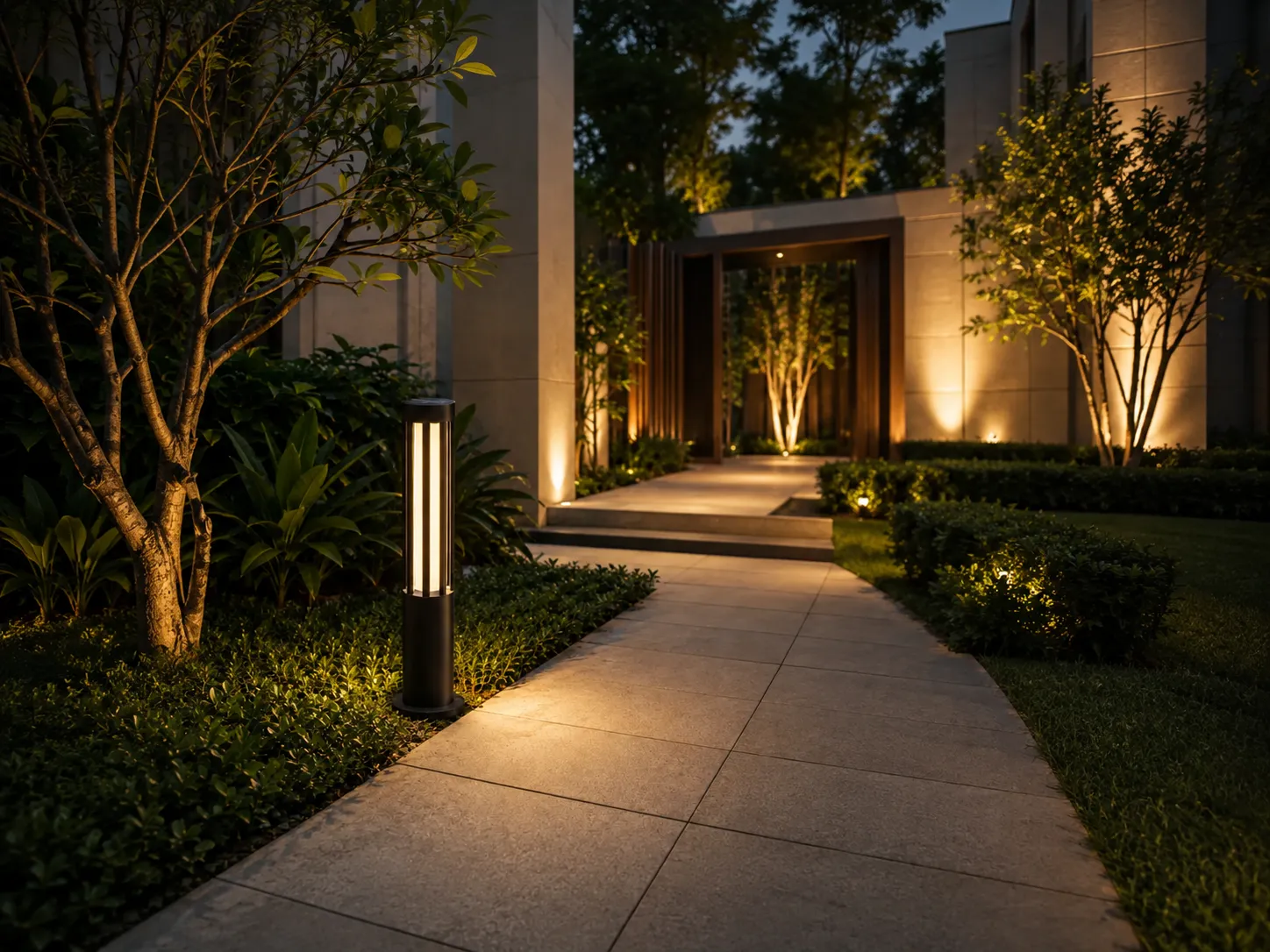

A practical, science-informed guide to modern bollard lighting for gardens, villas and pedestrian pathways
Outdoor lighting is not only about brightness
A well-lit garden path should feel easy to read, comfortable to walk through and visually connected to the architecture around it. That means the best outdoor lighting is rarely the brightest lighting. Instead, successful pathway illumination balances visibility, uniformity, glare control, color appearance and energy use.
This is where bollard lights are especially useful. Positioned close to pedestrian eye level but below typical wall and pole luminaires, they can define path edges, reveal changes in paving, highlight planting and create a calm visual rhythm through a landscape. The goal is to provide enough light for orientation without turning a garden into a floodlit space.
Science in practice
The Illuminating Engineering Society treats pedestrian lighting as a combination of reassurance, safety, visual comfort, environmental responsibility and enjoyment. The U.S. Department of Energy also notes that well-designed LED outdoor luminaires can improve uniformity while reducing energy use compared with older high-intensity-discharge systems.
1. Molde Black Halo: architectural light with a softer visual signature
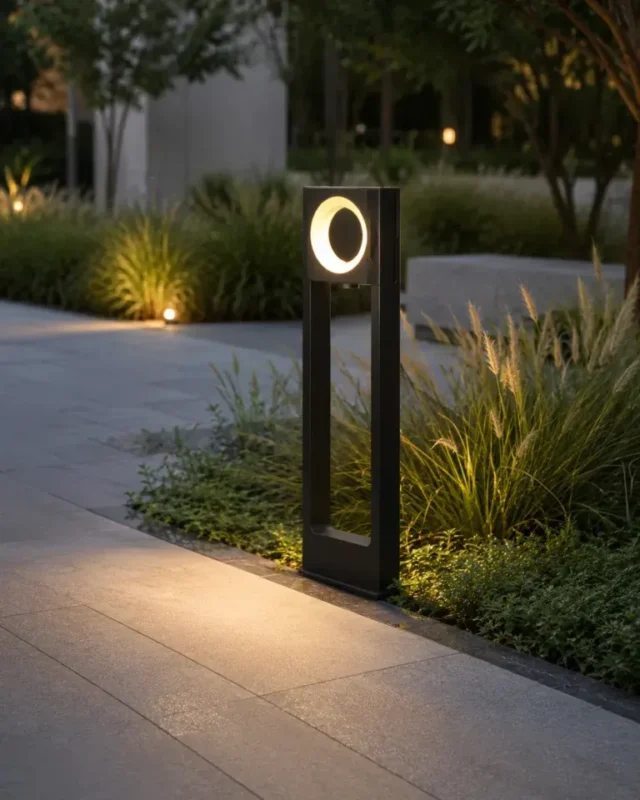
The Molde Black Halo Outdoor Bollard Light is built around a luminous ring set into a slim black frame. The form is immediately legible in the landscape: the dark structure almost disappears at night while the circular light becomes a visual marker along the path.
According to the Xunlu Lighting product specification, the fixture uses a black aluminum body, an acrylic ring diffuser and an integrated 12W LED module rated at 1000 lm. It is available in 3000K, 4000K and 6000K color temperatures, uses AC 110–240V power, is IP65-rated, and measures approximately 20 × 10 × 60 cm (7.9 × 3.9 × 23.6 in).
| Specification | Molde Black Halo |
| Design | Halo-style rectangular bollard |
| Material | Aluminum body + acrylic diffuser |
| Light source | Integrated LED |
| Rated power | 12W |
| Nominal output | 1000 lm |
| CCT options | 3000K / 4000K / 6000K |
| Ingress protection | IP65 |
| Size | 20 × 10 × 60 cm / 7.9 × 3.9 × 23.6 in |
| Best suited to | Villa entrances, garden paths, lawns, corridors and landscape edges |
Why the halo geometry works: a diffused luminous ring spreads apparent brightness across a larger visible area than a tiny exposed point source. In practice, that can make the fixture feel visually softer at close range, provided the product is installed and aimed so that the brightest surfaces are not directly in the normal line of sight.
2. Black Cylindrical Bollard: vertical rhythm and low-key guidance
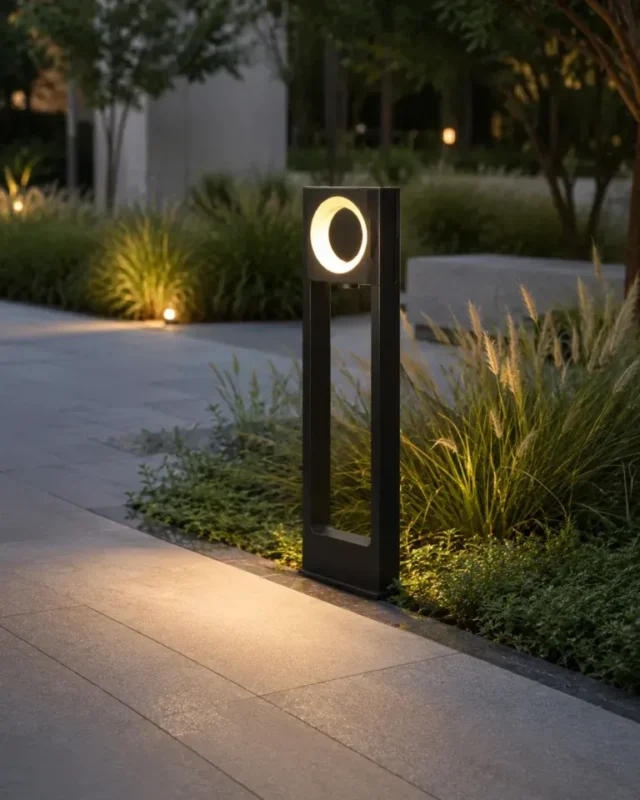
The Black Cylindrical Outdoor Bollard Light takes a different approach. Rather than presenting a single luminous ring, its tall cylindrical form uses vertical illuminated elements within a matte black body. The result is a more linear, understated lighting effect that suits contemporary gardens, drive approaches and long pathways.
Xunlu Lighting lists the cylindrical model with an aluminum body, acrylic diffuser, integrated LED source, approximately 5W power, AC 110–240V input, selectable 3000K / 4000K / 6000K color temperatures and an IP65 rating. Three heights are available: 40 cm, 60 cm and 80 cm, all with a diameter of approximately 10.5 cm.
| Specification | Black Cylindrical Bollard |
| Design | Slim cylindrical bollard with vertical luminous elements |
| Material | Aluminum + acrylic diffuser |
| Light source | Integrated LED |
| Rated power | Approx. 5W |
| CCT options | 3000K / 4000K / 6000K |
| Ingress protection | IP65 |
| Sizes | Ø10.5 × H40 / H60 / H80 cm |
| Best suited to | Paths, courtyards, lawns, villa landscapes and commercial outdoor areas |
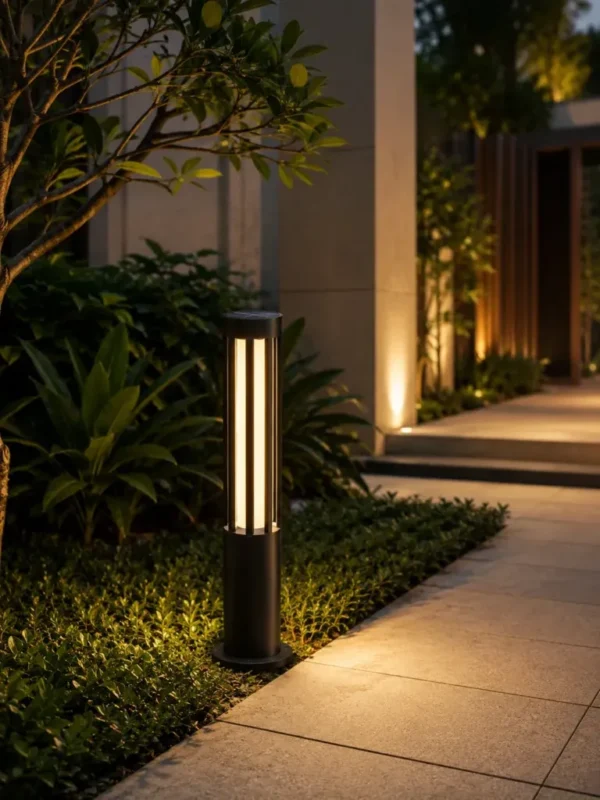
A cylindrical bollard can create a strong vertical rhythm along planting beds and entrance routes.
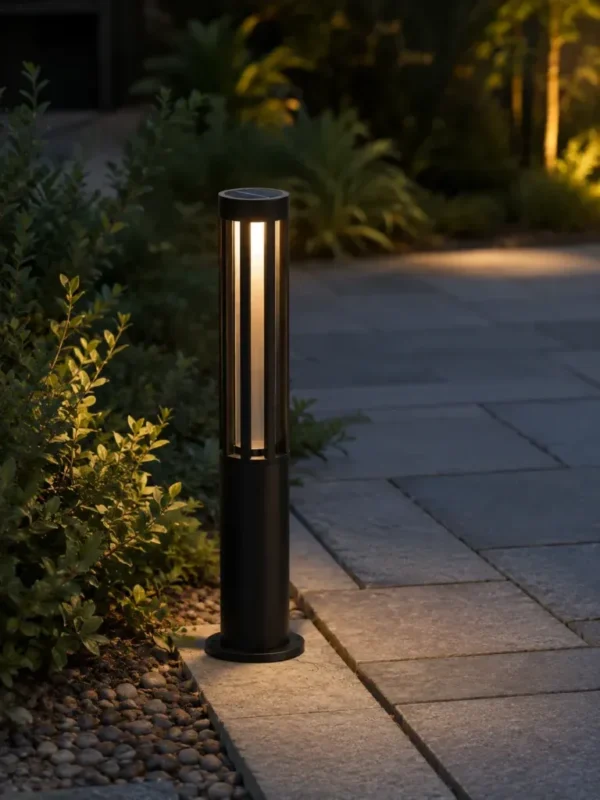
The same fixture family can feel quieter and more integrated when used beside a darker, naturalistic path.
3. What “good” pathway lighting actually means
Uniformity often matters more than maximum brightness
For pedestrians, sudden bright-to-dark transitions can be more uncomfortable than a consistently moderate light level. The eye needs time to adapt when luminance changes sharply. A row of carefully spaced bollards can therefore be more useful than a few very bright fixtures because it creates a more predictable sequence of illuminated zones.
The U.S. Department of Energy has highlighted uniformity as a key advantage of well-designed LED outdoor systems. In one DOE outdoor-area comparison, an LED configuration achieved a maximum-to-minimum ratio of 2.68:1 while using less energy than the reference high-pressure-sodium system. The exact values in a garden will differ, but the principle is useful: evaluate the light pattern across the route, not only the brightness directly under a fixture.
Glare control protects comfort and visibility
Glare is not simply an aesthetic problem. A very bright source in a dark environment can reduce visual comfort and make nearby details harder to perceive. For bollard lighting, the practical strategy is to keep luminous surfaces diffused, avoid placing fixtures directly in the central line of sight, and use spacing that does not require excessively high output from each unit.
Color temperature changes the character of the landscape
Both Xunlu models are offered in 3000K, 4000K and 6000K. For residential gardens, 3000K generally creates the warmest and most relaxed appearance, especially beside wood, stone and warm-toned planting. 4000K provides a cleaner neutral impression and can suit contemporary architecture. 6000K appears much cooler and can feel visually harder in a residential night landscape, so it is best used only when that crisp effect is intentionally desired.
4. How to position bollard lights around a home
A successful scheme starts with the walking route, not the fixture count. Identify where people need to make decisions: entrances, turns, steps, changes in paving, narrow sections and transitions between open and enclosed areas. Those points deserve more attention than evenly lighting every square meter of the garden.
- Along straight paths: use repeated spacing to create visual continuity, then fine-tune spacing after a nighttime mock-up.
- At steps and level changes: prioritize visibility of the leading edge and landing rather than aiming light directly into the eyes.
- Near planting: offset the bollard from dense foliage so leaves do not block the beam or create distracting high-contrast shadows.
- At villa entrances: use the Molde halo as a stronger architectural marker, or the cylindrical design when a quieter vertical accent is preferred.
- For long routes: consider alternating sides where appropriate to reduce the “runway” effect and improve depth cues.
5. Which of the two designs should you choose?
| Design priority | Molde Black Halo | Black Cylindrical |
| Visual presence | Stronger sculptural identity; halo becomes a visible nighttime landmark | More discreet, linear and architectural |
| Light expression | Soft luminous ring with broad visual glow | Vertical bands of light with a restrained profile |
| Power / output | 12W, 1000 lm listed | Approx. 5W listed |
| Height choice | Single 60 cm size listed | 40 / 60 / 80 cm options |
| Best for | Feature entrances, signature paths, modern villas | Long paths, planting edges, repeated landscape rhythm |
Neither design is universally “better.” The halo model is more expressive and can act as part of the architecture. The cylindrical model is easier to repeat in longer runs and gives designers more height flexibility. In many larger properties, the two can even be combined: a distinctive halo fixture near the main entrance and quieter cylindrical bollards along secondary garden paths.
6. LED efficiency and controls: use only the light you need
LED technology is well suited to exterior lighting because it combines controllability, long service potential and high efficacy. The U.S. Department of Energy’s current federal purchasing guidance lists an efficacy requirement of at least 100 lm/W for designated bollard luminaires in federal applications. That threshold is not a claim about these specific Xunlu products, but it is a useful reminder that modern outdoor lighting should be evaluated by both light delivered and power consumed.
Controls can improve the result further. Timers, photocells and motion-responsive strategies can reduce operating hours, lower energy use and keep the garden darker when no one is present. DOE guidance specifically notes that automatic and networked controls can add savings beyond luminaire efficiency alone.
7. Installation details that affect long-term performance
Both products are hardwired ground-installed outdoor luminaires, so installation quality matters as much as fixture selection. A stable mounting surface, weather-protected electrical connections, correct grounding where required, suitable cable routing and drainage around the base all contribute to reliable operation.
The product pages list an IP65 rating for both models. In practical terms, an IP rating should be treated as one part of the weather-resistance strategy, not a substitute for correct installation. Follow local electrical codes and use a qualified installer for permanent outdoor circuits, especially in wet locations or where underground cabling is involved.
8. A simple lighting recipe for a modern residential garden
For a warm contemporary villa landscape, start with 3000K. Use the halo bollard at the entrance or a major turn where a stronger visual marker helps orientation. Continue the route with cylindrical bollards at a consistent height to create rhythm. Keep surrounding planting slightly behind the fixtures so the light grazes foliage without being blocked.
Then test the scheme after dark before finalizing every position. Walk the path in both directions. Check whether any fixture appears uncomfortably bright from normal eye level, whether shadows hide changes in level, and whether one area is much brighter than the next. Small placement changes can improve comfort more effectively than simply increasing wattage.
Conclusion: light the journey, not just the ground
Good outdoor lighting should make movement feel intuitive while preserving the calm of the night environment. The Molde Black Halo Outdoor Bollard Light brings a sculptural, recognizable signature to entrances and feature paths. The Black Cylindrical Outdoor Bollard Light offers a quieter and more flexible way to build repeated guidance along gardens and walkways.
Used with thoughtful spacing, restrained brightness, appropriate color temperature and reliable controls, bollard lights can improve the usability of an outdoor space without overpowering it. The most successful result is one where people notice the garden and the architecture first—and the lighting simply makes both easier to experience.