

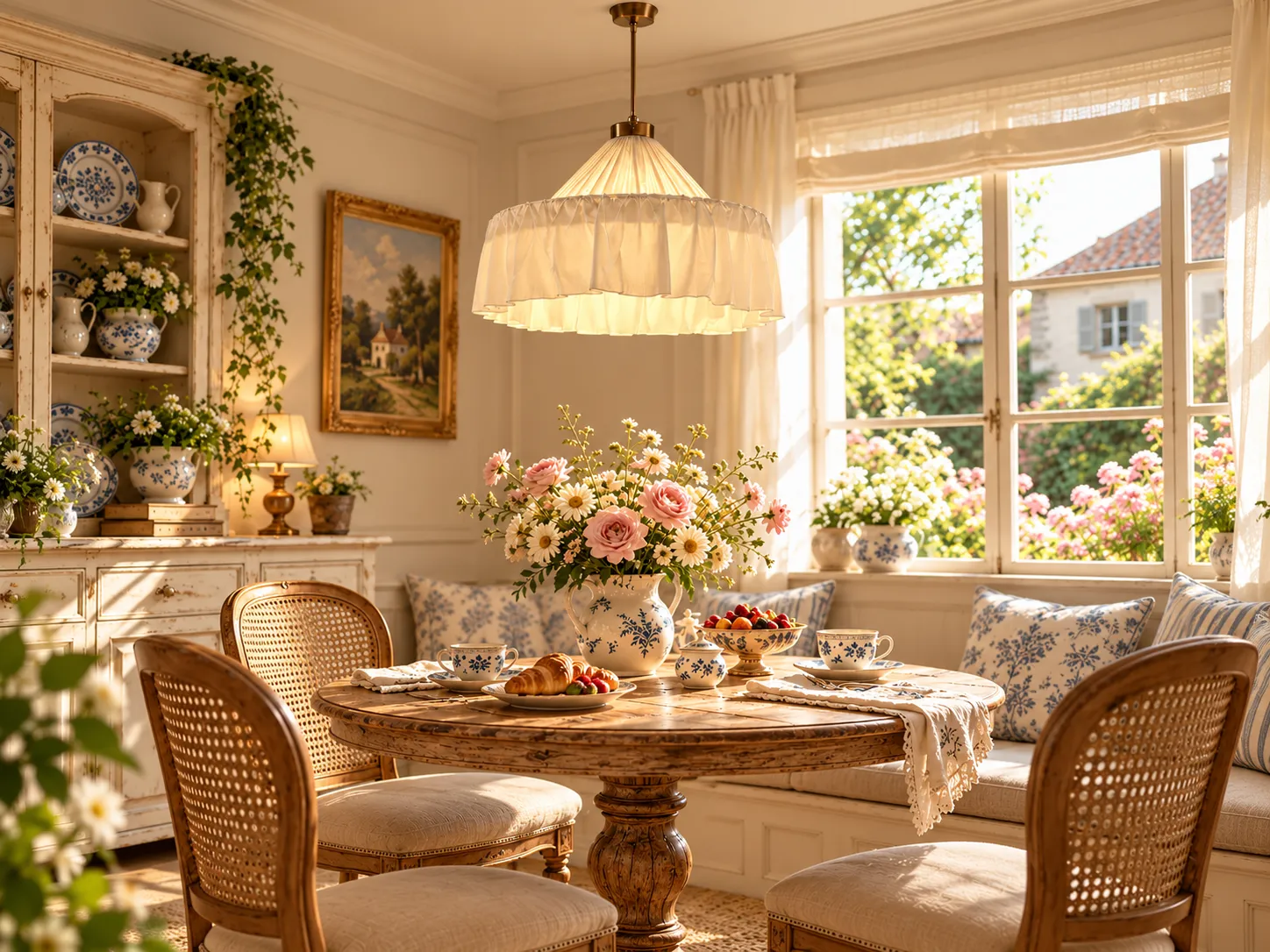

A practical, evidence-based guide to linen diffusion, 3000K color temperature, lumen output, scale, placement, and layered lighting for dining rooms, living rooms, bedrooms, cafés, and hospitality interiors.
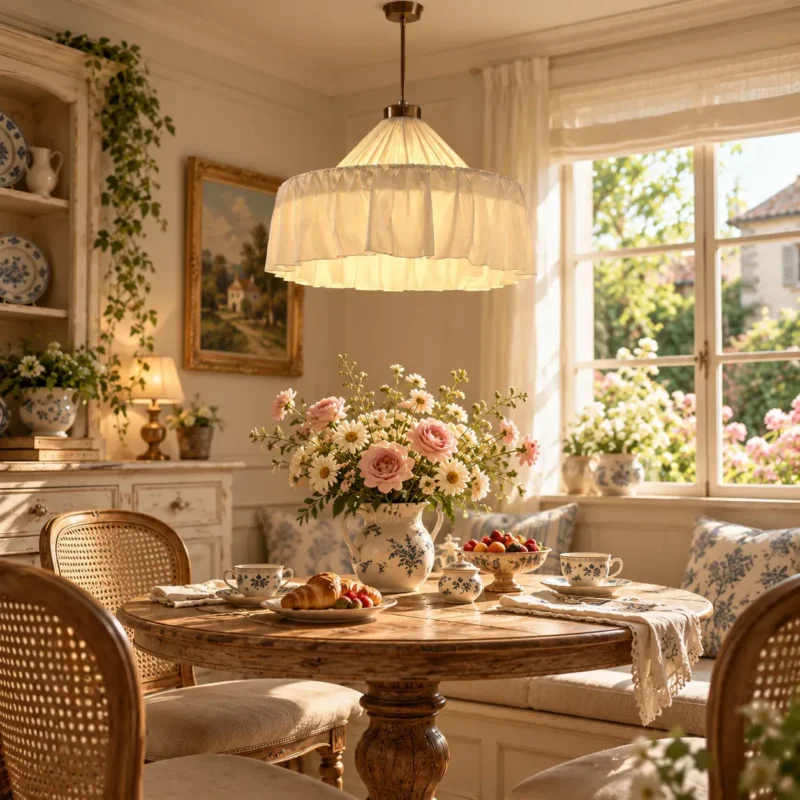
A softer kind of statement light
A pendant light can be visually dramatic without feeling hard or overly bright. The French Pleated Linen Pendant Light pairs a layered cream-white textile shade with antique-brass detailing, using texture and translucency to turn a single E27 light source into a broad, warm visual glow. Xunlu Lighting lists the fixture in two sizes—45 × 33 cm (17.72 × 12.99 in) and 60 × 38 cm (23.62 × 14.96 in)—with a 12 W LED, 3000K warm-white specification, and approximately 900–1,200 lumens depending on the bulb. [1]
Those numbers matter, but they do not tell the whole story. How comfortable a room feels also depends on where the light is distributed, how bright the source appears in your field of view, the color rendering of the bulb, room finishes, mounting height, and the amount of additional ambient or task lighting. The U.S. Department of Energy (DOE) specifically notes that real residential installations may need more or fewer fixtures depending on room size, geometry, and surface reflectance. [4]
Product at a glance
| Feature | 45 cm version | 60 cm version |
|---|---|---|
| Fixture size | 45 × H33 cm / 17.72 × H12.99 in | 60 × H38 cm / 23.62 × H14.96 in |
| Material | Metal + handmade pleated linen | Metal + handmade pleated linen |
| Finish | Cream white + antique brass | Cream white + antique brass |
| Light source | 1 × E27 LED bulb | 1 × E27 LED bulb |
| Listed power | 12 W | 12 W |
| Listed color temperature | 3000K warm white | 3000K warm white |
| Listed output | Approx. 900–1,200 lm, bulb-dependent | Approx. 900–1,200 lm, bulb-dependent |
| Adjustable suspension | Approx. 120–150 cm / 47.24–59.06 in | Approx. 120–150 cm / 47.24–59.06 in |
1. What the pleated linen shade actually does to light
A bare LED lamp can create a very high-brightness source in a small area. When light encounters a translucent textile, some rays are transmitted directly while others are scattered by the fibers, yarn geometry, surface texture, and air gaps in the weave. Research on architectural fabrics shows that light-colored fabrics can have meaningful diffuse transmittance, and that fabric structure and openness affect how light is redistributed. [5]
For a lampshade, the practical result is a broader luminous surface: instead of seeing only a concentrated point source, the eye also sees the illuminated fabric. That can reduce the visual harshness of the source and create softer transitions between bright and dark areas. The exact glare reduction cannot be predicted from material name alone—linen weight, lining, pleat depth, bulb position, and lumen output all matter.
The pleats add a second visual effect. Their alternating folds create small changes in thickness and angle, producing gentle gradients of light and shadow. That is why a cream fabric pendant can feel dimensional even when the palette is intentionally neutral.
2. Why 3000K works well with cream fabric and antique brass
Correlated color temperature (CCT) describes the color appearance of white light in kelvin. Lower values appear warmer; higher values appear cooler. DOE guidance describes 2700K as warm and 3000K as a soft, warm-pleasing appearance often used in homes, lobbies, and restaurants. [3]
That makes 3000K a logical match for this pendant’s materials. Warm-white light reinforces the cream shade and brass finish without pushing the room toward the orange tone of very low-CCT decorative lamps. In wood-rich, cottage, French-vintage, or cream-style rooms, it also tends to maintain visual continuity with warm finishes.
CCT is not a quality score. A 3000K bulb can still render colors poorly if its spectrum is weak. DOE notes that CRI 80 is a common minimum recommendation for interior lighting, while CRI 90 or higher indicates excellent color fidelity. [2] For spaces with flowers, food, artwork, warm timber, or patterned textiles, choosing a high-CRI E27 LED is often more important than choosing between two nearby warm-white CCTs.
3. Lumens matter more than watts for brightness
Watts measure electrical power input; lumens measure the amount of visible light produced. DOE recommends comparing light sources by lumen output rather than assuming wattage equals brightness. [3] The product page lists approximately 900–1,200 lumens for the selected E27 LED bulb. [1]
But fixture lumens and room illuminance are not the same thing. A textile shade absorbs and redirects some light, so the amount that reaches a tabletop, floor, or wall will be lower than the bulb’s raw output. Mounting height, shade geometry, room size, wall color, and the presence of other lights all influence the final result. That is why the listed “recommended area” should be treated as a broad product guideline rather than a photometric calculation.
4. Use it as part of a layered lighting plan
Residential lighting works best when one fixture is not forced to do every job. DOE residential guidance illustrates multiple approaches—direct, recessed, and indirect lighting—and emphasizes that actual fixture counts depend on the room and finishes. [4] A soft fabric pendant naturally serves the decorative and ambient layer; task lighting can be added where higher illuminance is needed.
| Layer | Purpose | Good companions for this pendant |
|---|---|---|
| Ambient | General room brightness | Pendant plus ceiling or indirect lighting |
| Task | Focused light for reading, prep, desk work | Table lamps, under-cabinet lights, directional spots |
| Accent | Adds visual hierarchy and highlights surfaces | Picture lights, wall washers, shelf lighting |
| Decorative | Defines style and atmosphere | The pleated linen pendant itself |
5. Choosing the right size and placement
Dining table
The 45 cm version suits smaller round or square tables, breakfast nooks, and compact dining areas. The 60 cm version has more visual presence and is better suited to wider tables or rooms where the pendant needs to read as the primary focal object. A common residential-design starting point is to hang the bottom of a pendant roughly 75–90 cm (30–36 in) above a dining tabletop, then adjust for fixture scale, sightlines, and ceiling height. This is a design convention, not an electrical code requirement.
Living room
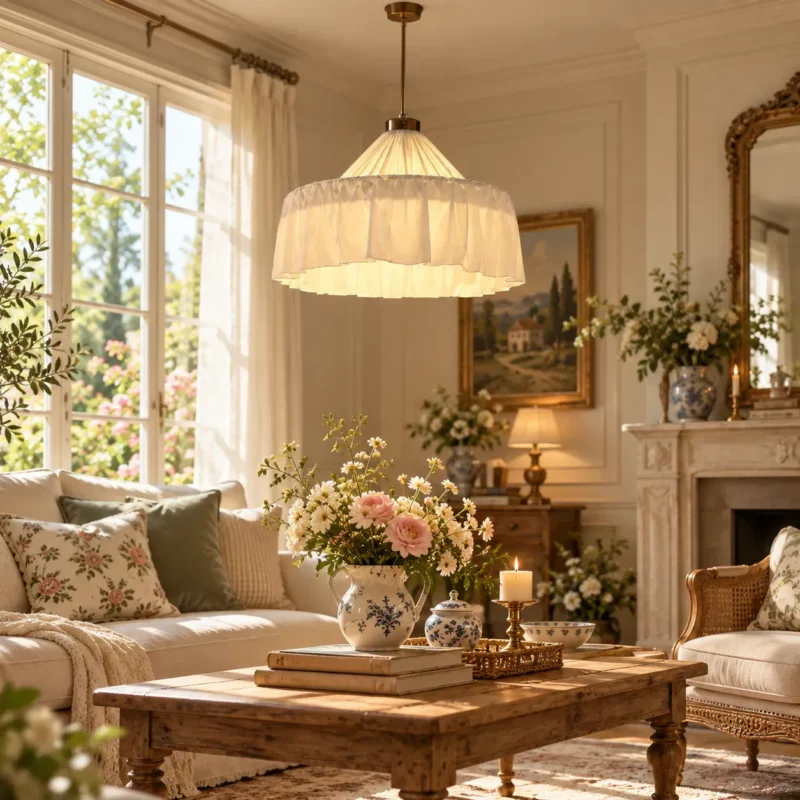
In a living room, the pendant is strongest when it anchors a defined zone—such as a coffee table, conversation area, or reading corner—rather than floating in an unrelated circulation path. Keep enough head clearance for normal movement, and use floor or table lamps for reading so the pendant can remain comfortably warm and atmospheric.
Bedroom
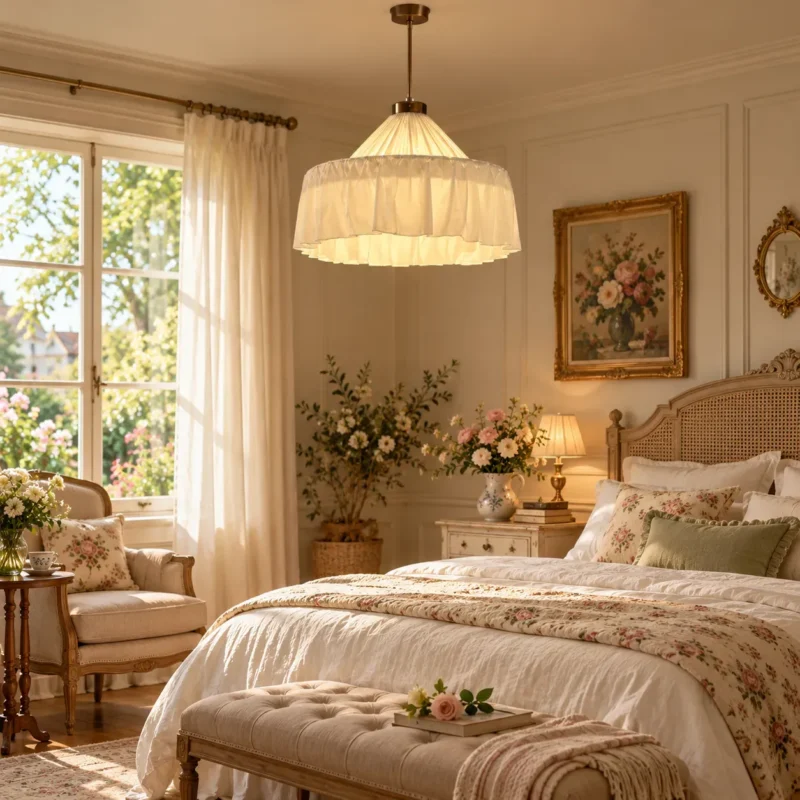
A fabric pendant can be particularly effective in a bedroom because the shade itself reduces the visual dominance of the bulb. Position it where it cannot be bumped and where it does not create direct glare when someone is lying in bed. If the room also needs dressing or reading light, add dedicated task lighting rather than increasing the pendant to an uncomfortable brightness.
6. Interior styles that suit a pleated linen pendant
The design works because its materials bridge several style categories rather than belonging to only one. The cream textile reads soft and relaxed, the pleating introduces traditional dressmaking detail, and the antique-brass hardware adds a subtle aged-metal note. That combination makes it easy to use in:
• French vintage and provincial rooms: Pair with warm white walls, muted florals, antique or reproduction wood furniture, cane seating, and aged brass.
• Cream-style interiors: Use tonal ivory, oatmeal, beige, and warm greige surfaces so the pleats provide texture without adding color noise.
• Romantic cottage rooms: Combine with botanical prints, soft linens, painted furniture, ceramics, and natural wood.
• Modern French spaces: Keep the architecture cleaner and let the fabric pendant provide the one softer, decorative gesture.
• Cafés, boutique hotels, and hospitality: Repeat the fixture over seating zones for a recognizable visual rhythm; use higher-output task or service lighting separately where staff need it.
7. Color rendering: the overlooked specification
A room full of warm materials can still look flat under a low-quality LED. CRI is a widely used measure of color fidelity, although DOE notes that newer metrics such as IES TM-30 can provide a more complete picture. [2] For everyday residential use, CRI 80 is acceptable, but CRI 90+ is a worthwhile upgrade when you want food, skin tones, flowers, timber, art, and patterned fabrics to look more natural.
For this pendant, color quality matters twice: first because the light is filtered by a cream textile, and second because the design is usually paired with warm, low-saturation interior palettes where subtle color differences are part of the aesthetic.
8. Installation, safety, and care
Electrical installation should follow local code and manufacturer instructions. Because the fixture is ceiling mounted and the suspension length is adjustable, final height should be set only after considering ceiling structure, walking clearance, table height, and the selected bulb. Use an LED bulb within the fixture’s specified rating and avoid higher-heat lamp types unless the manufacturer explicitly approves them.
For routine care, switch off power and allow the bulb to cool. Use a soft dry duster or low-suction upholstery attachment for the linen pleats. Avoid soaking the fabric or using aggressive household cleaners, which can distort the textile or leave water marks. Brass-colored metal parts are best wiped with a soft dry microfiber cloth unless the manufacturer specifies another method.
Frequently asked questions
Is 3000K warm white?
Yes. 3000K is generally perceived as a warm or soft white. DOE materials commonly classify 2700K as warm and 3000K as soft/warm-pleasing for homes and hospitality. [3]
Is 12 W bright enough for a dining room?
The wattage alone does not answer that question. The listed bulb output is about 900–1,200 lm, but shade losses, room size, surface colors, and mounting height affect delivered illuminance. Use the pendant as part of layered lighting in larger rooms. [1][3][4]
Should I choose the 45 cm or 60 cm size?
Choose by visual scale. The 45 cm model is easier in compact rooms and smaller tables; the 60 cm model creates a stronger focal point over broader tables or in larger rooms.
Can I use a dimmable bulb?
Usually yes if the E27 bulb is dimmable and the wall dimmer is compatible, but confirm the specific bulb and electrical control before purchase.
What CRI should I look for?
CRI 80 is a common interior minimum; CRI 90+ offers better color fidelity and is a strong choice for dining, bedrooms, artwork, natural materials, and hospitality. [2]
Will linen make the room darker?
A fabric shade will absorb and redirect some light compared with a bare bulb. That is the tradeoff that creates softer visual brightness. Exact transmission depends on the weave, thickness, lining, bulb position, and lamp output.
The takeaway: softness is a lighting strategy, not just a style
The appeal of the French Pleated Linen Pendant Light is not only its vintage silhouette. Its textile shade changes the way a point source is perceived, creating a broader, softer luminous surface. Pair that optical effect with a high-CRI 2700–3000K E27 LED, choose the fixture size in proportion to the room, and support it with task and accent lighting where needed. The result is a room that feels warm and visually layered without relying on excessive brightness.
Explore the product: French Pleated Linen Pendant Light | Cream Vintage Lamp
