

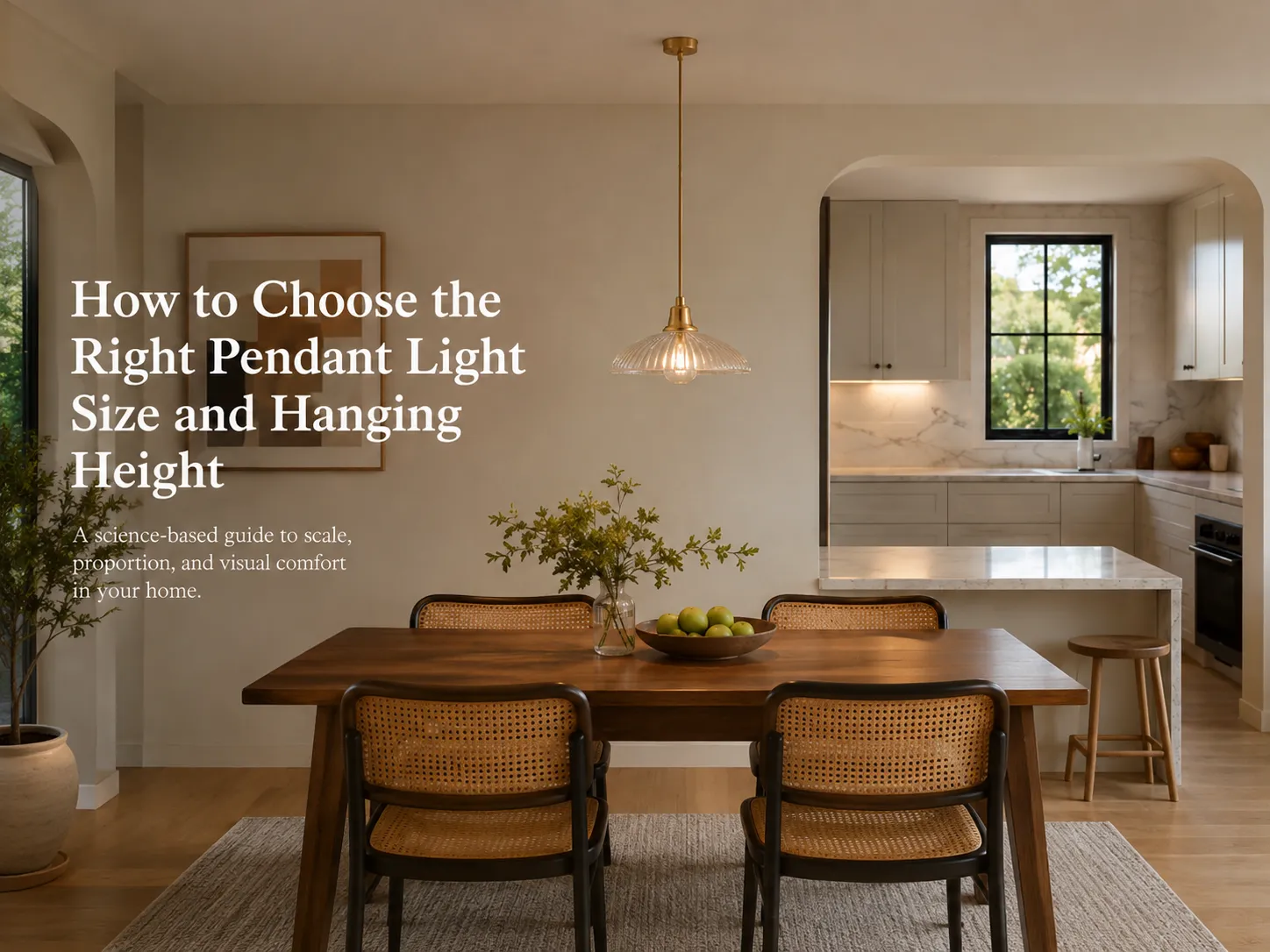

A science-based guide to diffusion, visual comfort, warm light, and layered illumination
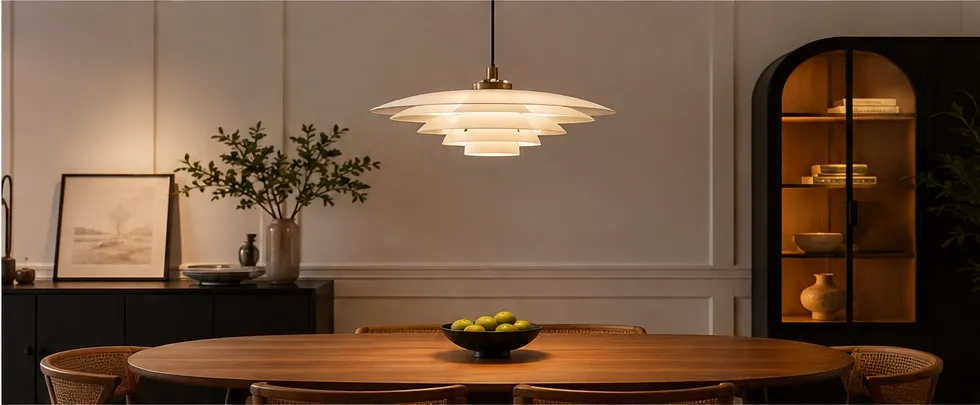
Interior lighting scene: a warm decorative pendant used as part of a layered residential lighting scheme.
Lighting comfort is not determined by brightness alone. The way a luminaire distributes light – whether it exposes a bright source, reflects it from a surface, or diffuses it through glass – strongly affects how a room feels. Frosted glass is especially useful in homes because it scatters light over a larger apparent surface, helping reduce harsh point-source contrast while preserving an inviting glow. This guide explains the underlying science and shows how to apply it in living rooms, dining spaces, bedrooms, entryways, and other residential interiors.
QUICK TAKEAWAYS
• Frosted glass increases diffusion and can reduce the visual harshness of small bright sources.
• Warm white light around 2700–3000K is generally better suited to evening relaxation than high-CCT light.
• Decorative chandeliers work best as one layer of a lighting plan, not as the only light source.
• Hanging height, surface reflectance, dimming, and room size all influence comfort as much as fixture style.
• Warm white light around 2700–3000K is generally better suited to evening relaxation than high-CCT light.
• Decorative chandeliers work best as one layer of a lighting plan, not as the only light source.
• Hanging height, surface reflectance, dimming, and room size all influence comfort as much as fixture style.
1. The Science of Frosted Glass Diffusion
A clear shade allows a relatively direct view of the source. This can create sparkle, but it can also create high luminance contrast. Frosted or opal glass contains microscopic surface texture or scattering material that redirects light in many directions. The apparent luminous area becomes larger and the source looks less concentrated from normal viewing angles. In practice, the light often appears smoother, more even, and less visually aggressive.
Diffusion does not automatically eliminate glare. Glare depends on source luminance, viewing angle, adaptation level, fixture position, and the brightness of surrounding surfaces. A frosted diffuser is therefore most effective when paired with appropriate output, sensible mounting height, and balanced ambient light elsewhere in the room.
2. Why 3000K Warm Light Works Well in Evening Interiors
Correlated color temperature (CCT) describes the visual appearance of white light. Lower values such as 2700–3000K appear warmer, while 4000–6500K appears progressively cooler. Studies of home lighting and circadian response show that evening exposure to higher-CCT, short-wavelength-rich light can produce stronger melatonin suppression than warmer light. A recent comparison of common residential lamps likewise found substantially lower estimated melatonin suppression for warm-white sources than for cool-white sources.
This does not mean every room should be dim and warm throughout the day. Kitchens, work surfaces, and home offices often need stronger task light. A useful strategy is to use brighter, functional light when activity requires it, then lower intensity and favor warmer light as bedtime approaches.
3. Layered Lighting Beats a Single Bright Fixture
The Illuminating Engineering Society (IES) publishes application-based illuminance recommendations rather than one universal brightness target for every room. That is important because a decorative pendant or chandelier rarely provides every type of light a room needs. A more comfortable residential scheme combines ambient light for overall visibility, task light for focused activities, and accent or decorative light for depth and atmosphere.
| Ambient | Task | Accent |
|---|---|---|
| General visibility: ceiling, indirect or broad-area light. | Higher local light for reading, cooking, grooming or work. | Decorative contrast that gives the room depth and hierarchy. |
4. Product Spotlight: Frosted Glass Bead Chandelier
A useful example from Xunlu Lighting is the Frosted Glass Bead Chandelier. The fixture uses frosted glass globe beads with brass-toned hardware and an integrated LED system. Xunlu lists a 3000K warm-white output, a single-strand version at approximately 900–1100 lumens, and a double-strand version at approximately 1800–2200 lumens. The double-strand form is designed as a soft U-shaped composition that can work above dining zones, in living areas, or in taller circulation spaces.
What makes this type of fixture interesting from a lighting-design perspective is the repetition of many small diffusing elements. Instead of a single exposed lamp, the luminous pattern is distributed across a sequence of frosted spheres. This can create a softer visual rhythm and a stronger decorative presence without relying on one intense central point of light.
| Product | Frosted Glass Bead Chandelier | Modern LED Pendant Light |
|---|---|
| Materials | Metal frame, frosted glass beads, brass hardware |
| CCT | 3000K warm white |
| Single strand | 18 glass beads; 12W; approx. 900–1100 lm |
| Double strand | 35 light points; 24W; approx. 1800–2200 lm |
| Product page | xunlulighting.com/product/frosted-glass-bead-chandelier-modern-led-pendant-light/ |
5. Where Frosted Decorative Lighting Works Best
Living room: Use the chandelier as a visual anchor, then add floor or table lamps near seating. This prevents the ceiling fixture from carrying the entire lighting load and reduces the temptation to over-brighten the room.
Dining area: Keep the decorative light visually connected to the table. If a pendant hangs above a surface, a common starting range is roughly 70–90 cm (28–35 in) above the tabletop, then adjust for fixture size, sightlines, and room proportions.
Bedroom: Warm, diffused lighting is well suited to the period before sleep. Keep high-output cool-white light away from the final hours of the evening when possible, and use bedside task lighting only as bright as needed.
Entryway or staircase: A repeated bead form can create a strong vertical or curved visual gesture. Make sure the lowest point remains clear of normal circulation and that adjacent wall or step lighting provides adequate orientation.
6. Five Practical Rules for Better Visual Comfort
- Choose lumens for the task, not watts. LED wattage is an energy measure; lumen output is the more direct indication of visible light quantity.
- Keep bright sources out of direct sightlines. A diffuser helps, but fixture position still matters.
- Use dimming where possible. Reducing output in the evening can improve atmosphere and lower unnecessary light exposure.
- Light vertical surfaces. Moderately illuminated walls can make a room feel brighter and more balanced without relying on an excessively bright central fixture.
- Treat decorative lighting as part of a system. Combine it with task and ambient layers so each light does one job well.
7. A Simple Room-by-Room Strategy
| Room | Preferred evening CCT | Primary goal | Recommended layers |
|---|---|---|---|
| Living room | 2700–3000K | Comfort + conversation | Ambient + decorative + local lamps |
| Dining room | 2700–3000K | Food + atmosphere | Pendant/chandelier + dimmable ambient |
| Bedroom | 2200–3000K | Wind-down + reading | Low ambient + bedside task |
| Kitchen | 3000–4000K | Visibility + food prep | Ambient + under-cabinet/task |
| Entry/stair | 2700–3500K | Orientation + safety | Decorative + wall/step lighting |
Conclusion
Frosted glass is more than a decorative finish. By redistributing light over a larger visible surface, it can help create a softer luminous appearance and reduce the harshness associated with small exposed sources. The best results come from combining diffusion with appropriate brightness, thoughtful mounting height, warm evening color temperature, and layered lighting. Used this way, a sculptural fixture such as Xunlu Lighting’s Frosted Glass Bead Chandelier can function as both a visual centerpiece and a comfortable part of the home’s overall lighting environment.