

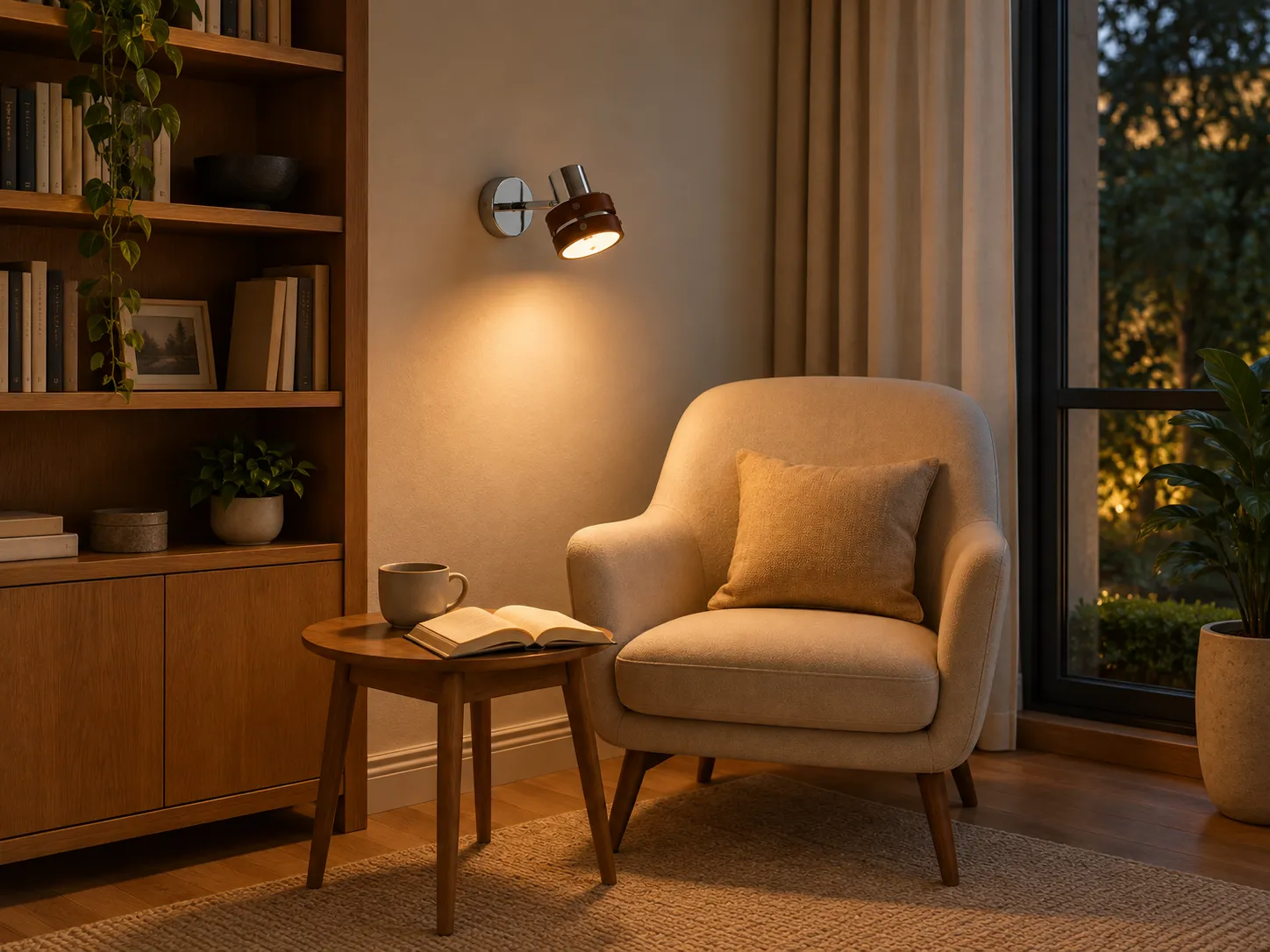

A practical guide to task lighting, visual comfort, evening ambience, and space-saving bedroom design
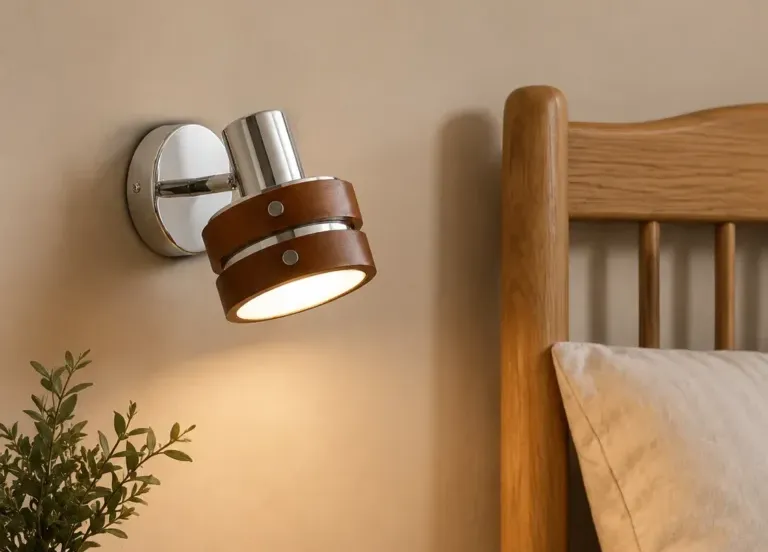
Why Bedside Lighting Deserves More Attention
Bedroom lighting has two jobs that often compete with each other: it must be bright enough for a visual task such as reading, yet calm enough to preserve the relaxed atmosphere that helps a bedroom feel restful. A well-placed adjustable wall light solves this conflict by putting useful light close to the page while avoiding the need to flood the entire room with high ambient brightness.
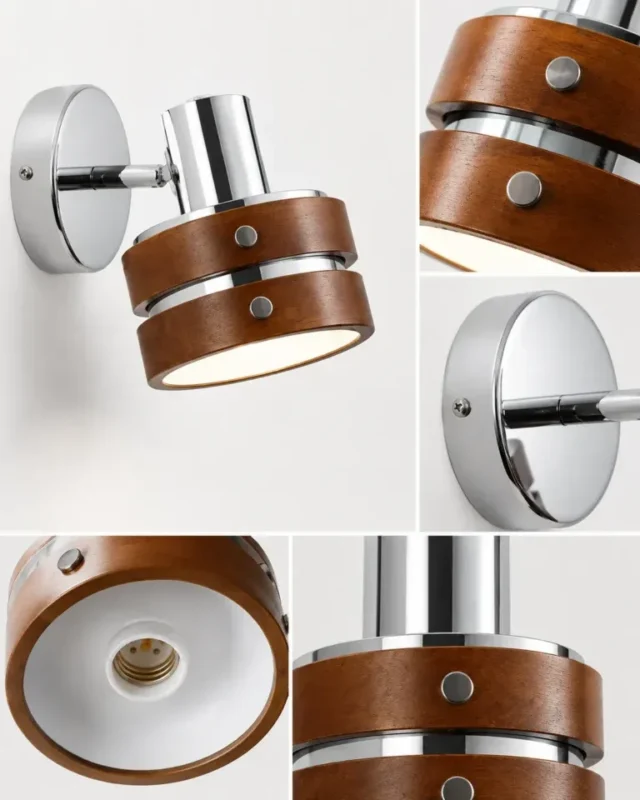
This wood-and-chrome wall light combines a compact directional head, a white inner shade, an E27 lamp holder, and an adjustable format. According to the product specification, it is designed for bedrooms, reading corners, studies, corridors, staircases, and living-room accent areas, with a shade diameter of about 13 cm, a wall projection of about 17 cm, and a maximum lamp power of 40 W.
1. Task Lighting: Put Light Where the Eyes Need It
Reading is a localized visual task. Instead of raising the brightness of an entire bedroom, task lighting concentrates illumination on the book, magazine, or work surface. Research on residential lighting commonly places reading tasks in the hundreds-of-lux range at the task plane, while real-world bedroom measurements show that actual night-time reading conditions vary widely from home to home.
An adjustable wall spotlight is useful because the user can aim the beam toward the page rather than toward the eyes. This improves the ratio between task brightness and surrounding brightness, helping the page remain legible without making the whole room feel overlit. The key is positioning: the beam should arrive from the side or slightly behind the reader’s shoulder so that the hand and head do not cast a strong shadow across the page.
2. Why Adjustability Matters for Glare and Comfort
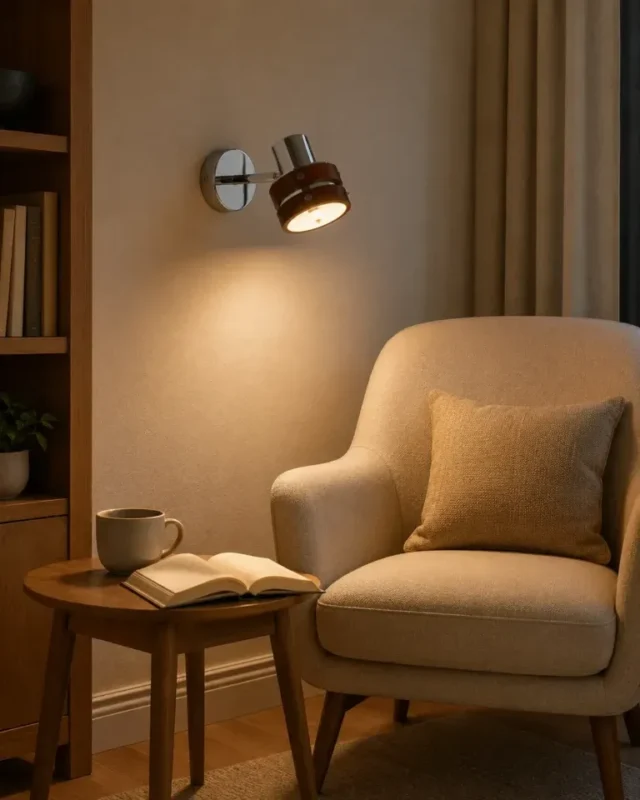
A fixed wall lamp can work beautifully when the bed, chair, and fixture are all perfectly aligned. Real bedrooms, however, are used by different people, at different sitting heights, and for different activities. An adjustable head gives the user a simple way to redirect the beam and reduce unwanted glare.
Visual discomfort often occurs when a bright source is visible directly in the field of view or when there is an excessive brightness difference between the task and its surroundings. The white inner shade of this fixture helps produce a cleaner luminous surface, while the directional head makes it easier to keep the brightest part of the lamp outside the reader’s direct view.
3. Warm Light in the Evening: A Better Fit for Bedrooms
The product recommends a 3000 K warm-light bulb. That recommendation aligns well with bedroom use. Peer-reviewed guidance on evening light exposure notes that warm-white domestic LEDs around 2700–3000 K can provide useful visual illumination while generally producing less melanopic stimulation than cooler, blue-enriched sources at the same photopic light level.
This does not mean that color temperature alone determines sleep effects—brightness, spectrum, timing, duration, and distance from the eyes all matter. Still, for a bedside lamp used close to bedtime, a warm white bulb at the lowest comfortable brightness is a sensible design choice.
A Simple Bulb-Selection Guide
| Use case | Suggested bulb characteristic | Why it helps |
|---|---|---|
| Bedside reading | 2700–3000 K, good color rendering, dimmable if possible | Warm appearance with enough clarity for text |
| Study / focused task | 3000–4000 K depending on preference | Slightly cooler light can feel more alert and neutral |
| Ambient accent | 2700 K, lower lumen output | Creates a softer, more relaxed visual hierarchy |
4. Material Contrast: Why Wood and Chrome Work Together
The visual appeal of this fixture comes from contrast. Natural wood introduces warmth, grain, and a tactile residential character; polished chrome adds crisp reflection and a cleaner architectural edge. Used together, the materials bridge Scandinavian, mid-century, modern minimalist, and warm contemporary interiors.
The combination is especially effective near timber furniture. A wooden bed frame, bedside table, or shelving unit creates material continuity, while the chrome hardware prevents the composition from becoming visually heavy. In lighter rooms, the reflective metal can also pick up nearby wall and textile tones, helping the fixture feel integrated rather than isolated.
5. Space-Saving Design for Small Bedrooms
Wall-mounted task lighting frees the bedside table from a lamp base and trailing cord. That matters in compact apartments, guest rooms, hotel-style bedrooms, and narrow reading corners where every horizontal surface is valuable.
With a wall projection of approximately 17 cm and a compact 13 cm shade, the fixture remains visually small while still creating a defined pool of light. This can make a bedroom feel less cluttered and leaves more room for books, charging devices, a glass of water, or decorative objects.
6. Installation Height and Placement
There is no single universal mounting height because bed height, mattress depth, headboard shape, reader posture, and fixture articulation all vary. A more reliable method is to position the fixture relative to the seated reader rather than relative to the floor.
As a starting approach, mount the lamp so the light head sits slightly above shoulder level when the user is seated in bed, then aim the beam down and across the reading plane. The lamp should be reachable enough to adjust, but not so low that the bright source shines directly into the eyes. In twin-bed or two-reader layouts, use one fixture per side so each person can control their own task light independently.
7. Layering It with the Rest of the Bedroom Lighting
A comfortable bedroom usually works best with layered lighting rather than one powerful source. The adjustable wall light should serve as the task layer. Add low-level ambient light from a ceiling fixture, cove, or floor lamp for general circulation, and optional decorative lighting for atmosphere.
Layering improves flexibility: bright task light can be used for reading, ambient light can be reduced before sleep, and both can be combined when cleaning, dressing, or organizing. This approach also helps avoid the flat appearance created when every surface is illuminated to the same level.
Where This Wall Light Works Best
Bedroom bedside: A direct replacement for a table lamp when nightstand space is limited.
Reading nook: Aimable light for an armchair, bookcase corner, or small lounge area.
Study: Useful as a focused supplementary light above a desk or side work surface.
Hallway or staircase: Adds a warm decorative highlight and can direct light toward circulation surfaces.
Living-room corner: Creates a small pool of warm light near a chair, artwork, or shelving.
Product Specification Snapshot
| Product type | Adjustable wall light / wall spotlight |
| Main materials | Metal with natural wood accent |
| Finish | Wood + polished chrome |
| Light source | 1 × E27 bulb |
| Maximum power | 40 W |
| Voltage | AC 110–240 V, 50/60 Hz |
| Recommended CCT | 3000 K warm light, depending on bulb |
| Shade diameter | Approx. 13 cm / 5.12 in |
| Fixture height | Approx. 10 cm / 3.94 in |
| Distance from wall | Approx. 17 cm / 6.69 in |
| Canopy size | Approx. Ø10 cm |
Design Takeaway
The strongest feature of this wall light is not simply its wood finish or polished chrome. It is the way several small design decisions work together: a compact wall-mounted footprint, directional adjustment, a warm residential material palette, a white inner shade, and the freedom to select an E27 bulb that suits the room.
For bedrooms and reading corners, this is exactly the kind of fixture that can improve both function and atmosphere. Used with a warm-white bulb and aimed carefully at the reading plane, it can provide useful task light without turning the bedroom into a brightly lit workspace.
Modern Wood and Chrome Alloy Adjustable Bedroom Reading Wall Lamp—Click to View Product:View the product page
