

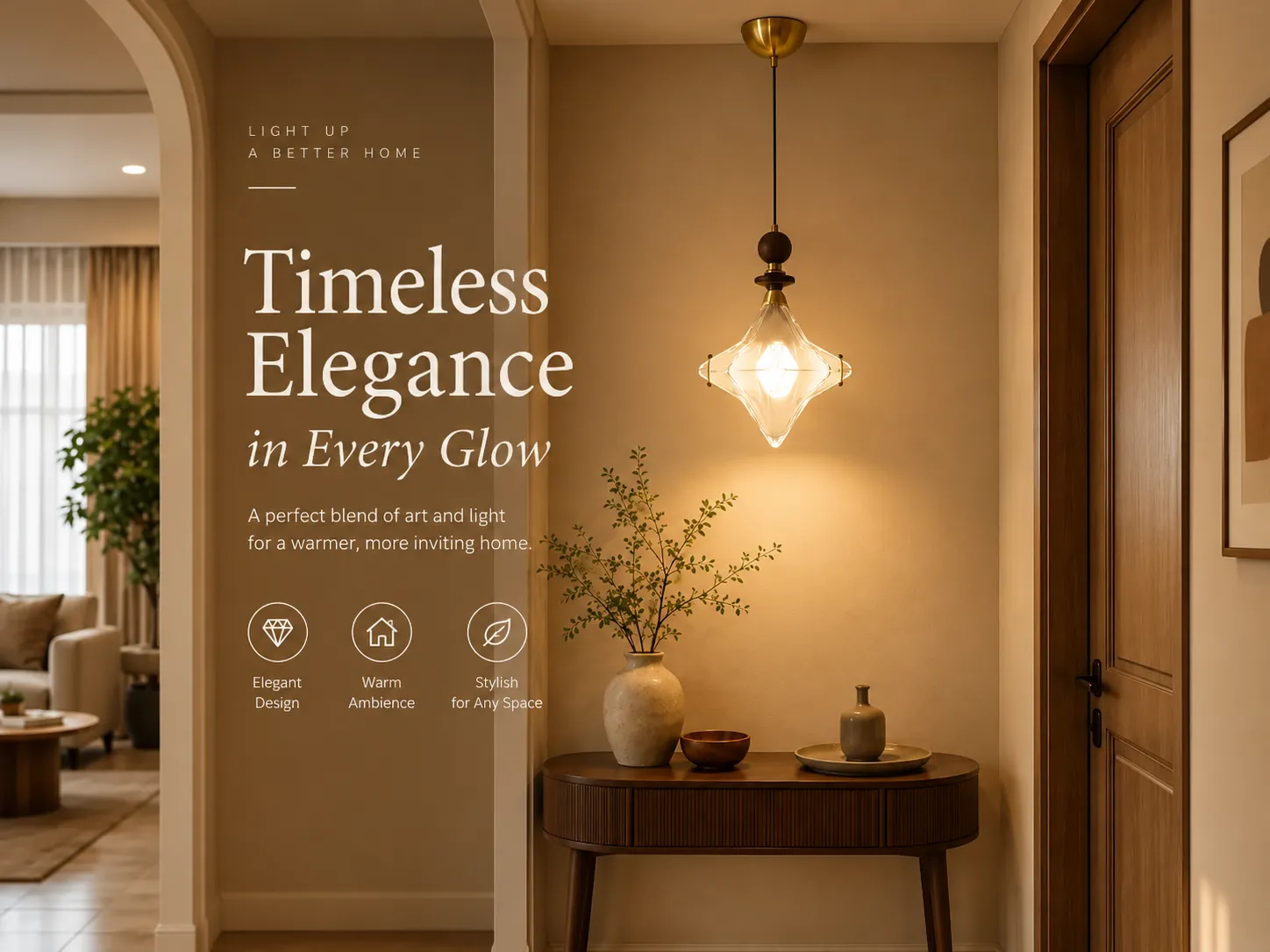

A science-informed guide to scale, glare control, color temperature, layering, and placement in bedrooms, dining areas, hallways, cafés, and boutique spaces
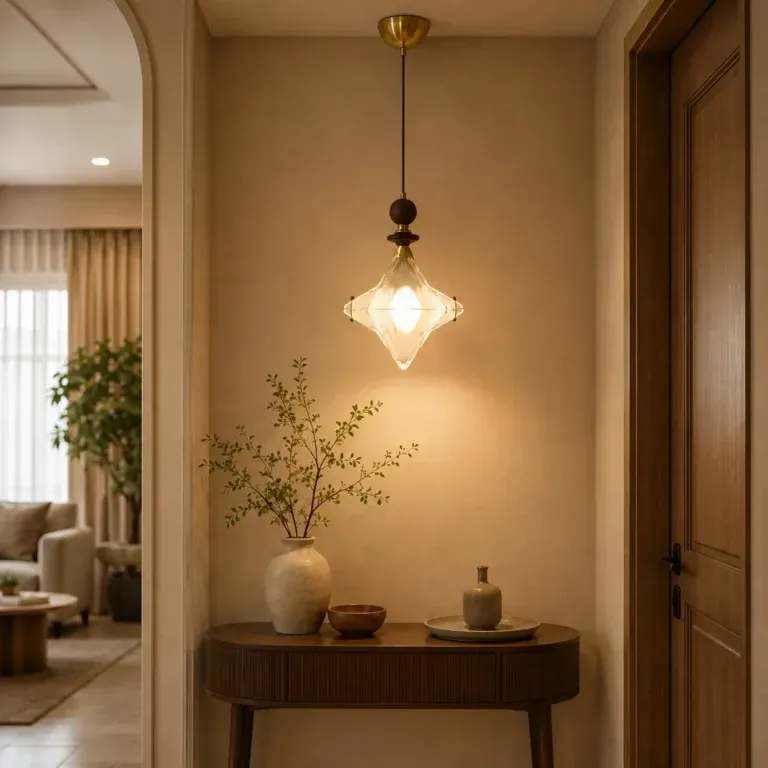
Why Small Pendant Lights Can Have a Big Design Impact
A pendant does more than provide illumination. Because it hangs within the visual field, it becomes part light source, part architectural marker, and part decorative object. In a bedroom corner, hallway niche, café table, or compact dining area, a carefully scaled pendant can define a zone without adding furniture or visual clutter.
This Crystal Walnut Pendant Light combines transparent glass, walnut wood, and brass-toned metal in a compact form. The product specification lists a 20 × 35 cm lamp body, an adjustable suspension length up to 180 cm, one E27 lamp holder, a maximum power of 16 W, and an approximate light output of 800–1200 lumens depending on the selected bulb. Those characteristics make it particularly suited to decorative ambient lighting and localized light rather than whole-room illumination on its own. [1]
1. The Design Science of Layered Light
Good residential lighting rarely relies on one fixture. A more comfortable scheme combines ambient light for general orientation, task light for activities, and accent or decorative light for visual depth. U.S. Department of Energy residential-lighting guidance similarly emphasizes glare-free ambient illumination, while noting that dining spaces often benefit from specific lighting at the table and from dimming controls. [2]
This is where a small pendant works especially well. It can become the decorative layer over a console, side table, bedside zone, or small dining setting, while recessed lights, wall washers, or other fixtures provide broader background illumination. The result feels more dimensional than a room lit by a single bright ceiling source.
2. Transparent Glass: Sparkle, Reflection, and Visual Lightness
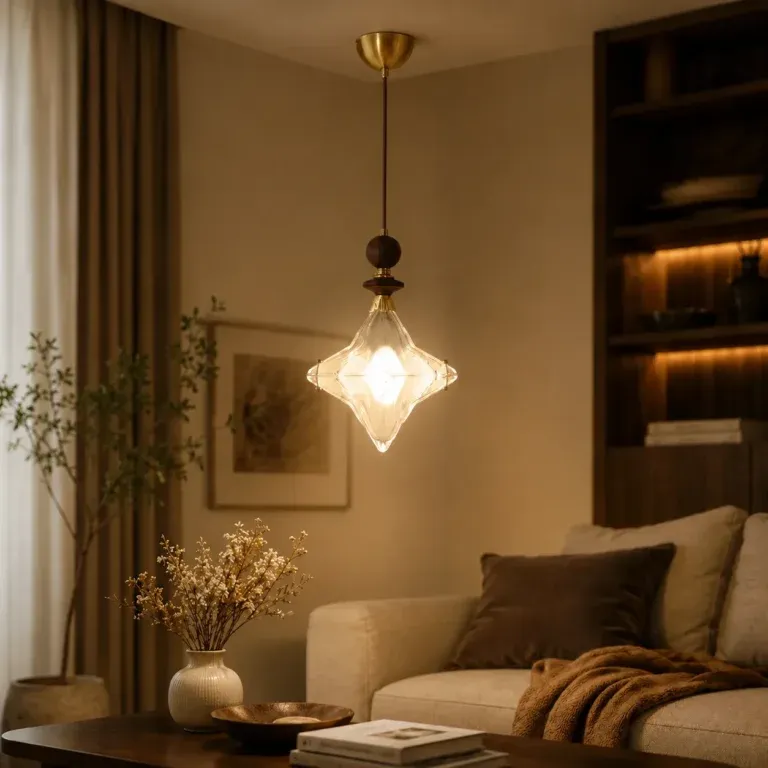
Transparent glass changes the visual character of a pendant in two important ways. First, it allows the lamp source and internal reflections to remain visible, which produces sparkle and makes the fixture feel jewel-like. Second, because the shade is visually permeable, it occupies less apparent mass than an opaque metal shade of the same size. That can be useful in compact rooms where a heavy fixture would dominate the space.
The trade-off is glare. A transparent shade does not hide the bulb as completely as an opaque or heavily diffused enclosure. Comfort therefore depends on choosing a bulb with appropriate brightness, placing the pendant outside direct eye level, and using dimming where possible. This matters especially in bedrooms and seated dining areas, where occupants may look toward the fixture for long periods.
3. Warm Color Temperature for Evening Interiors
The product supports 3000 K, 4000 K, and 6000 K bulb choices. For most bedrooms, lounges, dining rooms, cafés, and hospitality-style interiors, 3000 K is usually the most natural starting point because it gives wood and brass a warmer appearance and supports a relaxed evening atmosphere. [1]
There is also a physiological reason to keep evening residential light relatively warm and moderate in intensity. A consensus review on healthy indoor light exposure notes that many warm-white domestic LEDs in the 2700–3000 K range can provide useful visual illumination while producing lower melanopic stimulation than cooler, blue-enriched light at comparable photopic levels. The authors also stress that brightness, spectrum, timing, duration, and distance from the eyes all matter—not color temperature alone. [3]
Choosing the Right Bulb
| Room / mood | Suggested choice | Why it works |
|---|---|---|
| Bedroom / bedside ambience | 2700–3000 K, dimmable, moderate lumen output | Supports a warm, low-stimulation evening atmosphere and reduces the risk of an overly bright visible source. |
| Dining / café | 2700–3000 K, high CRI preferred | Warm light is flattering to wood, brass, food, and skin tones; dimming helps adapt the space from functional to intimate. |
| Hallway / entry | 3000 K, moderate brightness | Provides a welcoming tone while maintaining useful visual clarity. |
| Decorative accent only | Warm, lower-lumen bulb | Keeps the transparent glass visually comfortable and emphasizes sparkle rather than raw brightness. |
4. Why Walnut and Brass Feel Warm Without Looking Heavy
Material perception strongly influences how a light fixture reads in a room. Walnut brings visible grain and organic variation; brass adds a warm reflective note; transparent glass contributes clarity and sparkle. Together, these materials create contrast without the visual weight of a fully opaque chandelier.
This combination is easy to integrate into warm minimalism, contemporary luxury, mid-century-inspired rooms, Japandi-adjacent interiors, boutique hospitality spaces, and transitional homes. The pendant works especially well when at least one material is repeated elsewhere—for example, walnut furniture, brass cabinet hardware, a bronze mirror frame, or warm beige textiles.
5. Pendant Height: Design by Sightline, Not by a Fixed Number
Suspension height should respond to the activity below the fixture. The product includes an adjustable suspension length of up to 180 cm, giving flexibility for different ceiling heights and room types. [1]
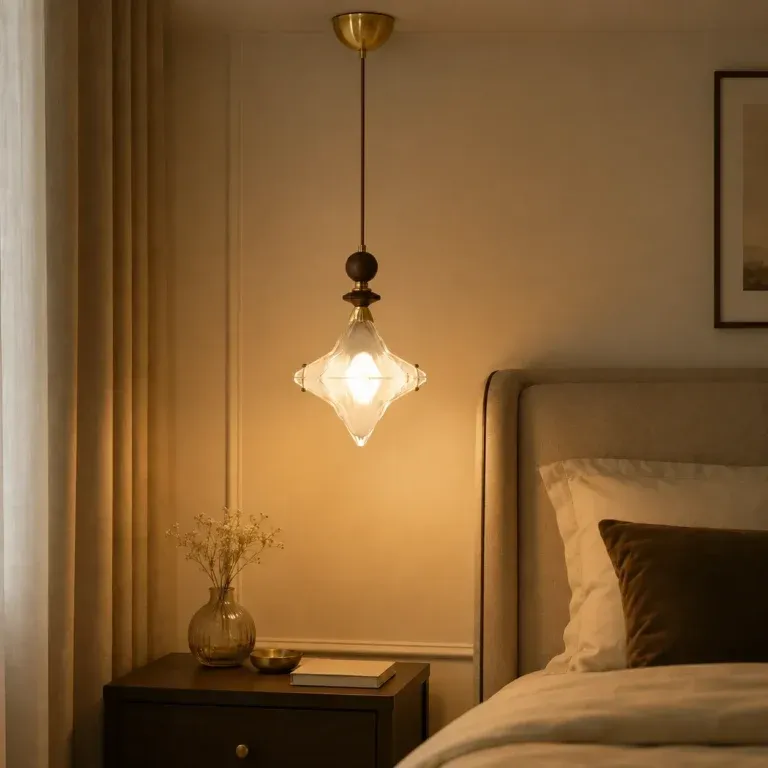
In a hallway or open circulation zone, the lowest point of the fixture must remain comfortably above normal head height. Beside a bed or above a console, it can hang lower because people do not walk directly beneath it. Above a dining table, the pendant can also sit lower because the tabletop creates a protected zone, but the bulb should not shine directly into seated eyes.
The most reliable method is to stand or sit in every normal viewing position before finalizing the drop. If the lamp source feels visually sharp, raise the fixture, reduce bulb brightness, use a more diffusing bulb, or add dimming. Designing around real sightlines is more dependable than copying a universal height from a photograph.
6. Scale and Proportion in Small Spaces
At 20 × 35 cm, this pendant is intentionally compact. That makes it useful where a large chandelier would overwhelm the architecture: beside a bed, in a narrow hallway, over a small breakfast table, in a reading corner, or as a repeated series along a bar or corridor. [1]
A small fixture can still feel luxurious when the visual hierarchy is clear. Leave enough negative space around the glass silhouette, avoid crowding it with competing decorative objects, and repeat one or two material cues elsewhere in the room. This allows the pendant to read as a deliberate focal point rather than a small object lost in a large volume.
7. Best Rooms and Applications
Bedroom bedside: A hanging pendant frees the nightstand surface and creates a hotel-like composition. Use a warm, dimmable bulb and position the source outside direct eye level.
Hallway or entry console: The pendant can anchor a console vignette and create a welcoming pool of light near the arrival point.
Small dining table: One fixture can define a two- to four-person dining zone. Combine with general ambient light and dimming for flexibility.
Living-room corner: Hang it near a side table or lounge chair as a decorative accent rather than as the room’s only light source.
Café / boutique hospitality: The walnut, brass, and transparent glass combination supports warm premium interiors and can be repeated rhythmically across small tables or niches.
8. Glare Control: The Most Important Detail with Clear Glass
Because the glass is transparent, the bulb remains part of the visual composition. This is beautiful when the source is restrained and uncomfortable when it is excessively bright. The DOE residential-lighting guide emphasizes glare-free illumination in dining environments and notes that direct lighting can create significant glare when not carefully controlled. [2]
For this pendant, the practical solution is straightforward: choose the lowest bulb brightness that still supports the intended task, prefer a dimmable LED when the electrical system allows it, avoid placing the bulb directly at seated eye level, and use surrounding ambient light so the fixture is not the only bright object in an otherwise dark room.
Product Specification Snapshot
| Product type | Small pendant light / crystal glass ceiling lamp |
| Materials | Walnut wood + brass + glass |
| Finish | Walnut wood + brass + transparent glass |
| Lamp body | 20 × 35 cm / 7.87 × 13.78 in |
| Ceiling canopy | 10 × 5 cm / 3.94 × 1.97 in |
| Suspension | 180 cm / 70.87 in, adjustable |
| Weight | Approx. 1.5 kg / 3.31 lb |
| Light source | 1 × E27 bulb, not included |
| Maximum power | 16 W |
| Voltage | AC 110–240 V, 50–60 Hz |
| Color temperature options | 3000 K / 4000 K / 6000 K |
| Approx. lumen output | 800–1200 lm, depending on bulb |
| Installation | Ceiling-mounted pendant |
A Simple Installation and Styling Checklist
• Confirm ceiling structure and electrical box suitability before installation; use a qualified electrician where required by local code.
• Adjust the suspension so the fixture is clear of normal circulation and comfortable from seated sightlines.
• For bedrooms and dining spaces, start with a warm 2700–3000 K LED rather than a cool white source.
• Choose moderate brightness because clear glass exposes more of the lamp source than an opaque shade.
• Use dimming when compatible with the bulb and control system.
• Repeat walnut, brass, or warm neutral materials elsewhere in the room to make the fixture feel integrated.
• Combine the pendant with ambient light from other sources so the room has depth and lower contrast.
Final Design Takeaway
The Crystal Walnut Pendant Light succeeds because it balances decorative richness with a small footprint. Transparent glass provides sparkle and visual lightness, walnut adds organic warmth, and brass introduces a refined metallic accent. The adjustable suspension and E27 bulb format make it flexible across bedrooms, hallways, compact dining areas, cafés, and lounge corners. [1]
The best results come from treating it as one layer in a broader lighting plan: use a warm, moderate-output bulb, keep glare out of normal sightlines, add dimming where practical, and support it with softer ambient light. That approach preserves the pendant’s jewel-like character while making the room more comfortable to live in after dark.
Crystal Walnut Pendant Light—Click to view the product:View the product page
