

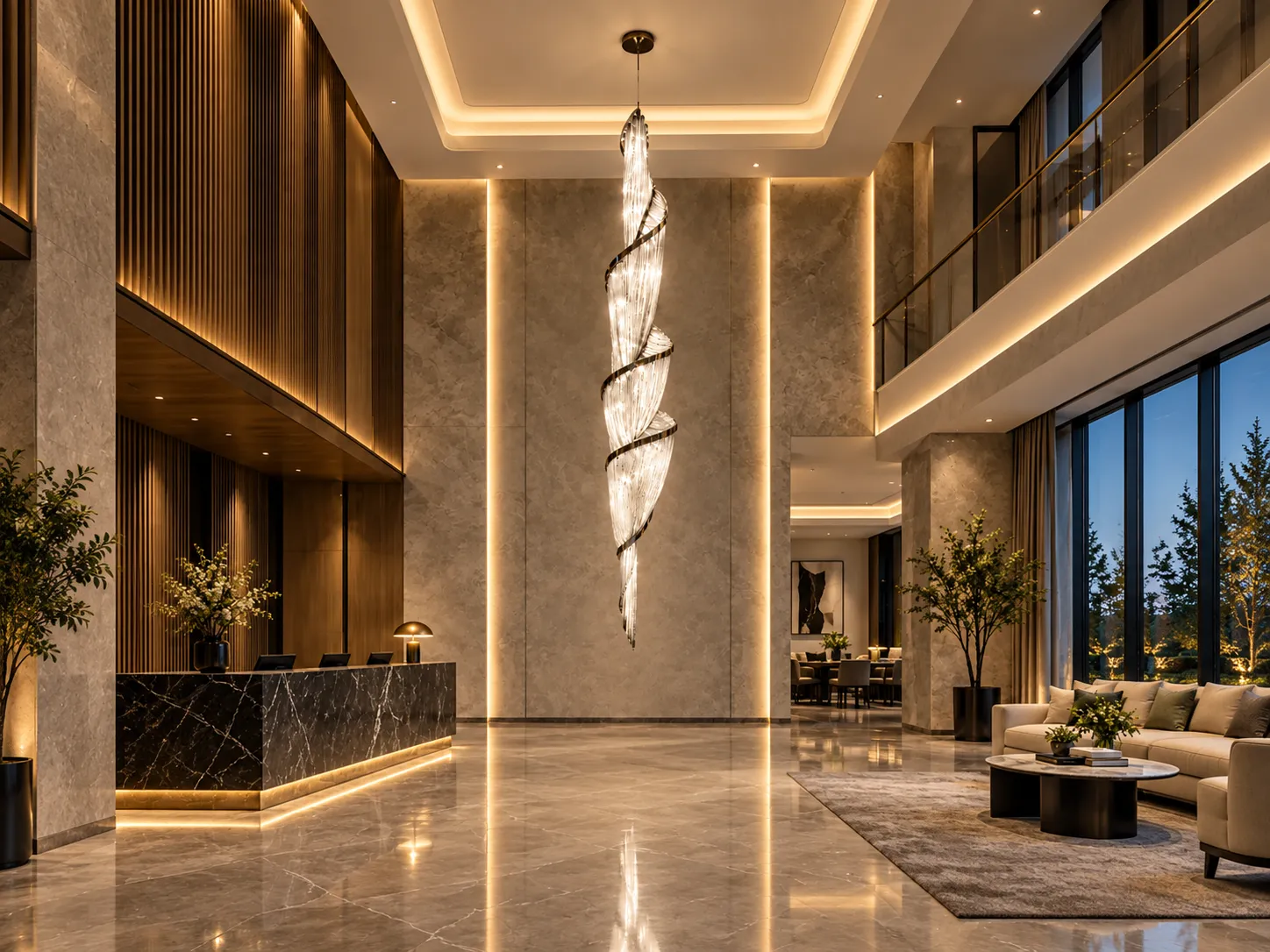

A design-led guide to visual hierarchy, glare control, color temperature, scale, and layered illumination
Why Vertical Chandeliers Work So Well in Tall Interiors
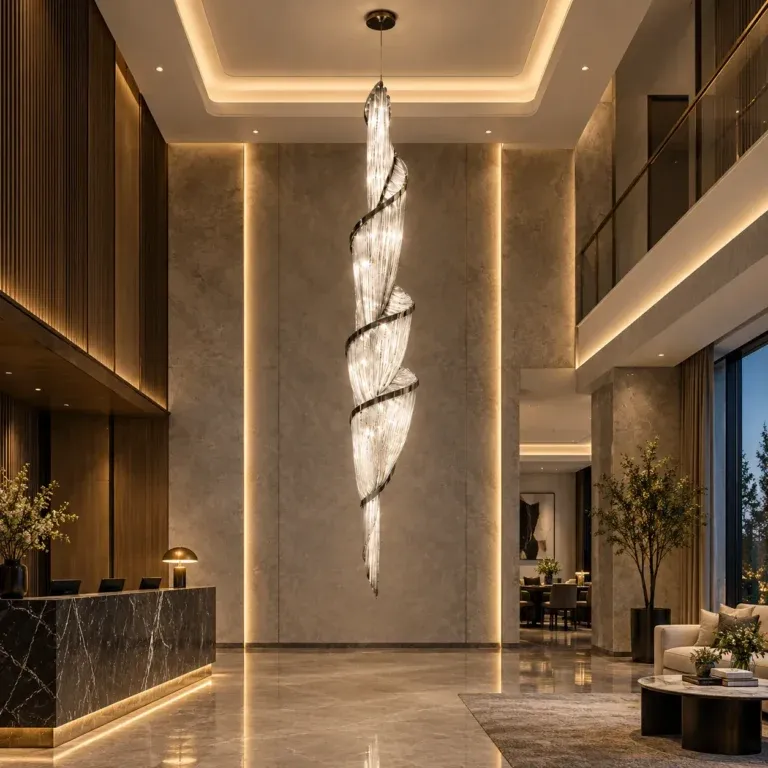
A double-height room, open staircase, or villa foyer creates a unique lighting problem: the space is visually impressive, but a conventional ceiling fixture can feel too small, too distant, or disconnected from the lower level. A vertically proportioned chandelier solves this by occupying the empty volume between floors and creating a clear visual link from ceiling to eye level.
The Modern Spiral Crystal Pendant Light is designed around that idea. Its 130 cm sculptural helix, chrome-silver frame, transparent crystal chain texture, and warm LED glow create a descending ribbon of light. Rather than functioning only as a source of illumination, it acts as an architectural object that reinforces ceiling height, guides the eye through the space, and creates a memorable focal point.
1. The Helix Shape Creates Visual Movement
Human vision is naturally drawn to contrast, direction, and repeated patterns. A spiral chandelier combines all three. The curved metal ribbon establishes a strong directional line, while repeated crystal elements catch and scatter light along the vertical axis. This produces a sense of movement even though the fixture itself is static.
In large interiors, that visual movement is useful because it prevents the central volume from feeling empty. The eye follows the helix downward, making the chandelier a bridge between the ceiling, mezzanine, staircase, and ground floor. This is especially effective in contemporary villas where clean architectural surfaces need one expressive centerpiece.
2. Crystal Does More Than Sparkle: It Changes the Distribution of Light
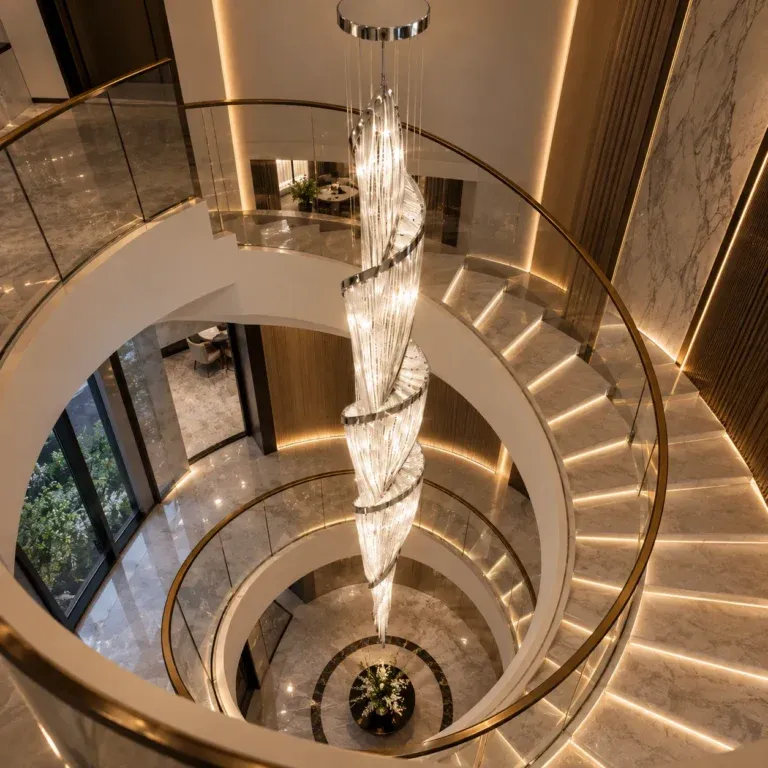
Transparent crystal and clear chain elements interact with light through transmission, reflection, and refraction. The result is a more complex visual field than a bare LED source would create. Small bright highlights appear across the crystal surface, while surrounding areas receive softer reflected light.
This complexity can make a chandelier feel luminous without relying on one exposed high-luminance point. From a visual-comfort perspective, this matters because glare is strongly influenced by source luminance, apparent source size, position in the field of view, and the viewer’s adaptation level. A larger luminous form with many distributed highlights can feel more decorative and less harsh than a single intense source, provided the individual LEDs are appropriately shielded and the fixture is not excessively bright for the room.
3. Warm White, Natural White, or Cool White?
The product is available in 3000 K warm white, 4000 K natural white, and 6000 K cool white. Each option produces a different interior impression. For luxury residential spaces, 3000 K is usually the most versatile because it complements wood, stone, bronze, beige, and warm wall finishes. Around 4000 K gives a cleaner, more neutral appearance that can suit contemporary galleries or commercial interiors. 6000 K creates a crisp, icy effect that emphasizes the clarity of crystal but can feel visually cooler.
Color temperature should not be treated as a health metric by itself. Evening biological effects depend on spectrum, brightness, timing, duration, and light reaching the eye. Research on home lighting shows that evening electric light can influence circadian physiology, and expert recommendations generally favor lower melanopic exposure in the hours before sleep. Warm-white LEDs around 2700–3000 K can make it easier to achieve a lower evening melanopic dose than many cooler sources when photopic light level is similar.
Color Temperature by Application
| Application | Suggested CCT | Design effect |
|---|---|---|
| Luxury villa / staircase | 3000 K | Warm, refined, flattering to stone and wood |
| Contemporary foyer / gallery | 4000 K | Neutral, crisp, architectural |
| Cool-toned commercial feature | 6000 K | Bright crystal sparkle and high visual contrast |
4. Scale Matters More Than Most Buyers Expect
A chandelier in a double-height space is viewed from several distances and elevations. If the fixture is too small, it can disappear against the architecture; if it is too large or hangs too low, it may dominate circulation zones or create uncomfortable sight lines.
This model measures approximately 30 cm in diameter and 130 cm in height, with an adjustable 150 cm suspension cable. That narrow vertical proportion makes it particularly suitable for stairwells and tall entry spaces where floor area may be limited but vertical volume is generous.
The product page recommends ceiling-height ranges of approximately 250–400 cm for staircase applications, 280–350 cm for living rooms, and 350–600 cm for lobby settings. These should be treated as design starting points rather than rigid rules. The final hanging height should also consider stair clearance, upper-floor sight lines, furniture, and local electrical installation requirements.
5. Lumen Output and Layered Lighting
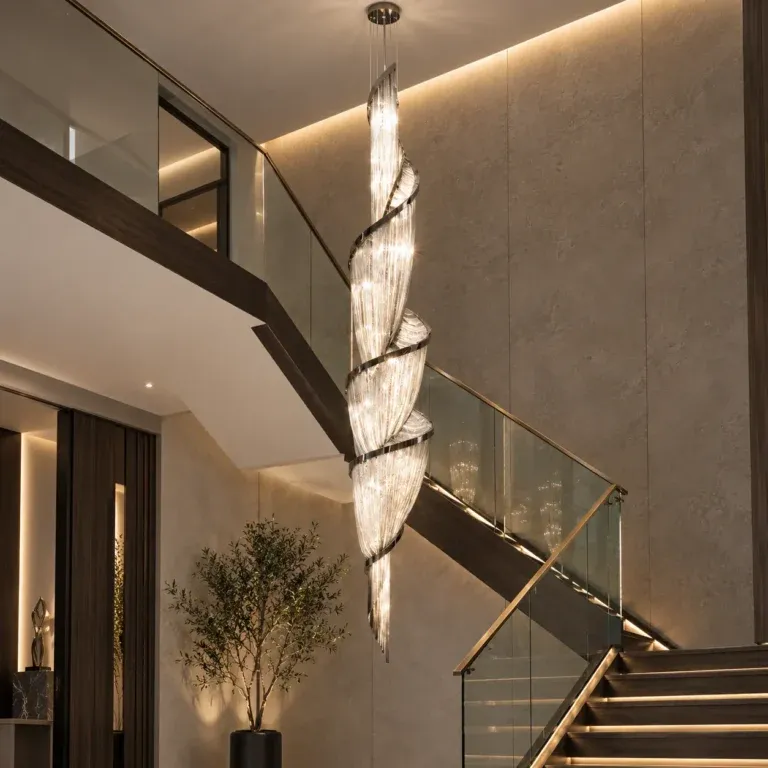
The listed lumen output is approximately 2500–3500 lm, depending on configuration and light source. In a tall space, that light is spread over a much larger volume than it would be in a standard-height room. For this reason, a decorative chandelier should rarely be expected to provide all of the useful illumination by itself.
A better approach is layered lighting. Let the chandelier provide the focal and ambient layer, then support it with recessed downlights, wall washing, step lighting, cove lighting, or concealed linear LEDs. Layering reduces the need to drive the chandelier excessively bright, which helps preserve sparkle and atmosphere while improving visual comfort.
6. Integrating the Chandelier with Stair Lighting
Staircases need safe, readable edges and consistent wayfinding. The chandelier can contribute ambient light, but tread and landing visibility should be supported by dedicated architectural lighting where needed. Low-level step lights or concealed linear light under handrails can provide useful guidance without competing with the chandelier.
This separation of roles is important: the helix pendant is strongest as a visual centerpiece, while localized stair lighting should handle navigation. When both are balanced, the space feels luxurious rather than overlit.
7. Material and Finish: Why Chrome Works with Crystal
Chrome silver is a natural partner for transparent crystal because both respond strongly to surrounding light. The metal reflects warm wall finishes, dark timber, marble, and nearby light sources, while the crystal adds fine-scale sparkle. This pairing works particularly well in modern luxury, Art Deco, minimalist, and hotel-inspired interiors.
To avoid a cold or overly reflective result, combine chrome and crystal with matte materials nearby. Stone, plaster, wood veneer, textured wall panels, and fabric upholstery provide visual softness and give the chandelier a calmer background against which to stand out.
8. Best Spaces for This Fixture
Villa staircase: Ideal when the vertical void is narrow but tall, especially with curved or floating stairs.
Double-height living room: Creates a central visual axis between upper and lower levels.
Entrance hall: Adds immediate visual identity and a hospitality-style arrival experience.
Boutique hotel lobby: Works as both ambient lighting and a recognizable design feature.
Gallery or showroom: The sculptural helix can function almost like illuminated art.
Luxury restaurant: Useful above a feature stair, reception zone, or central circulation void.
Product Specification Snapshot
| Product type | Spiral crystal pendant light / LED helix chandelier |
| Design style | Modern luxury, contemporary Art Deco, sculptural lighting |
| Main material | Aluminum frame + transparent crystal chain structure |
| Finish | Chrome silver |
| Light source | Integrated LED; E14 LED compatible per product specification |
| Light points | 6–8 LED light points |
| Power options | 24 W / 36 W / 48 W |
| Recommended power | 36 W LED |
| Voltage | AC 110–240 V |
| Color temperatures | 3000 K / 4000 K / 6000 K |
| Lumen output | Approx. 2500–3500 lm |
| Lamp size | Ø30 cm × H130 cm / 11.8 in × 51.2 in |
| Adjustable cable | 150 cm / 59 in |
| Canopy | Ø12 cm × H3 cm / 4.7 in × 1.2 in |
| Net weight | Approx. 8–10 kg |
9. Installation Planning for Tall Spaces
Because the fixture weighs approximately 8–10 kg and hangs in a potentially high or difficult-to-access location, the ceiling structure and mounting hardware must be appropriate for the load. Installation should be completed by a qualified professional in accordance with local electrical codes and structural requirements.
Before installation, confirm the final drop, the position of the ceiling canopy, access for future cleaning, and how the chandelier will appear from both the ground floor and the upper landing. In spiral staircases, checking the fixture from several viewpoints before final cable adjustment can significantly improve the final composition.
10. Cleaning and Maintaining Crystal Clarity
Crystal fixtures look best when dust and fingerprints are controlled. Switch off power and allow the fixture to cool before cleaning. Use a soft microfiber cloth or an appropriate non-abrasive method for the crystal and metal surfaces. Avoid aggressive chemicals that may dull plated finishes or leave residue on transparent elements.
For a chandelier installed over a high stair void, maintenance access should be considered during the design stage. A beautiful fixture that is impossible to service safely will lose its visual quality over time.
Design Takeaway
The Modern Spiral Crystal Pendant Light is most effective when treated as part of the architecture, not simply as a decorative object. Its tall helix form fills unused vertical space, crystal elements add layered reflections, and the chrome structure reinforces a clean contemporary character.
For luxury staircases, foyers, and double-height living rooms, the strongest result comes from combining three ideas: choose the correct hanging height, use a color temperature that supports the room’s mood, and let complementary architectural lighting handle navigation and general illumination. This keeps the chandelier dramatic without forcing it to do every lighting job at once.
Modern Spiral Crystal Pendant Light—Click to view the product:View the product page
