

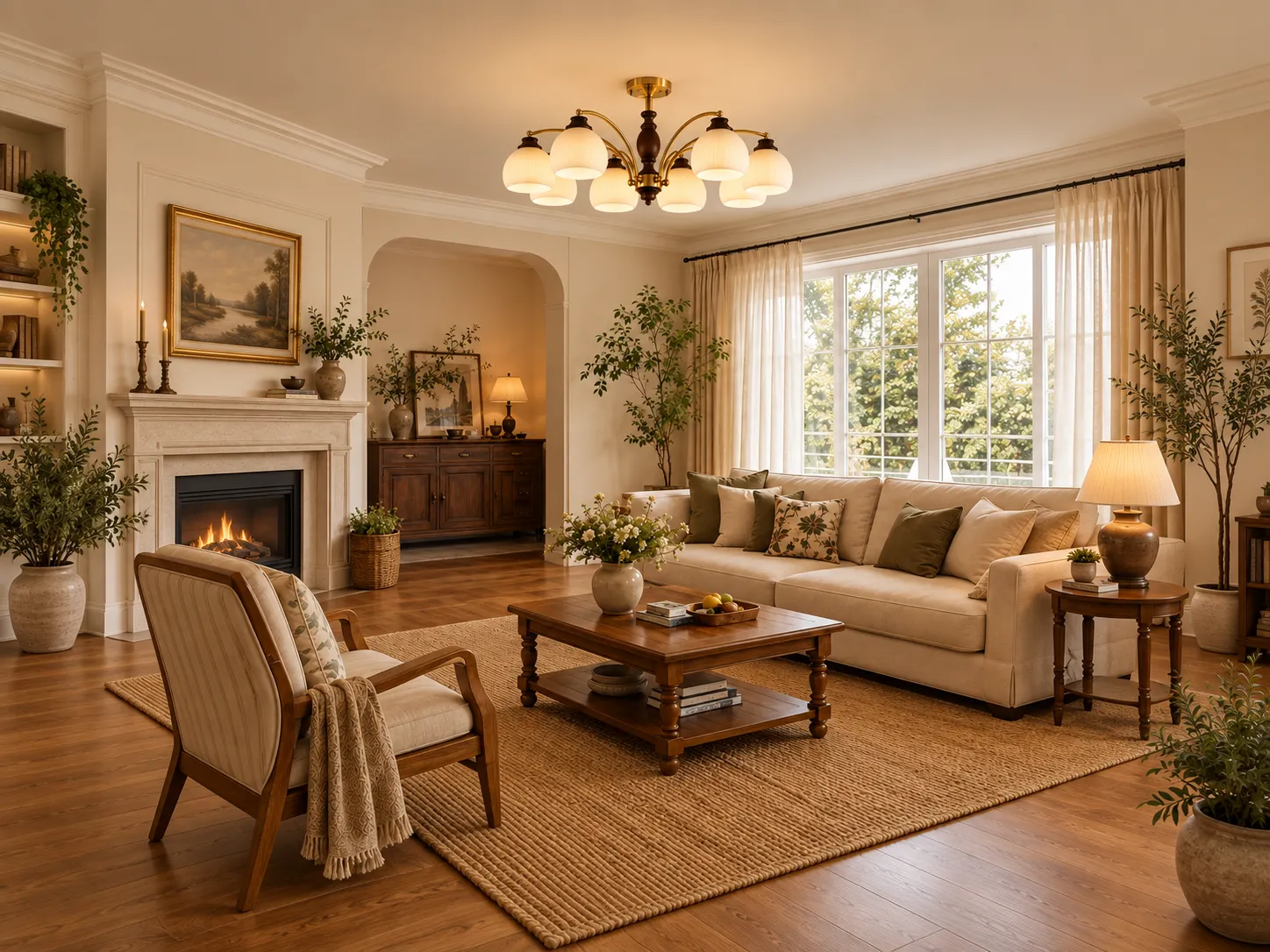

How a Classic Brass Ceiling Light with Ribbed Glass Creates Comfortable, Layered Illumination at Home
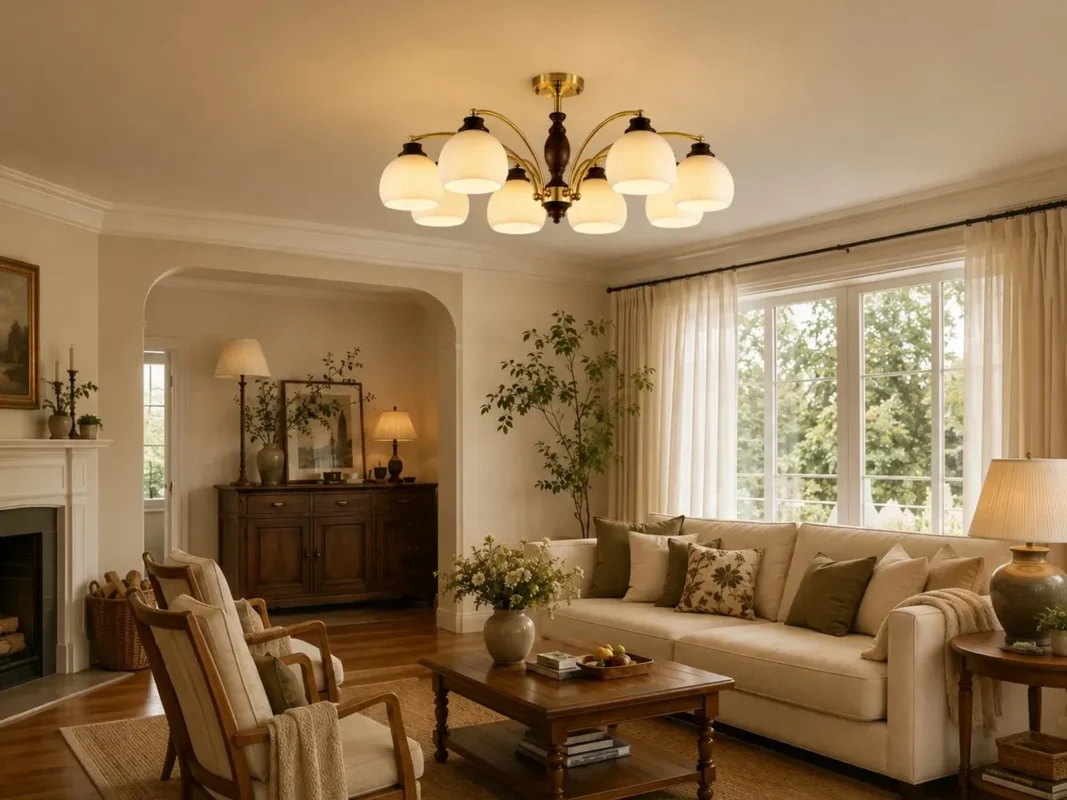
A ceiling fixture can do more than brighten a room. It can define the visual center of a space, reinforce the material palette, soften contrast, and influence how comfortable an interior feels after sunset. The Classic Brass Ceiling Light combines curved brass-toned arms, walnut-brown wood details and ribbed glass shades in a symmetrical composition that sits between traditional European lighting and warm modern residential design.
The practical advantage is equally important: the fixture uses replaceable E27 lamps rather than a permanently integrated light engine, giving homeowners flexibility over lumen output, color temperature and color rendering. That makes the design adaptable to living rooms, dining rooms, bedrooms, villas and hospitality interiors without forcing one fixed lighting specification.
Why This Design Works Visually
The chandelier’s visual strength comes from repetition and symmetry. Repeated glass shades establish rhythm, while the curved arms distribute the apparent mass outward from the center. In a living room or bedroom, this helps the fixture read as an architectural focal point without needing excessive vertical drop.
The brass-gold metal finish introduces a warm reflective surface, while the walnut-brown central elements add a natural material cue. In interiors with timber furniture, cream upholstery, stone, beige walls or muted green textiles, those finishes create continuity rather than looking like a separate decorative object.
The Science Behind Ribbed Glass and Visual Comfort
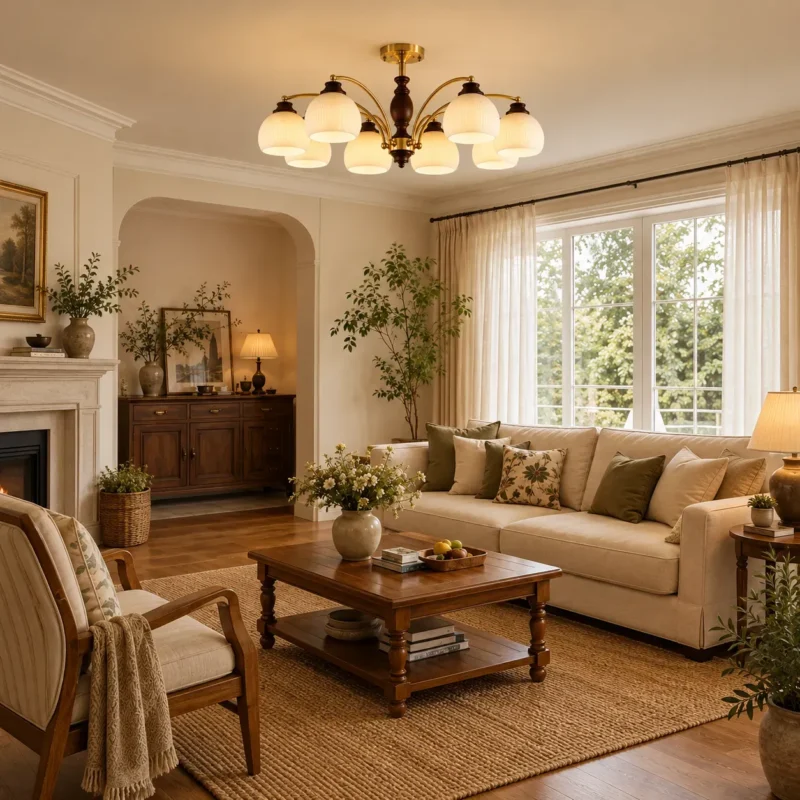
Bare lamps can create high luminance contrast when the bright source is directly visible against a darker ceiling or wall. Ribbed glass changes the visual experience by scattering and redistributing light across a larger apparent surface. The result is a softer transition between the luminous shade and the surrounding room, which can reduce the sensation of harsh point-source glare.
The ribs also create small highlights and shadows that give the shade depth even when the light is off. When illuminated, the textured glass produces a gentler luminous envelope than a clear globe would. This does not eliminate glare in every installation—the final result still depends on bulb brightness, lamp position and viewing angle—but it is an effective decorative strategy for making multi-lamp fixtures feel more comfortable.
Color Temperature: Why 2700K-3000K Suits This Fixture
The product is designed around a recommended warm-white range of approximately 2700K-3000K. That recommendation is consistent with established lighting practice for residential and hospitality settings. The U.S. Department of Energy describes lower correlated color temperatures as warmer in appearance and identifies 2700K and 3000K as common choices for homes, restaurants and other welcoming environments.
Warm-white light also complements the fixture’s brass and walnut finishes. At these color temperatures, wood, warm neutrals and gold-toned metal tend to appear visually coherent, while the room retains a relaxed evening atmosphere. For interiors dominated by warm timber and cream fabrics, 2700K is especially intimate; 3000K can feel slightly cleaner while still reading as warm.
Lumens Matter More Than Watts
With LED lamps, wattage tells you how much electrical power a bulb uses, not how much visible light it produces. The Department of Energy recommends evaluating modern light sources by lumen output. This chandelier supports standard E27 lamps, so the final brightness depends on the bulbs selected.
According to the product specification, the 6-head version can provide roughly 3000-4800 lumens and the 8-head version roughly 4000-6400 lumens, depending on lamp choice. Those are fixture-level estimates rather than guaranteed room illuminance. Actual light levels at a table, bed or floor depend on ceiling height, room size, wall reflectance, shade transmission and how much light is absorbed by furnishings.
Product Specifications at a Glance
| Specification | 6-Head Version | 8-Head Version |
|---|---|---|
| Light source | 6 × E27 replaceable bulbs | 8 × E27 replaceable bulbs |
| Maximum power | 40W per bulb; 240W total | 40W per bulb; 320W total |
| Voltage | AC 110–240V, 50/60Hz | AC 110–240V, 50/60Hz |
| Recommended CCT | 2700K–3000K | 2700K–3000K |
| Approx. luminous flux | 3000–4800 lm | 4000–6400 lm |
| Materials | Brass + wood + ribbed glass | Brass + wood + ribbed glass |
| Fixture size | 70 × 70 × 35 cm / 27.56 × 27.56 × 13.78 in | 82 × 82 × 35 cm / 32.28 × 32.28 × 13.78 in |
| Ceiling base | Approx. 12 cm / 4.72 in | Approx. 12 cm / 4.72 in |
| Approx. weight | 5–6 kg | 6–7 kg |
How to Choose Between the 6-Head and 8-Head Versions
Proportion should be decided before brightness. The 6-head model is approximately 70 cm (27.56 in) across and is a natural fit for medium-sized bedrooms, family rooms, smaller dining spaces and seating zones where a broad decorative presence is wanted without overwhelming the ceiling.
The 8-head model expands to approximately 82 cm (32.28 in) and is better suited to larger living rooms, wider furniture groupings and rooms where the fixture must hold its own against substantial architectural elements such as large windows, fireplaces or tall cabinetry. Because the 8-head version also accepts two additional bulbs, it offers more potential lumen output when higher ambient light is required.
Living Room Lighting: Use the Chandelier as the Ambient Layer
A living room usually benefits from layered lighting rather than one extremely bright ceiling source. The chandelier can provide the ambient layer, while table lamps, floor lamps or wall lights add local task and accent illumination. This approach reduces the need to drive the ceiling fixture at maximum brightness and creates a more comfortable distribution of light after dark.
Illuminating Engineering Society guidance emphasizes that lighting design is not simply about selecting a fixture; maintained illuminance, vertical light, uniformity and the visual task all matter. In practice, that means a living-room chandelier should be evaluated as part of the entire room rather than as the only source of light.
Bedroom Lighting: Warm, Dimmable, and Controlled
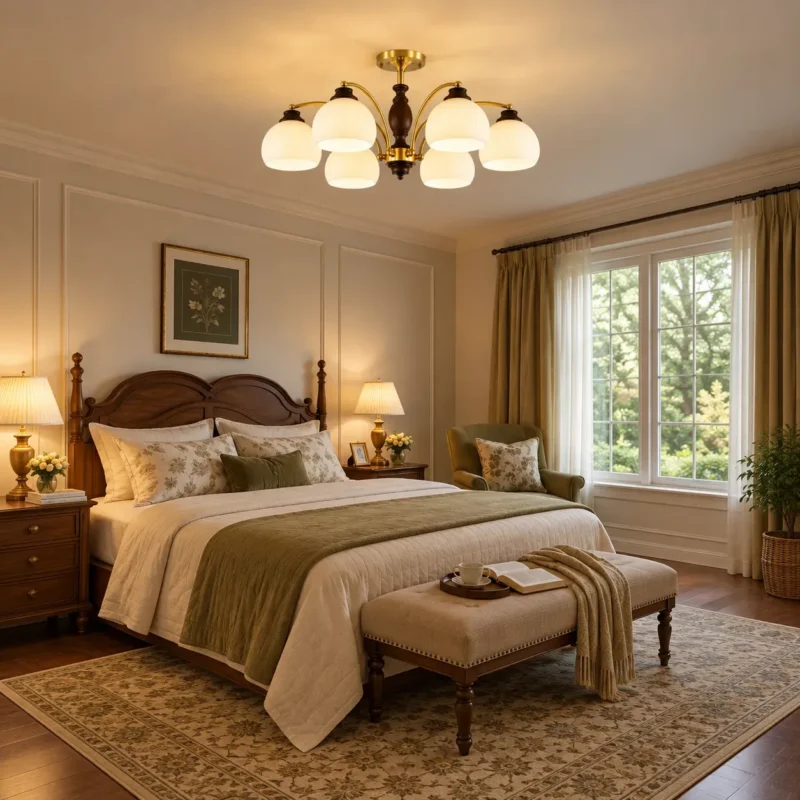
In a bedroom, visual comfort usually matters more than maximum output. A warm 2700K lamp with good color rendering and dimming capability can help the fixture transition from practical evening illumination to a softer pre-sleep setting. If dimming is desired, the E27 bulbs and wall dimmer must be mutually compatible; otherwise flicker, limited dimming range or audible noise may occur.
Because the shades face downward and outward, the fixture is well suited to general illumination while bedside lamps can handle reading and localized tasks. This layered arrangement avoids putting all visual demand on the ceiling light.
Dining Rooms and Family Spaces
Over a dining zone, the fixture’s symmetrical geometry works especially well with round or square tables, though it can also anchor a rectangular table when the fixture diameter is visually balanced with the tabletop. Warm-white lamps help wood furniture and food presentation feel natural and inviting.
For family lounges and open-plan rooms, the chandelier can also act as a visual zoning device. A ceiling fixture centered over the seating area subtly defines that zone even when there are no walls separating it from an adjacent dining or circulation space.
Bulb Selection: Four Specifications Worth Checking
• Lumen output: Choose brightness by lumens, not by wattage alone. Multiple moderate-output bulbs often create a more comfortable result than a few extremely bright lamps.
• Color temperature: Use about 2700K for a warmer traditional atmosphere or 3000K for a slightly cleaner warm-white appearance.
• Color rendering: DOE guidance notes that CRI 80 is a common minimum for interior lighting, while CRI 90+ indicates excellent color fidelity. Higher color rendering is valuable around wood, textiles, artwork and skin tones.
• Dimming compatibility: If using a dimmer, verify that both the LED lamps and the dimmer are rated for each other. Compatibility is more important than simply seeing the word ‘dimmable’ on the bulb box.
A Simple Lighting Principle: Distance Changes Illuminance
For an unobstructed point-like source, illuminance falls rapidly as distance increases; the familiar inverse-square relationship explains why the same bulb appears much less effective on a task surface when the ceiling is significantly higher. Real rooms are more complex because walls, ceilings, floors and shades reflect and redistribute light, but the principle is still useful: higher ceilings and darker finishes usually require more total lumen output or additional lighting layers.
This is why an 8-head version can make sense in a larger or taller room even when its appearance alone would not require it. Conversely, in a smaller bedroom with pale walls, the 6-head version may already provide ample ambient light with moderate-output LED lamps.
Installation and Safety Considerations
The fixture is ceiling-mounted and weighs approximately 5-7 kg depending on version. It should be fixed to a ceiling structure and junction box that are appropriate for the load, with electrical work completed according to local code. The product supports AC 110-240V, 50/60Hz, but the installed lamps and any dimming controls must also be compatible with the local electrical system.
Before installation, confirm the fixture diameter against ceiling features, door swings, wardrobes and nearby tall furniture. In circulation areas, maintain adequate head clearance. For sloped ceilings or unusual mounting conditions, verify suitability before purchase rather than assuming a standard canopy will accommodate the geometry.
Cleaning Ribbed Glass and Brass-Finish Surfaces
Turn power off and allow the lamps to cool before cleaning. Dust the glass regularly with a soft microfiber cloth. For fingerprints or light residue, use a slightly damp cloth and dry immediately. Avoid abrasive pads or aggressive chemicals on decorative metal finishes, because they can dull or discolor the surface.
Ribbed shades can trap dust along the grooves, so gentle repeated passes are preferable to heavy pressure. Keeping the glass clean also preserves light transmission and reduces the gradual loss of brightness caused by surface dust.
Who This Fixture Is Best For
This ceiling light is particularly suitable for homeowners and designers who want traditional warmth without an overly ornate crystal chandelier. It combines a familiar multi-arm silhouette with restrained materials: brass-toned metal, walnut-brown wood and softly textured glass. The result works in classic interiors, warm transitional homes, modern rustic spaces and boutique hospitality settings.
Its replaceable E27 format is also a practical advantage for long-term ownership. Instead of replacing the entire fixture when preferences change, the user can update lamp brightness, color temperature or dimming performance within the fixture’s rated limits.
Design Takeaway
Good residential lighting is a balance of appearance, distribution, color quality and control. The Classic Brass Ceiling Light succeeds because its decorative language and lighting function support one another: warm finishes suit warm-white light, ribbed glass softens the visual source, the broad multi-arm geometry distributes light around the room, and replaceable E27 lamps preserve flexibility.
For the most refined result, use the chandelier as the ambient layer rather than the only light source. Pair it with task and accent lighting, select high-quality warm-white LED bulbs, and scale the 6-head or 8-head version to the room rather than choosing by brightness alone.
Featured fixture: Classic Brass Ceiling Light | Ribbed Glass Chandelier
