

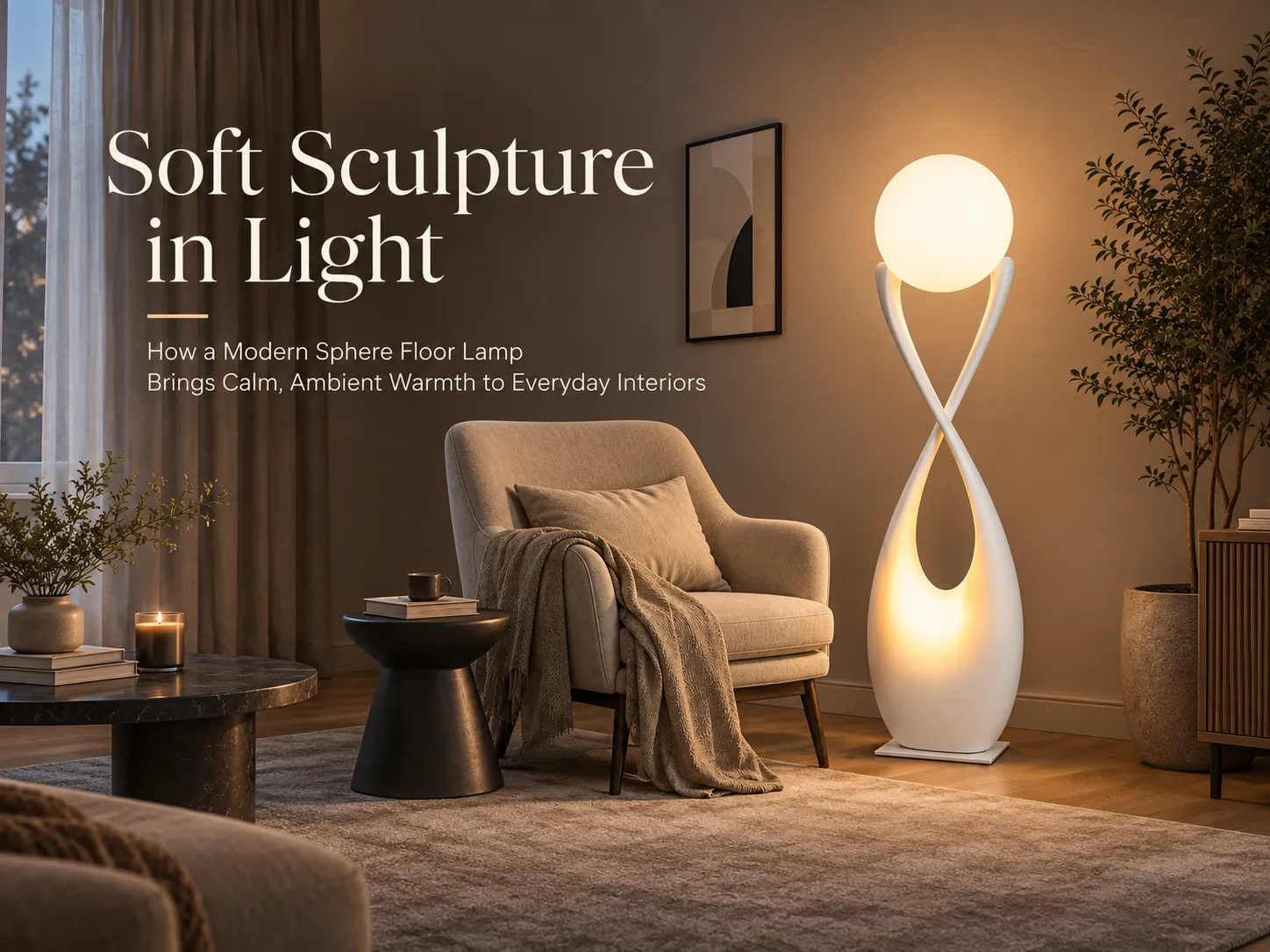

How the Infinity Sculptural Floor Lamp Combines Soft Diffusion, Warm Light, and Art-Led Interior Design
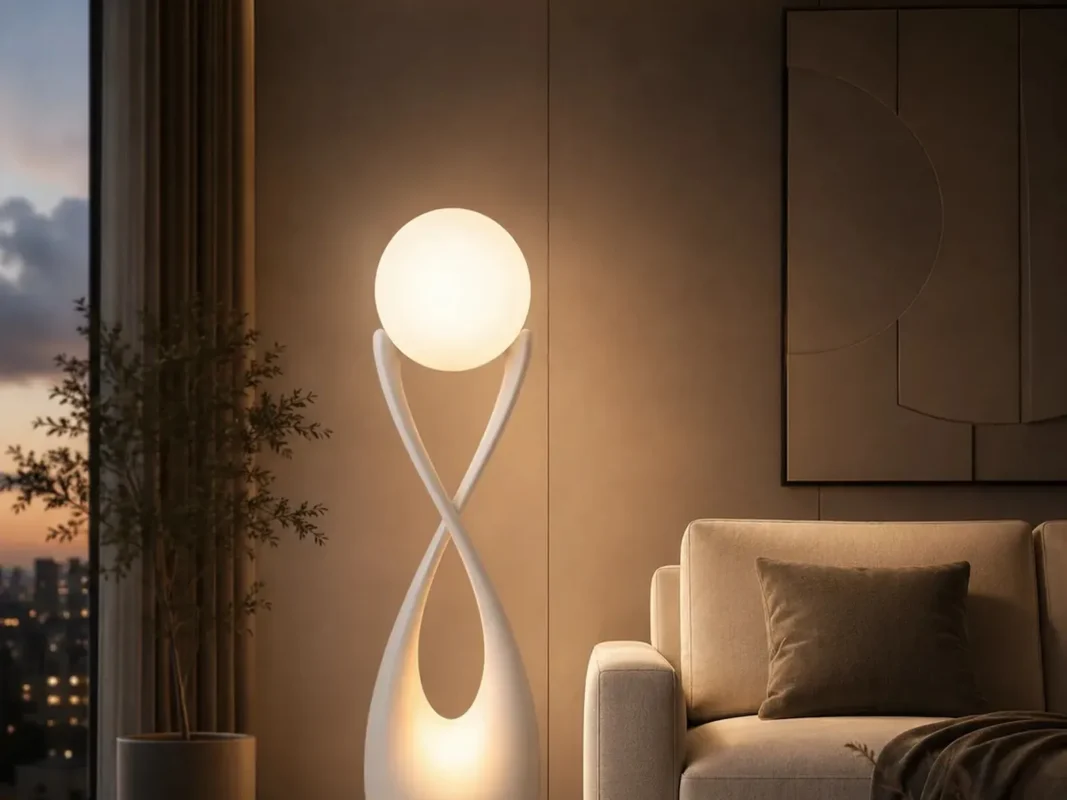
Some floor lamps are designed mainly to disappear into the background. The Infinity Sculptural Floor Lamp takes the opposite approach: its flowing crossed silhouette, matte white body and illuminated opal glass globe make it function as both a source of ambient light and a freestanding art object. At 160 cm (62.99 in) tall, it has enough visual presence to anchor a bedroom corner, reading zone, living room or hotel-style interior without requiring wall mounting or ceiling work.
Its design also supports a practical lighting strategy. The lamp uses one replaceable E27 bulb rather than a sealed LED module, so the user can choose brightness, color temperature and color quality within the fixture’s 40 W maximum rating. That flexibility matters because visual comfort depends not only on the shape of a luminaire, but also on source luminance, room brightness, viewing direction and color characteristics.
Why the Infinity Form Works as Interior Sculpture
The lamp’s crossed profile creates a continuous figure-eight or infinity-like movement. This does two things visually: it gives the object a recognizable silhouette from across the room, and it creates negative space through the center so the lamp feels tall and sculptural without becoming visually heavy. The matte white fiberglass surface keeps the form quiet and architectural, while the glowing globe introduces a soft focal point above eye level.
In interiors with cream fabrics, walnut, warm stone, bronze, plaster or muted earth tones, the white body acts as a neutral counterpoint. The lamp can therefore work in modern minimalist, soft contemporary, wabi-sabi-inspired and boutique-hotel settings without relying on ornate decoration.
Why Opal Glass Produces Softer Light
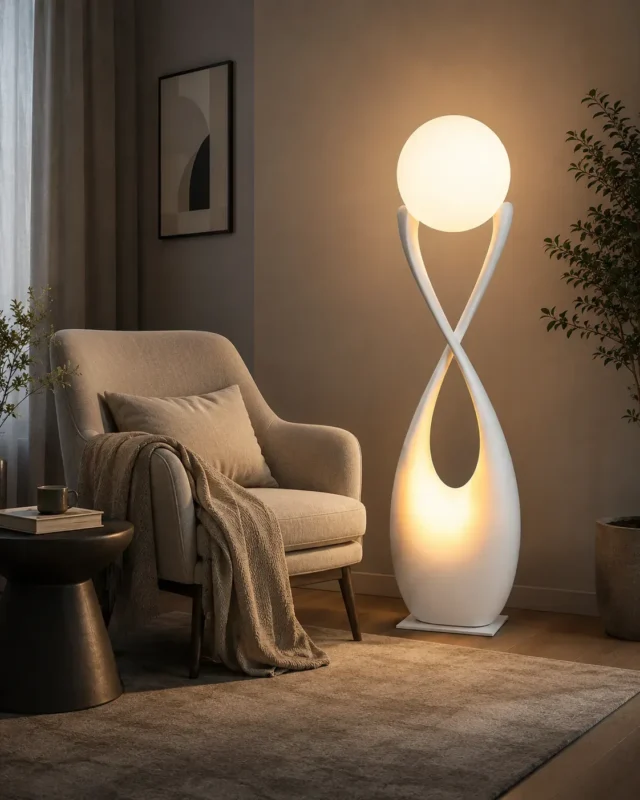
The product uses an opal glass globe around the bulb. Compared with a clear shade, opal glass diffuses light across a larger luminous surface and reduces the direct view of the lamp filament or LED emitters. This matters because the Illuminating Engineering Society defines glare as a sensation caused when luminances in the visual field are sufficiently greater than the viewer’s adaptation level to create annoyance, discomfort or reduced visibility.
Diffusion does not automatically eliminate glare, but it can lower the apparent contrast of a point source by making the luminous area larger and more uniform. The final comfort level still depends on bulb output, eye position, room brightness and the surrounding wall luminance. For a floor lamp used near seating, that makes a softly glowing globe a sensible design choice.
Warm Light and Residential Atmosphere
Xunlu Lighting recommends a correlated color temperature of about 2700K-3000K for this lamp. That range is commonly used in residential interiors because it appears warm and relaxed rather than cool or clinical. U.S. Department of Energy guidance on high-performance residential lighting recommends 3000K and 80+ CRI for many home applications, while modern LED sources are also widely available at 2700K when an even warmer evening atmosphere is preferred.
Warm light is particularly compatible with the lamp’s role as an accent and ambient source. In a bedroom or lounge, it reinforces wood, beige, brown and cream materials while preserving a calm nighttime mood. For a more neutral modern interior, 3000K usually provides a slightly cleaner white without losing the warm character.
Lumens, Not Watts: Choosing the Right Bulb
The lamp accepts one E27 replaceable bulb with a maximum power rating of 40 W. For LED bulbs, watts describe electrical consumption rather than visible light output, so brightness should be evaluated in lumens. The product page estimates an appropriate output range of roughly 450-800 lm.
At the lower end of that range, the lamp behaves mainly as a decorative accent or bedside ambient source. At the higher end, it can contribute more useful room illumination, especially when positioned near a pale wall that reflects light back into the space. Because it is a single-source floor lamp, it is best treated as one layer in a broader lighting plan rather than the only light in a large room.
Product Specifications
| Specification | Details |
|---|---|
| Product type | Sculptural floor lamp |
| Style | Modern minimalist / artistic sculptural / contemporary luxury |
| Main material | Fiberglass |
| Shade material | Opal glass |
| Body finish | Matte white |
| Overall size | Approx. 25 cm diameter × 160 cm high / 9.84 in × 62.99 in |
| Globe diameter | 25 cm / 9.84 in |
| Base size | 25 × 25 cm / 9.84 × 9.84 in |
| Net weight | Approx. 6.5 kg / 14.33 lb |
| Light source | 1 × E27 replaceable bulb |
| Bulb included | No |
| Maximum power | 40 W |
| Recommended CCT | 2700K–3000K warm white |
| Estimated output | Approx. 450–800 lm |
| Voltage | AC 100–240 V, 50/60 Hz |
| Cord length | 200 cm / 78.74 in |
| Switch | Foot switch |
| Installation | Freestanding / plug-in |
| Recommended wall clearance | 20–30 cm / 7.87–11.81 in |
| Application | Indoor use |
Where This Lamp Works Best
Bedroom: Positioned beside a bed or opposite a dresser, the lamp can provide warm ambient light without requiring a ceiling fixture to carry the full mood of the room. Its vertical silhouette also works well where wall space is limited but a decorative focal point is needed.
Reading corner: Beside a lounge chair, the lamp creates a comfortable pool of light and helps define the seating zone. Because the globe is not a directional task light, serious reading may still benefit from a dedicated adjustable lamp; the Infinity lamp is stronger as ambient and decorative illumination.
Living room: In a corner beside a sofa, console or large artwork, the lamp fills vertical space and can reduce the visual darkness of an unused corner. This is particularly effective in open-plan rooms where layered lighting helps avoid a flat, ceiling-only lighting scheme.
Hospitality and display spaces: Its sculptural shape is suitable for hotel rooms, show homes, reception areas and gallery-inspired settings where the fixture is expected to remain visually interesting even when switched off.
Placement: Why 20-30 cm of Wall Clearance Helps
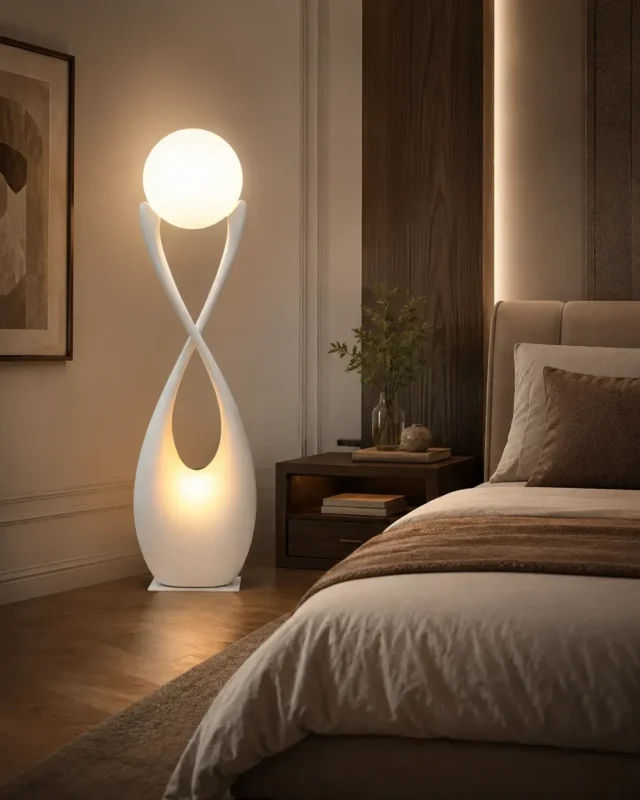
The manufacturer recommends approximately 20-30 cm (7.87-11.81 in) between the lamp and the wall. This spacing is useful for both visual and practical reasons. It allows the glow from the globe and lower illuminated body to spread onto the wall rather than creating a narrow bright patch, and it leaves room for cleaning, cable routing and airflow around the fixture.
A pale wall will reflect more light back into the room than a very dark wall. As a result, the same bulb can feel brighter in a cream or white interior than in a charcoal or dark-wood setting. This is one reason lighting recommendations should be treated as a system rather than a single lumen number.
Layered Lighting Is Better Than One Bright Source
Residential lighting performs best when ambient, task and accent layers are allowed to do different jobs. A sculptural floor lamp is especially effective as ambient/accent lighting: it raises the brightness of the surrounding wall, adds visual interest and creates a transition between dark and bright zones. Ceiling lighting can then provide broad room coverage, while local task lights handle reading, dressing or desk work.
This layered approach also relates to visual comfort. The IES notes that discomfort glare depends on source luminance, source size, its position in the field of view and the viewer’s adaptation level. Keeping the room from becoming completely dark around a bright source can therefore make the source feel more comfortable.
Color Rendering: A Small Specification With a Big Visual Effect
When selecting the E27 bulb, color rendering should not be overlooked. The U.S. Department of Energy notes that a CRI of 80 is generally recommended for interior lighting and that CRI 90+ indicates excellent color fidelity. In a room with wood grain, textiles, artwork and skin tones, a high-quality 90+ CRI LED bulb is a worthwhile choice if accurate, natural color appearance is important.
CRI is not a complete description of color quality, but it remains useful for consumer selection. If the bulb manufacturer also publishes TM-30 data, those metrics provide a broader view of fidelity and gamut than CRI alone.
Dimming and Control
The fixture itself uses a convenient foot switch. If dimming is desired, the bulb, any inline dimming device and the electrical control method must all be compatible. The Department of Energy advises checking that LED lamps are specifically rated for the intended dimming system. Incompatible combinations can cause flicker, audible noise, sudden drop-out at low levels or a limited dimming range.
For bedrooms and evening lounges, dimming can be especially useful because it allows the same fixture to provide brighter practical light earlier in the evening and a lower, calmer level before sleep.
Scale, Stability, and Safety
At approximately 160 cm (62.99 in) tall and 6.5 kg (14.33 lb), this is a substantial freestanding object rather than a small portable lamp. Place it on a flat, stable floor and keep the square base fully supported. Avoid high-traffic paths where the lamp could be bumped, and route the 200 cm power cord so it does not create a trip hazard.
The lamp is intended for indoor use. Before inserting a bulb, verify that it uses an E27 base, is appropriate for the supply voltage and does not exceed the 40 W fixture rating. Because modern LEDs can produce substantial light at far lower wattage, there is rarely a practical reason to approach the maximum power limit for ordinary residential use.
Cleaning and Long-Term Care
Turn the lamp off, unplug it and allow the bulb and globe to cool before cleaning. Use a soft microfiber cloth on the matte fiberglass body and opal glass. A slightly damp cloth can remove fingerprints or dust buildup, followed by a dry cloth. Abrasive pads and strong solvents should be avoided because they can change the surface sheen or mark the finish.
Keeping the globe clean is not only cosmetic: accumulated dust reduces light transmission and can make the fixture appear dimmer over time. Regular light cleaning is therefore preferable to infrequent aggressive cleaning.
Design Takeaway
The Infinity Sculptural Floor Lamp is most successful when it is treated as both light and furniture-scale sculpture. Its flowing silhouette gives a room identity; the opal globe softens the visible source; the matte white finish keeps the form versatile; and the replaceable E27 lamp lets the user choose the final brightness and color quality.
For a balanced result, pair the lamp with 2700K-3000K warm-white LED lighting, choose at least CRI 80 and preferably CRI 90+ for richer interiors, keep the lamp roughly 20-30 cm from the wall, and use it as part of a layered scheme rather than asking one bulb to illuminate an entire room.
Featured fixture: Infinity Sculptural Floor Lamp | Modern Art Lighting
