

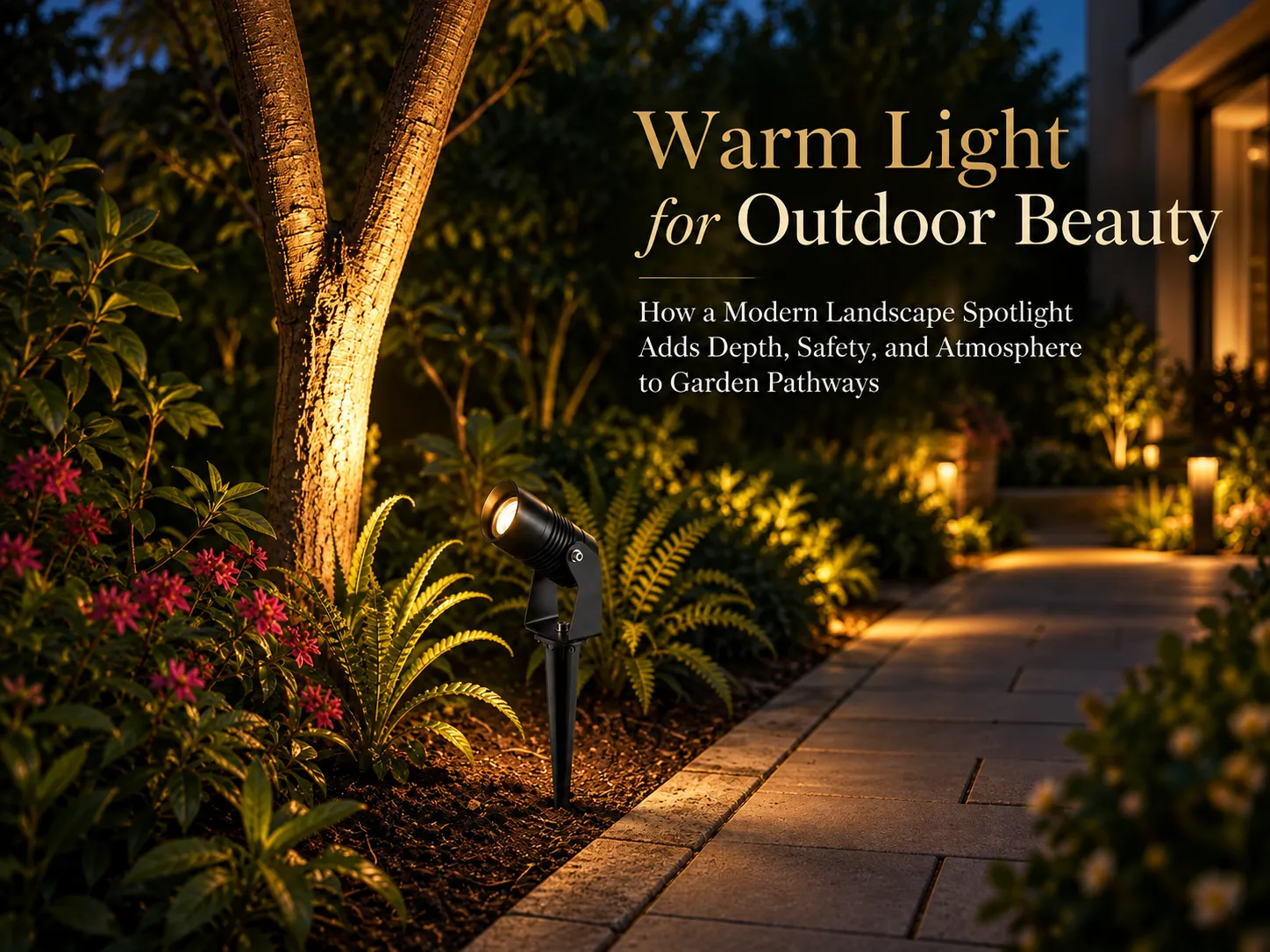

How a Modern LED Garden Spike Light Builds Safer Paths, Dramatic Planting, and More Responsible Outdoor Atmosphere
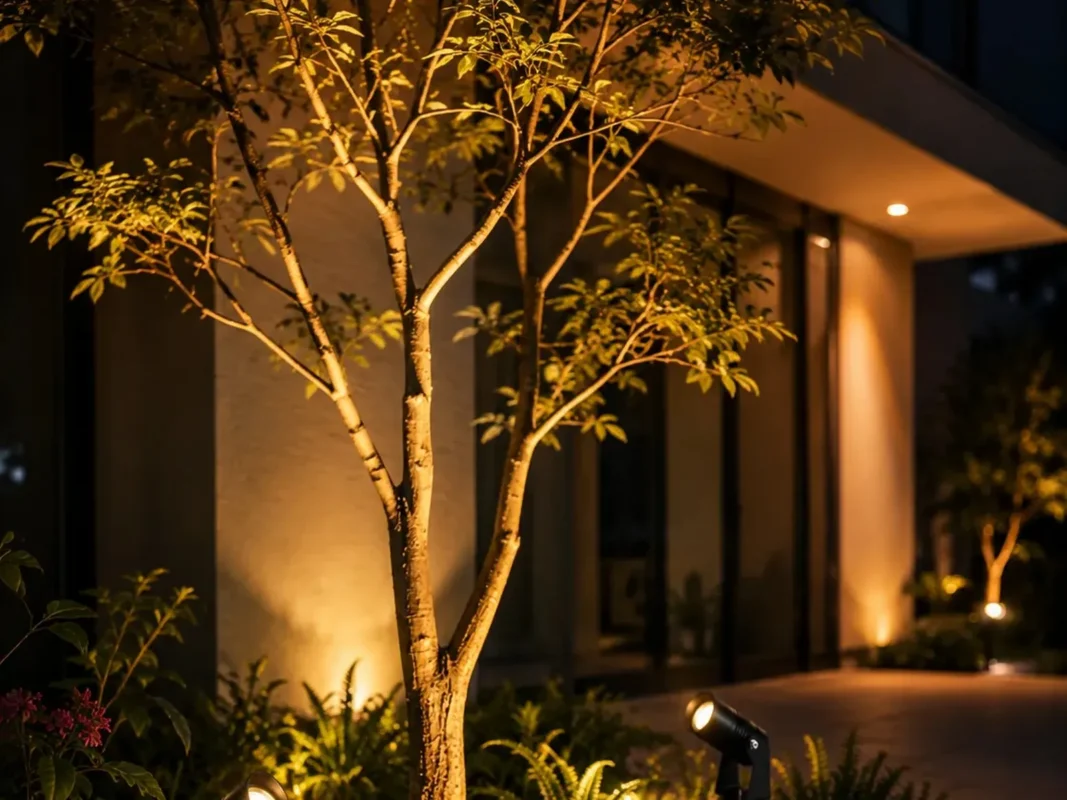
Outdoor lighting is most successful when it does not try to imitate daylight. A well-designed garden scheme uses modest, carefully aimed pools of light to reveal circulation, planting texture, tree trunks and architectural edges while preserving the contrast that makes night landscapes feel calm and dimensional.
The Modern LED Outdoor Garden Spike Light is designed for that kind of focused illumination. Its compact black aluminum body, adjustable head, tempered-glass lens and ground-spike installation make it suitable for planting beds, paths, villa gardens, patios and hospitality landscapes. The integrated 3W Bridgelux COB LED produces approximately 250-300 lumens at 3000K, giving designers a useful accent-lighting tool without relying on excessive output.
Why Spike Lights Work So Well in Residential Landscapes
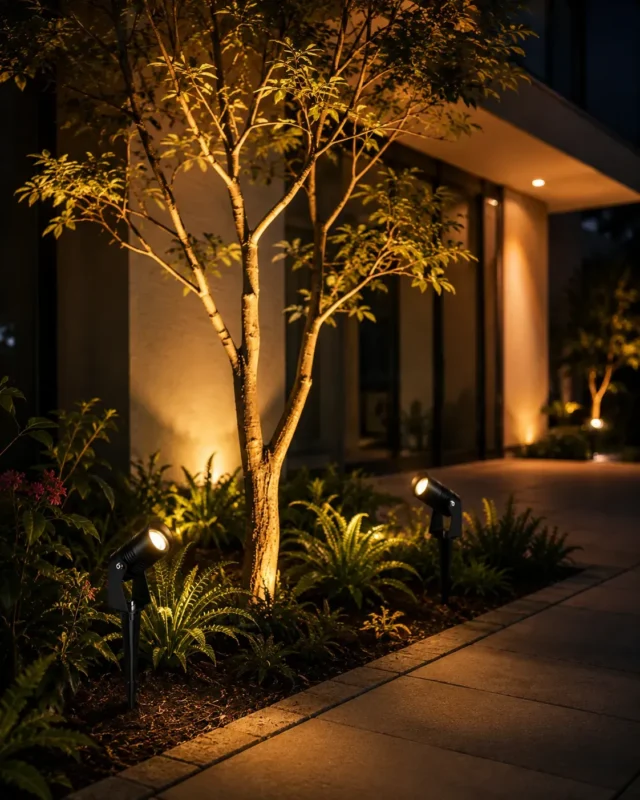
A spike light is flexible because its position and aiming angle can be changed after planting matures. Instead of washing an entire garden with uniform brightness, several small fixtures can create a visual hierarchy: brighter emphasis on a feature tree or textured wall, moderate light along a path, and deliberately darker areas between focal points. This contrast is what gives a night garden depth.
The hidden spike installation also keeps the hardware visually quiet during the day. In planted areas, the luminaire body can sit among foliage while the beam is aimed toward the intended subject. This is especially useful in villas and gardens where landscape lighting should support the design rather than dominate it.
The Science of Targeted Outdoor Lighting
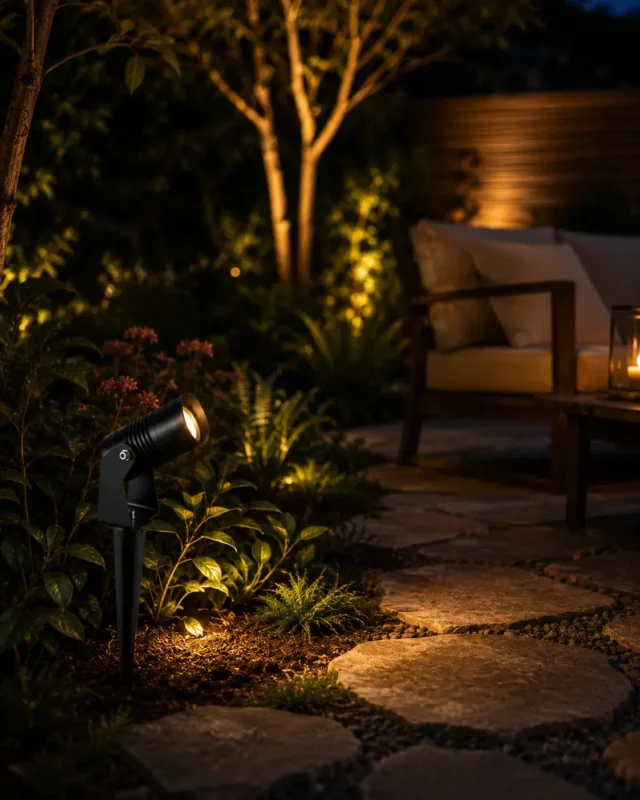
Light arriving on a surface decreases as distance from a compact source increases. In simple terms, moving a spotlight farther from a tree or wall reduces illuminance quickly, which is why small changes in fixture position can produce large changes in visual brightness. Beam angle also matters: a narrower beam concentrates luminous intensity on a smaller area, while a wider beam spreads the same available light across a larger surface.
This is one reason adjustable spike lights are useful. Rather than increasing wattage to compensate for a poor position, the designer can refine distance and aim so that more of the useful light reaches the intended feature. Good outdoor lighting is primarily an exercise in placement and control, not maximum brightness.
Why 3000K Warm White Is a Sensible Outdoor Choice
The product uses 3000K warm white light. That color temperature complements timber, brick, stone, soil and green foliage, and it generally feels more relaxed than higher-CCT cool white sources in residential landscapes. DarkSky International also places strong emphasis on warm-colored outdoor lighting and limits most DarkSky Approved luminaires to 3000K or lower because shorter-wavelength, blue-rich light contributes more strongly to sky glow and can have greater environmental effects.
For a home garden, the practical lesson is simple: use warm light, keep it no brighter than necessary, and aim it carefully. A 3000K source can provide good visual definition while preserving a softer nighttime atmosphere.
250-300 Lumens: Why Modest Output Can Be Enough
At 250-300 lumens, this 3W spike light is not intended to illuminate an entire yard from one point. Its strength is accent lighting. Used at short to moderate distances, the output is appropriate for individual shrubs, small trees, facade details, pathway edges and layered planting compositions.
DarkSky and the Illuminating Engineering Society promote the principle that outdoor light should be useful, targeted, low-level, controlled and warm-colored. In practice, that means multiple low-output fixtures with precise aiming often create a better landscape than a few very bright sources. Lower light levels can reduce glare, wasted spill light and visual adaptation problems while still giving people enough information to navigate.
Product Specifications at a Glance
| Specification | Details |
|---|---|
| Product type | Modern LED Outdoor Garden Spike Light |
| Material | Aluminum alloy body + tempered glass lens |
| Finish | Matte black sandblasted coating |
| Light source | 1 integrated Bridgelux COB LED |
| Power | 3W |
| Lumen output | 250–300 lm |
| Color temperature | 3000K warm white |
| Voltage | AC 220V / optional DC 12V / DC 24V |
| Lamp diameter | Ø40 mm / 1.57 in |
| Lamp length | 95 mm / 3.74 in |
| Ground spike length | 160 mm / 6.30 in |
| Overall height | 252 mm / 9.92 in |
| Installation | Ground spike mount |
| Waterproof rating | IP65 |
| Net weight | Approx. 0.45–0.6 kg per piece |
IP65: What the Rating Means in Real Use
The fixture is rated IP65. In the IEC ingress-protection system, the first digit 6 indicates a dust-tight enclosure, while the second digit 5 indicates protection against water jets. That makes IP65 appropriate for exposed garden applications such as rain, irrigation splash and dust when the product is correctly installed.
IP65 does not mean the fixture is designed for permanent submersion. Avoid placing it in locations that regularly flood or where water can pool around cable joints. Outdoor wiring connections should use weather-rated components and follow local electrical codes, especially for line-voltage installations.
Four Useful Ways to Apply This Fixture
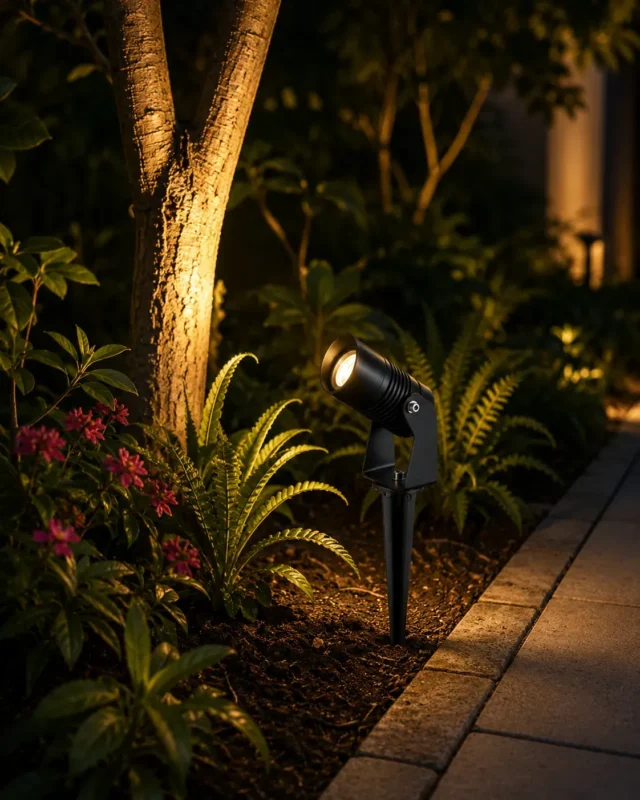
1. Tree uplighting: Place the spike outside the root flare and aim the beam up the trunk or into the lower canopy. A slight off-axis position often shows bark texture better than aiming directly from the front.
2. Pathway edge lighting: Set fixtures in planting beds beside the path rather than in the walking surface. Aim across or toward the ground to improve visibility while minimizing direct view of the LED source.
3. Shrub and ornamental-grass accents: Use short throw distances to bring out leaf texture and silhouette. Repeating fixtures at irregular intervals usually looks more natural than perfectly even spacing.
4. Architectural highlighting: Aim the beam at columns, textured masonry or facade details. Keep the illuminated area tightly controlled so light does not spill through windows or above the roofline.
Avoiding Glare and Light Trespass
Glare happens when a bright source or reflection is visible near the line of sight. With adjustable spike lights, this can often be reduced simply by changing the aiming angle or moving the fixture so the LED aperture is hidden behind planting. The goal is to see the illuminated tree, wall or path—not the bright source itself.
Light trespass occurs when illumination reaches areas where it is not wanted, such as a neighbor’s window or the night sky. DarkSky guidance recommends aiming light only at the intended target and using shielding or careful placement to reduce high-angle light. For upward tree lighting, keep the beam narrow and ensure that most of the beam is intercepted by the trunk and canopy rather than continuing into open sky.
Spacing: Think in Scenes, Not in a Grid
There is no universal spacing formula for landscape spike lights because planting density, beam angle, surface reflectance and viewing distance vary widely. A useful method is to light the most important visual anchors first—perhaps a feature tree, an entry path and one architectural surface—then add fixtures only where the scene still feels visually disconnected.
This approach avoids overlighting. It also reduces energy use and preserves the dark areas that make illuminated foliage and stone appear more dramatic.
Controls Make Outdoor Lighting Better
Outdoor lighting rarely needs to operate at full output all night. Timers, astronomical clocks, occupancy sensors and smart controls can reduce unnecessary operating hours. DarkSky’s Five Principles specifically recommend controls so that light is dimmed or switched off when it is not needed.
For a private garden, a practical schedule might provide full landscape lighting during evening use, reduce or switch off decorative accents later at night, and retain only essential safety lighting where required. This approach supports energy efficiency while reducing disturbance to neighbors and the nighttime environment.
Low Voltage or AC? Choosing the Supply
The product page lists AC 220V as well as optional DC 12V and DC 24V configurations. The correct version should be selected before installation because wiring, drivers and safety requirements differ. Low-voltage landscape systems can be convenient in gardens, but they still require correctly sized power supplies, weatherproof connections and voltage-drop planning. Line-voltage versions require installation practices appropriate to local electrical codes and should be handled by a qualified electrician where required.
Installation and Maintenance
Install the spike into stable, well-drained soil rather than forcing it into compacted ground by pushing on the lamp head. Keep the cable route protected from garden tools and future digging. After aiming, tighten the pivot hardware so wind or accidental contact does not change the beam direction.
Periodically clean the tempered-glass lens with a soft damp cloth. Dust, mineral deposits and organic debris can reduce light output and change beam quality. Check the fixture after major weather events, seasonal gardening or soil movement, and readjust the angle if plants have grown into the beam.
Design Takeaway
The Modern LED Outdoor Garden Spike Light is a compact architectural tool rather than a general-purpose floodlight. Its 3W, 250-300 lumen output, 3000K warm-white light, adjustable head and IP65 construction make it especially suited to precise residential landscape accents.
The best results come from restraint: illuminate selected surfaces, hide the source when possible, avoid unnecessary brightness, use warm light, and turn the system down or off when it is no longer needed. That combination creates a garden that feels richer at night while using light more responsibly.
Explore the Modern LED Outdoor Garden Spike LightModern LED Outdoor Garden Spike Light — Click to View Product
