

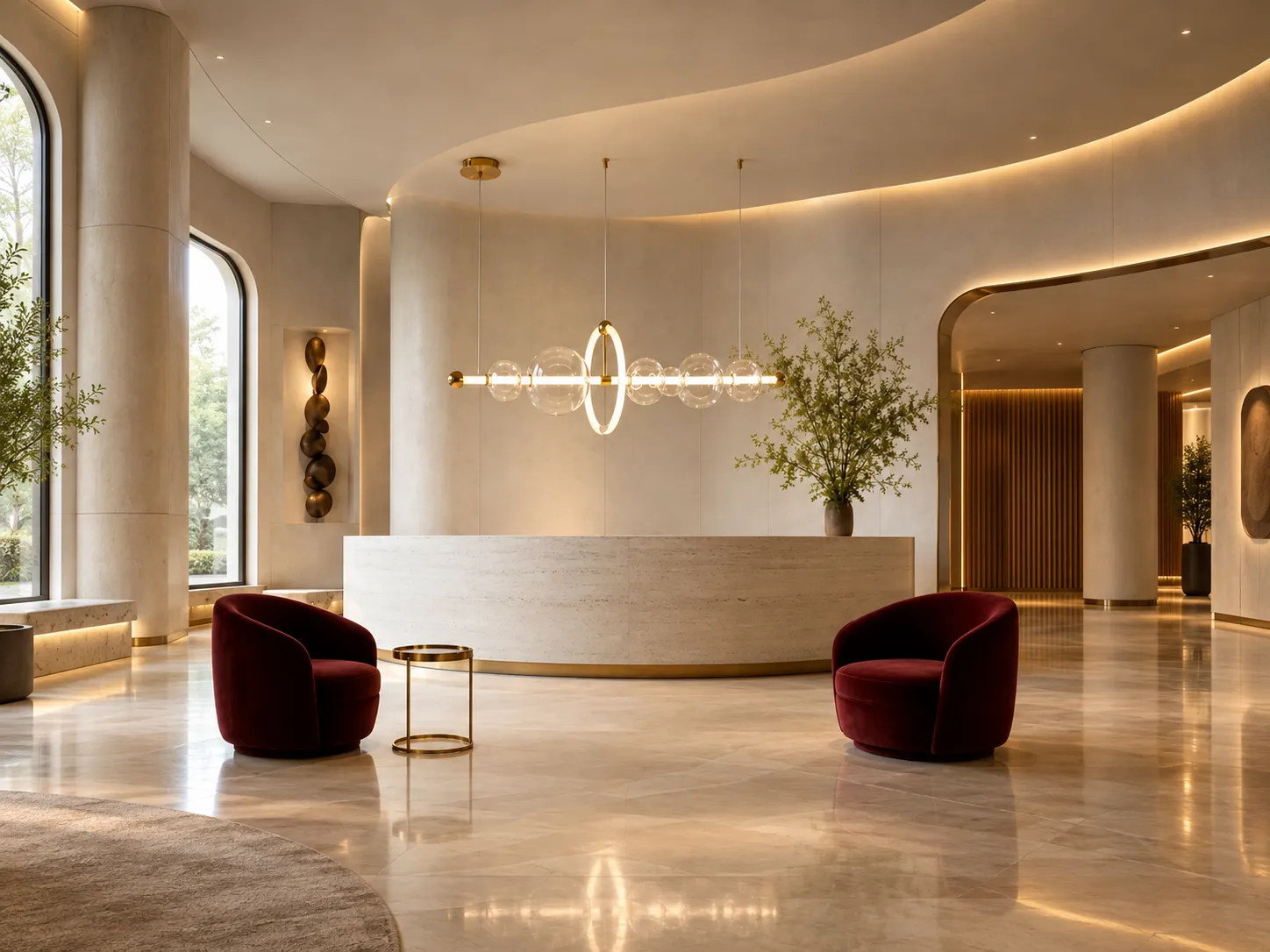

How Sculptural Glass, Linear LED Light and Proportion Shape a Refined Modern Interior
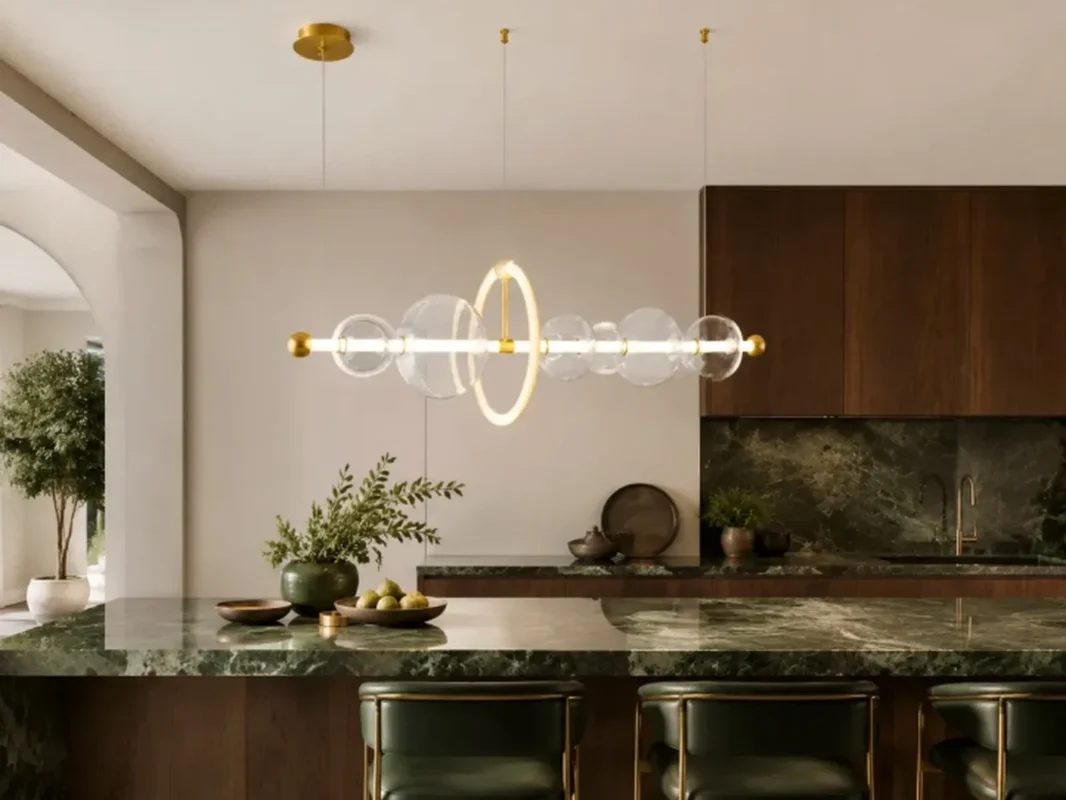
Design guide · product analysis · evidence-informed lighting principles
View the Glass Orb Halo LED Linear Pendant Light
A Pendant Light Can Be Both Illumination and Architecture
The strongest modern interiors rarely depend on a single decorative object. They depend on proportion, material contrast, controlled brightness, and a clear hierarchy of light. A linear pendant can contribute to all four. Suspended above a dining table, kitchen island, bar counter, or reception desk, it becomes a visual axis that helps organize the room while also providing useful light where people gather.
The Glass Orb Halo LED Linear Pendant Light takes that architectural role seriously. The fixture combines a slim brushed-gold metal structure, integrated linear LED illumination, transparent glass orbs, and a luminous vertical halo. The result is not a traditional chandelier with visible bulbs; it is a sculptural composition in which light appears to travel through and around a sequence of transparent volumes. According to the current Xunlu Lighting product specification, the design is offered in three lengths—50 cm, 90 cm, and 120 cm—with integrated LED output ranging from approximately 1,800 to 4,000 lumens depending on size.[1]
This article looks beyond appearance. It explains how the fixture works visually, how to choose the right size and color temperature, what the published lumen and wattage figures actually mean, how glare and mounting height affect comfort, and how to integrate the pendant into a layered residential lighting plan using established lighting guidance from the U.S. Department of Energy (DOE) and the International Commission on Illumination (CIE).
At a glance
- Materials: metal, acrylic and transparent glass; brushed-gold finish.
- Integrated linear LED; no exposed conventional bulbs in the main light line.
- Three sizes: 50 × 30 cm, 90 × 30 cm and 120 × 30 cm.
- Published output: approx. 1,800–2,000 lm, 2,700–3,000 lm and 3,600–4,000 lm respectively.
- Selectable color temperatures: 3000K, 4000K and 6000K.
- Adjustable suspension up to 150 cm; product page currently lists AC 220–240V input.[1]
1. Why the Glass-Orb-and-Halo Composition Feels Contemporary
The visual identity of this pendant comes from contrast. The metal frame is linear and precise; the glass is round and optically light; the illuminated halo introduces a vertical gesture that interrupts the horizontal line. In interior design terms, that creates a balanced tension between geometry and softness.
Transparent glass also behaves differently from opaque shades. Instead of reading as a solid mass, the orbs allow the background to remain visible through the fixture. This matters in smaller rooms or open-plan interiors because the pendant can create a strong focal point without forming a heavy visual barrier. Reflections in the glass add sparkle and depth, but the room itself remains part of the composition.
The brushed-gold finish contributes warmth without requiring an overtly classical style. In the supplied room scenes, it works especially well against walnut cabinetry, dark stone, travertine, warm plaster, and black furniture. Those materials have enough visual weight to anchor the transparent glass, while the gold introduces a controlled highlight rather than a large block of color.
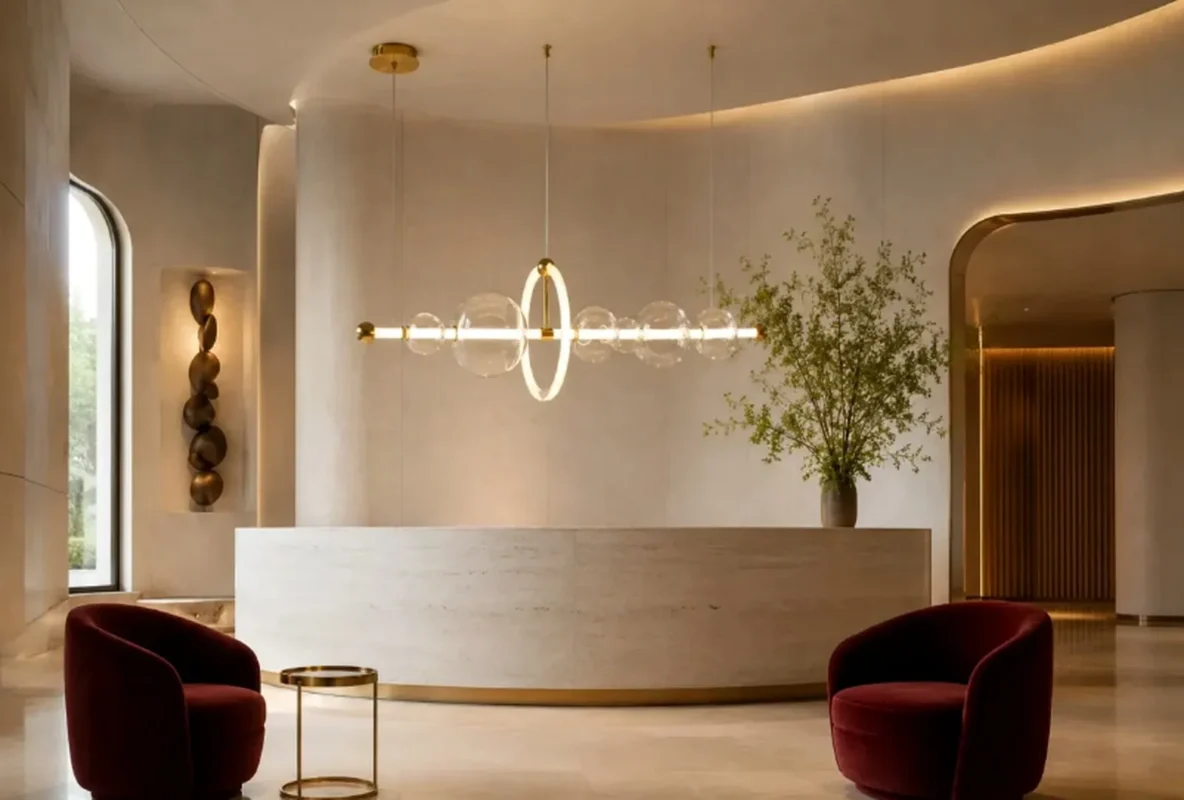
Figure 1. In a reception or hospitality setting, the linear pendant becomes a visual axis while the transparent glass preserves openness across the room.
2. Reading the Specifications Like a Lighting Designer
Decorative lighting specifications are most useful when wattage, lumens, distribution, color quality, and room conditions are considered together. A watt is a measure of electrical input; a lumen is a measure of visible light output. DOE guidance emphasizes that luminaire efficacy—the ratio of lumens to input watts—is a useful way to compare the efficiency of similar products, but it does not by itself tell you whether a fixture will light a specific room well.
| Size | Power | Published lumens | Approx. efficacy | Suspension | Typical scale |
|---|---|---|---|---|---|
| 50 × 30 cm | 24W | 1,800–2,000 lm | 75–83 lm/W | Up to 150 cm | Compact table / small island |
| 90 × 30 cm | 36W | 2,700–3,000 lm | 75–83 lm/W | Up to 150 cm | Medium dining table / island |
| 120 × 30 cm | 48W | 3,600–4,000 lm | 75–83 lm/W | Up to 150 cm | Long table / island / reception desk |
Calculated efficacy uses the midpoint-independent range: lumens ÷ watts. Actual delivered illuminance depends on photometric distribution, mounting height, room geometry and surface reflectance.
Across all three sizes, the published figures work out to roughly 75–83 lumens per watt. That consistency suggests the sizes are scaled versions of the same optical concept rather than three completely different lighting systems. The larger versions mainly add output and physical length, which makes size selection a question of both room proportion and required light—not simply ‘bigger is brighter.’
Lumens are not the same as lux
Illuminance is measured in lux, which describes how much light reaches a surface. DOE residential guidance references a calculation in which horizontal illuminance is determined from lamp lumens, number of lamps, coefficient of utilization, light-loss factors, and room area.[3] In practical terms, two rooms can use the same pendant and receive very different light levels because ceiling height, table height, wall colors, glass, and additional lighting layers all change how much light reaches the working plane.
That is why the pendant should be treated as one element in a layered scheme. It can provide a strong decorative and local lighting layer over the table or island, while recessed, cove, wall-wash, or under-cabinet lighting carries the rest of the room. DOE’s residential dining-room guidance specifically notes the value of glare-free ambient light together with pendant or chandelier lighting at the table, and also identifies dimming as desirable in dining spaces.[3]
3. 3000K, 4000K or 6000K? Choosing Color Temperature Deliberately
Correlated color temperature (CCT) describes the visual appearance of white light. Lower values look warmer and more amber; higher values look cooler and more blue-white. DOE guidance characterizes 2700K as friendly and personal for homes and restaurants, around 3000K as warm and pleasing for homes, lobbies and restaurants, and about 4100K as cleaner and cooler for offices, classrooms and showrooms.[4]
For this pendant, the 3000K option is the most natural starting point for residential dining rooms, warm minimalist kitchens, walnut interiors, travertine, cream plaster and hospitality-style living spaces. It reinforces the brushed-gold finish and keeps skin tones, wood and food looking visually warm. The 4000K option produces a more neutral, crisp expression that can suit contemporary kitchens with white stone, stainless steel, pale gray finishes or work-focused islands. The 6000K option is distinctly cool; some users may prefer that bright appearance, but in many residential dining settings it can feel visually harder than the warmer alternatives.
CCT should also be coordinated with nearby fixtures. Mixing a 3000K pendant with very cool downlights can make both sources look inconsistent. A more polished interior usually keeps the dominant evening lighting within a reasonably coordinated color-temperature family, unless contrast is an intentional design decision.
Do not confuse color temperature with color rendering
A warm 3000K light can still render colors poorly, and a cool 4000K light can render them very accurately. Color rendering depends on the spectral quality of the source, not just its color temperature. DOE notes that CRI 80 is commonly considered a minimum for interior lighting and that CRI 90 or higher indicates excellent color fidelity.[2] The CIE now recommends broader adoption of its Rf color-fidelity metric while CRI remains in transition.[5]
The current product page does not publish a CRI or Rf value, so it would be inappropriate to assume one. If the pendant will illuminate food, artwork, richly colored textiles or premium hospitality finishes, ask for color-rendering data before specifying it for a project. That is a better technical decision than choosing by CCT alone.
4. Glass, Brightness and Visual Comfort
Clear glass creates elegance because it reflects and refracts light without fully obscuring the structure behind it. The same transparency, however, means that visual comfort depends strongly on the brightness of the LED elements and their position in the field of view. A beautiful fixture can still feel uncomfortable if a luminous strip or halo sits directly at eye level from normal seated positions.
This is where suspension adjustment becomes important. The product is listed with an adjustable suspension length up to 150 cm.[1] Rather than relying on a single universal mounting number, treat the installation as a sightline problem: the fixture should feel connected to the table or island below, but the brightest parts should not dominate the viewer’s direct line of sight. A simple on-site mock-up—temporarily holding the fixture or a cardboard profile at the intended height—is often more reliable than a purely theoretical measurement.
Dimming is equally useful. DOE residential guidance specifically calls dimming desirable in dining rooms because the same space may support different activities.[3] A family dinner, homework session, reception, and late-evening conversation do not need the same light level. If the selected driver and control system support dimming, that flexibility can substantially improve comfort and atmosphere. Confirm dimmer/driver compatibility before installation.
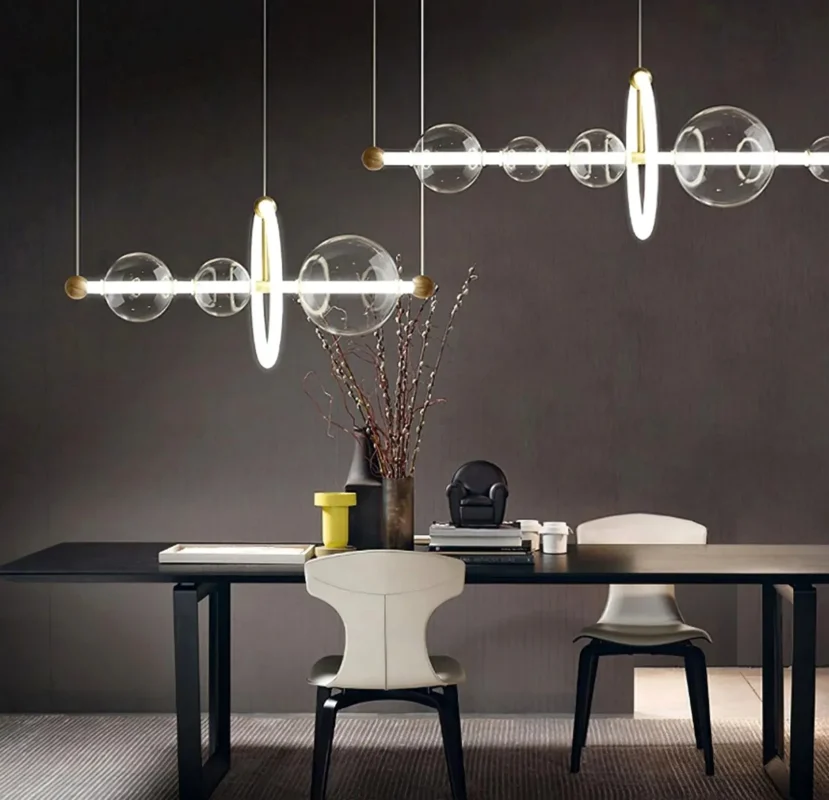
Figure 2. Over a dining or meeting table, mounting height and sightlines matter because the luminous ring and linear source remain visually prominent.
5. Choosing the Right Length for the Furniture Below
A linear pendant looks most intentional when its length is clearly related to the furniture or architectural element it serves. The goal is neither to match the table edge exactly nor to choose the smallest fixture that technically fits. The pendant should read as part of the composition, leaving visible breathing room at each end while remaining large enough to hold the center of the space.
The 50 cm version is best understood as a compact sculptural accent. It can work over a small round or short rectangular table, a compact island zone, a side counter, or as part of a repeated installation. The 90 cm version is more balanced for common medium-length dining tables and kitchen islands. The 120 cm version has enough horizontal presence for longer tables, large islands, reception desks and more architectural hospitality interiors.
When deciding between two sizes, consider the view from the room entrance as well as the view from directly below. In a wide open-plan space, a pendant that looks adequate over the table at close range can appear undersized from a distance. Conversely, in a low-ceiling or visually quiet room, an oversized fixture can dominate the space even if the furniture below is large.
6. Where This Pendant Works Best
Dining room: use the pendant as the visual center, not the only light source
Dining rooms benefit from a clear hierarchy: general ambient light for orientation, a focal layer at the table, and optional accent light for art, cabinetry or sideboards. The Glass Orb Halo pendant naturally serves as the focal layer. Its transparent volumes create sparkle without forming an opaque ceiling mass, while the illuminated line visually emphasizes the table axis.
For warm stone, walnut, smoked oak, cream upholstery or brass details, 3000K will usually create the most coherent evening atmosphere. Add dimmable downlights, concealed cove lighting or wall washers so the room does not become a bright island surrounded by darkness.
Kitchen island: combine decorative light with task lighting
A kitchen island may be used for food preparation, breakfast, entertaining and work. Those tasks can require more functional light than a relaxed dining scene. The pendant can contribute directly above the island, but it should be coordinated with ceiling downlights and under-cabinet lighting so work surfaces remain evenly illuminated and shadows are controlled. A neutral 4000K option can feel crisp in a modern working kitchen; 3000K is more atmospheric and often more sympathetic to timber and warm stone.
Living room or open-plan interior: use it to define a zone
In an open-plan room, lighting can define function without building walls. A linear pendant above the dining zone creates a clear visual boundary between dining, kitchen and lounge areas. Because the glass remains transparent, the fixture establishes a center without blocking long views across the space.
Reception, bar and boutique hospitality spaces: let scale become architectural
The larger 120 cm format is especially effective where the fixture must be readable from a distance. Above a reception counter or bar, the repeated glass spheres create rhythm while the central halo gives the installation an identifiable signature. In such spaces, verify ceiling height, maintenance access, driver location, and local electrical requirements during specification rather than treating the pendant as a purely decorative accessory.
7. Material Pairings That Make the Fixture Look More Expensive
Luxury does not come from adding more shiny surfaces. It comes from controlling contrast. This pendant already contains transparent glass, warm metal and luminous acrylic. The surrounding interior should provide calmer, more tactile materials that allow those elements to stand out.
- Walnut or smoked oak: deep timber tones give the brushed gold a sophisticated, architectural background.
- Travertine or warm limestone: matte stone softens the precision of the metal frame and echoes the warm color of 3000K light.
- Dark marble or green-veined stone: high contrast makes the transparent glass read more clearly and adds depth to a kitchen island.
- Soft plaster, microcement or cream walls: restrained surfaces keep the room calm while the glass reflections become the decorative detail.
- Black accents: black chairs, table legs or hardware create a visual anchor and prevent the palette from becoming overly warm or ornate.
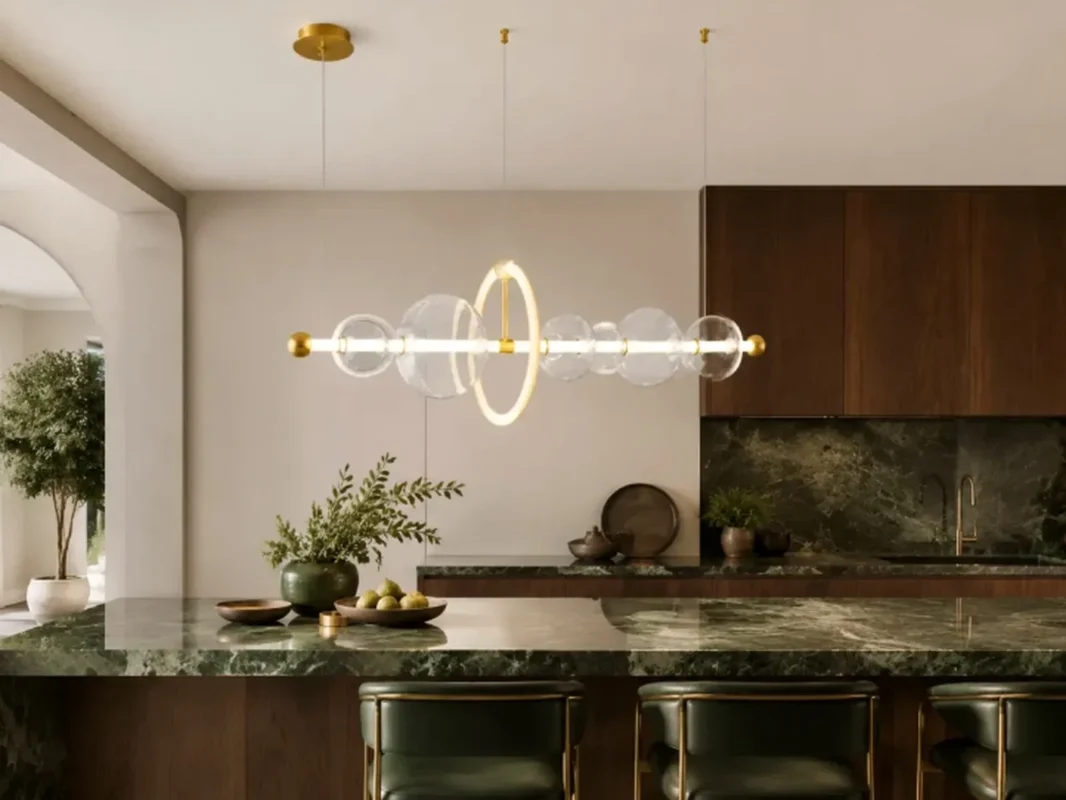
Figure 3. Warm stone, dark timber and restrained brass accents create a strong background for transparent glass and the illuminated halo.
8. A Practical Layered-Lighting Plan
A professionally resolved room normally uses several layers rather than one high-output fixture. DOE guidance on high-performance residential lighting repeatedly distinguishes ambient, task and decorative needs and emphasizes glare control.[3] The Glass Orb Halo pendant works best when each layer has a clear job.
| Layer | Purpose | Example in the room |
|---|---|---|
| Ambient | General orientation and comfortable room brightness | Recessed downlights, indirect cove light, wall washers |
| Task | Extra light where detailed activity occurs | Island worktop light, under-cabinet lighting, reading light |
| Decorative / focal | Establishes identity and visual hierarchy | Glass Orb Halo linear pendant |
| Accent | Emphasizes surfaces or objects | Artwork lighting, shelf lighting, textured-wall grazing |
If all layers are placed on separate controls, the room becomes far more adaptable. Bright general lighting can be used for cleaning or work, while evening scenes can reduce the ambient layer and allow the pendant to become the visual focus. This approach is usually more comfortable than trying to make one pendant do everything.
9. Installation and Specification Checklist
Before ordering or installing any integrated-LED decorative pendant, confirm the electrical and physical details that affect long-term performance. For this model, the current product page lists AC 220–240V and 50/60Hz.[1] Buyers in regions where nominal mains voltage differs should confirm driver compatibility or an appropriate product configuration before purchase.
- Choose the fixture length based on furniture scale and the view from the wider room—not only the table dimension.
- Confirm ceiling structure can support the listed product weight: approximately 3.5 kg, 5.2 kg or 6.8 kg depending on size.[1]
- Set suspension height after checking seated and standing sightlines to the brightest LED elements.
- If dimming is desired, confirm the LED driver and wall control are compatible before wiring.
- Coordinate CCT with nearby downlights, wall lights and under-cabinet lighting.
- For projects where color accuracy matters, request CRI/Rf and, ideally, photometric data instead of assuming performance.
- Confirm access for future driver service and safe cleaning of the glass orbs.
10. Care and Maintenance
Transparent glass shows dust, fingerprints and mineral residue more readily than opaque shades, so periodic cleaning preserves the optical clarity that gives the fixture its lightness. Turn power off and allow the luminaire to cool before cleaning. Use a soft microfiber cloth; avoid abrasive pads or aggressive chemicals on the brushed-gold finish. Where glass components are removable, follow the manufacturer’s assembly instructions rather than twisting or pulling against the supporting structure.
Integrated LEDs reduce routine bulb replacement, but the driver remains an electronic component. For long-term projects, it is useful to know whether the driver is accessible and replaceable. That information is more important to lifecycle planning than simply quoting an LED lifetime without test data.
11. Who Is This Pendant Best For?
The Glass Orb Halo LED Linear Pendant Light is strongest in interiors that want a focal point without the visual mass of a conventional chandelier. It is particularly well suited to contemporary luxury, warm minimalism, modern hospitality-inspired homes, dark-wood kitchens, stone islands, and dining rooms where transparent materials help preserve openness.
Its most useful technical strengths are the scalable three-size range, integrated LED construction, consistent published efficacy, multiple CCT choices, and adjustable suspension. The main specification questions to verify for a serious project are color-rendering quality, dimming compatibility, photometric distribution, and voltage suitability for the installation market.
Conclusion: Design the Light Around the Room, Not the Fixture Alone
A successful pendant installation is not created by choosing a beautiful object and hanging it in the center of a ceiling. It is created by matching the fixture to the furniture below, controlling sightlines and glare, coordinating color temperature, adding the right ambient and task layers, and verifying the electrical details before installation.
The Glass Orb Halo design offers a strong foundation for that approach. Its transparent orbs keep the composition visually light, the horizontal LED line gives the room structure, and the illuminated halo adds a sculptural signature. Used with deliberate proportions and layered lighting, it can function as both a practical source of light and a defining piece of interior architecture.
Glass Orb Halo LED Linear Pendant Light | Click to view product