

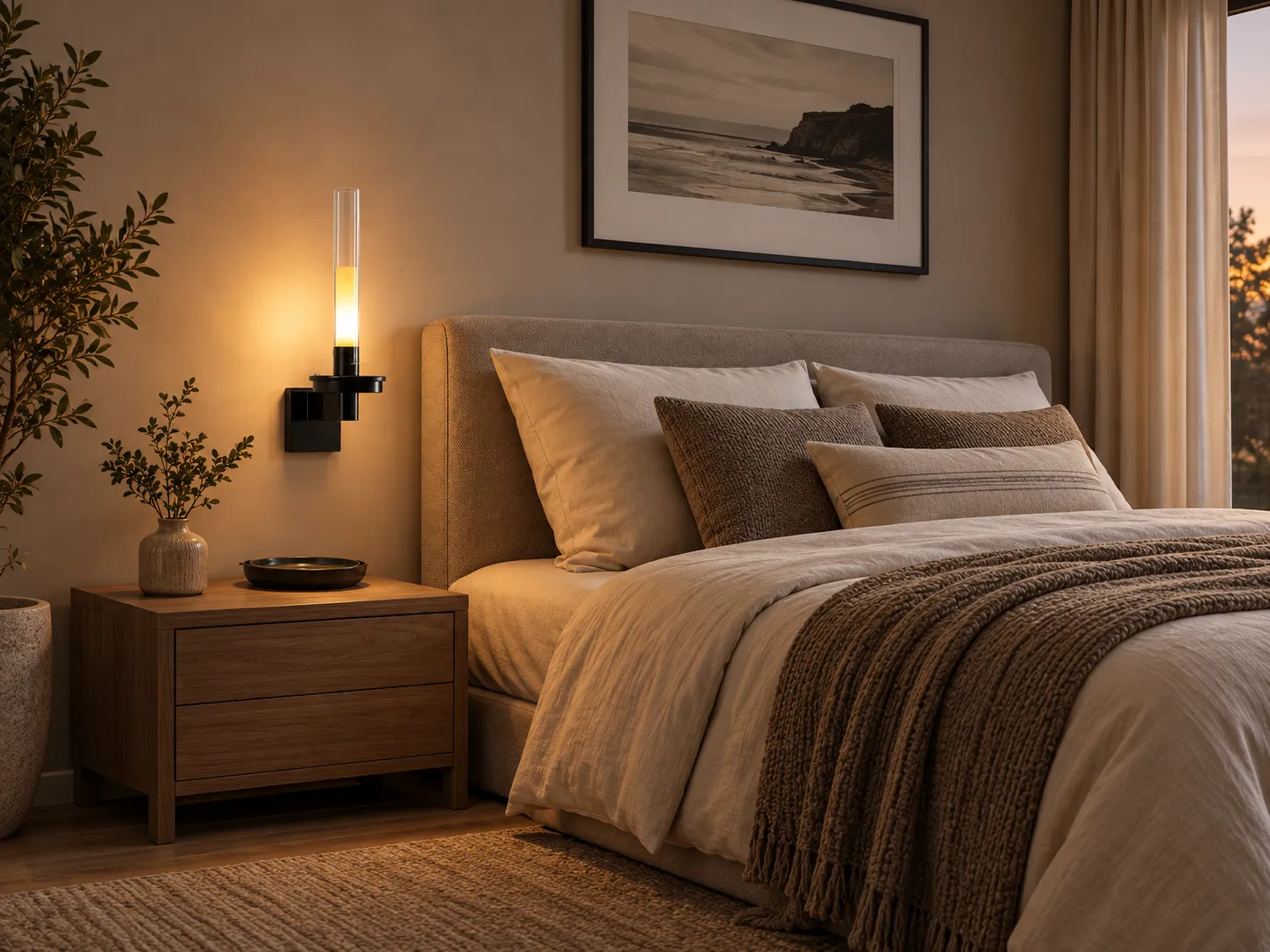

A practical, research-informed guide to using a vertical glass cylinder wall light in bedrooms, living rooms, hallways, hospitality spaces, and layered residential lighting schemes.
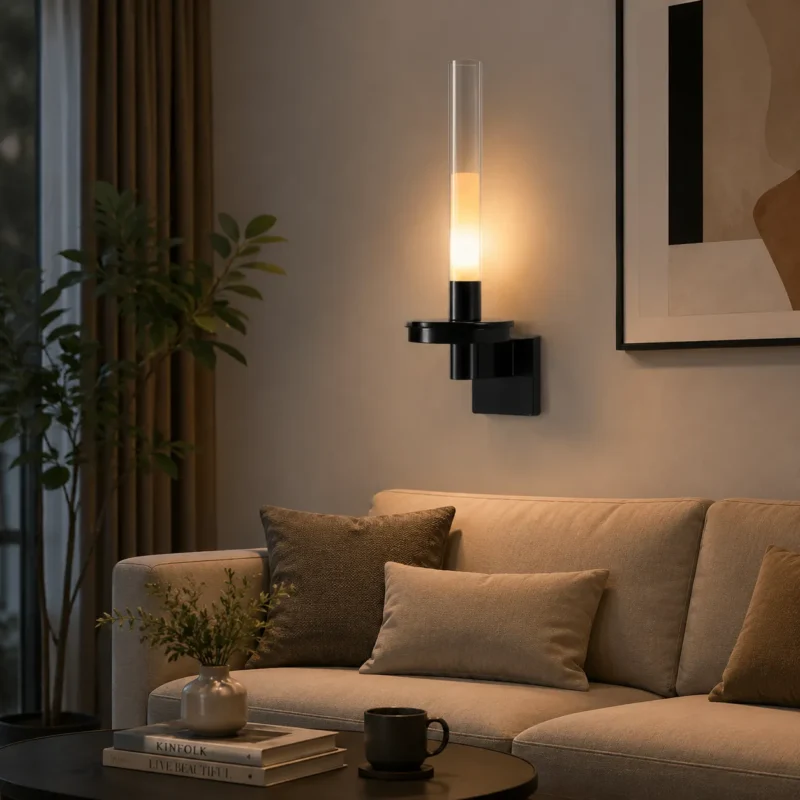
Wall lighting works best when it does more than simply brighten a surface. A well-placed sconce can shape how a room feels, reduce the visual dominance of ceiling fixtures, and create a more layered nighttime environment. The Modern LED Glass Tube Wall Light from Xunlu Lighting uses a clear cylindrical glass element, a pearl-black aluminum body, and an integrated LED source to create a clean architectural silhouette with a controlled halo of light.
The fixture is designed around a 3 W integrated LED module with an approximate output of 200–300 lumens and three selectable color-temperature settings: 3000 K warm white, 4000 K neutral white, and 6000 K cool white. That modest output is important to understand: this is primarily an accent and supplementary ambient light, not a substitute for a room’s complete general-lighting plan.¹
1. Why vertical wall light changes the perception of a room
Human perception responds not only to how much light reaches a horizontal work surface, but also to how bright the surrounding walls and objects appear. Illuminating a vertical surface can make a room feel visually richer without flooding the entire space with high output. A compact sconce creates a luminous reference point at eye level, which can help define circulation zones, frame furniture, or add depth beside a bed or sofa.
The glass cylinder also changes the visual character of the source. Instead of presenting a bare point of light, the transparent enclosure adds reflections, highlights, and a sense of depth. In darker interiors, these small specular effects can make the fixture read as an architectural object even when the overall light level remains low.
2. Choosing 3000 K, 4000 K, or 6000 K
Correlated color temperature (CCT) describes the apparent warmth or coolness of white light. Lower CCT values appear warmer; higher values appear cooler. U.S. Department of Energy guidance describes roughly 1800–2700 K as warm and 4500–6500 K as cool, while 3000 K and 3500 K are common interior preferences in many applications.²
| Setting | Visual character | Best use in the home |
|---|---|---|
| 3000 K warm white | Soft, warm, relaxed | Bedrooms, living rooms, evening ambience, hospitality-style interiors |
| 4000 K neutral white | Clean and balanced | Hallways, entries, dressing areas, contemporary multipurpose spaces |
| 6000 K cool white | Crisp and noticeably cool | Short-duration utility use or interiors intentionally designed around a cool visual palette |
For evening residential use, many people prefer a warmer visual atmosphere. However, color temperature alone does not determine biological effects. The Illuminating Engineering Society emphasizes that non-visual responses to light depend on several variables, including quantity, spectrum, timing, duration, and prior light exposure.³ In practical design terms, the safest approach is to avoid treating one Kelvin number as a “health setting” and instead use controllable, appropriately dim lighting that matches the activity and time of day.
3. Why low-output wall lighting is useful near beds and seating
At approximately 200–300 lumens, this sconce is in the range where it can provide a visible pool of light and strong decorative presence without behaving like a high-output ceiling fixture. The actual brightness experienced in a room will depend on wall color, mounting position, nearby surfaces, glass transmission, and the rest of the lighting system.
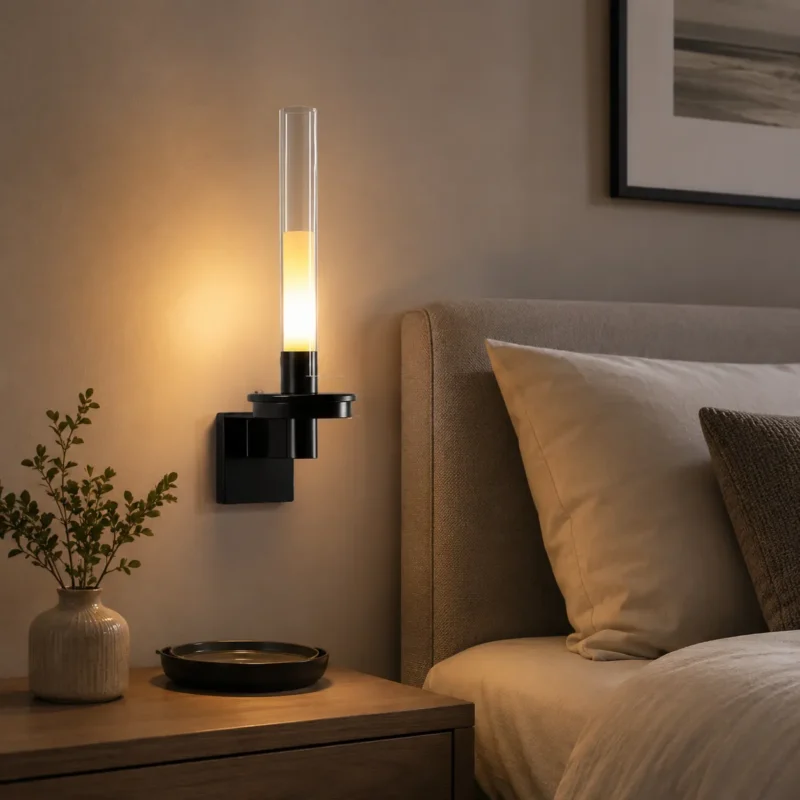
Beside a bed, that makes the fixture useful for orientation, soft pre-sleep ambience, and visual comfort. For sustained reading, however, a dedicated task light should still be considered if the wall light does not deliver enough illuminance on the page. In a living room, the same modest output works well as a secondary layer beside a sofa, art wall, console, or architectural corner.
4. Layered lighting: the core principle behind a more comfortable room
A polished interior rarely relies on a single source. Layered lighting combines several functions so that no one luminaire has to do everything. A practical residential scheme usually includes:
• General light for safe movement and overall visibility.
• Task light for reading, cooking, grooming, or detailed work.
• Accent and vertical light for walls, artwork, texture, and atmosphere.
• Decorative light that contributes to the visual identity of the space even when switched off.
The glass-tube sconce naturally occupies the accent/decorative layer. Because it sits on the wall rather than in the ceiling plane, it introduces light at a different height. That change in direction is one reason a room can feel more dimensional with wall lighting added, even when the total lumen count remains moderate.
“Good residential lighting is less about maximum brightness and more about placing the right amount of light in the right location.”
5. Material logic: glass, aluminum, and thermal management
The fixture combines a transparent glass tube with an aluminum-alloy body. These materials perform different jobs. Glass protects the luminous element and contributes optical sparkle and reflections. Aluminum provides a rigid, corrosion-resistant structure and is commonly used in LED products because it can help transfer heat away from electronic components.
Thermal management matters because LED lifetime is influenced by operating conditions. The U.S. Department of Energy notes that good-quality white LED products can commonly achieve useful lives of roughly 30,000–50,000 hours or longer, while also emphasizing that electronics, thermal conditions, color shift, and overall product design affect real-world reliability.⁴ This is a general property of LED systems rather than a specific lifetime claim for this individual wall light.
6. Where this cylinder wall sconce works best
| Space | Recommended design role |
|---|---|
| Bedroom | Bedside ambience, paired symmetry, soft nighttime orientation light |
| Living room | Accent beside a sofa, console, artwork, or reading corner |
| Hallway | Repeated rhythm along a circulation wall; useful for visual guidance |
| Entry | A compact architectural marker near a mirror, console, or doorway |
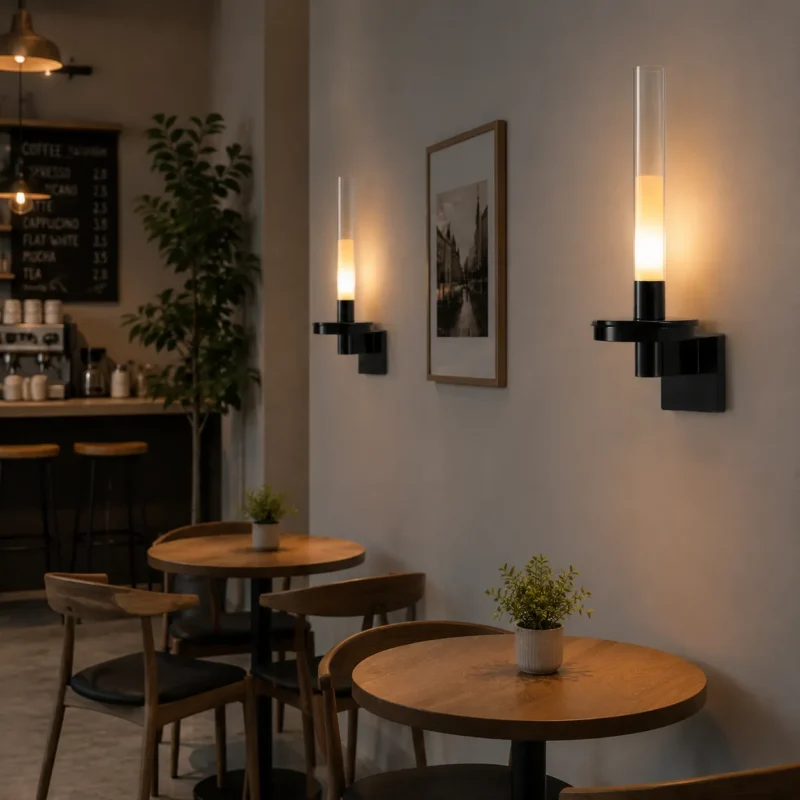
| Hotel or café | Atmospheric secondary lighting that adds a recognizable design motif |
| Stair or landing | Supplementary wall illumination when integrated with code-compliant general and safety lighting |
7. Placement and installation principles
Mounting height should be selected in relation to furniture, eye level, room scale, and the viewing direction. The goal is to keep the luminous element visible enough to contribute atmosphere without positioning it where it produces distracting brightness directly in the line of sight. In paired bedside installations, align the sconces to the bed and headboard rather than to arbitrary wall dimensions.
Because this is a wired wall-mounted fixture operating on mains voltage, installation should follow local electrical codes and be performed by a qualified electrician where required. Junction-box location, wall construction, switch strategy, and access for future service should be resolved before final mounting.
8. A simple room-planning formula
For a cohesive result, start with the room function rather than the fixture. Decide where people sit, walk, read, dress, or relax. Then identify the vertical surfaces that need visual emphasis. Place the wall sconce where it supports one of those functions, and add other layers only where needed. This prevents over-lighting and produces a more intentional hierarchy.
A useful sequence is: ambient base → task lighting → wall/accent layer → dimming or switching control. In a bedroom, for example, the ceiling fixture can provide housekeeping light, bedside sconces can provide warm evening ambience, and a localized reading light can be added only if required.
Conclusion: small fixture, strong architectural effect
The Modern LED Glass Tube Wall Light is most compelling when treated as part of a layered lighting system. Its slim vertical form introduces light at eye level, the glass cylinder adds depth and reflection, and the three selectable color-temperature settings make it adaptable to different interior moods. Used beside a bed, sofa, hallway wall, or hospitality feature surface, it can provide exactly what a large ceiling fixture often cannot: localized atmosphere and visual structure.
For interiors that favor modern geometry, dark metal details, warm neutral materials, and controlled pools of light, this type of cylinder wall sconce offers a clean way to make lighting feel integrated with the architecture rather than added as an afterthought.
Explore the Modern LED Glass Tube Wall Light
Minimal geometry. Adjustable white light. A refined wall-lighting layer for modern interiors.View product at xunlulighting.com
