

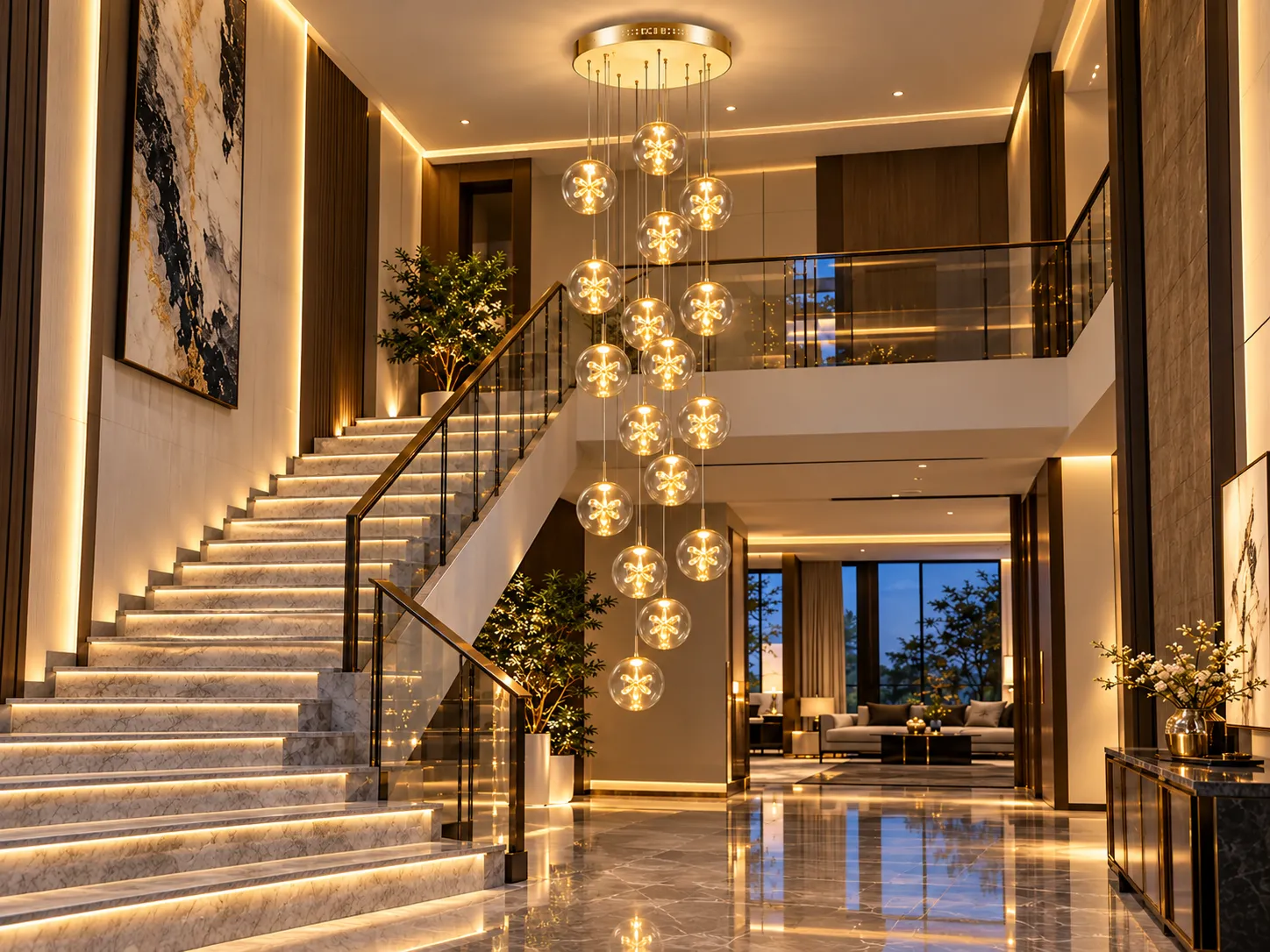

A practical guide to scale, lumen output, color temperature, glare control, installation height, and styling for double-height stairwells and foyers.
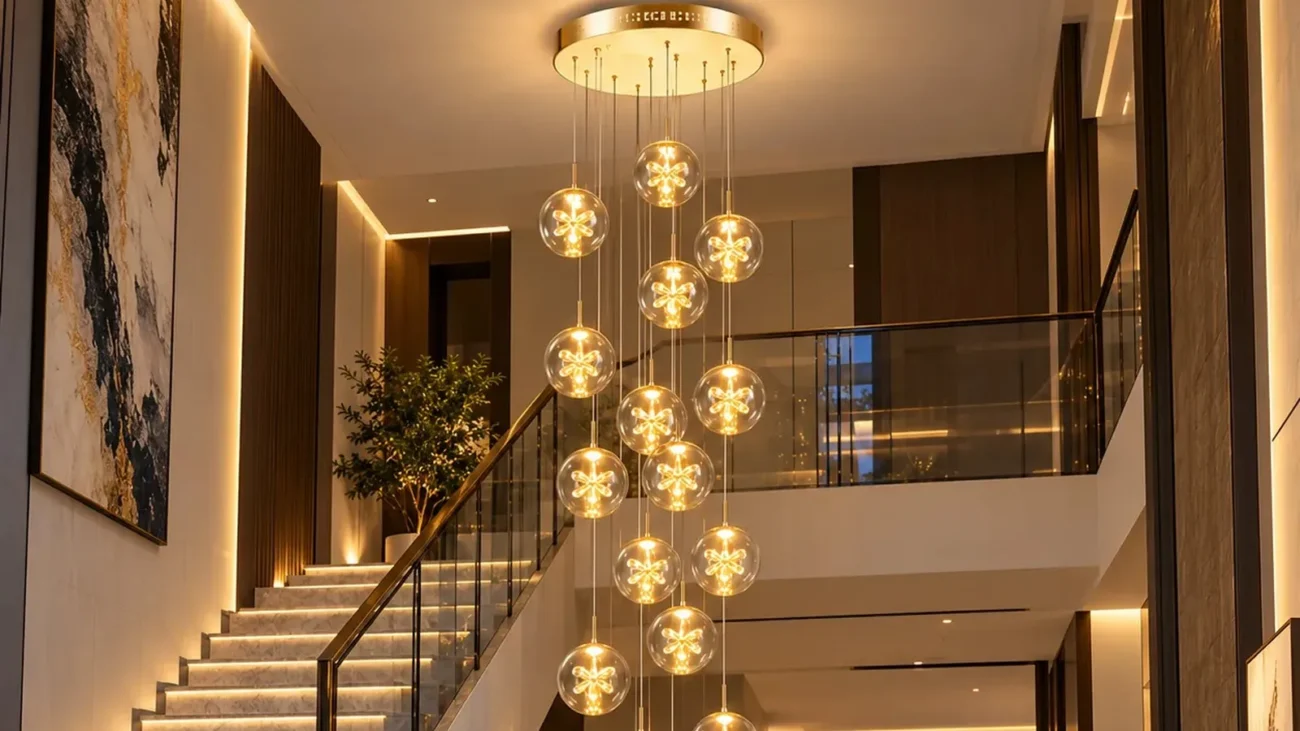
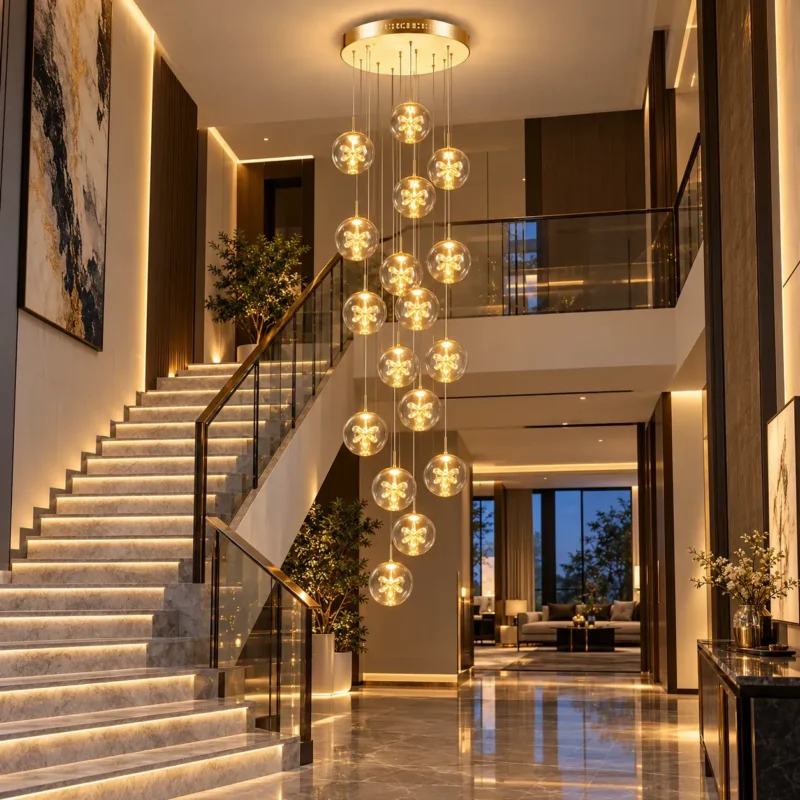
A staircase chandelier has a different job from an ordinary ceiling light. It must read beautifully from several floors and viewing angles, provide useful vertical illumination, avoid uncomfortable glare on the stairs, and remain visually proportional to a large architectural void. The Crystal Glass Staircase Chandelier from Xunlu Lighting is designed around that problem: clear glass globes, crystal floral elements, integrated LED light, and adjustable suspension cables create a cascading composition that can be tailored to tall stairwells, duplex foyers, villas, lofts, and high-ceiling living rooms.
1. Why Vertical Chandeliers Work So Well in Stairwells
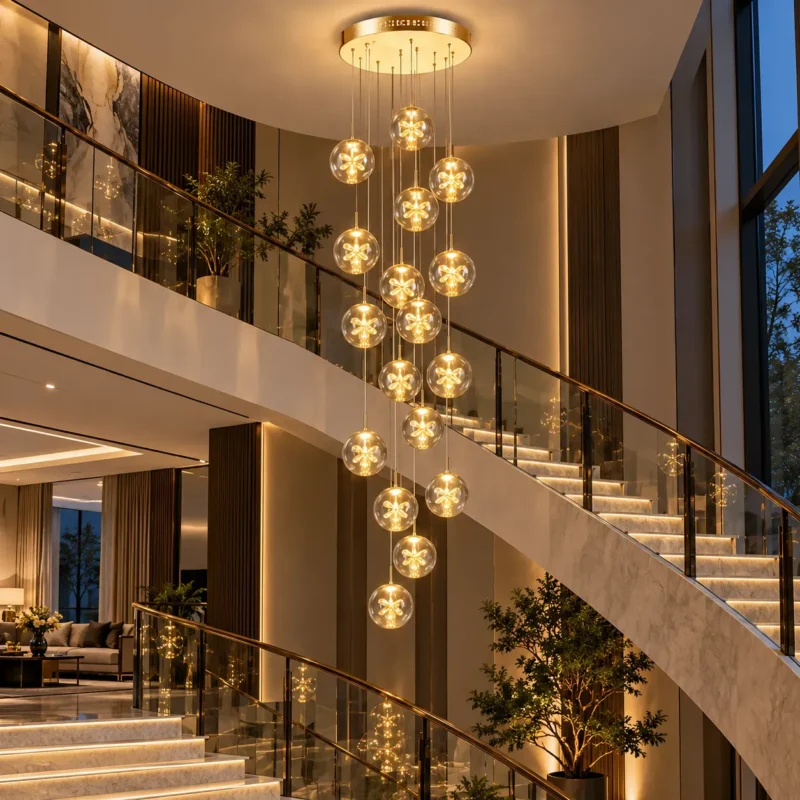
In a double-height space, the eye naturally tracks vertical lines: stair flights, balustrades, wall panels, curtains, and windows. A cascading chandelier reinforces that vertical movement while filling the empty volume between floors. Unlike a flat flush-mount fixture, a multi-level cluster creates visual information throughout the height of the space, so the lighting becomes part of the architecture rather than a decorative object attached only to the ceiling.
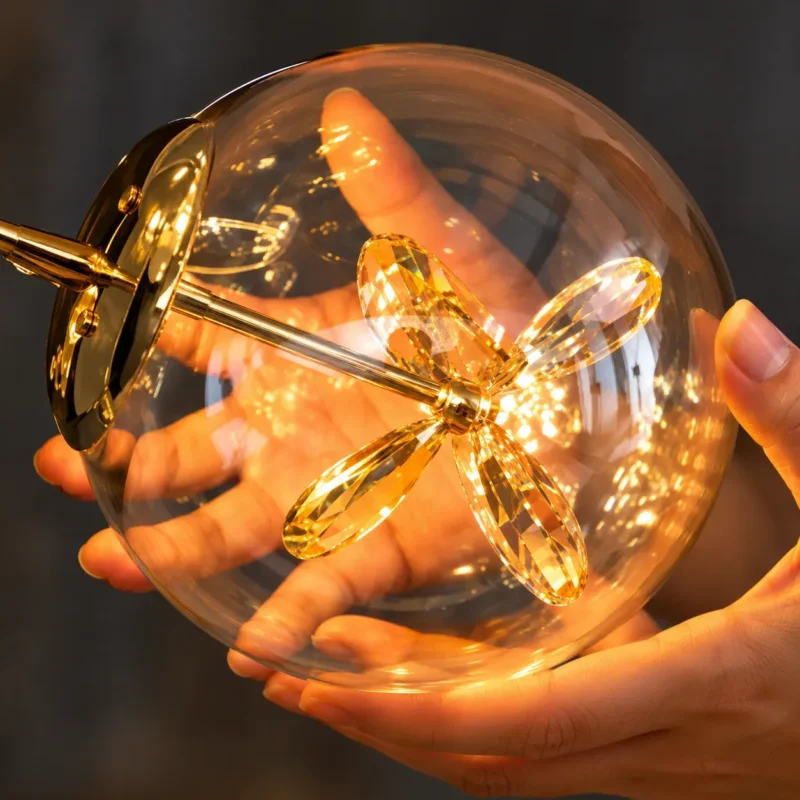
The transparent globes are especially useful in this setting because they preserve sightlines. Clear glass allows light to remain visible from multiple levels without forming a large opaque mass. The crystal flower detail adds small high-luminance highlights, which can make the installation feel more dimensional and sparkling when viewed from the staircase or landing.
There is also a practical benefit: spreading light sources over different elevations can help illuminate the volume more evenly than concentrating all light at the ceiling. However, the final result still depends on photometric distribution, wall reflectance, mounting height, and the position of the staircase. A chandelier should therefore be treated as one layer in a complete lighting plan—not as the only source of safe stair illumination.
2. The Science Behind the Light: Lumens, CCT, CRI, and Glare
Lumens are not the same as illuminance
Luminous flux (lumens) describes how much visible light a source emits; illuminance (lux) describes how much of that light reaches a surface. A high-output chandelier mounted six meters above the floor can produce less useful light on stair treads than a lower-output fixture mounted closer to the task. Optics, beam spread, glass transmission, suspension height, surface reflectance, and room geometry all matter. This is why lumen output is best used for comparing fixture capacity, while a real project should verify actual illuminance at the stairs, landings, and floor with photometric calculations or on-site measurement.
As a visibility benchmark, public-access guidance often targets approximately 100–200 lux on stair surfaces and emphasizes smooth transitions and glare control. Residential requirements vary by jurisdiction, so local electrical/building codes and the site-specific lighting design should take priority. In practice, step lights, wall washers, handrail lighting, or ceiling downlights can complement the chandelier so that the decorative focal point does not have to carry all of the safety lighting by itself.
Color temperature changes the atmosphere
The product offers three CCT options: 3000K warm white, 4000K neutral white, and 6000K cool white. Correlated color temperature describes the appearance of white light—not its brightness. 3000K generally produces a warmer, more relaxed impression and works especially well with wood, bronze, beige stone, and gold finishes. 4000K feels cleaner and more neutral, which can suit modern marble, white walls, and cooler architectural palettes. 6000K appears noticeably cooler and more blue-white, so it is best used intentionally when a crisp, high-contrast aesthetic is desired.
U.S. Department of Energy guidance notes that 3000K and CRI 80+ are widely suitable targets for residential interiors, while higher CRI values can improve color fidelity. For luxury residential spaces where finishes, art, wood grain, and skin tones are important, a high-quality light source with CRI 90+ can be worth prioritizing when available. DOE also notes that CRI is only one part of color quality; newer metrics such as IES TM-30 provide a more complete picture of fidelity and gamut.
3. Choosing the Right Size: 10, 18, or 30 Heads
The chandelier is available in three vertical configurations. The key question is not simply the room’s floor area; it is the total void volume, the number of visible floors, the ceiling height, and how far the fixture needs to descend before it feels connected to the staircase.
| Configuration | Canopy | Max. drop | Power | Luminous output | Approx. weight | Best visual scale |
|---|---|---|---|---|---|---|
| 10 heads | Ø40 cm / 15.75 in | Up to 200 cm / 78.74 in | 50 W | Approx. 3,500–4,500 lm | Approx. 10–13 kg | Smaller duplex stairs, compact foyers, 3–4 m ceilings |
| 18 heads | Ø50 cm / 19.69 in | Up to 350 cm / 137.80 in | 90 W | Approx. 6,300–8,100 lm | Approx. 16–21 kg | Medium double-height voids, villas, 4–6 m ceilings |
| 30 heads | Ø70 cm / 27.56 in | Up to 600 cm / 236.22 in | 150 W | Approx. 10,500–13,500 lm | Approx. 25–32 kg | Large stair atriums, multi-level villas, 6–8 m ceilings |
The “best visual scale” column is a design starting point, not a code requirement. Ceiling height and stair geometry should be measured before ordering, and the final cable arrangement should be mocked up on an elevation drawing whenever possible.
A simple proportional test
Stand at the main entry viewpoint and imagine the chandelier occupying the vertical void. It should be large enough to feel connected to the staircase but not so wide that it crowds the balustrade, landing, or adjacent walls. In tall spaces, insufficient vertical length is often more noticeable than insufficient width. A 30-head chandelier can work well because the 600 cm maximum suspension creates visual continuity over several stories, while the 70 cm canopy remains relatively compact at the ceiling.
4. Hanging Height and Staircase Clearance
The product’s adjustable cables are one of its most important design features. Instead of hanging every globe at the same level, a staircase installation should usually step or spiral through the void. This helps the fixture follow the architecture and prevents the composition from looking like a flat cluster floating too high above the stairs.
• Keep the lowest globe comfortably above any walking path, landing, handrail zone, or furniture location. The required clearance depends on the project and local code, so verify it from floor plans and sections—not from perspective images alone.
• Use a staggered rhythm rather than equal spacing. Small variations in vertical distance create a more natural cascade, but the overall silhouette should remain intentional.
• Check sightlines from every level. A globe that looks perfectly positioned from the ground floor may sit directly in front of a face-level view from the upper landing.
• For the heavier 18- and 30-head versions, confirm that the ceiling structure and mounting hardware are suitable for the listed fixture weight. Installation should be completed by a qualified electrician/installer familiar with heavy decorative luminaires.
• Because the fixture is rated IP20, use it in dry indoor locations rather than exposed exterior or wet-zone applications.
5. Layer the Chandelier with Other Light Sources
A visually dramatic chandelier should not create a “bright object in a dark void.” The most comfortable luxury interiors use layers: ambient light for general brightness, vertical light on walls and materials, localized step or handrail lighting for safe circulation, and decorative light for visual identity.
Ambient layer
Recessed or indirect ceiling light keeps the overall space from becoming too contrasty.
Vertical layer
Wall washing or concealed linear light reveals stone, timber, art, and tall wall panels.
Safety layer
Step, handrail, or landing lights improve tread visibility independent of the chandelier.
Decorative layer
The glass-and-crystal chandelier becomes the focal point and provides sparkle and depth.
This layered approach also reduces glare. Glare is driven not only by total lumens but by luminance, source size, viewing angle, and contrast with the background. A sparkling crystal point can feel elegant when the room is moderately illuminated, but the same point may feel harsh if it is the only bright element in an otherwise dark stairwell. Dimming and scene control are therefore especially useful in multi-level spaces.
6. Styling the Gold Crystal Glass Chandelier
Modern luxury: Pair the gold finish with warm stone, dark timber, bronze or black metal, smoked glass, and concealed linear lighting. Keep surrounding forms simple so the chandelier remains the visual centerpiece.
Contemporary minimal: Use fewer decorative objects, clean white or grey surfaces, and a restrained 4000K scene. The transparent globes help maintain the open feeling of a minimal space.
Hotel-inspired residential: Combine 3000K lighting with textured wall panels, marble, full-height curtains, and warm accent lighting. The repeated crystal highlights can create a lobby-like sense of arrival without requiring an oversized opaque fixture.
Double-height living room: Position the chandelier where it can be seen from both the staircase and seating area. Use the vertical cluster to visually connect upper-level balconies with the ground-floor living space.
7. Maintenance: Keep Glass and Crystal Looking Bright
• Turn off power and allow the fixture to cool before cleaning.
• Use a soft microfiber cloth on clear glass; avoid abrasive pads that can create fine scratches.
• For crystal details, remove fingerprints and dust carefully so the faceted surfaces can reflect light cleanly.
• Because the fixture may hang several meters above the floor, plan safe access before installation. In very tall stairwells, periodic professional cleaning may be more practical than household ladders.
• Check suspension cables, canopy hardware, and electrical connections during routine maintenance, especially in large 18- and 30-head installations.
8. Frequently Asked Questions
Is 3000K warm white a good choice for a staircase chandelier?
Yes. 3000K is commonly used in residential and hospitality environments because it feels warm without becoming extremely amber. It is particularly compatible with gold finishes, timber, beige stone, and warm neutral interiors.
How many heads should I choose?
Use ceiling height and the vertical void as the primary guide. The 10-head version suits smaller double-height spaces, 18 heads provide a stronger presence in medium villas and foyers, and 30 heads are designed for large multi-level stairwells where the fixture needs a long visual drop.
Can the chandelier be the only light on the stairs?
It can contribute substantial ambient light, but a stairway is safer and more visually comfortable when decorative lighting is supported by dedicated lighting for treads, landings, walls, or handrails. Verify actual illuminance and local code requirements.
Does more lumen output always mean a brighter staircase?
Not necessarily. Lumen output is the amount of light leaving the fixture. The brightness measured on stair treads depends on mounting height, beam distribution, room size, glass transmission, and surface reflectance.
Can the suspension lengths be adjusted?
Yes. The product uses adjustable suspension cables, allowing spiral, cascading, or layered arrangements to suit the staircase geometry.
Is it suitable for outdoor use?
No. The listed IP20 rating is intended for dry indoor locations.
Conclusion: Treat the Chandelier as Architecture
The strongest staircase chandeliers do more than decorate a ceiling—they organize a vertical space. For this crystal glass design, the transparent globes keep the volume visually open, the crystal floral elements create controlled sparkle, and the adjustable suspension system lets the composition follow the height of the stairwell. Choosing the correct head count, color temperature, hanging length, and supporting light layers will produce a result that looks luxurious from every floor while remaining practical and comfortable to live with.
Crystal Glass Staircase Chandelier | Modern Luxury LED:View on Xunlu Lighting
