

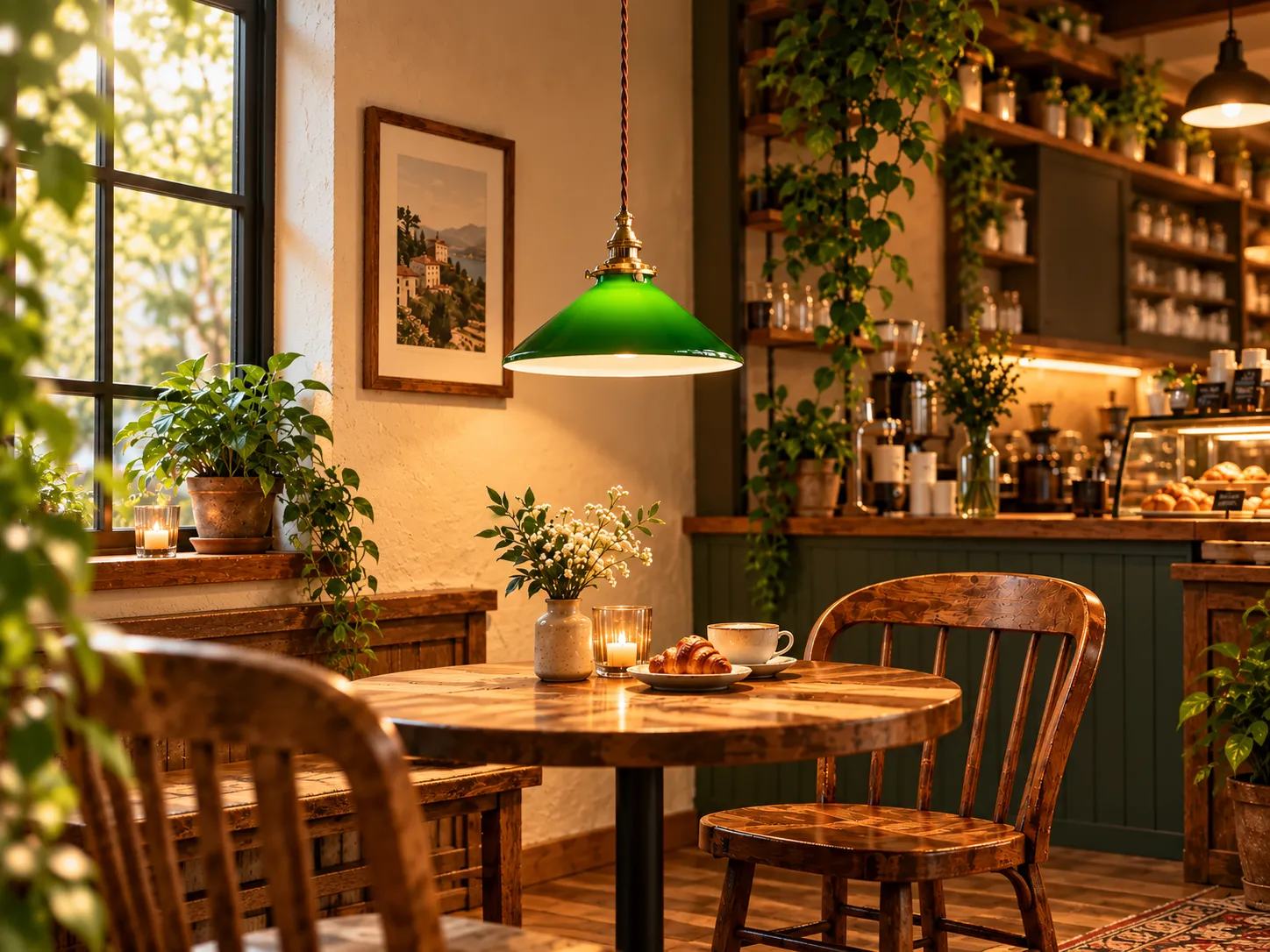

A Science-Based Guide to Warm, Layered Interiors
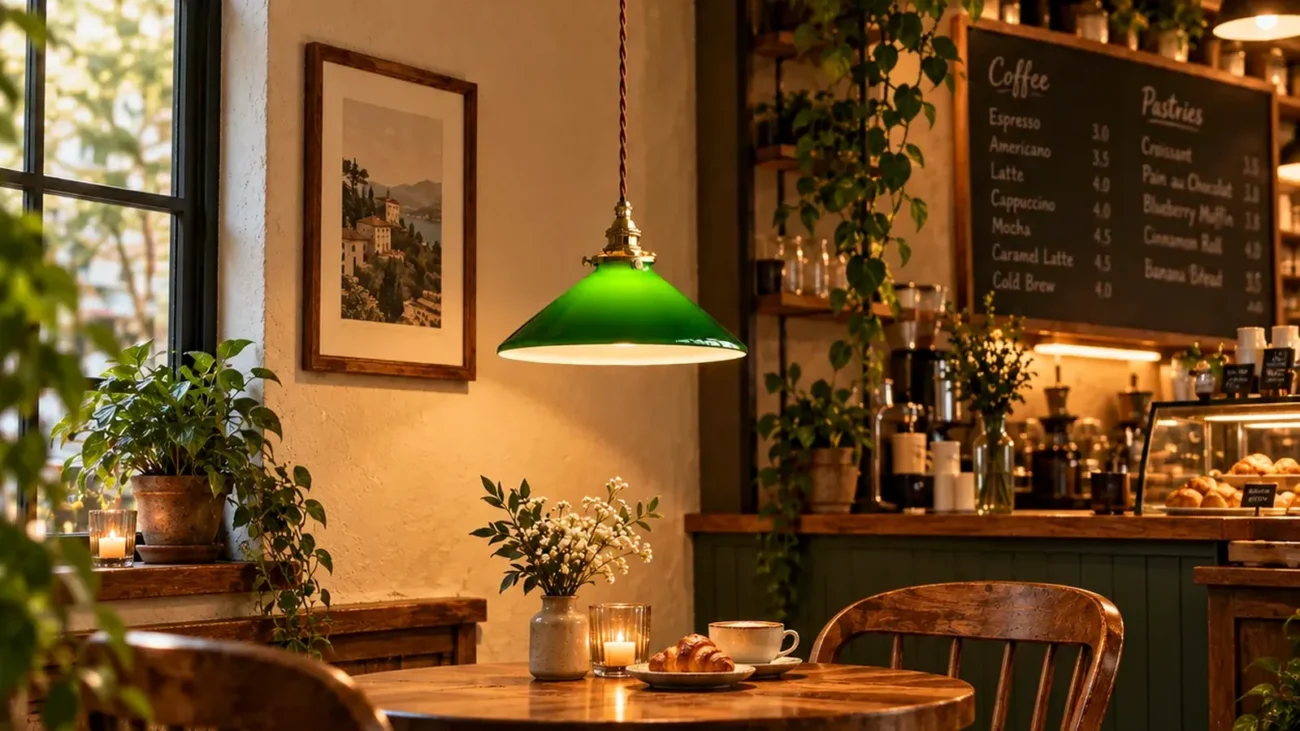
A Small Pendant Can Change the Way a Room Feels
A pendant light does more than make a table visible. Its shade shape, finish, color temperature, brightness, mounting height, and relationship to the rest of the room all influence visual comfort and atmosphere. The Green Glass Pendant Light from Xunlu Lighting combines a shallow cone-shaped green glass shade with an antique-brass lamp holder and round gold canopy. The white inner surface directs more of the visible light downward, while the glossy green exterior adds color without flooding the whole room with green light. [1]That combination makes the fixture especially effective over dining tables, breakfast nooks, kitchen counters, café tables, bedside corners, and compact reading areas. It is also a useful example of a broader lighting principle: decorative lighting works best when appearance and photometric function support each other. This guide explains why 3000K warm-white light is a natural fit for this design, what 500–600 lumens actually means in a room, how to choose the right LED bulb, and how to layer the pendant with other light sources for a more comfortable interior
Lighting Science at a Glance
Green Glass Pendant Light — practical performance markers
3000K
Warm white
DOE: warm, pleasing for homes and restaurants
500–600 lm
Local light output
Best used within a layered lighting plan
6W LED
Efficient source
Low wattage with useful task/ambient output
E26 / E27
Replaceable bulb
Choose compatible LED; CRI 90+ for rich color
Source basis: Xunlu product specifications; U.S. Department of Energy lighting guidance; NIST definition of lux.
1. Why Green Glass and Brass Feel Warm — Even Before the Bulb Is Switched On
Green sits naturally beside wood, cream, black metal, warm stone, and aged brass because it echoes a color already common in plants and natural materials. In interiors, that makes a saturated green shade easier to integrate than many brighter decorative colors. The antique-brass hardware adds a second warm material cue: its yellow-gold surface visually connects with timber, candlelight, warm fabrics, and amber-toned accessories.
The shallow cone shape also matters. Compared with a bare bulb, an opaque or semi-opaque shade reduces direct view of the light source from many angles and sends more useful light toward the table or counter below. In this model, the white inner shade further supports downward reflection. The result is a concentrated pool of light rather than an evenly glowing ceiling fixture — exactly why this pendant reads as intimate and focused in dining and hospitality spaces. [1]
2. What 3000K Warm White Actually Means
Correlated color temperature, or CCT, describes the apparent warmth or coolness of white light in kelvin (K). The U.S. Department of Energy describes 2700K as warm and friendly, and 3000K as warm and pleasing, with both commonly used in homes and restaurants. That makes the product’s specified 3000K lamp a strong match for dining, conversation, and relaxed evening environments where a cooler daylight appearance can feel visually out of place. [2]CCT is not the same as brightness, and it is not a complete measure of color quality. Two 3000K bulbs can render food, wood grain, flowers, skin tones, and brass differently. For that reason, color rendering is also worth checking. DOE guidance notes that CRI 80 is a reasonable minimum for interior lighting, while CRI 90 or higher indicates excellent color fidelity. For a dining table or décor-focused room, a high-quality 3000K LED with CRI 90+ is a sensible upgrade when accurate color appearance matters
3. How Bright Is 500–600 Lumens?
The product page specifies approximately 500–600 lumens with a recommended 6W LED source. Lumens measure the total visible light emitted by a source. Illuminance, measured in lux, describes how much luminous flux reaches a surface; by SI definition, 1 lux equals 1 lumen per square meter. [1] [4]
A simple theoretical check is useful. If 500–600 lumens were distributed perfectly and uniformly across 5 m², the arithmetic average would be about 100–120 lux (500–600 lm ÷ 5 m²). Real installations are not uniform: the shade controls direction, mounting height changes the size of the light pool, some light is absorbed by surfaces, and the bulb itself may not send equal flux in every direction. Without a photometric file or on-site meter reading, the exact tabletop illuminance cannot be stated. Still, the calculation helps explain why a single compact pendant is best treated as focused local light rather than the only source of general illumination in a larger room. [1] [4]
That conclusion also aligns with DOE residential-lighting guidance: dining rooms benefit from glare-controlled ambient lighting, with chandeliers or pendant lamps added as specific task or accent light, and dimming is often desirable. In practical terms, the most comfortable result usually comes from layers — the pendant over the table, plus softer general light from recessed, cove, wall, or adjacent lamp sources. [5]
4. Best Rooms and Styling Strategies
Dining room: let the table become the visual center
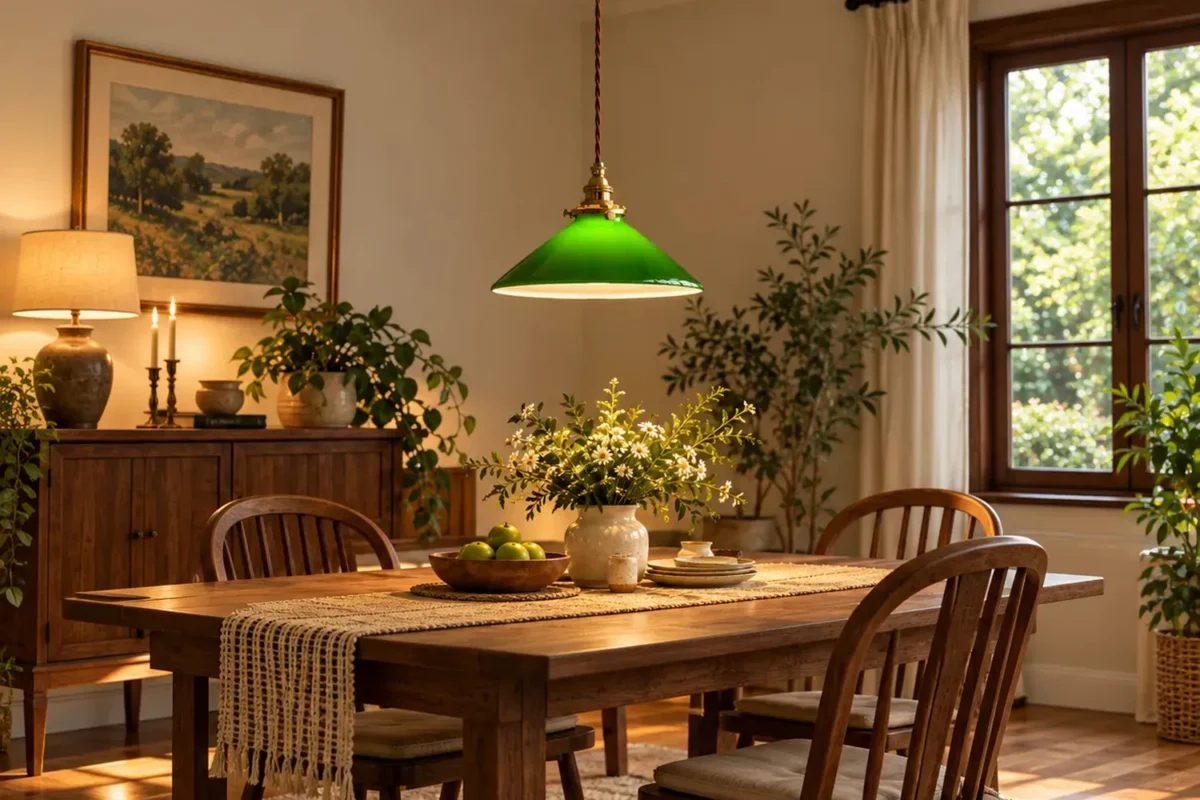
Use one pendant over a small round or square table, or repeat several fixtures over a longer table when you want rhythm and stronger visual presence. The green shade works especially well with medium-to-dark wood, cream walls, vintage chairs, natural linen, and plants. Keep the surrounding ambient lighting softer so the tabletop remains the focal point.
Kitchen island or breakfast bar: repeat for balance
For a longer island, two or three pendants can look more intentional than one small fixture placed in the center. Keep spacing visually consistent and align the shades with the island rather than with unrelated ceiling features. Because this model is compact at Ø25 cm (9.84 in), repeated installations can create impact without appearing oversized. [1]
Café, bar, or hospitality corner: use color as identity
Green glass is distinctive enough to become part of a space’s visual identity. In cafés and bars, repeated green pendants can create a recognizable ceiling line while the warm-white lamp preserves an inviting atmosphere at table level. The vintage brass details naturally complement timber counters, black framing, dark green cabinetry, and exposed textures.
Bedroom or study: keep it local and controlled
A single pendant can free up bedside or desk surface area, but it should be positioned so the bulb is not in direct view from the normal seated or lying position. If you plan to read under it, choose a good-quality LED with suitable color rendering and add another layer of room light to reduce strong contrast around the page or work surface.
5. Product Specifications That Affect Real-World Use
Product Specifications
| Specification | Product data / practical meaning |
|---|---|
| Shade size | Ø25 × H10 cm / Ø9.84 × H3.94 in — compact enough for single or repeated arrangements. |
| Ceiling canopy | Ø10 cm / Ø3.94 in, round gold finish. |
| Suspension | Adjustable up to 180 cm / 70.87 in — useful for varied ceiling heights. |
| Light source | 1 × E26/E27 LED Edison bulb, recommended 6W. |
| Light output | Approx. 500–600 lm, depending on bulb used. |
| Color temperature | 3000K warm white. |
| Voltage | AC 110–240V, 50/60Hz. |
| Recommended area | Approx. 5 m² / 53.82 sq ft as stated by the product page; treat this as a product-use guide, not a measured lighting calculation. |
| Ingress protection | IP20 — dry indoor locations only. |
6. Hanging Height, Spacing, and Visual Comfort
For a dining table, a practical starting point is to place the bottom of a pendant roughly 75–90 cm (30–35 in) above the tabletop, then adjust for the shade diameter, ceiling height, eye level, and sight lines. This is a design rule of thumb rather than a universal code requirement. The goal is simple: the lamp should feel connected to the table without blocking conversation or creating direct glare in seated eyes.
Over kitchen islands, keep the bottom edge high enough for standing sight lines and normal food-preparation movement. When using multiple pendants, equal spacing usually looks calmer than irregular spacing. The 180 cm adjustable suspension gives this fixture enough range for many residential and hospitality installations, but final cable length should be set only after the furniture position is confirmed. [1]
7. Choosing the Right LED Bulb
Because the fixture uses a replaceable E26/E27 lamp, the bulb becomes part of the lighting design. For the warm vintage look shown here, start with a 3000K LED close to the recommended 6W output. If food, wood, artwork, or textiles are important, look for CRI 90+ when available. If dimming is desired, both the LED bulb and the wall dimmer must be explicitly compatible; dimmability should never be assumed from the pendant fixture alone. [1] [3]
LEDs are also the logical efficiency choice. DOE guidance reports that modern LED lamps can use at least 75% less energy than traditional incandescent sources and can last far longer, although actual savings and service life depend on the specific bulb, operating temperature, controls, and usage pattern. In a pendant where the bulb can be replaced independently, you can upgrade light quality later without replacing the decorative fixture. [6]
8. Installation and Maintenance Notes
- Use this IP20 fixture in dry indoor locations only; it is not intended for wet or exposed outdoor environments. [1]
- Have fixed wiring installed or checked by a qualified electrician in accordance with local electrical codes.
- Use a compatible E26/E27 LED lamp and stay within the manufacturer’s recommended lamp power. [1]
- Clean glass only after power is off and the lamp has cooled. Use a soft microfiber cloth; avoid abrasive cleaners that can dull glossy surfaces or brass finishes.
- If using a dimmer, verify the bulb and dimmer are designed to work together. [2]
9. Who Is This Pendant Best For?
This design is a particularly good fit if you want a small fixture with more visual personality than a neutral glass globe or plain metal cone. It suits Japanese-vintage, mid-century, retro-industrial, café-inspired, and warm contemporary interiors. It is also useful for designers who want a repeatable pendant that can work as a single focal point in a small room or as a row over a longer table or counter. [1]
It is less suitable as the only light source in a large open-plan room, and its IP20 rating means it should not be used in wet zones. For larger spaces, treat it as one component of a layered scheme rather than expecting one 500–600 lumen pendant to do every lighting job. [1] [5]
Frequently Asked Questions
Is 3000K considered warm light?
Yes. DOE guidance describes 3000K as warm and pleasing, with common use in homes and restaurants. It is slightly whiter than classic 2700K warm light while still feeling comfortable and residential. [2]
Is 500–600 lumens enough for a dining room?
It can be useful over a small dining table, but whether it is enough for the whole room depends on room size, surface colors, mounting height, shade optics, and other light sources. For a larger dining room, combine it with ambient lighting. [4][5]
Can I use a dimmable bulb?
Yes, if the bulb is compatible with the E26/E27 socket and the bulb and dimmer are designed to work together. Check the lamp and dimmer specifications before installation. [1][2]
What bulb quality should I look for?
For normal interiors, CRI 80 is a useful minimum; CRI 90+ provides excellent color fidelity and is a good choice for dining, decorative materials, and spaces where color appearance matters. [3]
Can this pendant be used outdoors or in a bathroom?
The product is rated IP20, so it is intended for dry indoor locations. It should not be used where moisture protection is required. [1]
Final Takeaway: Design the Light, Not Just the Fixture
The strongest interiors rarely rely on a single lamp to solve every problem. This green glass pendant succeeds because its decorative character and lighting function point in the same direction: a compact shade, warm brass accents, a white reflector surface, warm-white 3000K light, and an adjustable drop all support intimate, localized illumination. Use it to define a table, counter, or corner, then support it with softer ambient light around the room. The result is more balanced, more comfortable, and visually richer than simply increasing bulb wattage.
Explore the Green Glass Pendant Light:View product details at xunlulighting.com
