

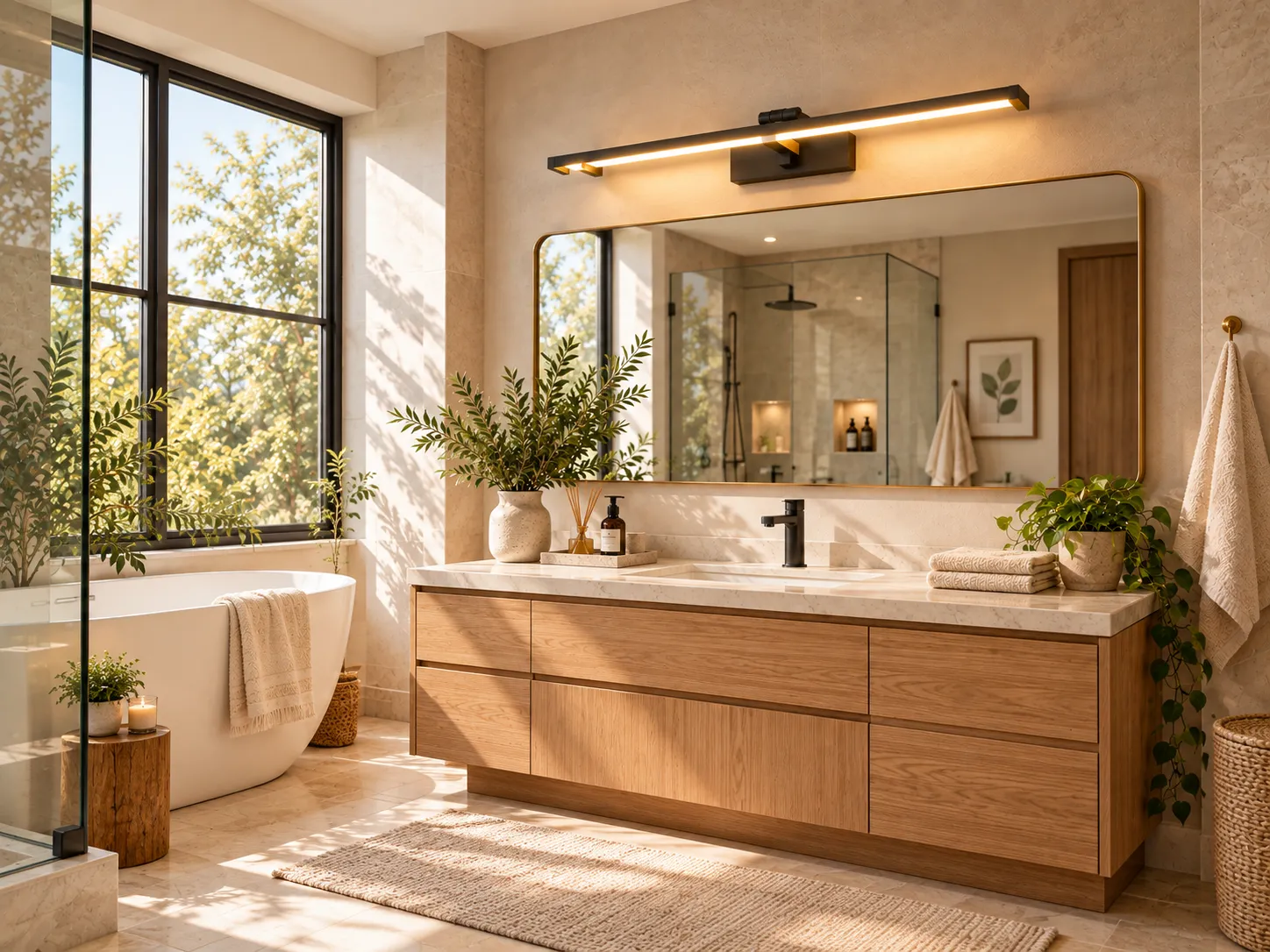

Modern Black Linear LED Vanity Light: A Practical Guide to Better Bathroom Mirror Lighting
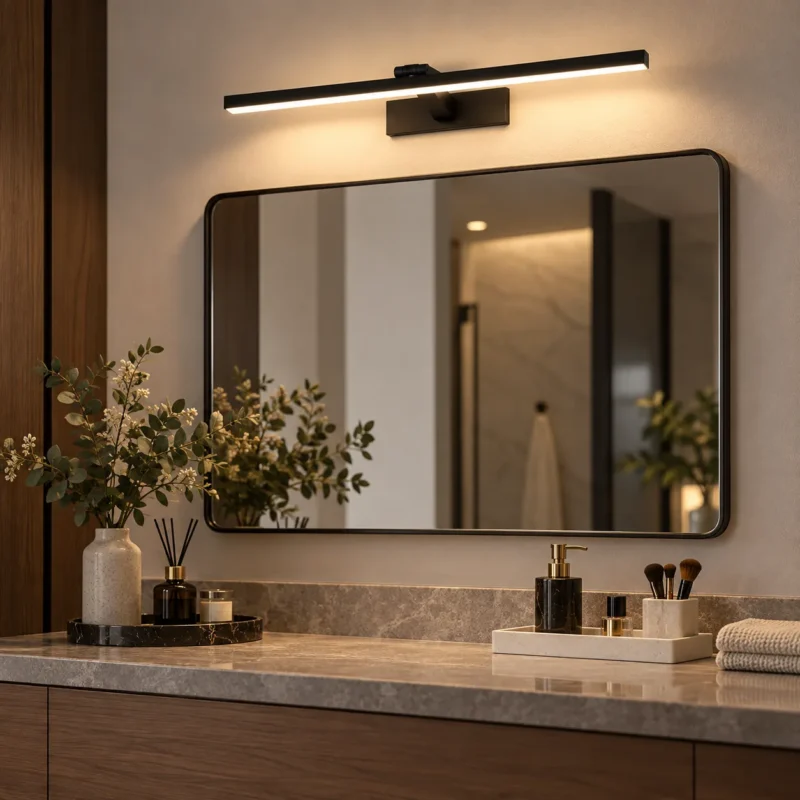
A slim black linear LED vanity light can visually anchor a wide mirror while keeping the bathroom composition clean and architectural.
Product Overview and Key Specifications
This modern black linear LED vanity light is designed for horizontal installation above a bathroom mirror. Its slim metal body, matte black finish, integrated LED source, and acrylic diffuser create a restrained architectural look while providing useful task and ambient light. The product page lists a 60 cm overall length, 14 W integrated LED power, approximately 900–1200 lumens, three selectable color temperatures, and CRI 80 as standard with a CRI 90 upgrade option.
| Specification | Details |
|---|---|
| Product Type | Linear LED vanity wall light / bathroom mirror light |
| Finish | Matte black |
| Main Material | Metal body with acrylic diffuser |
| Overall Dimensions | Approx. L60 × D18 × H5 cm (23.62 × 7.09 × 1.97 in) |
| Power | 14 W integrated LED |
| Luminous Flux | Approx. 900–1200 lm |
| Color Temperature | 3000 K / 4000 K / 6000 K selectable |
| Color Rendering | CRI ≥80; CRI ≥90 upgrade available |
| Voltage | AC 110–240 V, 50/60 Hz |
| Installation | Horizontal wall-mounted above mirror |
1. Why Vanity Lighting Deserves More Attention
Bathroom lighting is often treated as a finishing detail, but the vanity zone is one of the most visually demanding areas in the home. People use the mirror for shaving, skincare, makeup, contact lenses, hair styling, and other tasks that require the face to be clearly visible. A ceiling light alone can illuminate the room yet still leave shadows beneath the brow, nose, and chin. A dedicated vanity light adds light from the front or upper-front direction, helping the face read more clearly.
The Illuminating Engineering Society emphasizes that lighting at mirrors should illuminate the face effectively rather than merely brightening the room. Its guidance for restrooms also notes the importance of vertical illuminance near mirrors. This is a useful distinction: horizontal illuminance describes light falling on a countertop, while vertical illuminance is closer to what reaches a person’s face. For grooming, that vertical component matters.
A linear fixture is particularly practical when wall space beside the mirror is limited. Side sconces can provide excellent facial modeling, but they are not always possible in compact bathrooms, medicine-cabinet layouts, or wide-mirror installations. In those cases, a broad diffused bar above the mirror can create a continuous field of light and reduce the harshness associated with small point sources.
2. Why the Linear Form Works Above a Mirror
The visual strength of a linear vanity light comes from proportion. A long horizontal bar echoes the geometry of a mirror, countertop, backsplash, and vanity cabinet. That repetition makes the entire wall look more intentional. The matte black finish adds a thin, graphic line that can coordinate with black faucets, shower frames, door hardware, or dark decorative details without requiring every element in the room to match exactly.
A 60 cm fixture is especially versatile above medium-size mirrors. Rather than appearing as a small bright object floating over the mirror, the longer bar distributes visual weight over a broader area. This can help the mirror wall feel balanced even when the mirror itself is much wider than the luminaire.
The fixture’s understated silhouette also makes it compatible with very different interior styles: warm modern bathrooms with oak cabinetry, monochrome black-and-white schemes, stone-clad hotel bathrooms, contemporary apartments, and minimalist spaces with large frameless mirrors.
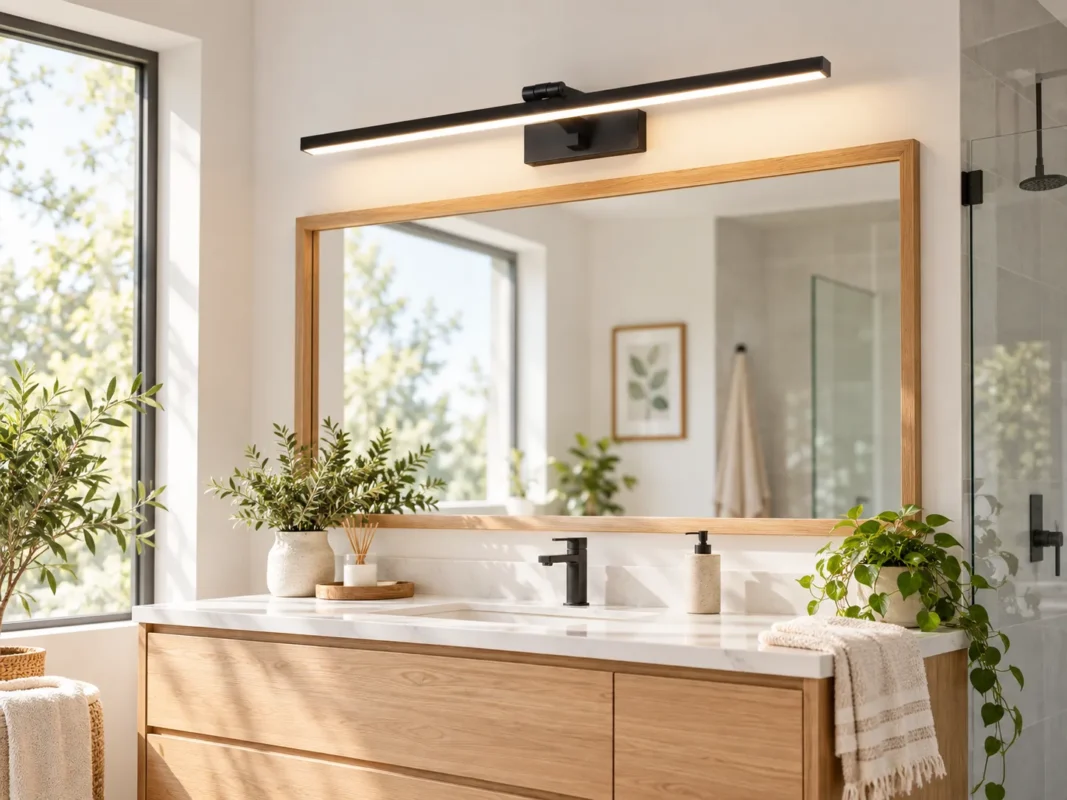
In a bright bathroom, the black profile creates crisp contrast without visually overpowering natural wood, white stone, or daylight.
3. Understanding Lumens, Watts, and Useful Light
Wattage tells us how much electrical power a fixture consumes; lumens describe how much visible light it produces. For this product, the listed 14 W power and approximately 900–1200 lm output indicate an integrated LED system intended to deliver useful task and ambient illumination with relatively low electrical demand.
The U.S. Department of Energy stresses that LED efficiency should be evaluated at the luminaire level, because the final performance depends on the LED package, driver, optical system, diffuser, and fixture design. In practical terms, a higher lumen number is not automatically better if those lumens create glare or miss the task area. Good vanity lighting is about delivering light where it is useful while maintaining visual comfort.
In a bathroom, a diffused 900–1200 lm bar can make a meaningful contribution to the mirror zone, but the overall room should still be supported by ambient lighting. The vanity light should not be expected to replace all ceiling or general illumination, especially in larger spaces.
4. Color Temperature: What 3000 K, 4000 K, and 6000 K Actually Change
Correlated color temperature, or CCT, describes the apparent color of white light and is expressed in kelvins. Lower values look warmer and more yellow; higher values look cooler and more blue-white. The U.S. Department of Energy explains that CCT describes color appearance, not quality: a cooler light is not automatically better than a warmer one.
At 3000 K, the light feels warm and residential. It works especially well with beige stone, walnut or oak cabinetry, brass hardware, and evening routines. Around 4000 K, the light becomes more neutral and visually crisp, which many users prefer for grooming because it feels less amber without becoming strongly blue. At 6000 K, the light appears cool and daylight-like; it can make white tile and cool gray finishes look brighter, though some people find it too clinical for a relaxing bathroom.
Because this fixture offers three selectable CCTs, it can adapt to different finishes and preferences. A useful design strategy is to coordinate the vanity light with the dominant ambient lighting rather than mixing very warm and very cool sources in the same small room. Consistency generally produces a calmer result.
5. CRI, Skin Tones, and Why Color Rendering Matters
Color Rendering Index, commonly abbreviated CRI, is a traditional metric used to describe how faithfully a light source renders a set of test colors relative to a reference source. The product specification lists CRI 80 as standard and CRI 90 as an available upgrade. The U.S. Department of Energy has long treated CRI values in the 80s as good for general interior use and values in the 90s as excellent, while also noting that CRI alone does not tell the whole story of color quality.
For a bathroom mirror, higher color fidelity can be useful because skin tone, cosmetics, hair color, clothing, and surface finishes are viewed at close range. If makeup application or color-sensitive grooming is important, the CRI 90 option is the better choice. For a guest bathroom or general washroom where the main goal is comfortable visibility, CRI 80 may be sufficient.
Modern lighting practice increasingly supplements CRI with more advanced methods such as IES TM-30, which evaluates both color fidelity and gamut. Consumers rarely see TM-30 data on residential products, but the broader lesson is important: light quality is multidimensional. CRI should be considered together with spectrum, CCT, glare, and distribution.
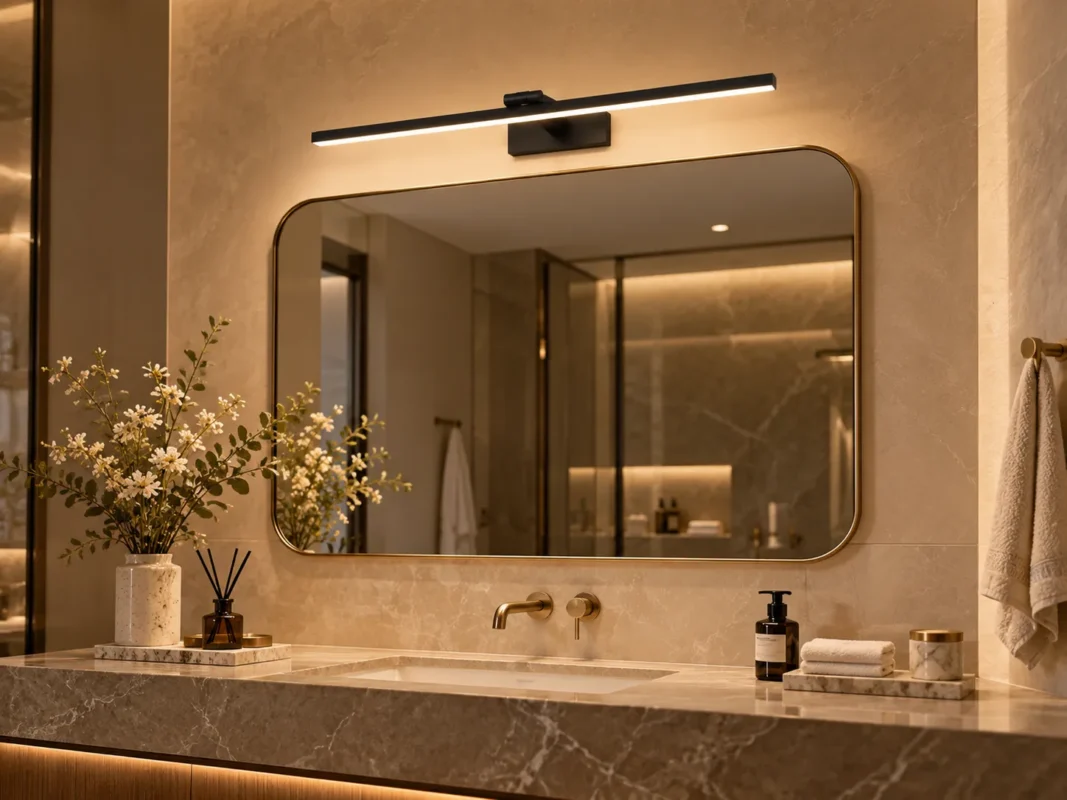
Warm-neutral light reinforces stone and brass finishes while the long bar spreads light across a wide mirror zone.
6. The Acrylic Diffuser and Glare Control
An integrated LED strip can be visually intense if the individual diodes are exposed. The acrylic diffuser on this vanity light softens the source and spreads its brightness over a larger luminous area. That reduces the sharpness of highlights and helps the fixture read as a continuous line rather than a row of bright points.
Glare is especially relevant around mirrors because both the eyes and the reflective glass may see the source directly. The ideal outcome is not “no brightness” but controlled brightness. A diffuser, adequate distance from the eyes, and a broad linear form all contribute to more comfortable viewing.
Wall and counter finishes also affect perceived glare. Very glossy stone, polished metal, or mirror-like tiles can create secondary reflections. Matte or satin surrounding finishes usually produce a calmer visual field because they scatter reflected light more broadly.
7. Placement: Above-Mirror Lighting and Facial Shadows
Lighting professionals generally consider side lighting at roughly face height the most effective way to minimize shadows on the face. IES guidance on bathroom mirrors similarly favors lighting that reaches the face rather than simply the wall or ceiling. However, side-mounted fixtures require adequate wall space and symmetrical placement, conditions that do not exist in every bathroom.
When a bar light is used above the mirror, width and diffusion become important. A longer source creates a broader angle of light, and a diffuser reduces hard shadow edges. The fixture should be centered over the mirror or vanity zone, and it should be mounted high enough to stay out of the direct line of sight while remaining close enough to contribute useful front light.
For wide double vanities, one central 60 cm bar may be best used as part of a layered solution rather than as the sole task light. For single-sink vanities and medium mirrors, the proportions are more favorable. The key is to evaluate the mirror width, sink position, user height, and other light sources together rather than choosing a mounting height in isolation.
8. Layered Lighting: The Best Way to Use This Fixture
A bathroom is more comfortable when lighting is layered. The vanity light should serve as the task layer at the mirror. Ceiling fixtures or recessed downlights can provide ambient illumination for circulation and cleaning. Small accent lights can highlight niches, shelves, or architectural materials. These layers reduce the pressure on any single fixture to do everything.
This matters particularly in the evening. A bright ceiling-only scheme can feel harsh, while a vanity light combined with low-level indirect lighting can create a more relaxed atmosphere. During morning routines, the ambient and vanity layers can operate together for higher visibility.
If dimming is desired, the driver and control system must be verified for compatibility. Not every integrated LED fixture is dimmable, and incompatible dimmers can cause flicker, noise, limited range, or premature driver stress. Color selection and dimming are separate features unless the product specifically states otherwise.
9. Styling the Matte Black Finish
Matte black works because it behaves almost like a graphic outline. Against light walls it creates strong contrast; against dark stone it becomes more integrated and subtle. In warm bathrooms, pairing black with brass or bronze can add depth. In cooler spaces, black works naturally with chrome, nickel, gray tile, or white quartz.
It is not necessary to repeat black everywhere. A small number of coordinated elements – such as the vanity light, shower frame, faucet, or cabinet pulls – is usually enough to create visual continuity. Overmatching every accessory can make a bathroom feel overly themed.
The slim bar also works well above framed and frameless mirrors. With a black-framed mirror, the effect is architectural and cohesive. With a wood-framed mirror, the black fixture adds contrast and keeps the design from becoming too warm or rustic.
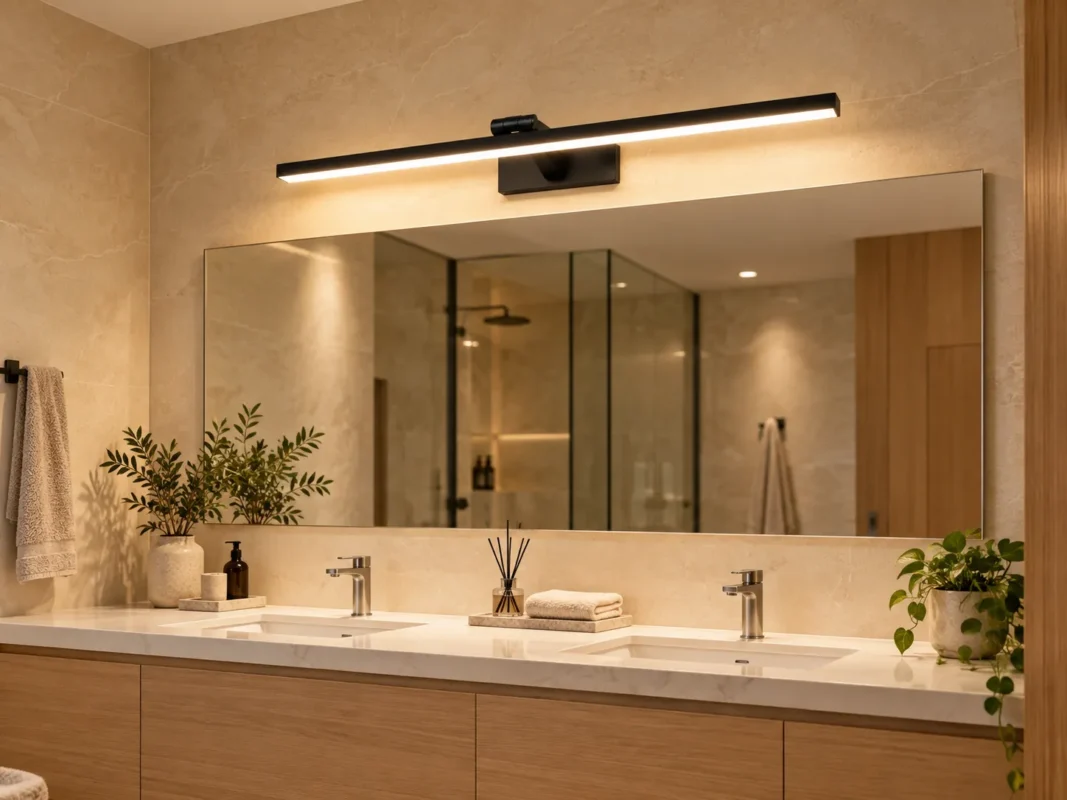
On a wide double vanity, the linear fixture contributes a strong horizontal accent and works best as one layer within the overall lighting scheme.
10. Bathroom Safety and Moisture Considerations
Bathrooms are wet environments, so electrical safety matters as much as visual design. A wall light must be installed in a location appropriate for its electrical rating and local code. Fixtures positioned near showers, tubs, or other splash zones may require specific damp- or wet-location ratings. The product’s exact ingress or location rating should be verified before installation in a moisture-prone zone.
The fixture should be hardwired by a qualified installer where required by local regulations. Connections should remain accessible according to applicable electrical practice, and the wall box must support the fixture securely. Because this model projects approximately 18 cm from the wall, the installer should also confirm that it will not conflict with cabinet doors, mirrored medicine cabinets, or other moving elements.
Integrated LED fixtures contain both the light source and electronic driver. Adequate thermal management is important for long-term performance, so the luminaire should not be covered or installed in a way that traps excessive heat beyond its intended design.
11. Choosing the Right Version for the Room
For a warm, hotel-like bathroom with stone and brass, 3000 K is usually the most harmonious setting. For a bright contemporary bathroom where grooming clarity is important, 4000 K can provide a clean neutral appearance. The 6000 K option is useful for users who prefer a visibly cool, high-contrast white or for certain commercial washroom aesthetics.
If the vanity is used for makeup, hair coloring, or other color-sensitive tasks, prioritize the CRI 90 upgrade. If the room already has excellent side lighting and the bar is mainly decorative or supplemental, the standard CRI 80 version may be adequate.
The listed 900–1200 lm output should be evaluated together with the size and reflectance of the room. Light-colored walls and counters reflect more light back into the space; dark stone, dark paint, and deep wood absorb more. The same fixture can therefore feel noticeably brighter in a white bathroom than in a dark charcoal one.
12. Practical Checklist Before Installation
Before ordering or installing a vanity light, confirm the mirror width, distance from the mirror to the ceiling, wall-box location, nearby cabinet clearances, desired CCT, and whether a high-CRI upgrade is needed. Also confirm the moisture/location rating and dimmer compatibility if those features matter to the project.
For a polished result, center the fixture on the visual axis of the mirror or sink, keep the spacing between fixture and mirror intentional, and coordinate the black finish with at least one other dark element in the room. Finally, test the actual light at the face rather than judging the installation only from how the wall looks.
Conclusion
The modern black linear LED vanity light succeeds because it combines a restrained architectural form with practical lighting features. Its 60 cm width, integrated 14 W LED source, selectable 3000 K / 4000 K / 6000 K color temperatures, acrylic diffuser, and optional higher-CRI configuration make it adaptable to a wide range of modern bathrooms.
The most important design lesson is that vanity lighting should be evaluated as part of a system. Light quality, placement, mirror size, room finishes, and ambient lighting all influence the final result. Used thoughtfully, a slim over-mirror bar can provide useful facial illumination, visual order, and a strong contemporary focal point without overwhelming the room.
Modern Black Linear LED Vanity Light for Bathroom Mirror | Click to View Product