

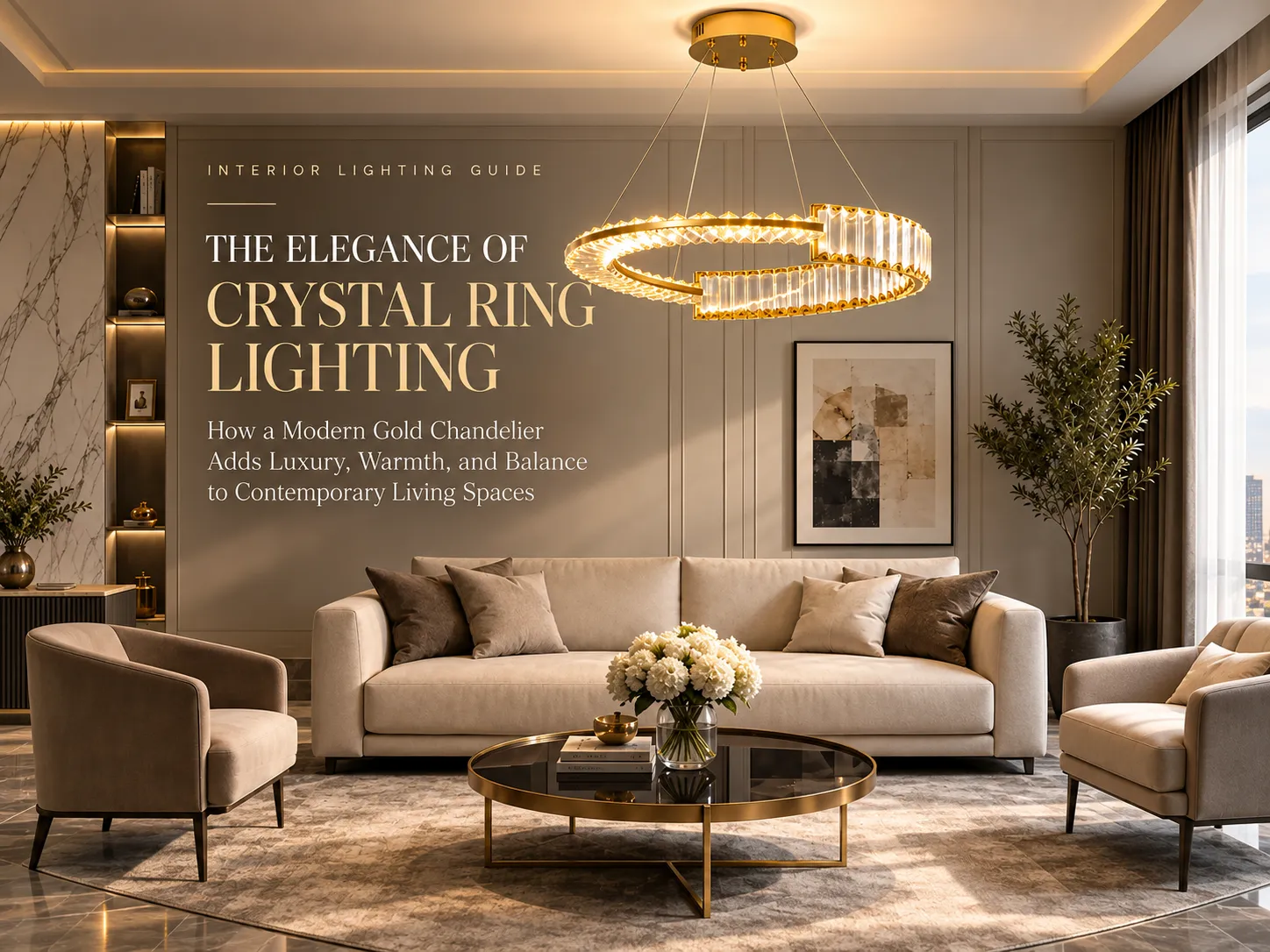

How a Luxury Crystal Ring Chandelier Adds Structure, Sparkle, and Warmth to Modern Interiors
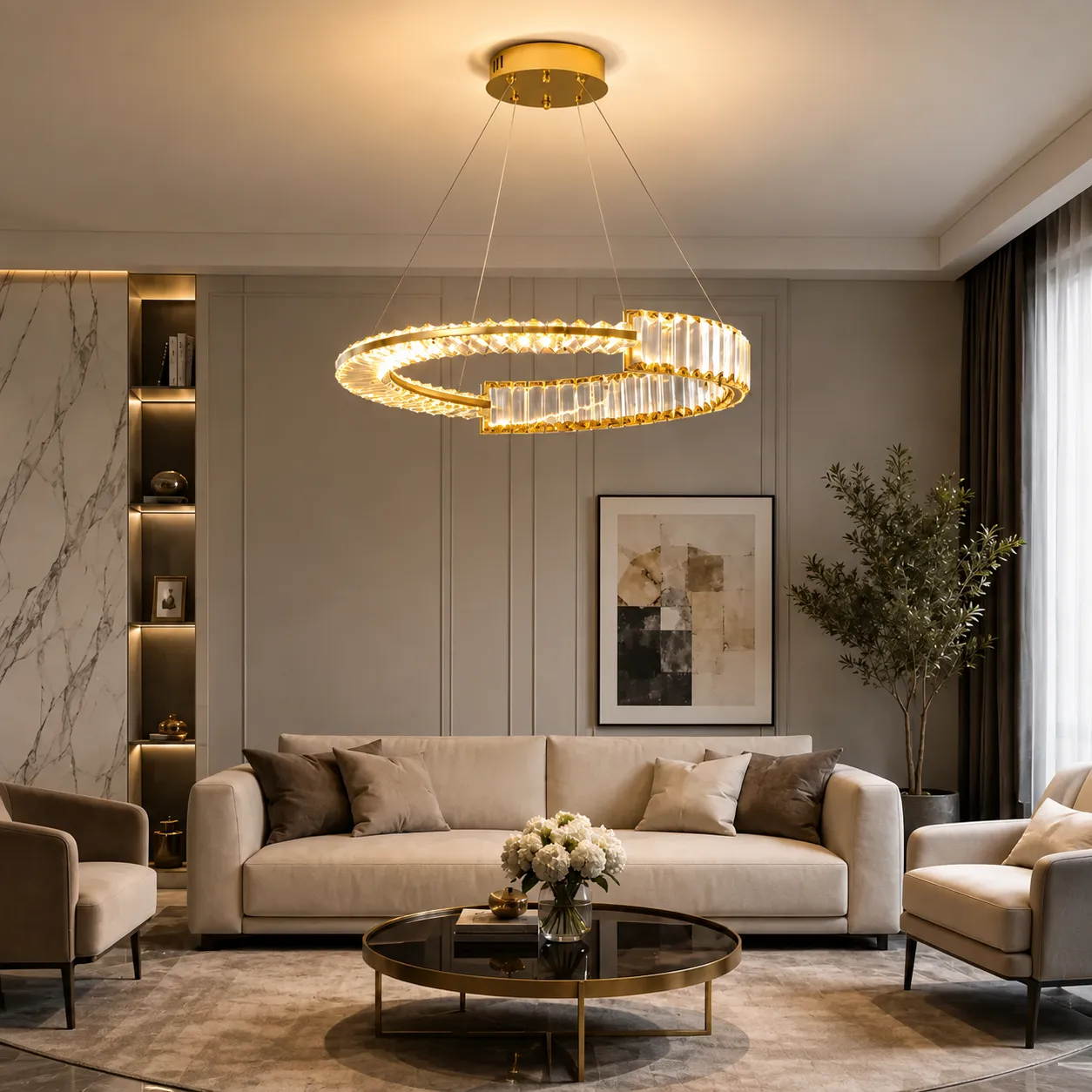
Why Ring Chandeliers Work So Well in Contemporary Spaces
A ring chandelier combines two qualities that modern interiors often need at the same time: visual simplicity from a clean geometric outline and decorative richness from reflective materials. The circular form reads clearly from across a room, while crystal surfaces break the light into highlights that add depth and movement without relying on a heavily ornamented silhouette.
The Luxury Crystal Ring Chandelier from Xunlu Lighting uses a champagne-gold stainless-steel and aluminum frame with clear K9 crystal elements and an integrated LED system. According to the product specification, the fixture is 60 cm (23.62 in) in diameter, uses a 65 W integrated LED light source, provides approximately 4500-5500 lumens, offers 3000K, 4000K, and 6000K color-temperature options, and includes smart dimming with suspension adjustable up to 150 cm (59.06 in).
| Product Detail | Specification |
|---|---|
| Overall diameter | 60 cm / 23.62 in |
| Main materials | Stainless steel, aluminum alloy, K9 crystal |
| Finish | Champagne gold + clear crystal |
| Light source | Integrated LED module |
| Power | 65 W |
| Voltage | AC 110-240 V |
| CCT options | 3000K / 4000K / 6000K |
| Output | Approx. 4500-5500 lm |
| Dimming | Smart dimming available |
| Suspension | Adjustable up to 150 cm / 59.06 in |
| Weight | Approx. 5.5-6.5 kg / 12.1-14.3 lb |
1. Crystal Optics: Why Small Facets Create Large Visual Effects
K9 crystal is valued in decorative lighting because polished, transparent facets redirect light through refraction and reflection. A faceted crystal element does not increase the electrical output of the LEDs, but it changes how that light is distributed and perceived. Multiple bright edges and internal reflections create sparkle, while transparent surfaces allow part of the light to pass through the material.
This distinction matters when evaluating a chandelier. The visual brilliance comes from optical redistribution rather than from raw wattage alone. In a room with darker cabinetry, stone, glass, lacquer, or metallic finishes, those reflections can help build a sense of depth. In a very reflective room, however, dimming becomes important because too many high-luminance highlights can feel visually busy.
2. 3000K, 4000K, and 6000K: Choosing the Right White
Correlated color temperature, or CCT, describes the appearance of white light. Lower CCT values look warmer; higher values look cooler. The U.S. Department of Energy identifies CCT as one of the key ways white-light appearance is described and notes that LED systems can be engineered across a wide range of color qualities.
For this chandelier, 3000K is the most natural choice for living rooms, dining rooms, hotel lounges, and other spaces where warm metals, wood, beige stone, and soft fabrics are prominent. 4000K gives a more neutral appearance that can suit contemporary kitchens, showrooms, or brighter multipurpose rooms. 6000K is much cooler and produces a crisper visual impression, but it is usually less intimate for evening residential use.
3. Dimming Is More Than a Mood Feature
Dimming is especially useful in a crystal fixture because brightness changes both the useful light level and the intensity of the sparkle. At high output, the chandelier can support general illumination in a larger room. At lower output, it becomes more atmospheric, with the crystal reading as a decorative luminous object rather than a dominant source.
The Illuminating Engineering Society defines ambient lighting as general illumination throughout an area and task lighting as light directed to a specific surface or visual task. A dimmable chandelier fits naturally into a layered scheme: let the chandelier provide adjustable ambient light while table lamps, wall lights, under-cabinet lighting, or reading lights handle more localized tasks.
4. Understanding 4500-5500 Lumens in a Real Room
The listed 4500-5500 lumen range is substantial for a decorative pendant, but lumens measure total emitted light rather than the illuminance that reaches a table, floor, or work surface. Actual brightness depends on suspension height, crystal geometry, room size, surface reflectance, and how much light is directed upward, outward, or downward.
This is why chandelier selection should not be based on lumens alone. A bright chandelier in a room with dark walls may feel less intense than the same fixture in a compact room with pale glossy surfaces. Dimming allows the user to tune the final installation after the fixture is in the actual space.
5. Color Rendering: The Important Metric the Product Page Does Not Specify
The U.S. Department of Energy recommends a minimum CRI of 80 for interior lighting and describes CRI 90 or higher as excellent color fidelity. DOE also notes that IES TM-30 provides a more comprehensive way to evaluate color rendering than CRI alone. NIST has similarly documented the limitations of traditional CRI for modern solid-state light sources.
The Xunlu product page does not publish a CRI or TM-30 value for this chandelier, so this article does not assign one. For projects where artwork, skin tones, food, textiles, or material samples must look especially accurate, buyers should request color-rendering data before specification.
6. Scale and Proportion: Why the 60 cm Ring Works
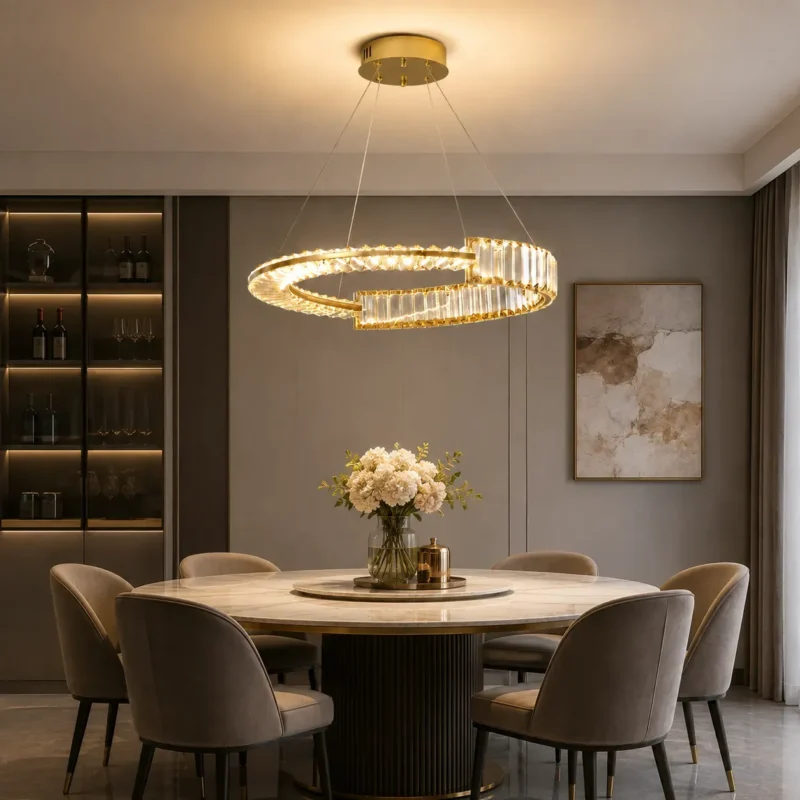
At 60 cm in diameter, the chandelier has enough visual mass to act as a focal point without becoming oversized in many medium-to-large residential rooms. The circular profile works particularly well with round dining tables because the geometry repeats, but it can also soften rooms dominated by rectangles such as sofas, cabinetry, wall panels, and stone slabs.
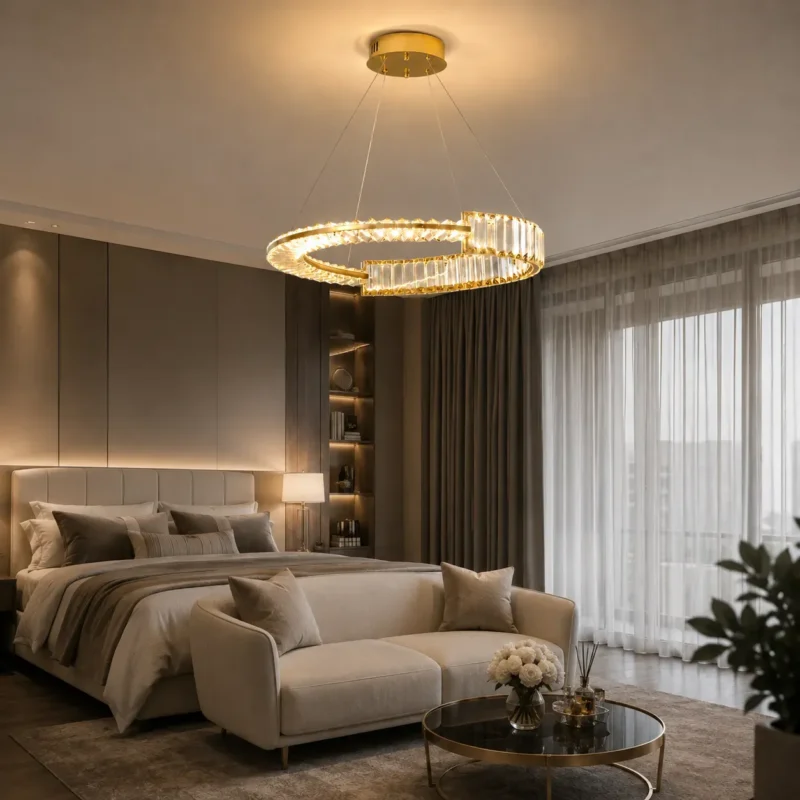
For living rooms, the fixture can be centered over a seating group rather than over the geometric center of the ceiling. In bedrooms, the chandelier should be positioned where the rings are visually balanced with the bed and where the suspension height does not conflict with circulation. In hotel lobbies or entrance halls, the same form can be lowered or raised to suit the room volume.
7. Hanging Height and Sightlines
The product page recommends approximately 70-90 cm between the fixture and a dining tabletop. That range is a practical starting point because it keeps the chandelier visually connected to the table while preserving sightlines across it. Ceiling height, fixture diameter, and the eye level of seated users should still be considered before finalizing the suspension length.
In living rooms or circulation zones without furniture directly below the chandelier, the key requirement is comfortable head clearance. The adjustable cable length of up to 150 cm gives installers flexibility in rooms with higher ceilings, recessed trays, or architectural ceiling details.
8. Where the Chandelier Works Best
Living room
Use the chandelier as the central decorative layer over the seating group. Pair it with wall washers or floor lamps so the ceiling fixture is not responsible for every lighting task.
Dining room
The ring geometry is especially effective above round or oval tables. Warm dimming helps transition from brighter family meals to lower evening ambience.
Bedroom
Use lower output and 3000K for a softer visual environment. Complement the chandelier with bedside lamps for reading instead of increasing the central light to excessive brightness.
Villa entrance or double-height space
The reflective crystal and strong circular silhouette remain visible from multiple angles, making the fixture useful where the light must read as an architectural feature.
Boutique hotel, restaurant, or reception area
The crystal creates a premium first impression while dimming allows the same fixture to support daytime brightness and evening atmosphere.
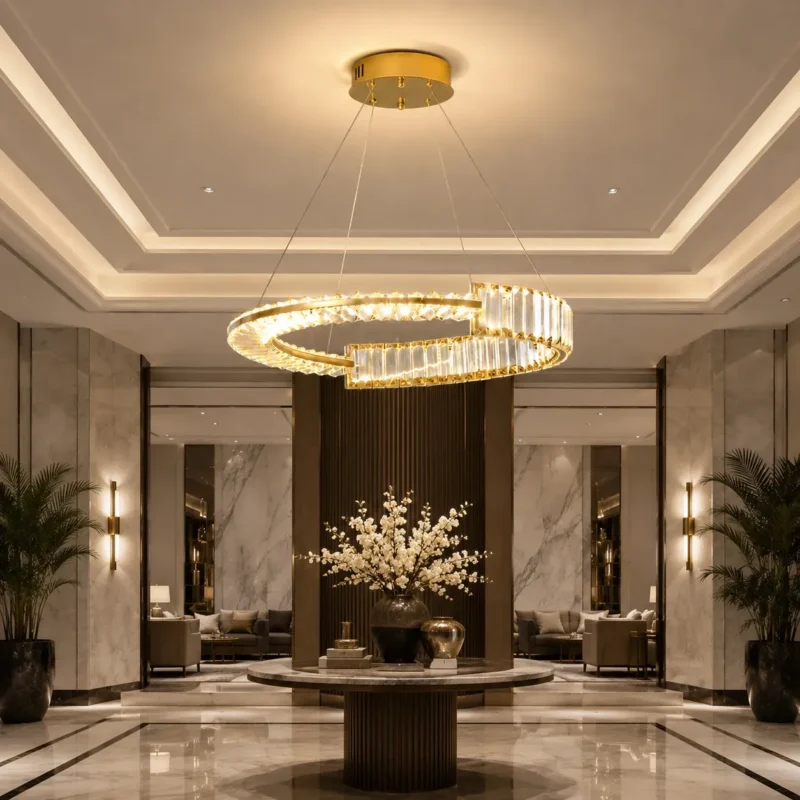
9. Material Pairing: Gold and Crystal Without Visual Excess
Champagne gold and clear crystal can feel luxurious without becoming overly ornate when the surrounding palette remains controlled. Warm stone, cream upholstery, walnut, smoked glass, dark bronze, taupe, and soft gray all support the fixture while allowing the crystal to remain the brightest element.
A useful design principle is to repeat the metal finish selectively. One or two smaller gold details, such as a coffee-table frame, cabinet pull, mirror edge, or decorative object, are usually enough. Repeating gold everywhere can reduce the chandelier’s ability to act as a focal point.
10. Integrated LED: Efficiency, Maintenance, and Long-Term Planning
The fixture uses an integrated 65 W LED module rather than replaceable bulbs. Integrated LEDs allow the light source to follow the ring geometry closely, which is important for continuous halo illumination. The U.S. Department of Energy notes that overall LED performance depends not only on the LED devices but also on fixture design, thermal management, drivers, and optical components.
Because the LED module is integrated, buyers should consider the driver, control system, warranty, and availability of replacement electronic components as part of the purchase decision. In a high-end installation, serviceability is an important practical factor alongside appearance.
Conclusion: Luxury Works Best When Light, Material, and Scale Are Controlled
The strength of this chandelier is not simply that it uses crystal or a gold finish. Its success comes from the interaction between geometry, optics, dimming, and scale. The ring form gives the fixture a clean architectural identity; the crystal multiplies highlights; the warm metal adds richness; and the adjustable LED system allows the atmosphere to change with the room.
Used as one layer in a broader lighting plan, the Luxury Crystal Ring Chandelier can work in living rooms, dining rooms, bedrooms, villas, hotels, restaurants, and reception spaces where lighting needs to be both functional and visually memorable.
Explore the Luxury Crystal Ring Chandelier :View product details on Xunlu Lighting
