

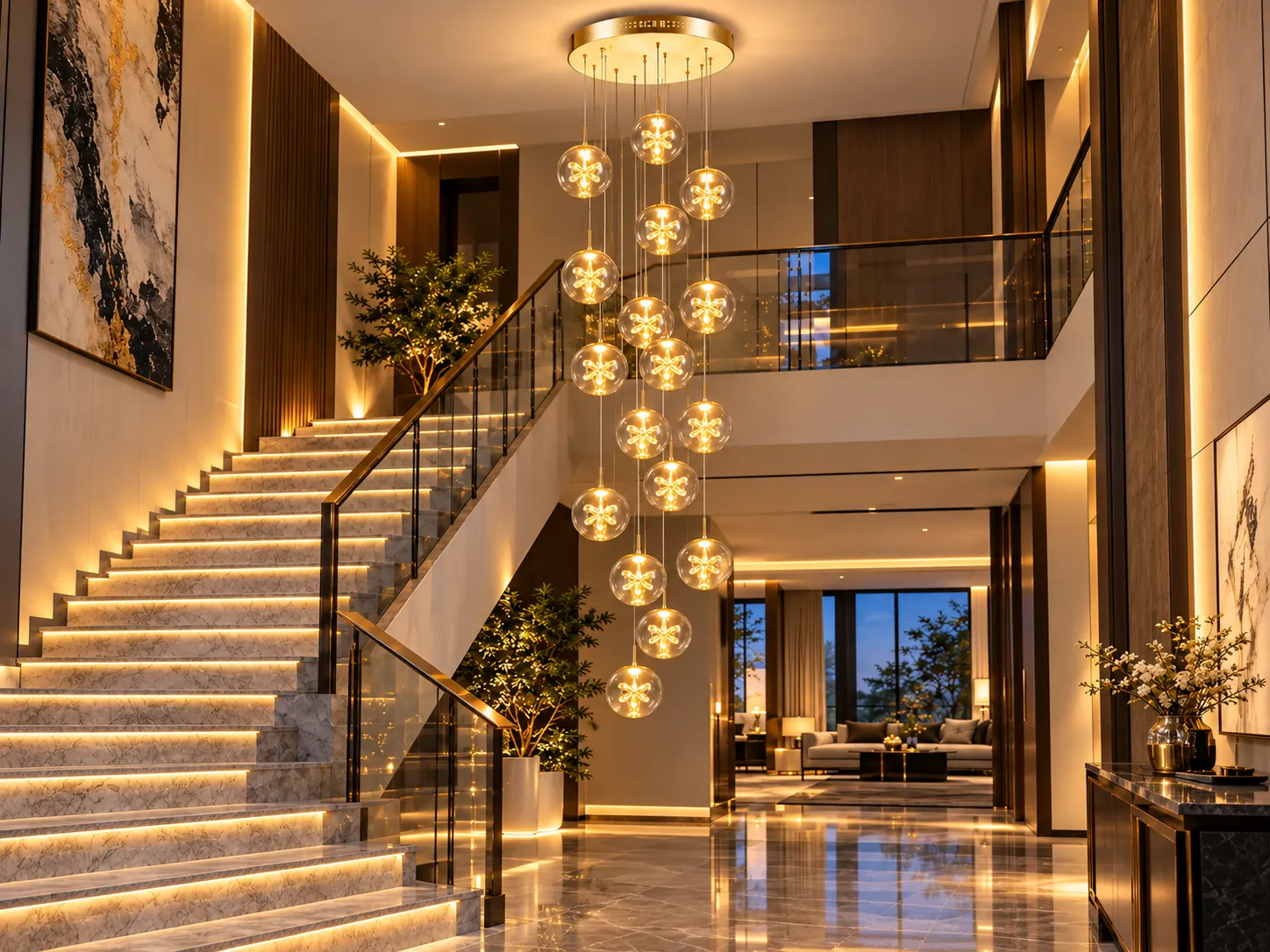

How to Transform a Modern Double-Height Interior with Layered LED Lighting
A practical, evidence-informed guide to proportions, light quality, installation planning and contemporary design.
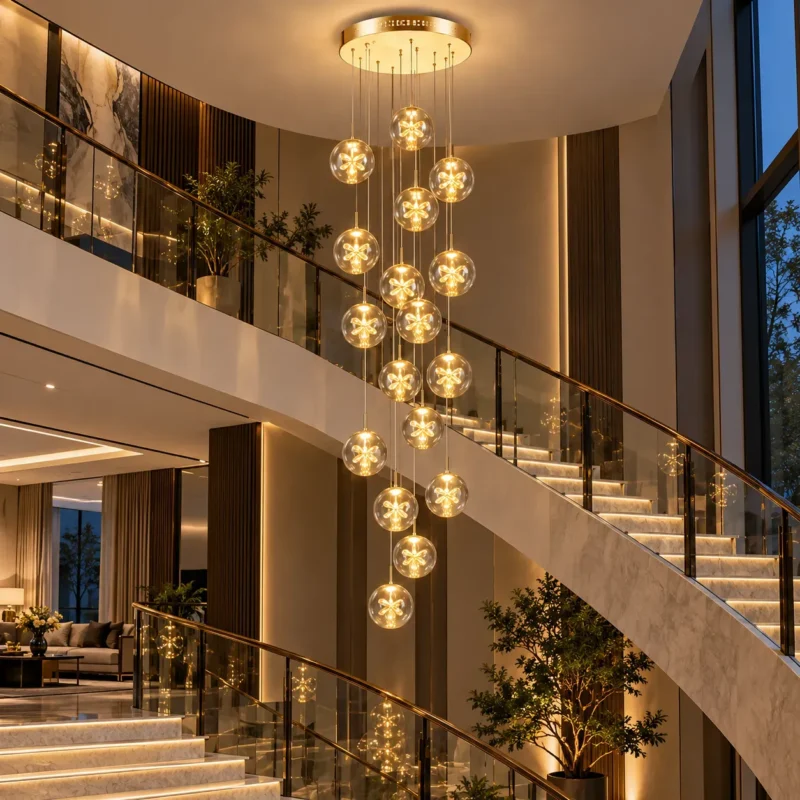
A double-height foyer or staircase can be one of the most memorable parts of a home, but it is also a demanding space to light. The eye travels between multiple floors, railings and wall planes; decorative lighting must therefore look balanced from several viewpoints while still allowing people to see steps, landings and handrails clearly. A cascading chandelier can anchor this volume with a sculptural sequence of illuminated glass globes. The best result combines visual drama with a careful, measurable lighting plan.
1. Why a Cascading Glass Chandelier Works in Tall Spaces
Unlike a compact pendant, a vertical cluster occupies the height of an atrium, making use of otherwise empty air. At different levels, the staggered glass spheres establish rhythm and scale. In the featured Xunlulighting design, clear globes reveal crystal-inspired floral details, while the slender suspension cables and round canopy preserve a clean architectural silhouette. The decorative sparkle changes with the viewer’s position, adding interest without relying on excessively ornate metalwork.
The chandelier should be considered an architectural feature rather than the only light in the room. Even a luminous installation can leave stair treads, corners or circulation zones insufficiently illuminated if light distribution is not verified.
2. Select the Right Configuration and Drop Length
The product listing offers the following configurations. Sizes describe the listed canopy diameter and maximum suspension height; final height should be confirmed during installation planning.
| Version | Canopy Diameter | Max. Drop | Listed Power |
|---|---|---|---|
| 10 heads | 40 cm / 15.75 in | 200 cm / 78.74 in | 50 W |
| 18 heads | 50 cm / 19.69 in | 350 cm / 137.80 in | 90 W |
| 30 heads | 70 cm / 27.56 in | 600 cm / 236.22 in | 150 W |
A 10-head arrangement may suit a shorter or narrower void, while the 18-head and 30-head versions provide greater visual length. However, choose based on actual floor-to-ceiling measurements, available hanging space, safe access and views from both storeys—not a universal “one chandelier per ceiling height” rule. The manufacturer lists approximate weights, outputs and dimensions; obtain the current technical drawing and verified shipping/fixture weights before specifying structural supports.
3. Design for Different Viewing Angles
A staircase chandelier is seen from below, across the landing and sometimes from above. Sketch these views before finalizing cable lengths. The lowest globe should not interfere with people, furniture, door swings or cleaning equipment. Leave an appropriate safety margin around the handrail and any upper-floor walkway. Where the chandelier hangs above a traffic path, follow applicable local building and electrical codes rather than a decorative rule of thumb.
4. Use Layered Lighting, Not Decorative Light Alone
Ambient, task and accent lighting
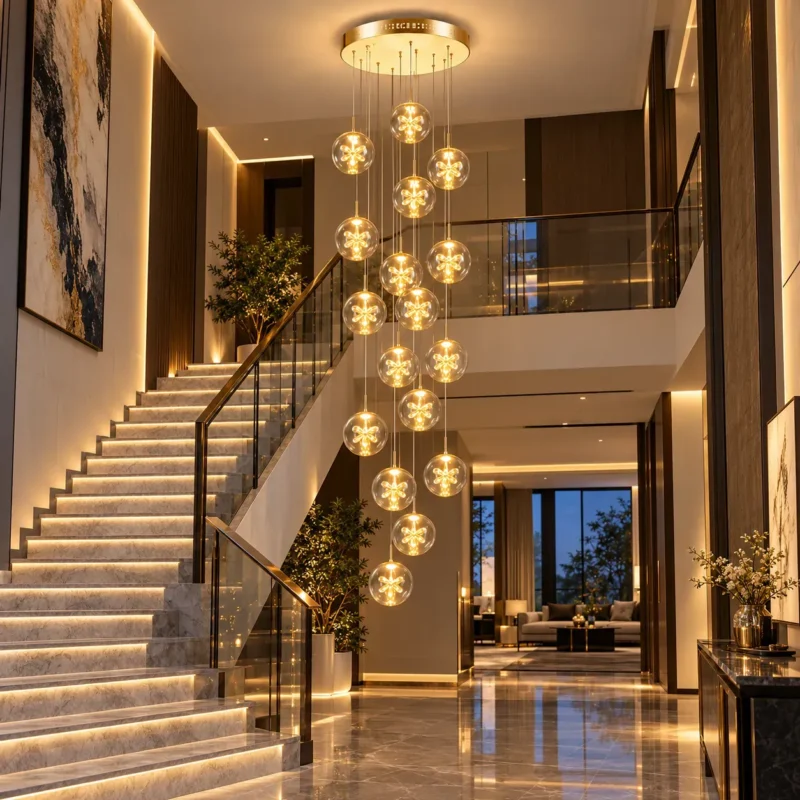
A well-planned high-ceiling interior commonly combines ambient light for overall navigation, task light at specific activity areas, and accent light for architecture or art. Integrate the statement chandelier with practical stair-step or wall lighting and separate circuits or controls. This makes it possible to keep the stairs legible even when the chandelier is dimmed for evening atmosphere.
Understand lumens and lux
Lumens describe the quantity of visible light emitted by a source, whereas lux measures the illumination reaching a surface (1 lux = 1 lumen per square metre). Rated fixture lumens cannot by themselves establish floor or tread illuminance; geometry, beam distribution, surface reflectance and mounting height all matter. The Illuminating Engineering Society (IES) publishes task- and application-specific illuminance guidance, so designers should assess the actual staircase layout instead of presenting a single lux target as suitable for every home.
Control glare from multiple eye levels
Glare occurs when bright surfaces in the field of view are significantly brighter than the eyes are adapted to. In a staircase, light sources may align with the line of sight on a landing. Test the chandelier’s visibility from typical walking positions; position supplemental lights to illuminate steps without shining into eyes. Dimming may improve comfort when supported by compatible drivers and controls.
5. Choose a Color Temperature That Fits the Interior
Correlated color temperature (CCT) describes whether white light looks visually warmer or cooler, measured in kelvin (K); it does not directly measure heat or brightness. The product page lists 3000 K warm white, 4000 K neutral white and 6000 K cool white options. Warm light can support a relaxed residential mood; neutral light may make detail appear crisper; cool light may suit some brighter, contemporary schemes but can feel less intimate in an evening lounge. Coordinate CCT among the chandelier, concealed strips, wall washers and step lights for a coherent result.
The U.S. Department of Energy recommends comparing brightness in lumens rather than watts and reading the lighting-facts information when available. Wattage describes electrical consumption, not guaranteed perceived brightness or adequate coverage.
6. The Glass Globe and Crystal Floral Detail
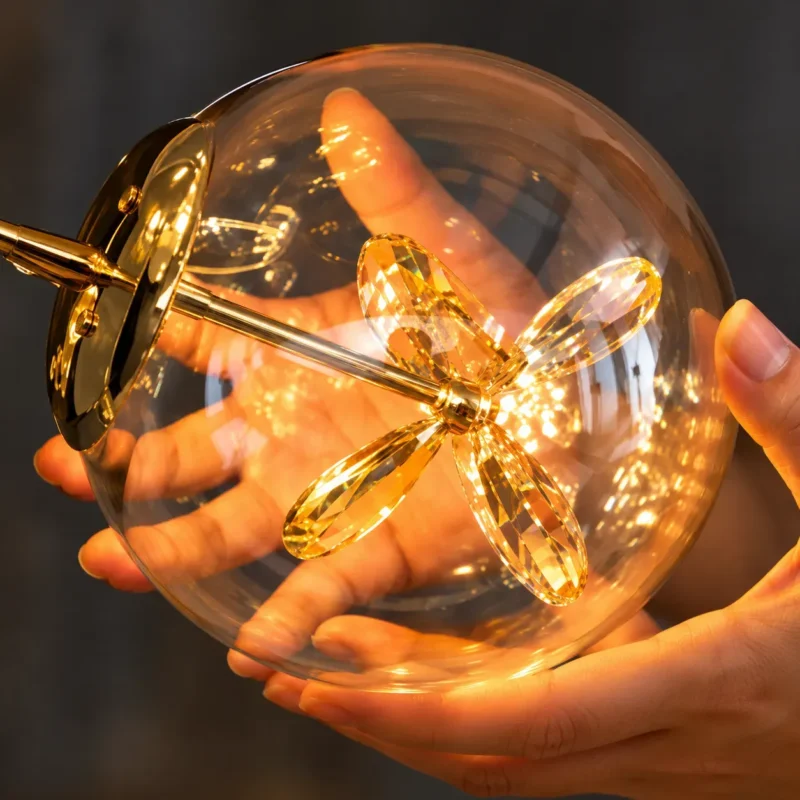
The clear enclosure and decorative floral element make the light source visible as part of the composition. Transparent materials can create reflections and sparkles, but apparent brilliance in photographs depends on exposure and other room lighting. Glass is also not a promise of uniform diffusion: check the real sample or manufacturer photometric data if exact distribution, glare control or color rendering is important.
7. Safe Installation in a Double-Height Stairwell
Install only through a qualified electrician or appropriately licensed professional. The support structure and mounting hardware must be rated for the complete assembled fixture, including the canopy, glass and all hanging elements; plasterboard alone should not be treated as the structural support. Request an installation drawing and verify cable anchoring, local voltage, earthing/grounding requirements, driver access and control compatibility. The website lists AC 110–240 V, an adjustable suspension and IP20, indicating use in dry indoor environments—not wet or outdoor areas.
Plan maintenance before the chandelier is hung. On high staircases, access may require a professional ladder system, scaffold or lift suitable for the location. Do not position furniture beneath the fixture as an improvised maintenance platform.
8. Cleaning and Long-Term Care
Turn off power and allow components to cool before cleaning. Remove loose dust with a soft microfiber cloth. Use a manufacturer-approved cleaner sparingly on the cloth—not sprayed directly into electrical assemblies. Support fragile glass components during cleaning and avoid abrasive pads or harsh chemicals that can scratch transparent surfaces or alter metal finishes. Check the suspension, electrical connections and signs of damage during scheduled professional service.
9. A Simple Planning Checklist
- Measure the ceiling, staircase void, landing geometry and accessible floor area.
- Choose a 10-, 18- or 30-head configuration based on the actual vertical composition.
- Verify suspension arrangement, fixture weight, support capacity and minimum clearances.
- Select a consistent color temperature and confirm the desired control/dimming option.
- Provide independent step or wall lighting and test visibility from every stair level.
- Schedule safe professional installation and a realistic cleaning method.
Frequently Asked Questions
Can this chandelier be the only light in a staircase?
It should not be assumed sufficient without evaluating actual illuminance and visibility on stairs and landings. Supplementary lighting is often useful.
What is the difference between 3000 K and 4000 K?
3000 K looks warmer; 4000 K looks more neutral. Neither value alone determines how bright the room will be.
Is the 30-head version suitable for every double-height home?
No. Its listed maximum suspension height is 600 cm (236.22 in); verify fit, clearances and structure before ordering.
Does integrated LED mean the light is dimmable?
Not necessarily. Confirm the exact LED driver, control system and dimming protocol before purchasing.
Bring Architectural Light to Your Home
The Crystal Glass Staircase Chandelier by Xunlulighting combines contemporary glass spheres with delicate crystal floral details to give tall interiors a distinctive sense of depth. For a successful installation, start with measured space, safe structural planning, balanced lighting and a realistic maintenance plan.
Crystal Glass Staircase Chandelier-Click to view the product