

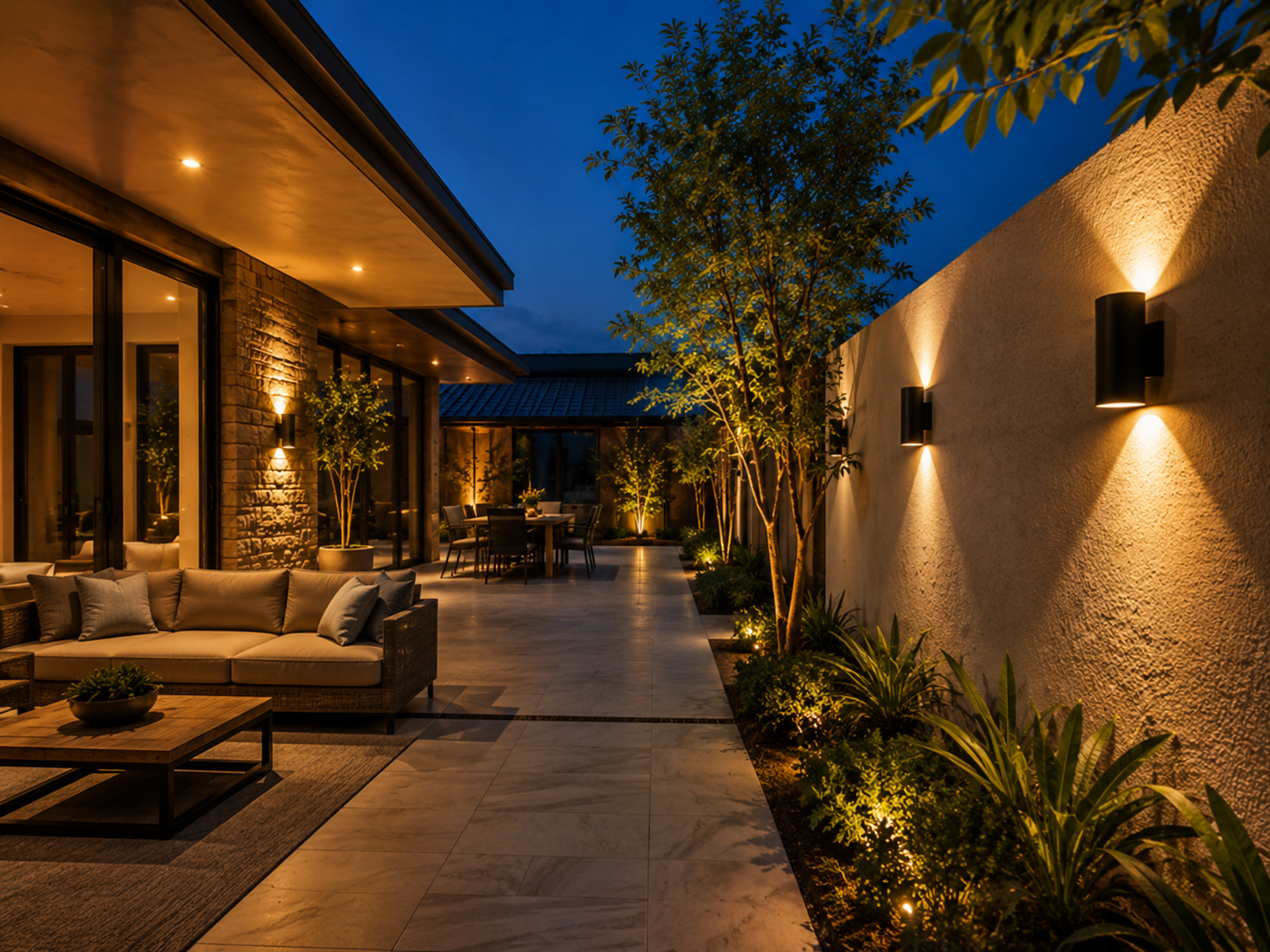

A Science-Based Guide to Safer, Warmer and More Energy-Smart Home Exteriors
Featuring the Modern Outdoor Wall Light | Solar LED IP64 Wall Sconce from Xunlu Lighting
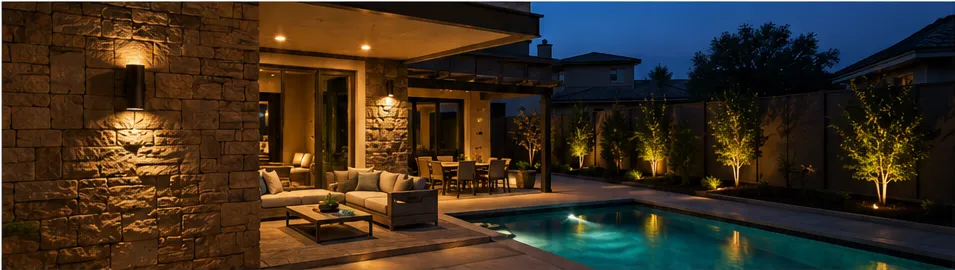
Outdoor lighting works best when it does more than make a house brighter. A well-designed exterior lighting plan helps people see steps and paths, makes entrances easier to navigate, adds depth to architecture, and creates a calmer transition between indoor and outdoor living. At the same time, too much light—or light aimed in the wrong direction—can create glare, waste energy and contribute to light pollution.
This guide uses a real outdoor fixture currently listed on Xunlu Lighting—the Modern Outdoor Wall Light | Solar LED IP64 Wall Sconce—as a practical example. The product combines a stainless-steel body, an acrylic/PC diffuser, an integrated 3W LED module, 3000K warm-white light, solar charging, automatic light sensing, approximately 200–300 lumens of output and an IP64 enclosure rating. Those specifications make it a useful case study for explaining how outdoor lighting choices connect with visual comfort, energy use, weather resistance and responsible nighttime design.
Product Spotlight: A Solar Wall Light for Modern Exteriors
| Product | Modern Outdoor Wall Light | Solar LED IP64 Wall Sconce |
|---|---|
| Brand / source | Xunlu Lighting — xunlulighting.com |
| Light source | Integrated 3W LED module |
| Color temperature | 3000K warm white |
| Luminous flux | Approx. 200–300 lm |
| Power system | DC 3.7V solar-powered system with automatic light sensor |
| Materials | Stainless steel body + high-transparency acrylic / PC diffuser |
| Ingress protection | IP64 |
| Best-fit applications | Villa exterior walls, entrances, terraces, garden paths and landscape zones |
The value of this type of fixture is not simply that it is solar powered. The stronger design idea is the combination of modest light output, warm color temperature, diffusion and wall mounting. That combination is well suited to orientation lighting and architectural accent lighting, where the goal is to reveal surfaces and routes without turning the exterior into a high-brightness floodlit zone.
1. Start with Visual Comfort, Not Maximum Brightness
Outdoor spaces often have large differences between bright and dark areas. The human visual system can adapt to low light, but abrupt brightness contrasts can make it harder to see detail around the brightest source. This is why glare control matters. A small luminaire with an exposed, intense LED can feel harsher than a larger diffused source producing the same general amount of useful light.
DarkSky International and the Illuminating Engineering Society jointly recommend that outdoor lighting be useful, targeted, low-level, controlled and warm-colored. For a home, this usually means placing light where people actually walk or gather, shielding or diffusing the source, and avoiding unnecessary spill into windows, neighboring properties or the sky.
Why 3000K Works Well Outdoors
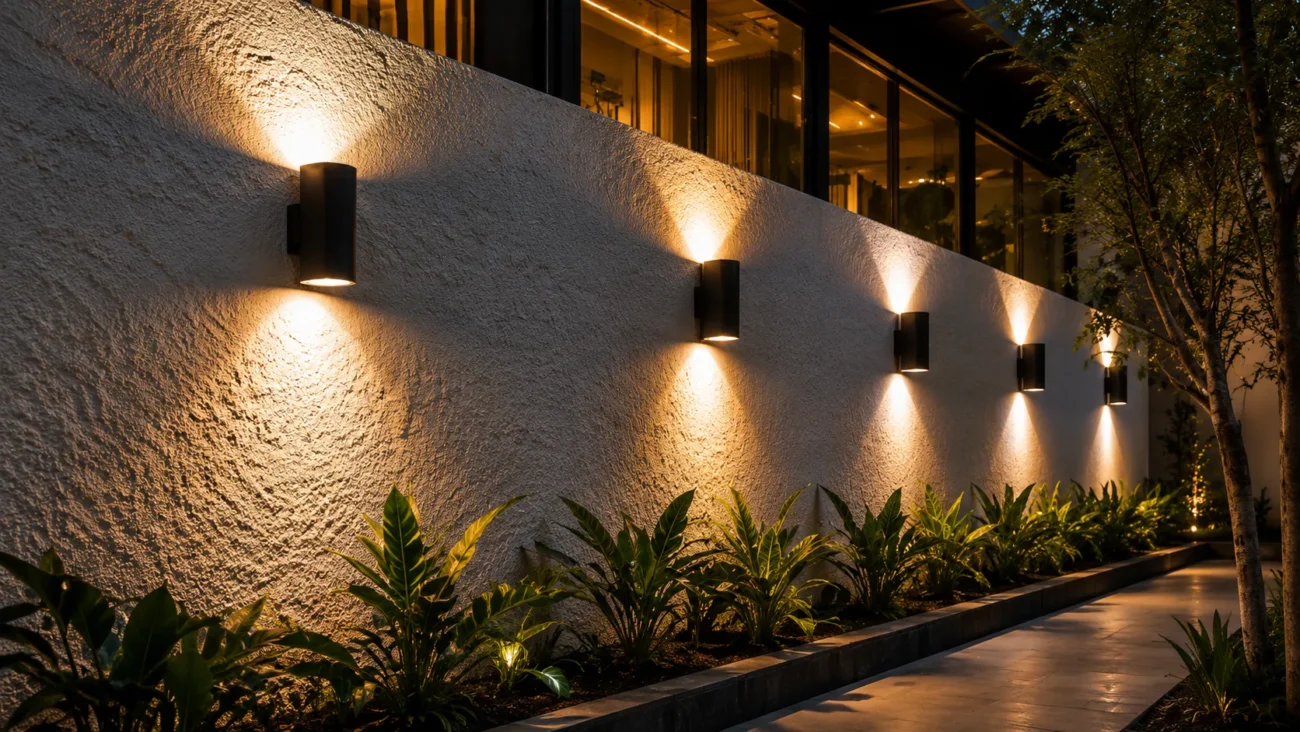
Correlated color temperature (CCT) describes the overall appearance of white light. Lower CCT values look warmer; higher values look cooler and bluer. For residential outdoor environments, warm light around 2700–3000K is widely favored because it supports a relaxed visual atmosphere and limits the proportion of short-wavelength blue light compared with cooler sources. The Xunlu fixture’s 3000K specification therefore fits the design principle of using warmer outdoor light where practical.
2. Put Light Where People Need Information
A good lighting plan is really an information plan. People need to read edges, changes in level, door hardware, steps, paths and obstacles. The Illuminating Engineering Society’s exterior-lighting guidance treats pedestrian visibility, glare and environmental impact as connected design issues rather than separate problems.
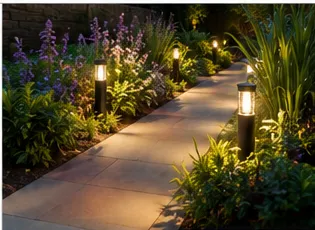
For a home, prioritize the transition points: the front door, the first and last step of a stair, the curve of a walkway, the garage-to-house route and changes in paving material. These are the places where modest, well-positioned illumination often contributes more to usability than simply increasing total lumens.
A Practical Layering Strategy
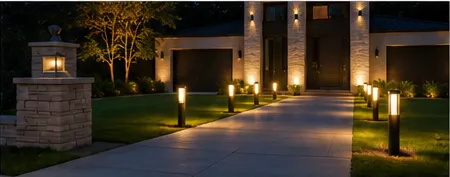
- Orientation layer: Low-level light for steps, paths, gates and circulation.
- Architectural layer: Wall sconces or grazing light that reveals texture, entrances and façade rhythm.
- Landscape layer: Selective light for planting, trees or focal elements rather than uniform blanket illumination.
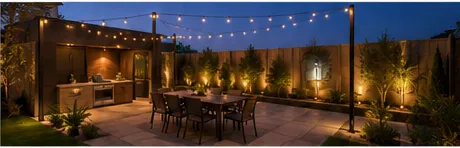
- Activity layer: Task light for outdoor kitchens, dining tables or work surfaces.
3. Match Light Output to the Task
Lumens measure the total visible light emitted by a source, but the amount of light reaching a surface depends on beam distribution, mounting height, distance and surrounding reflectance. A 200–300 lm wall fixture can therefore be perfectly appropriate for accent and orientation lighting even though it would be too low for a large work area.
The goal is not to make every outdoor surface equally bright. In fact, a visually interesting and comfortable exterior usually contains controlled contrast: the route is readable, the entrance is identifiable, and landscape features appear as selected highlights. Excessive uniform brightness can flatten the scene and increase glare.
4. Understand IP Ratings Before Installing Outdoors
Outdoor luminaires must tolerate environmental exposure. The IP Code is defined by IEC 60529 and classifies the degree of protection provided by an enclosure against access, solid foreign objects and water. An IP64 rating indicates a high level of protection against dust ingress and protection against water splashing from any direction under the standardized test conditions associated with the rating.
That does not mean every IP64 fixture is suitable for every possible location. Exposure under an open eave is different from a fixture close to irrigation spray, a coastal façade or a location where water can pool. Always follow the manufacturer’s installation instructions, local electrical requirements and any location-specific wet/damp rating requirements that apply in your market.
5. Solar Lighting Is a System, Not Just a Lamp
A solar luminaire links four elements: the photovoltaic panel, rechargeable battery, electronic controls and LED light source. Its nighttime performance depends on the energy collected during the day. Panel orientation, seasonal sun angle, shade from trees or eaves, dirt on the panel, ambient temperature and battery condition can all affect runtime.
The Xunlu outdoor wall light uses a built-in solar panel and automatic light sensor. That makes installation simpler because no mains wiring is required, but it also makes site selection more important. A visually ideal wall location is only a good solar-lighting location if the panel receives adequate daylight.
How to Site a Solar Wall Light
- Choose a wall with reliable direct or strong ambient daylight; avoid deep shade under dense trees or roof overhangs.
- Keep the solar panel clean so dust, pollen and debris do not reduce incident sunlight.
- Do not place the fixture where another bright light shines directly on its sensor at night, because this can interfere with automatic switching.
- Use multiple low-output fixtures for rhythm and wayfinding rather than expecting one small solar light to illuminate a large yard.
6. LEDs Reduce Energy Demand, but Controls Still Matter
Solid-state LED lighting has enabled major energy savings compared with older lighting technologies. U.S. Department of Energy guidance for exterior lighting also emphasizes luminaire efficacy—how much useful light output is produced per watt—and notes that advanced controls can further reduce energy and operating costs.
For residential outdoor lighting, the most efficient watt is the watt you never need to use. Timers, occupancy or motion sensing, and appropriate light levels reduce operating time and unnecessary brightness. Solar luminaires naturally shift part of the energy source away from the grid, while automatic controls help ensure the light operates primarily after dark.
7. Use Warm Light and Shielding to Reduce Nighttime Impact
Responsible outdoor lighting is not about eliminating exterior light. It is about controlling where, when and how much light is used. DarkSky’s five-principle framework is especially useful for residential design: light only when needed, aim it only where needed, keep levels no higher than necessary, use controls, and favor warmer light.
The practical design translation is simple: avoid bright upward-facing sources near the eye, avoid lighting large empty areas all night, and choose fixtures with good optical control. Warm 3000K wall light is a strong starting point for patios, entrances and façade lighting because it supports visual hierarchy without the stark appearance of high-CCT white light.
8. A Simple Outdoor Lighting Plan for a Modern Home
Front entrance — Use one or two shielded wall lights near the door. Keep the light warm and make sure the lock, threshold and first step are visible.
Side path — Use low-level path lights or carefully aimed wall lighting at turns and grade changes. Avoid a runway effect from overly dense spacing.
Patio — Create a soft ambient layer, then add brighter task lighting only over cooking or serving areas.
Feature wall — Use wall grazing or up/down effects to reveal texture, but check the beam from normal eye positions to prevent glare.
Garden — Highlight only a few plants or trees. Darkness between focal points creates depth and uses less energy.
Conclusion: Better Outdoor Lighting Is Controlled Lighting
The best outdoor lighting is rarely the brightest. It is the lighting that makes the route clear, the entrance welcoming and the architecture legible while leaving unnecessary areas dark. A warm, diffused, low-output wall luminaire can therefore be more successful than a higher-powered fixture when it is placed thoughtfully.
Xunlu Lighting’s Modern Outdoor Wall Light | Solar LED IP64 Wall Sconce is a useful example of that approach: 3000K warm-white LED light, moderate 200–300 lm output, solar power, automatic light sensing, a weather-protected IP64 enclosure and a diffuser designed for softer light distribution. For villas, garden paths, terraces and entrances, these features support a modern exterior lighting scheme that is practical, restrained and visually comfortable.