

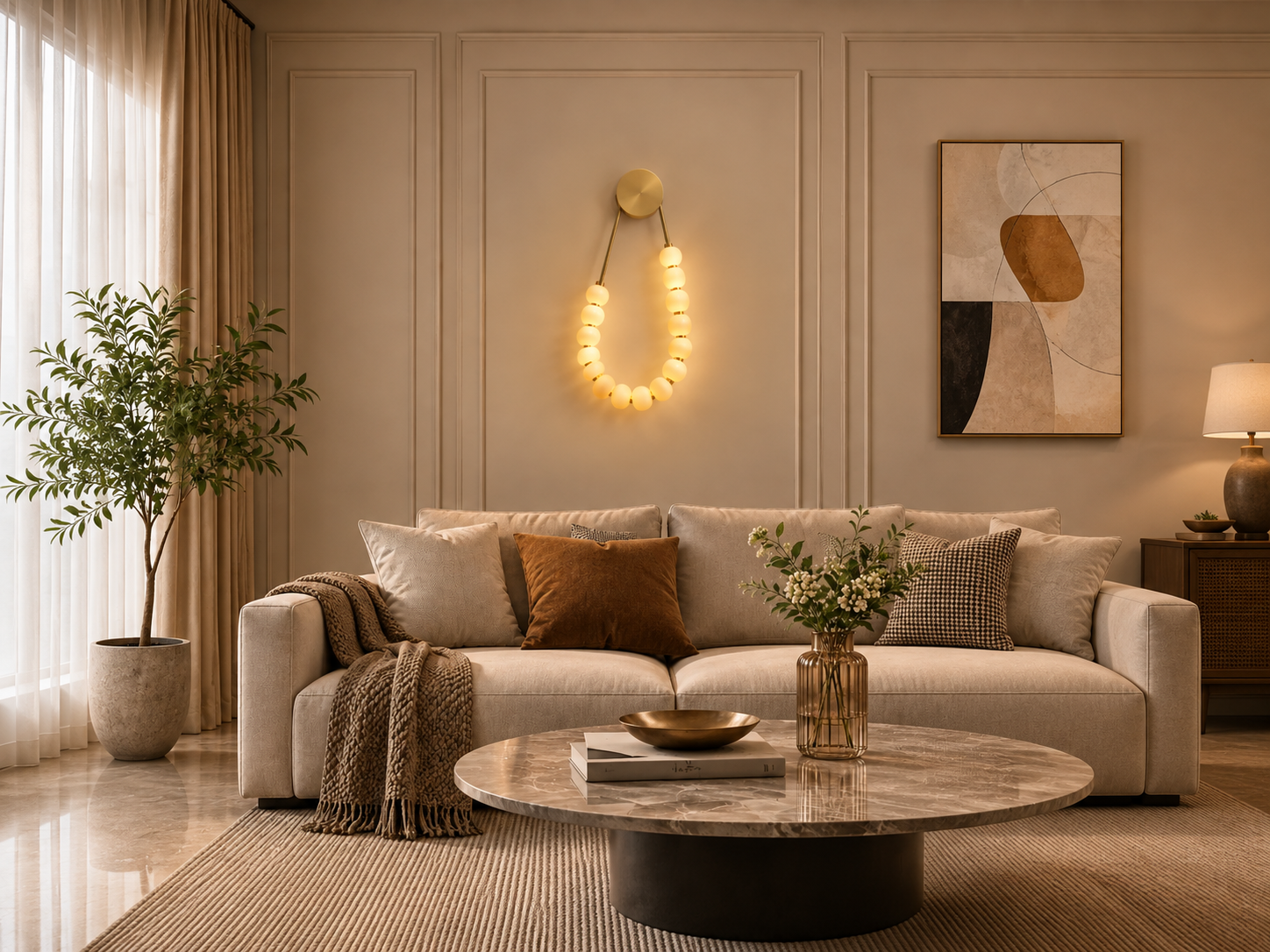

A science-informed guide to layered light, color temperature, visual comfort, and two sculptural Xunlu Lighting wall sconces.
Why Natural Stone Works So Well in Wall Lighting
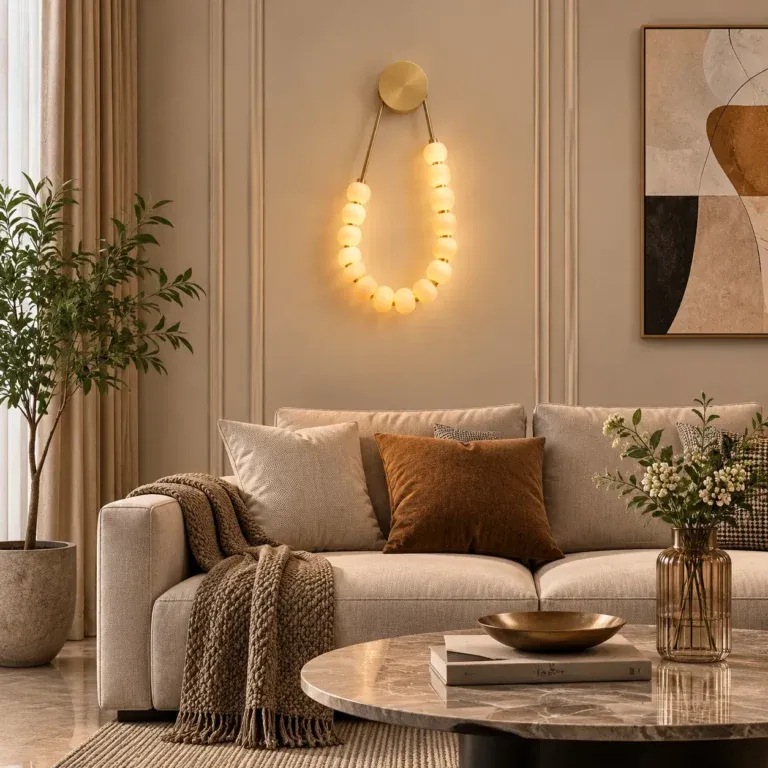
Wall lighting sits in a useful middle ground between decorative objects and functional illumination. Unlike a ceiling fixture, a wall sconce is viewed close to eye level, so its material, brightness, diffusion and placement strongly influence how comfortable a room feels. Natural stone is especially effective here because it adds visible texture while partially filtering and scattering light, turning the fixture itself into a glowing architectural feature.
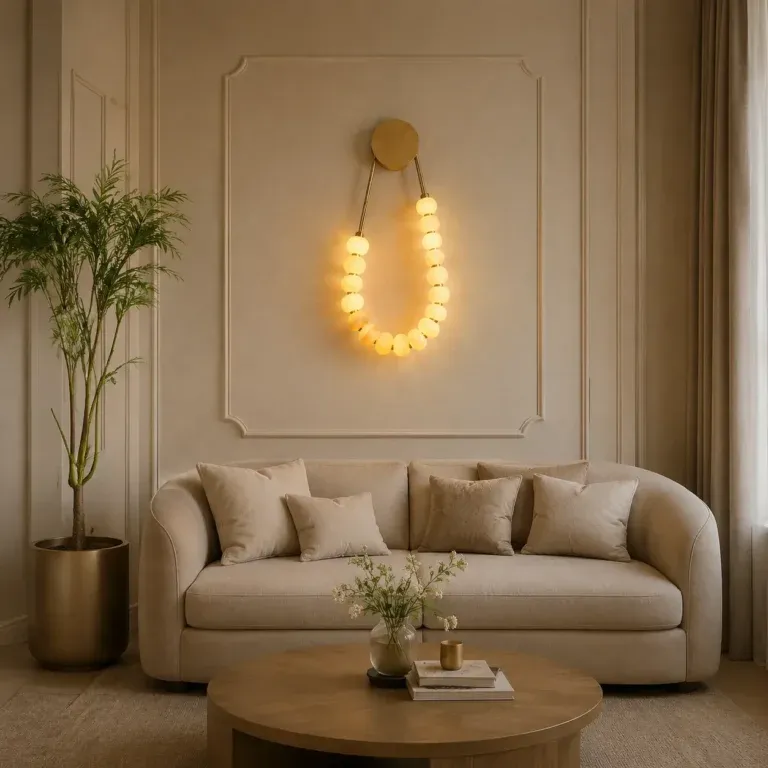
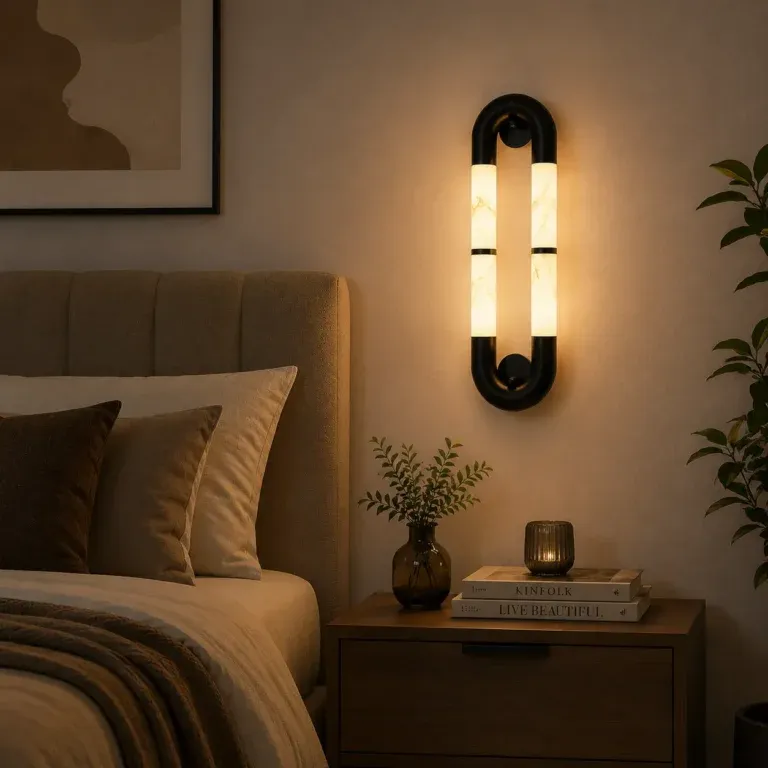
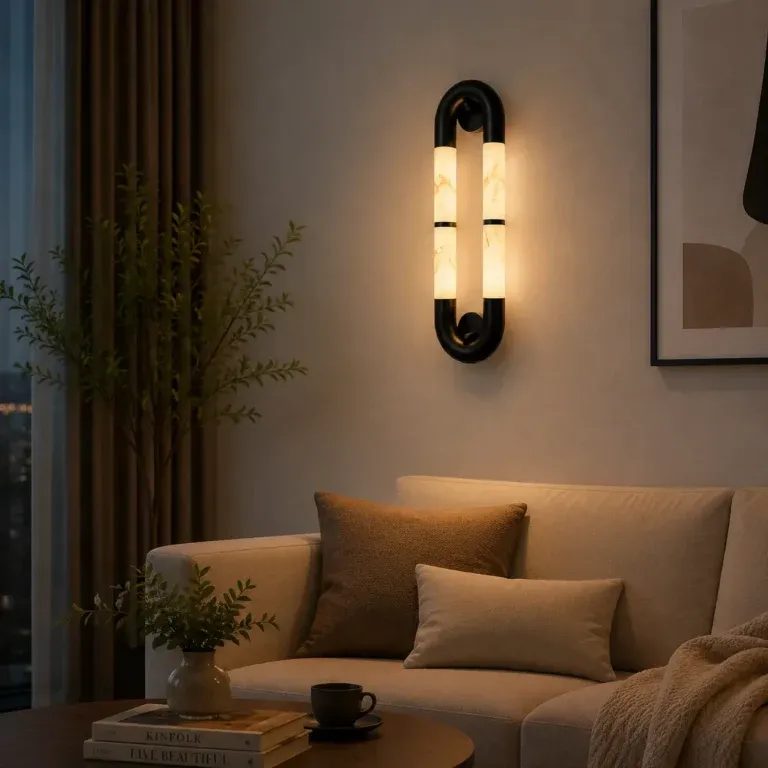
This article looks at two different interpretations of that idea from Xunlu Lighting: the Modern Marble LED Wall Light, built around a black titanium stainless-steel oval and natural marble diffuser, and the Luxury Brass Jade LED Wall Light, which combines brushed brass with translucent jade beads in a sculptural U-shaped form. They share the same design principle—natural material plus integrated LED—but they create very different visual moods.
The science behind a softer wall glow
Visual comfort is not determined by wattage alone. A bright source can feel harsh when its luminance is concentrated in a small visible area. Diffusers increase the apparent emitting area and soften contrast, while nearby walls become secondary reflecting surfaces. This is one reason a glowing stone wall sconce can feel calmer than an exposed point source even when total lumen output is similar.
For residential interiors, it is also useful to separate three lighting jobs: ambient light for orientation, task light for activities, and accent light for depth and visual hierarchy. A decorative wall sconce is usually strongest as ambient/accent lighting; it should complement, rather than replace, focused reading or work lighting.
Two natural materials, two distinct effects
| Design factor | Modern Marble LED Wall Light | Luxury Brass Jade LED Wall Light |
|---|---|---|
| Visual character | Architectural, graphic, tailored | Sculptural, organic, jewelry-like |
| Material expression | Cream marble texture + black titanium frame | Natural jade beads + brushed brass |
| Light output | Approx. 900–1000 lm | Approx. 1500–1800 lm |
| Power | 12W integrated LED | 24W integrated LUMILEDS LED strip |
| CCT | 3000K standard; 4000K / 6000K optional | 2700K / 4000K / 6000K adjustable |
| Best role | Bedroom, corridor, living-room accent | Statement wall, living room, dining/entry accent |
| Size | 20 × 60 cm | 35 × 8 × 72 cm |
The higher stated lumen output of the jade model makes it capable of contributing more general ambient light, but perceived brightness still depends on room size, wall reflectance, viewing angle and how much of the emitted light is absorbed by the stone. The marble model is lower-output and more restrained, making it especially suitable where the goal is visual depth rather than maximum illumination.
Color Temperature: Designing for the Time of Day
Correlated color temperature (CCT) describes whether white light appears visually warm or cool. It is not a direct measure of circadian impact, because spectrum and intensity matter too, but it is a useful design shorthand. The U.S. Department of Energy notes that CCT describes the color appearance of white light, while color fidelity describes how accurately objects appear under that source.
For evening relaxation, warmer settings are usually the more appropriate choice. Research on home lighting shows that evening light—especially light with greater short-wavelength content and higher melanopic stimulation—can suppress melatonin and influence sleep timing. A recent residential-lamp study found substantially lower estimated melatonin suppression for warm-white sources than for cool-white sources under its test conditions. That does not mean every 2700K lamp is automatically ‘sleep-safe’; brightness, exposure duration, distance and spectrum still matter.
Practical CCT guidance
• 2700K: best suited to bedrooms, evening living rooms and hospitality-style ambience.
• 3000K: warm but slightly cleaner; a versatile choice for contemporary living rooms and corridors.
• 4000K: useful where clearer visual definition is wanted, such as dressing, circulation or mixed-use spaces.
• 6000K: visually crisp and cool; better reserved for task-oriented moments rather than late-evening relaxation.
Color Rendering Matters More With Natural Materials
Stone, brass, timber, textiles and skin tones all depend on spectral quality for convincing color. The familiar CRI (Ra) metric estimates color shift relative to a reference source, but modern lighting science recognizes its limitations for LEDs. CIE now recommends broader fidelity approaches such as the CIE General Colour Fidelity Index (Rf), while the U.S. Department of Energy also points to TM-30 as a more detailed color-quality framework.
The practical takeaway is simple: when a wall light is used near artwork, premium fabrics, timber or natural stone, do not evaluate it only by watts and color temperature. Ask for color-rendering data as well. Xunlu describes the jade model as using high-CRI LED technology, which is relevant because jade and brass depend on subtle warm tones.
Placement: Where Wall Lights Feel Most Natural
1. Beside or above a sofa
A sculptural sconce can anchor an otherwise empty wall and create a vertical layer of light above seating. Keep the brightest part of the fixture outside the direct line of sight from normal seated positions. In a symmetrical room, one centered sconce can act like wall art; in a wider composition, a pair can frame a sofa or console.
2. At the bedside
Wall lights free the nightstand and reduce visual clutter. For pure ambience, place the luminous body slightly above eye level when sitting in bed. If reading is important, pair the decorative sconce with a directional task source rather than relying on diffuse wall light alone.
3. Hallways and entry walls
Vertical wall light increases the amount of visible illuminated surface, which can make circulation spaces feel less flat. Repeating fixtures at consistent spacing creates rhythm; a single high-character piece at the end of a corridor creates a destination point.
4. Dining rooms and hospitality spaces
Warm wall light can provide background brightness without competing with a pendant or chandelier over the table. In restaurants and hotels, this layered approach is useful because it supports facial modeling and material richness while keeping the ceiling visually quieter.
How to Layer These Sconces With Other Lights
A comfortable room usually benefits from multiple low-to-moderate brightness sources rather than one extremely bright source. A practical evening setup might combine:
• Ceiling or pendant light: dimmed general illumination.
• Stone wall sconce: ambient/accent glow at eye-level architecture.
• Table or floor lamp: localized light near seating.
• Directional reading light: only where a high-contrast task requires it.
This approach reduces the pressure on any single fixture to illuminate the entire room and gives users more control over brightness after sunset.
Product Specifications at a Glance
Modern Marble LED Wall Light | Luxury Wall Sconce
• 12W integrated LED; approx. 900–1000 lm
• 3000K warm white; 4000K and 6000K optional
• Stainless steel + natural marble diffuser
• Black titanium + cream marble finish
• 20 × 60 cm (7.87 × 23.62 in)
• Approx. 10 cm (3.94 in) projection from wall
Luxury Brass Jade LED Wall Light | Decorative Sconce
• 24W integrated LUMILEDS LED strip; approx. 1500–1800 lm
• Three-color adjustable: 2700K / 4000K / 6000K
• Solid brass / metal support + natural jade diffuser beads
• Brushed brass gold finish
• 35 × 8 × 72 cm (13.78 × 3.15 × 28.35 in)
• Approx. 12.5 cm (4.92 in) projection from wall
Which One Should You Choose?
Choose the marble wall light when you want a quieter, more architectural statement. Its black oval frame gives the eye a strong outline, while the marble introduces a controlled, softly luminous center. It suits modern bedrooms, sophisticated corridors and living rooms with darker metal details.
Choose the brass jade wall light when the wall itself should become a focal point. The larger scale, warm brass and bead-like stone composition make it more decorative and more expressive. Its adjustable CCT also makes it easier to shift the mood between warm evening ambience and brighter daytime use.
In both cases, the most successful result comes from treating the sconce as one layer in a complete lighting plan—balancing brightness, color temperature, material reflectance and viewing angle.
Final Thoughts
Natural stone wall lighting is effective because it combines two kinds of value at once: illumination and material presence. Marble feels architectural and calm; jade feels organic and jewel-like. When paired with modern LED technology, both can create a softer vertical glow, add depth to walls and help a room feel more considered after dark.
For homeowners and designers, the key is not simply to choose the brightest fixture. Start with the atmosphere you want, then consider lumen output, color temperature, color quality and placement. A well-chosen wall sconce should look beautiful when it is off—and make the entire room feel better when it is on.