

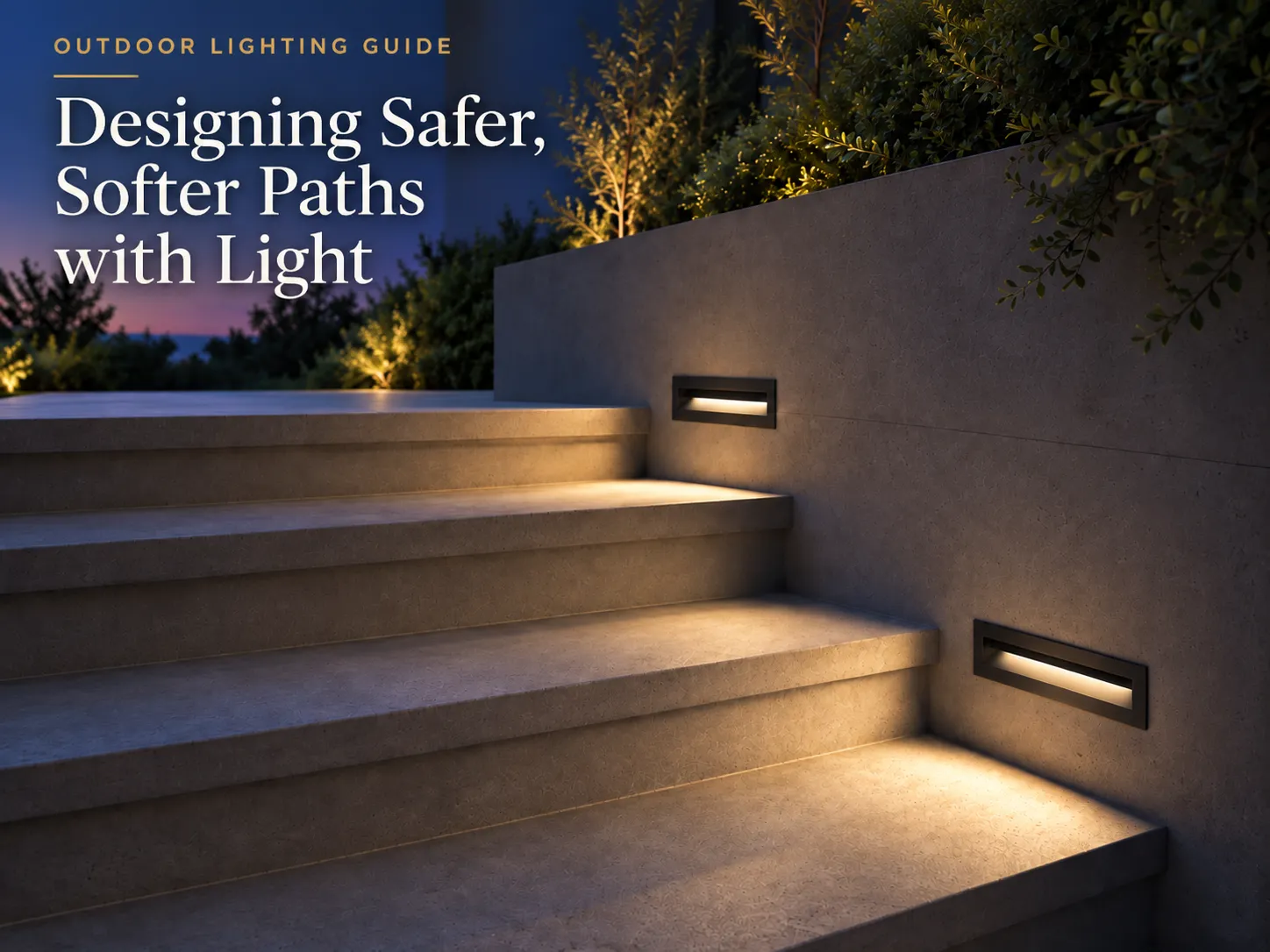

A Science-Based Guide to Recessed LED Step Lighting for Stairs, Corridors, and Outdoor Transitions
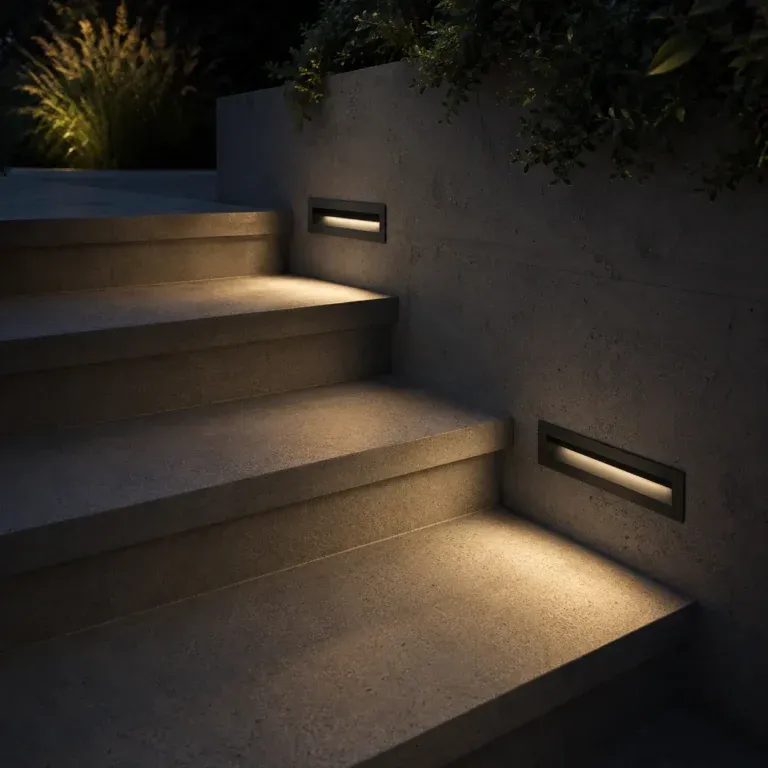
Small Fixtures, Important Visual Work
Step lighting is easy to overlook because the fixtures are small and mounted close to the floor. Yet this layer of light has a focused job: it helps people read changes in level, understand direction, and move through transitional spaces without flooding the entire environment with overhead light.
The 3W LED Recessed Step Light uses a slim rectangular aperture, matte-black aluminum body, integrated LED source, and PC/acrylic optical cover. According to the product page, the standard configuration is 4000K natural white with an approximate output of 180–240 lumens. The recessed construction allows the light to feel integrated into the wall rather than added on afterward.
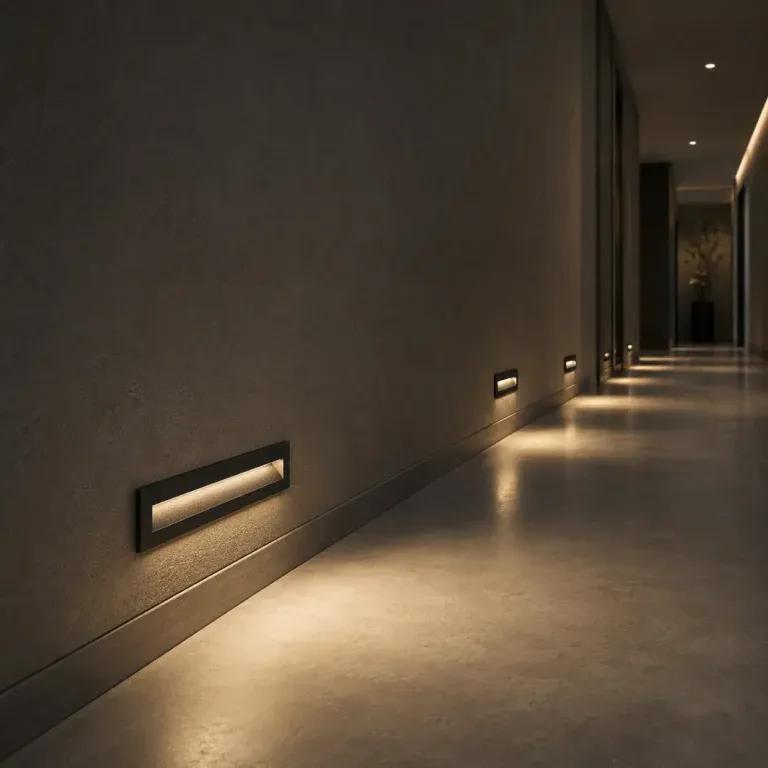
The strongest installations are not simply bright. They are balanced. They reveal the floor, tread, or edge that matters while keeping the luminous opening outside the most common line of sight. This is why fixture height, spacing, beam direction, wall finish, and surrounding darkness must be considered together.
The Science of Visibility: Contrast, Direction, and Glare
Enough light must reach the walking surface, but illuminance alone does not describe visual quality. CIE guidance notes that visibility also depends on how light is delivered, the color properties of light and surfaces, and glare. For stair and corridor lighting, the practical goal is to reveal geometry without creating a distracting bright source.
1. Reveal the horizontal surface
A recessed wall light should throw useful light across the tread, landing, or adjacent floor. Grazing light creates a visible transition between riser and tread and can strengthen texture. If the fixture is too high or aimed too far outward, the beam may miss the critical surface. If it is too low or obstructed, shoes, furniture, planting, or accumulated debris may block it.
2. Keep the source away from direct view
Discomfort glare is influenced by source luminance, size, position, background brightness, and the viewer’s adaptation. Shielding the LED behind a diffuser and downward-directed aperture helps, but the installation still needs to be checked from both directions of travel, from nearby seating, and from the top and bottom of a staircase.
3. Build a rhythm, not a row of bright dots
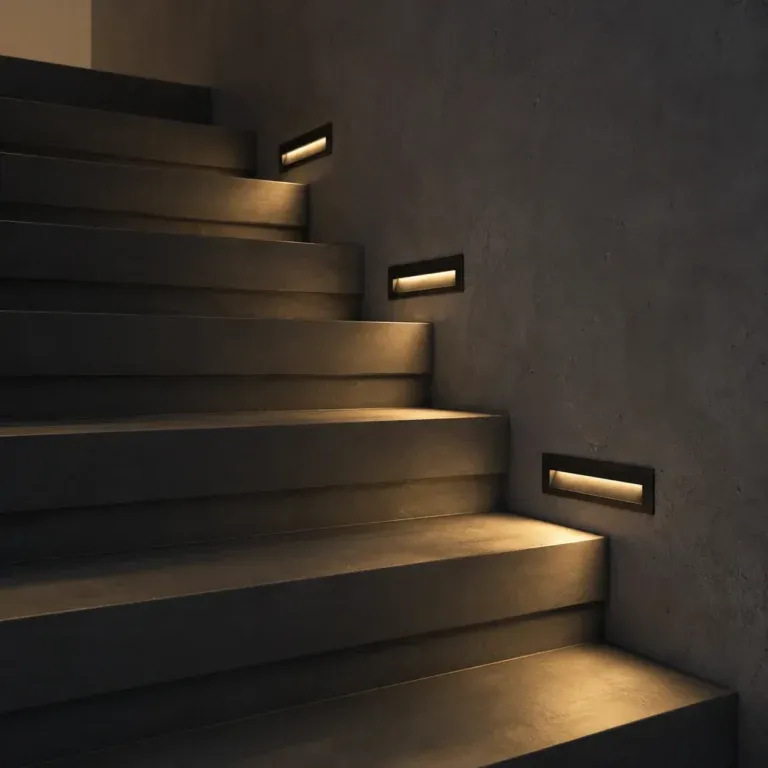
Repeated step lights can communicate direction and pace. Regular spacing often feels calm, while irregular spacing should follow genuine changes in geometry such as landings, turns, or doorways. The objective is a readable pattern of illuminated surfaces—not visual clutter from exposed luminaires.
Why 3W Can Be Useful in a Layered Scheme
A 3W luminaire is intended for localized guidance and accent illumination, not for replacing the principal lighting of an entire room. Its effectiveness comes from proximity: the light is placed close to the surface that needs to be seen. This can reduce the need to raise general ambient light solely to make a circulation edge visible.
The published output range of approximately 180–240 lumens is a product-level value, not a guarantee of illuminance on a stair tread. Delivered light depends on optical distribution, mounting height, spacing, wall reflectance, dirt, voltage, and the geometry of the installation. When compliance or exact performance matters, request photometric data and calculate or test the actual project.
Understanding the 4000K option
The product page lists 4000K natural white. This neutral appearance can help concrete, stone, gray plaster, and architectural edges read clearly. In hospitality or residential settings, however, it should be coordinated with nearby lighting. A neutral step light beside very warm 2700K decorative lighting can look disconnected; a consistent or deliberately graduated palette usually feels more coherent.
The scene images appear warm because perception is affected by camera processing, surrounding materials, brightness, and display settings. Final color should be judged from the specified product sample rather than from an online image alone.
Light only when and where it is useful
Controls can improve both experience and energy use. Depending on the project, step lights may be switched with the main circulation lighting, dimmed after peak hours, or activated by an appropriate occupancy or time control. Any control must be compatible with the driver and must not undermine required emergency or code-mandated lighting.
Indoor Applications
Residential stairs
Place fixtures where they reveal the walking line and changes in level. Check that the pattern remains understandable when approached from either direction. In open-riser, curved, or unusually wide stairs, one standard spacing rule may not be enough; mock up representative positions before the wall is finished.
Hallways and circulation zones
A sequence of low-mounted luminaires can create a clear nighttime route without turning on a bright ceiling grid. Maintain enough background light to avoid extreme contrast and use the rhythm to reinforce doors, intersections, and changes in direction.
Bedrooms and hotel rooms
Near a bedroom, low-level lighting should be visually quiet. Avoid placing a bright aperture opposite the bed or mirror, and confirm the source is not intrusive from a reclined viewpoint. Dimming or carefully selected switching can make the lighting more adaptable after dark.
Interior design integration
The matte-black frame pairs naturally with concrete, charcoal plaster, dark timber, bronze details, and minimalist joinery. In lighter interiors, the black aperture becomes a graphic accent; repeat the finish sparingly in hardware or trim so it feels intentional.
Outdoor Steps, Garden Paths, and IP65
The product is listed with IP65 protection and an aluminum body, making it suitable for appropriate indoor and outdoor applications. Under IEC 60529, an IP rating classifies the degree of protection provided by an enclosure. It does not by itself certify the quality of the complete installation, the junction box, cable entry, wall penetration, drainage, or local wiring method.
What IP65 does—and does not—mean
- The first digit indicates a high level of protection against access and dust ingress; the second digit addresses water-jet exposure under defined test conditions.
- IP65 is not a submersion rating. Do not locate the fitting where water can pool around it or where it will be continuously underwater.
- The surrounding construction still needs suitable sealing, drainage, corrosion consideration, and a weather-appropriate electrical connection.
- Outdoor suitability must be assessed for the complete product option, local climate, installation orientation, and applicable electrical rules.
Important voltage check
The published specification is AC 220–240V. Before purchase, confirm that the exact model matches the supply voltage and regulatory requirements of the destination market. This is especially important for 120V markets. Recessed mains-voltage work should be planned and completed by a qualified electrician in accordance with local codes and manufacturer instructions.
Product Snapshot
| Attribute | Published product information |
|---|---|
| Product type | Recessed LED step light / linear stair wall light |
| Construction | Aluminum body; PC diffuser / acrylic optical cover |
| Finish | Matte black |
| Light source | Integrated LED, 3W |
| Published output | Approximately 180–240 lm |
| Published CCT | 4000K natural white |
| Published voltage | AC 220–240V |
| Protection | IP65 enclosure rating |
| Installation | Recessed / built-in; cut-out and wall cavity required |
| Applications | Indoor stairs, corridors, entrances, outdoor steps, pathways, and villa walls |
Installation planning checklist
- Confirm supply voltage, local certification needs, driver/control compatibility, and the exact product option.
- Coordinate the published 195 × 42 mm cut-out and approximately 45 mm depth with the wall build-up before finishing work.
- Plan cable routes, junctions, waterproofing, and service access before closing the wall.
- Mock up mounting height and beam direction on a representative tread or corridor surface.
- View the mock-up from both directions of travel and from nearby seated or resting positions.
- Keep fittings away from standing water, impact zones, and locations where landscaping or furniture will block the beam.
- Use the required number of fixtures based on geometry and performance—not simply a decorative spacing pattern.
- Have installation and final testing completed by a qualified professional under applicable local codes.
A Better Way to Think About Step Lighting
The best step-lighting scheme is almost invisible as equipment and immediately legible as light. It makes the floor plane readable, communicates a route, and reduces dependence on a single bright overhead layer. The 3W recessed format supports this approach because it places modest light close to the surface and keeps the architectural profile slim.
Success still depends on design judgment. The same fitting can feel calm or glaring, useful or decorative, depending on height, orientation, spacing, surrounding luminance, and construction detail. Treat the fixture, wall, tread, control system, and observer as one visual system, then verify the result in the real space.
3W LED Recessed Step Light – Click to view the product