

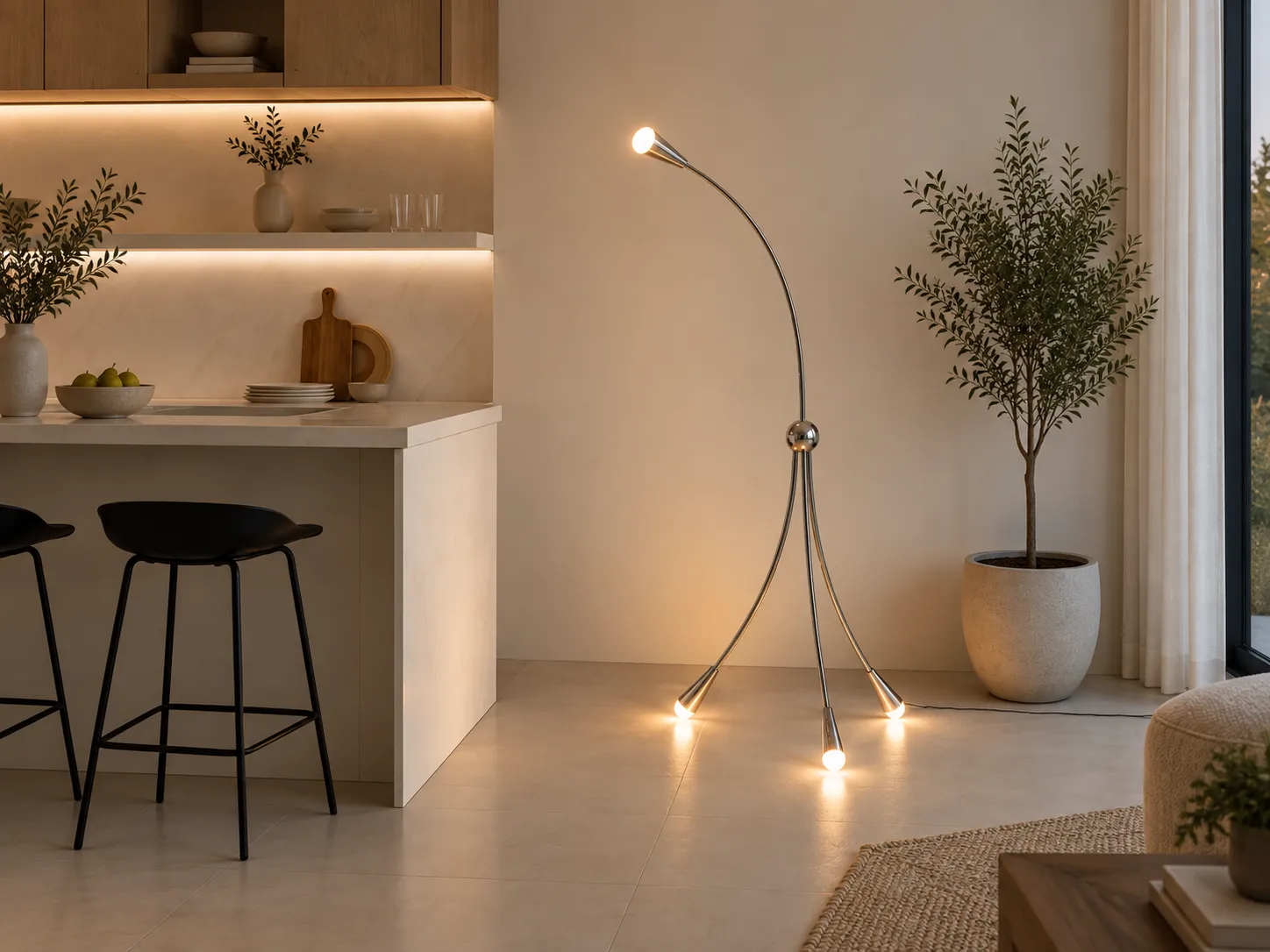

How a Modern Arc LED Floor Lamp Builds Warmth, Depth, and Visual Comfort
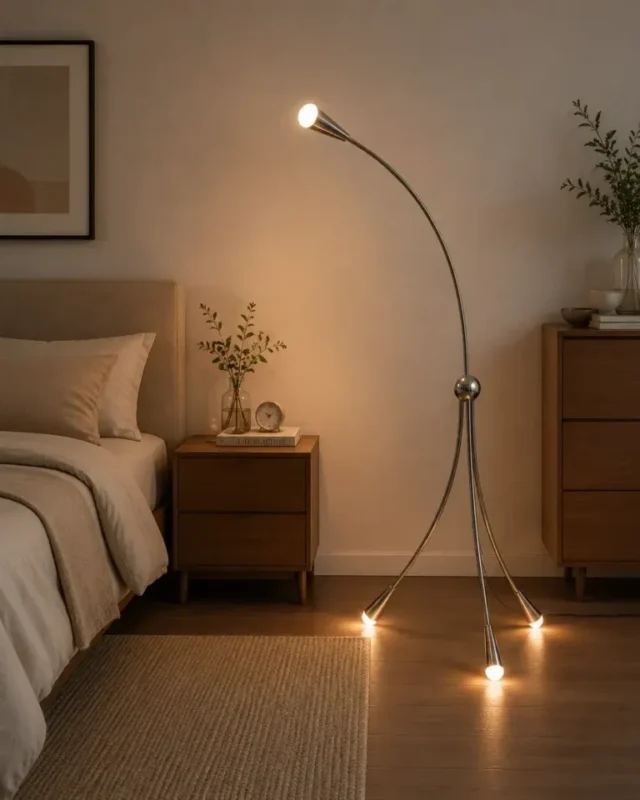
A Floor Lamp That Behaves Like Architecture
A well-designed floor lamp does more than brighten a dark corner. It changes how the eye reads height, depth, circulation, and balance. The Modern Arc LED Floor Lamp uses a sweeping upper arm, polished chrome surfaces, and three illuminated support points near the floor to create a silhouette that is part luminaire and part sculpture.
The product page describes a metal and aluminum-alloy body, an acrylic diffuser with an integrated LED optical lens, a 3000K warm-white option, and a floor-standing structure approximately 150 cm high. Its form makes it especially useful where a room needs an architectural focal point but a pendant or wall light is impractical.
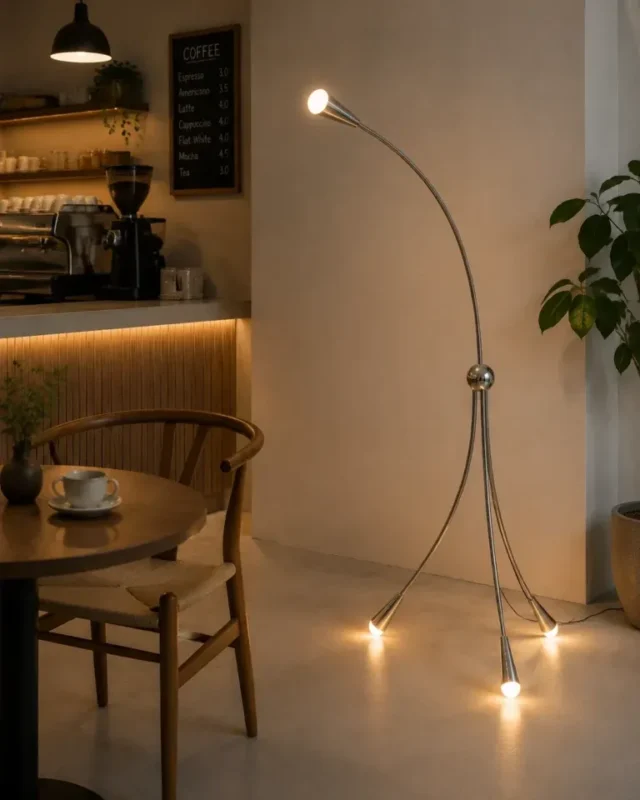
The most convincing interiors rarely depend on a single central fixture. They use layers: ambient light for orientation, task light for seeing detail, and accent light for hierarchy and atmosphere. A sculptural floor lamp can contribute to the ambient and accent layers at the same time, while remaining movable and easy to add after the main electrical work is complete.
The Science Behind Softer, More Comfortable Light
1. Brightness is not the same as comfort
Visual comfort depends on luminance relationships, source visibility, direction, contrast, and the task being performed—not only on total lumen output. A bright point source inside a dim field of view can feel harsh because the eye must adapt across a large contrast range. Diffusers and optical lenses help by spreading emitted light over a larger apparent area, reducing the intensity of the visible hot spot. The lamp’s acrylic diffuser is therefore an important part of its visual character, not merely a decorative cover.
Even with diffusion, placement matters. Avoid aiming the upper light directly into the normal seated line of sight. A slight turn toward a wall or adjacent surface can produce gentler reflected light and improve the balance between the lamp and its background.
2. Warm light supports an evening atmosphere
The specified 3000K option is a practical choice for living rooms, bedrooms, lounges, and hospitality settings because it visually reinforces warm materials such as oak, walnut, beige textiles, leather, and bronze. Color temperature should still be coordinated with the rest of the room; mixing very cool overhead light with a warm floor lamp can make the scene feel visually fragmented.
The CIE emphasizes that the biological response to light depends on timing, intensity, duration, spectrum, and personal context. For evenings, a sensible design approach is to use only as much light as the activity requires, keep sources comfortable, and dim them when possible rather than treating color temperature alone as a health guarantee.
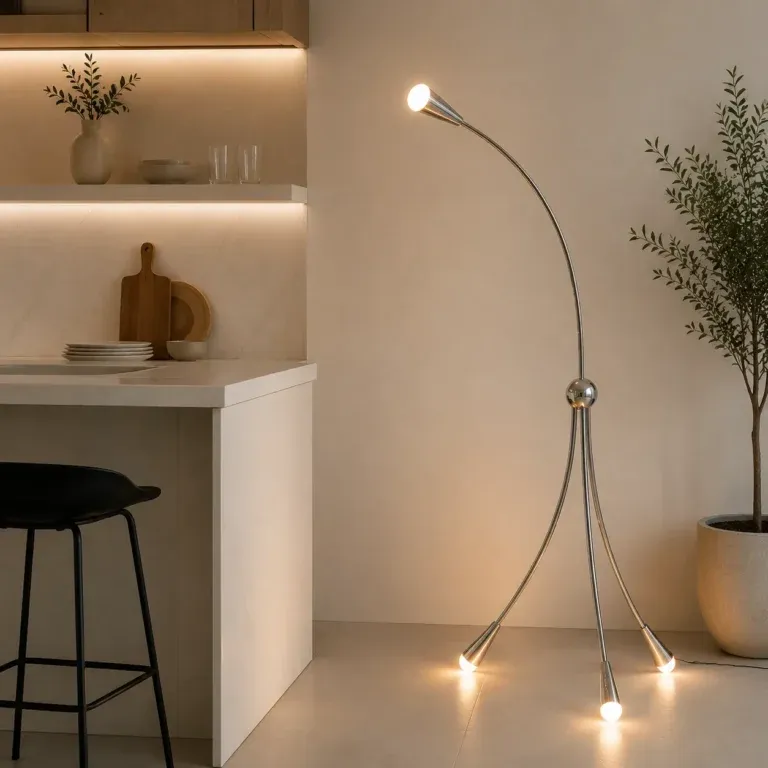
Why the Arc Form Changes the Room
A conventional floor lamp usually reads as a vertical object with a shade at the top. An arc lamp reaches outward. That horizontal reach places light nearer to seating, a side table, or an architectural corner while the base remains outside the main activity zone. It can provide some of the visual effect of an overhead fixture without a ceiling junction box.
This particular design adds a second gesture: three slim lower supports terminate in illuminated points. The result is a triangular footprint and a low-level glow that visually connects the lamp to the floor plane. The upper curve draws the eye upward, while the illuminated feet pull attention back down. That top-to-bottom movement helps a tall blank wall feel intentional rather than empty.
Three useful design effects
- Vertical emphasis: the 150 cm profile makes low furniture arrangements feel more balanced and gives a bare corner a stronger sense of height.
- Controlled asymmetry: the off-center upper arc introduces movement, which works well beside rectilinear sofas, beds, cabinets, and kitchen islands.
- Reflective contrast: chrome can echo daylight, glass, polished stone, or stainless steel while standing apart from matte plaster, timber, and textiles.
The lamp should not be expected to replace every layer of room lighting. Its published output range of approximately 800–1500 lumens may support ambient use, but reading comfort and perceived brightness will vary with the selected version, dimming level, distance, surfaces, and surrounding light. For demanding visual tasks, pair it with dedicated task lighting and evaluate the actual scene.
Room-by-Room Placement Guide
Living room
Place the base beside or slightly behind the sofa so the arc enters the seating composition without crossing a walkway. The product page recommends roughly 20–50 cm from the wall; the exact position should also keep the approximately 65 cm base width clear of foot traffic. Aim the upper head toward a wall, coffee-table zone, or reading seat instead of directly toward viewers.
Bedroom
Use it as an atmospheric counterpoint to lower bedside lamps. The warm 3000K setting can support a calmer evening scene, while the sculptural frame fills vertical space beside a dresser or bed. Keep the cable routed behind furniture or along the wall, and position the lit feet where they will not become a nighttime trip hazard.Kitchen and open-plan dining area
In an open-plan room, the lamp can mark the transition between the kitchen and an adjacent dining or lounge area. Keep it away from wet zones and food-preparation traffic. Its warm light can soften hard finishes after brighter work lighting is reduced in the evening.
Café, hotel, and boutique interior
Use one lamp to define a waiting area, intimate table, quiet corner, or circulation pause. Repetition can be effective in larger projects, but spacing should preserve each lamp’s silhouette. For commercial installations, confirm local electrical, accessibility, stability, and fire-safety requirements before specification.
Styling the Chrome Finish
Chrome is visually active because it reflects surrounding colors and highlights. The finish can look crisp and futuristic in a monochrome interior, but it can also feel warm when it reflects timber, terracotta, beige plaster, and 3000K light. The easiest way to integrate it is to repeat one or two related details elsewhere—cabinet hardware, a mirror edge, a stainless appliance, or a small polished accessory—without turning every surface reflective.
Material pairings that work
Warm woods and linen: The contrast between polished metal and tactile natural materials keeps the room from feeling cold.
Stone and microcement: A restrained mineral background makes the curved silhouette and localized glow more legible.
Smoked or clear glass: Glass repeats the lamp’s sense of lightness without competing with the slender metal frame.
Deep matte colors: Charcoal, olive, espresso, or warm gray can strengthen reflections and make the illuminated points appear more dramatic.
Product Snapshot
| Attribute | Published product information |
|---|---|
| Construction | Metal + aluminum alloy; acrylic diffuser and integrated LED lens |
| Finish | Chrome silver electroplated finish |
| Lighting | Integrated LED; 12–20W; approximately 800–1500 lm |
| Color temperature | 3000K standard; 3000K / 4000K / 6000K options listed |
| Controls | Foot switch; optional touch dimmer, remote, or smart control |
| Approximate dimensions | 150 cm high; 100 cm maximum arm span; 65 cm base width |
| Suggested applications | Living room, bedroom, lounge, hotel, café, and showroom |
A Practical Setup Checklist
- Measure the full footprint before purchase, including the 100 cm arm reach and approximately 65 cm base width.
- Choose a position where the arc does not project into a primary walkway or doorway.
- Use the intended voltage and verify the plug, driver, control, and dimming option for the destination market before ordering.
- Place the cable along a wall or under an appropriate cable-management solution; never create a loose crossing path.
- Test the lamp from normal seated and standing viewpoints, then rotate or dim it if the visible source causes discomfort.
- Coordinate color temperature with neighboring luminaires; reserve cooler settings for contexts that genuinely need them.
- Clean the chrome with a soft, non-abrasive cloth and follow the manufacturer’s care instructions for the diffuser and electrical parts.
What to Confirm Before Ordering
Because the product page lists optional color temperatures and optional controls, confirm the exact configuration at checkout or with the supplier. Also verify local plug type, voltage, dimming compatibility, cable routing, and any project-specific compliance requirements. Published dimensions and output values are approximate; designers should use a sample or photometric data when a precise lighting calculation is required.
Conclusion: Let the Lamp Shape the Composition
The Modern Arc LED Floor Lamp succeeds when it is treated as part of the room’s composition rather than as a last-minute source of brightness. Its high arc gives the eye a vertical path, its low illuminated supports ground the form, and its warm diffused light can soften the transition between furniture and architecture. Positioned carefully, it can make an empty corner feel purposeful, add intimacy to hospitality spaces, and bring a sculptural identity to everyday ambient lighting.
Modern Arc LED Floor Lamp—Click to view the product