


A practical design guide to natural marble, layered lighting, color temperature, and room-by-room styling
Natural stone and precision lighting can make a striking partnership. A thin disc of marble adds texture and visual calm, while an integrated LED provides a focused, contemporary glow. This guide explores why the combination works, where it fits best, and how to specify it responsibly.
Why a marble disc feels both modern and timeless
Marble is geologically distinctive: variations in mineral content, veining and thickness create visible differences between individual pieces. Against the pendant’s pearl-black and antique-brass details, the pale stone reads as a sculptural plane rather than a traditional lampshade. Its compact circular silhouette suits modern minimalism, quiet luxury and wabi-sabi-inspired schemes without requiring ornate decoration.
The xunlulighting Modern Marble Pendant Light combines a natural marble disc with an aluminum-alloy structure and a 12W integrated LED. According to the product listing, the disc is approximately 20 cm (7.9 in) in diameter and the overall product height is 7.5 cm (3.0 in). The adjustable suspension cable extends up to 200 cm (78.7 in).
The optical science: what natural stone really does to light
Light striking stone may be reflected, absorbed or transmitted, depending on the stone’s composition, thickness, finish and the geometry of the LED. Some thinner marble sections reveal a gentle translucent appearance; however, not every marble slab transmits light in the same way. Avoid assuming the entire disc glows uniformly. The warm pool visible under this style of pendant also depends on its directional LED source and reflector geometry.
For accurate expectations, assess the lamp both switched on and off. Stone appearance changes with daylight and adjacent materials, while polished nearby surfaces may increase perceived brightness through reflection. A visual mock-up is especially useful when a fixture is being installed above highly reflective stone countertops or close to eye level.
Choose the color temperature for the activity
The product page lists three selectable correlated color temperatures (CCT): 3000K, 4000K and 6000K. Kelvin describes the color appearance of white light, not its brightness. A 3000K setting generally appears warmer and is well suited to relaxed evenings; 4000K looks more neutral for shared work or preparation; 6000K appears cooler and can be useful when a crisp visual impression is desired. The U.S. Department of Energy describes 2700–3000K as warm/soft, 3500–4100K as cool/bright, and 5000–6500K as blue-white/daylight-like.
Unlike color temperature, lumens quantify visible light output. The listed output of approximately 900–1100 lumens is a manufacturer-stated range rather than an independently verified measurement. Actual illumination at a desk or kitchen worktop depends on mounting height, beam spread, surface reflectance and surrounding light.
Room-by-room styling ideas
1. Home office: sculptural ambient light with a separate task lamp
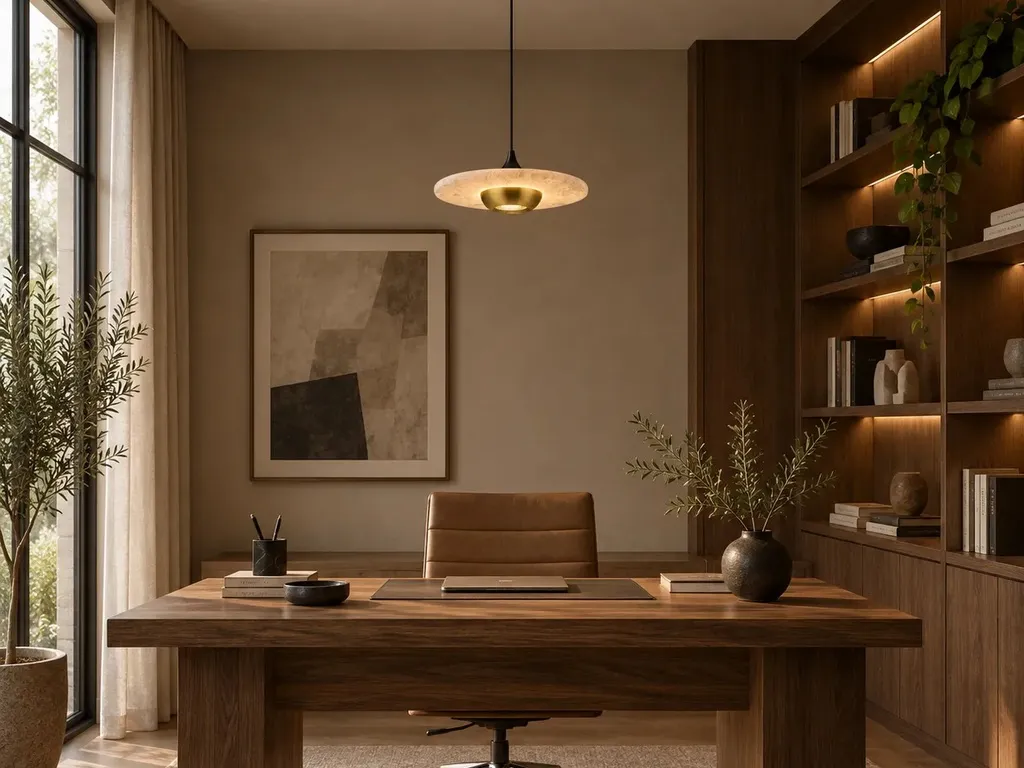
Suspended above or near a desk, the shallow marble disc introduces a soft material contrast to timber cabinetry and textured walls. It should not be assumed to replace a dedicated adjustable desk lamp for reading and fine-detail work. The Illuminating Engineering Society defines task-ambient lighting as the combination of general illumination with separate task illumination — a useful principle for reducing unnecessary brightness across the whole room.

2. Bedroom: low visual clutter and a warm evening setting
For a bedside location, a single small pendant can release surface space otherwise occupied by a table lamp. A 3000K setting can offer a softer evening impression, but comfort also depends on where the bright element sits in the viewer’s line of sight. Position the pendant so occupants do not look straight into the LED when reclining. Use separate focused lighting where regular bedtime reading demands it.

3. Kitchen island: a focal point, not the only work light
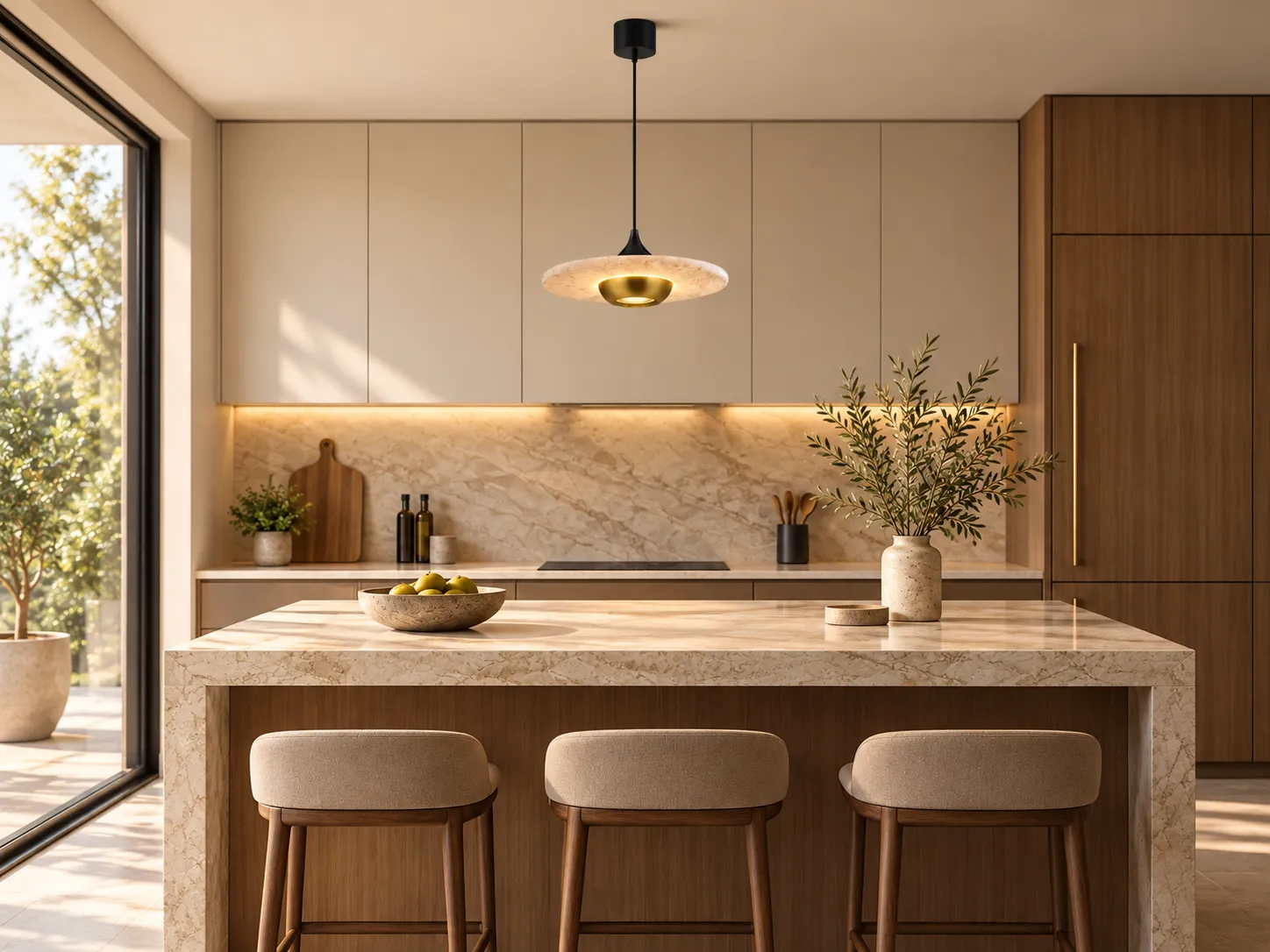
One disc can act as an accent over a small island; larger islands may need multiple fixtures arranged with consistent spacing. Avoid relying solely on decorative pendants for chopping and cooking, where shadows from the body and cabinets can interfere with visibility. Under-cabinet or ceiling task lighting can support the pendant and illuminate preparation surfaces more evenly.

Sizing and placement: practical checkpoints
Before ordering, record the ceiling height, work-surface height, desired bottom-of-fixture height and any walking paths below. Above kitchen islands, designers often begin by testing a bottom-of-pendant clearance around 75–90 cm (30–36 in) above the counter; this is a starting point, not a universal safety rule. Over bedside tables, prioritize clear sightlines and headroom. Confirm cable adjustability, ceiling junction-box support and site-specific electrical requirements with the installer.
For an especially small 20 cm disc, the perceived scale is subtle. Two or three units can create rhythm across a longer surface, but spacing should be tested against the island width, seating positions and the fixture’s light distribution. The product listing recommends approximately 50–80 cm from the wall; project geometry may justify a different layout.
Product specifications at a glance
| Construction | Natural marble + aluminum alloy + integrated LED |
| Finish | Pearl black + antique brass |
| Light source | 1 × 12W integrated LED |
| Color temperature | 3000K / 4000K / 6000K selectable |
| Output | Approx. 900–1100 lm (supplier stated) |
| Disc diameter | 20 cm / 7.9 in |
| Overall height | 7.5 cm / 3.0 in |
| Suspension | Adjustable cable up to 200 cm / 78.7 in |
| Voltage | 110–240V (supplier stated) |
| Net weight | Approx. 1.6–2.0 kg |
Specifications are transcribed from the current product listing; verify the chosen variant, CCT switching method, dimming compatibility, certification and installation hardware before purchase.
Care, installation and long-term enjoyment
Use a qualified electrician for mains wiring and mounting. Switch off power and allow the fixture to cool before cleaning. A soft, dry microfiber cloth is the safest starting point for the stone disc; avoid acidic or abrasive cleaners because natural calcite-based marbles can etch. Do not spray cleaner directly toward the integrated LED or electrical openings. Always follow the manufacturer’s instructions and the stone finish recommendations provided with the fixture.
Frequently asked questions
Will every natural marble disc look identical?
No. Veining, shade and transmission can vary by piece. This variation is a material characteristic rather than a promise of identical appearance.
Does 6000K produce more lumens than 3000K?
Not necessarily. CCT is color appearance; brightness is described separately by lumens and illuminance. Check photometric data for each mode if exact performance matters.
Is one pendant sufficient to light an entire kitchen?
It depends on area and task needs. A layered scheme with ambient and localized task sources is generally more versatile than relying on one decorative fixture.
Bring sculptural stone lighting into your space
The Modern Marble Pendant Light is especially compelling when treated as a small architectural accent: a refined stone circle, a neat metallic core and a calm relationship with surrounding wood, plaster and natural textiles. Pair it with task illumination where needed, select the CCT to suit how the room is used, and place it where the disc can be enjoyed without unwanted glare.
Modern Marble Pendant Light-Click to view the product