


How Natural Materials, Warm Light and Linear Composition Create a More Inviting Interior
Product reference: Rustic Wooden Beam Linear Pendant Chandelier with Rope
A Statement Light That Works Through Material Contrast
Rustic interiors are often described as warm or natural, but the strongest rooms do more than repeat wood tones. They create contrast: rough and smooth, dark and light, linear and organic, decorative and functional. The Rustic Wooden Beam Linear Pendant Chandelier with Rope uses that contrast as its design language. A horizontal timber beam establishes visual order, rope introduces texture and craft, black metal lantern cages add structure, and multiple pendant points distribute warm light across a longer surface such as a dining table, bar counter or kitchen island.
The result is not simply a farmhouse chandelier. In the right setting, the fixture becomes an architectural layer that helps define a zone within an open-plan interior. Because the body is linear, it naturally relates to rectangular tables and counters. Because the lamps are suspended at several points, the eye reads the composition rhythmically rather than as one concentrated glowing object. And because the materials have different tactile qualities, the fixture still feels visually rich even when the surrounding room uses a restrained palette.
This article explains how to use that design effectively, how to select lamp color and quality, how to manage glare, why dimming matters, and how the fixture can support both residential and hospitality lighting. Technical guidance is based on established lighting resources from the U.S. Department of Energy (DOE), the International Commission on Illumination (CIE), and the Illuminating Engineering Society (IES). Where a choice depends on a specific lamp or installation, the recommendation is presented as a design target rather than as a fixed rule.
Design note
The trailing greenery shown in the lifestyle photography is a styling treatment. If plants or decorative foliage are added to a real installation, keep them clear of hot surfaces, electrical connections and lamp envelopes, and follow the luminaire and lamp manufacturers’ safety instructions.
1. Reading the Design: Why the Linear Beam Works
The beam is the dominant visual element because it establishes proportion before the lights are even switched on. A long horizontal form echoes the geometry of a dining table or bar, making the fixture feel intentional rather than centered arbitrarily within the room. This is especially useful in open-plan homes where furniture, not walls, often defines the dining zone.
Rope softens the hard geometry. Its fibers add shadow, irregularity and a handmade character that contrasts with the straight beam and metal cages. The black metal parts then act as visual punctuation: they keep the composition from becoming overly soft or themed. In contemporary farmhouse, industrial-rustic and modern lodge interiors, this combination lets the fixture connect traditional materials with cleaner modern furniture.
The multiple pendant drops also help break a long beam into smaller visual intervals. That rhythm matters. A single source in the center of a long table can create a bright center and dim ends; several sources can distribute light more evenly, provided the lamp output and spacing are appropriate. The goal is not to eliminate contrast, but to keep the table visually legible without producing distracting hot spots.

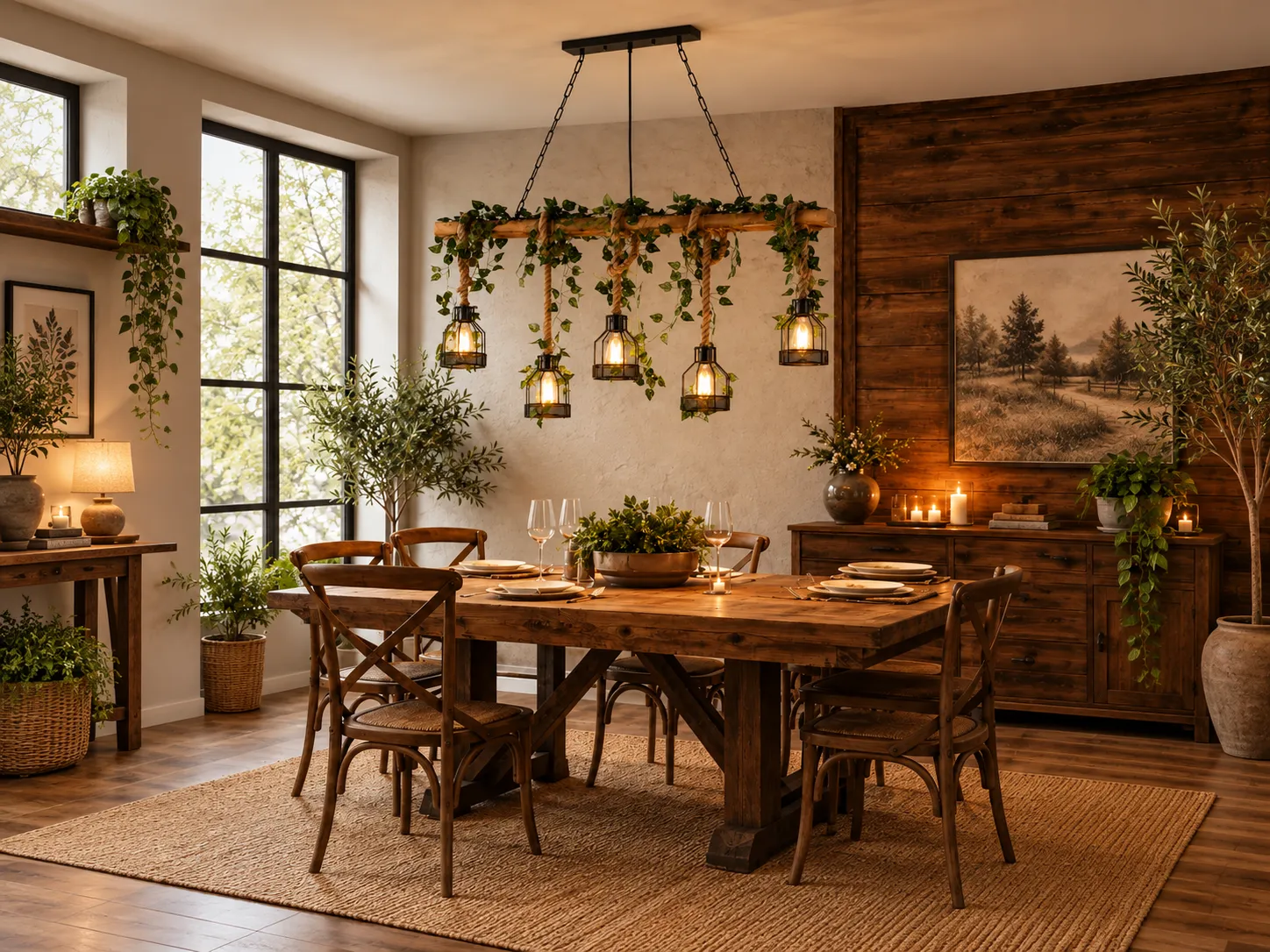
Material detail: timber, rope, black metal suspension and foliage styling create a layered tactile composition.
2. Light Quality Matters More Than “Brightness” Alone
When selecting lamps for a decorative chandelier, many buyers focus first on wattage. For modern LED lamps, this is the wrong starting point. Wattage describes electrical power, while luminous flux (lumens) describes visible light output. Two LED lamps can consume similar power yet produce different amounts of light, and two lamps with similar lumen ratings can create very different experiences because of optics, color temperature, color rendering and glare.
Correlated color temperature: keep the atmosphere warm
Correlated color temperature (CCT) describes whether white light appears warm, neutral or cool. DOE guidance explains that lower CCT values appear warmer, while higher values appear cooler; 3000 K and 3500 K are common interior preferences in many U.S. applications. For this rustic wood-and-rope chandelier, a warm range is usually the most coherent choice because it reinforces the amber and brown tones of wood, rope and leather rather than visually flattening them.
For a home dining room, 2700–3000 K is a practical starting range. In a bar, wine room or hospitality setting where a deliberately low, candle-like atmosphere is desired, lamps nearer the warm end can be appropriate, provided color quality remains acceptable. Cooler sources can work in mixed-use spaces, but they tend to make the fixture feel more industrial and less intimate.
Color rendering: especially important around food and natural materials
Color rendering describes how faithfully illuminated object colors appear relative to a reference. The DOE notes that a CRI of 80 is generally recommended as a minimum for interior lighting and that CRI 90 or higher indicates excellent color fidelity. [2] The CIE defines CRI as a measure of the degree to which object colors under a test illuminant conform to their appearance under a reference illuminant.
For a dining fixture, better color fidelity helps food, timber grain, textiles, artwork and skin tones retain more natural relationships. A specification of CRI 90+ is therefore a useful target when the budget and lamp options allow. For more rigorous projects, CRI should not be treated as the whole story: the CIE now recommends its newer general color fidelity index Rf for scientific characterization and encourages reporting both during the transition.
Glare: the key risk with visible lamps
Decorative cage pendants intentionally expose the lamp, which is part of their visual appeal. But a bright point source can become uncomfortable when it sits directly in the normal line of sight. DOE guidance describes glare as excessive brightness that interferes with seeing the intended task or scene and notes that exposed or unshielded lamps can be a concern. In practice, this means the chandelier should be positioned and lamped so that people can look across a table or bar without staring into an excessively bright filament or LED element.
The simplest controls are lamp output, dimming and mounting height. A lower-lumen decorative lamp can often create a better experience than a very bright clear lamp. If the chandelier is the main ambient source, use additional layers—such as wall lights, concealed lighting or downlights—rather than asking the exposed lamps to do every lighting job in the room.
Evidence-informed specification targets
| Parameter | Practical target | Why it helps |
|---|---|---|
| CCT | 2700–3000 K for most dining interiors | Supports a warm, relaxed appearance and complements timber and rope. |
| Color fidelity | CRI >80 minimum; CRI 90+ preferred where available | Improves the appearance of food, skin tones, wood grain and textiles. |
| Dimming | Use dimmable lamps + a compatible dimmer | Allows one installation to shift from task-oriented brightness to evening ambience. |
| Glare control | Moderate lamp output; avoid direct eye-level exposure | Keeps visible lamps decorative rather than uncomfortable. |
| Layering | Combine decorative pendant light with ambient/accent sources | Reduces the need to over-brighten exposed lamps and improves depth. |
3. Dining Room: Make the Fixture Part of the Table Composition
A linear chandelier is strongest when it visually belongs to the table below it. The fixture should be centered on the table axis rather than simply on the room. In open plans, those two centers are often different. Aligning to the furniture makes the dining zone feel deliberate and keeps the light distribution relevant to the people actually using the space.
Instead of relying on a universal hanging-height number, evaluate three relationships on site: the sightline of seated and standing occupants, the spread of light across the tabletop, and the visual proportion between the chandelier and the room volume. A higher installation can feel airier and reveal more of the wood beam; a lower installation can create intimacy but increases the chance that bright lamps enter the field of view. Mocking up the lowest edge with tape or a temporary line is a simple way to test before final installation.
For dining, the table itself is the important visual task plane. The IES has highlighted the value of placing light over the table so that plates and the center of the table receive useful illumination without extreme contrast. The chandelier’s multi-point layout is well suited to this concept, but final light levels depend on the chosen lamps, their distribution, room reflectance and mounting height.
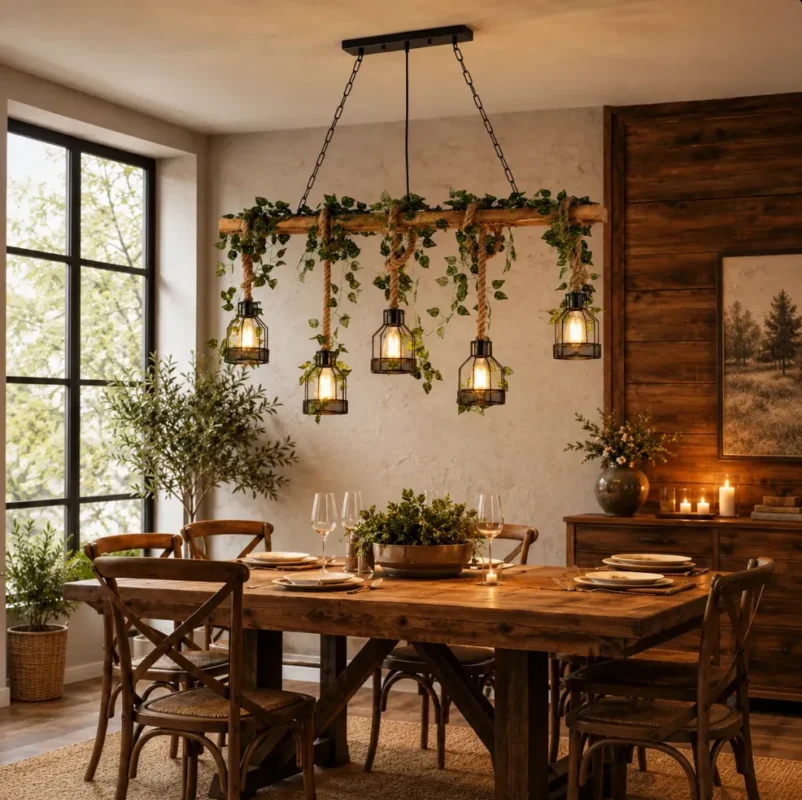
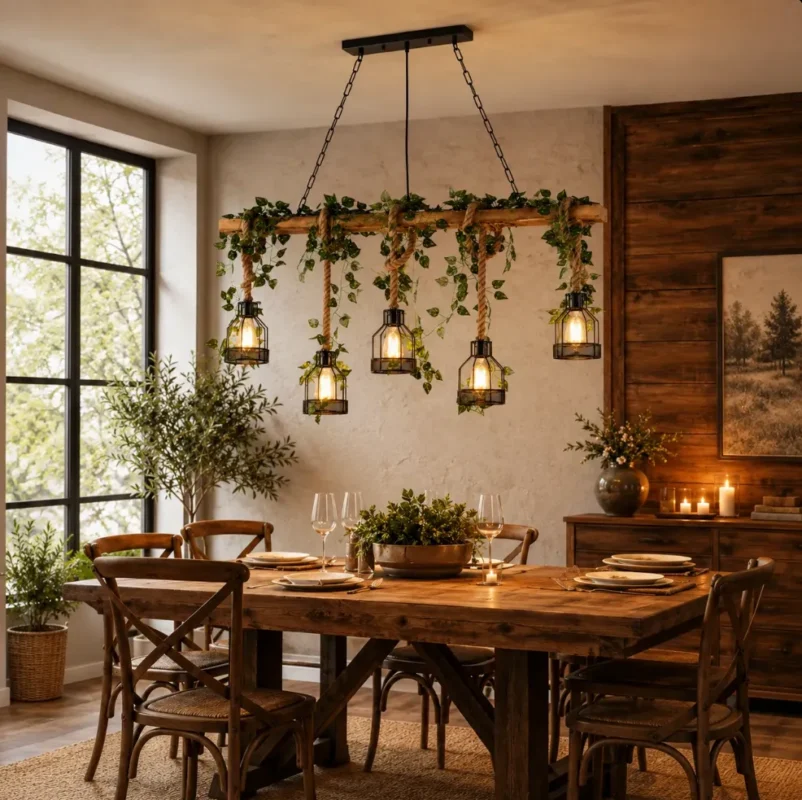
Residential dining application: the long beam echoes the table geometry while multiple pendant points create a rhythmic pool of warm light.
4. Kitchen Islands and Open-Plan Living
Over a kitchen island, the same linear proportion can work well, but the lighting objective changes. A dining table benefits from atmosphere; an island may also support chopping, reading labels, preparing drinks or casual work. If the decorative chandelier does not deliver enough task light by itself, integrate discreet downlights or under-cabinet lighting rather than installing excessively bright exposed lamps.
This is an example of layered lighting: one luminaire establishes character and spatial identity, while other sources provide task performance or vertical brightness. The approach is often more comfortable than trying to achieve every requirement from one decorative fixture. It also gives the room better night-time flexibility: the chandelier can remain dimmed for mood while targeted task lighting is used only where needed.
In modern open-plan rooms, the wood beam can act as a bridge between finishes. It can repeat the tone of dining furniture, contrast with painted cabinetry, and visually connect to floors or architectural beams. If the room already contains several competing wood species, choose the chandelier finish as either a deliberate match or a deliberate contrast; near-matches can look accidental.
5. Restaurants, Bars and Boutique Hospitality
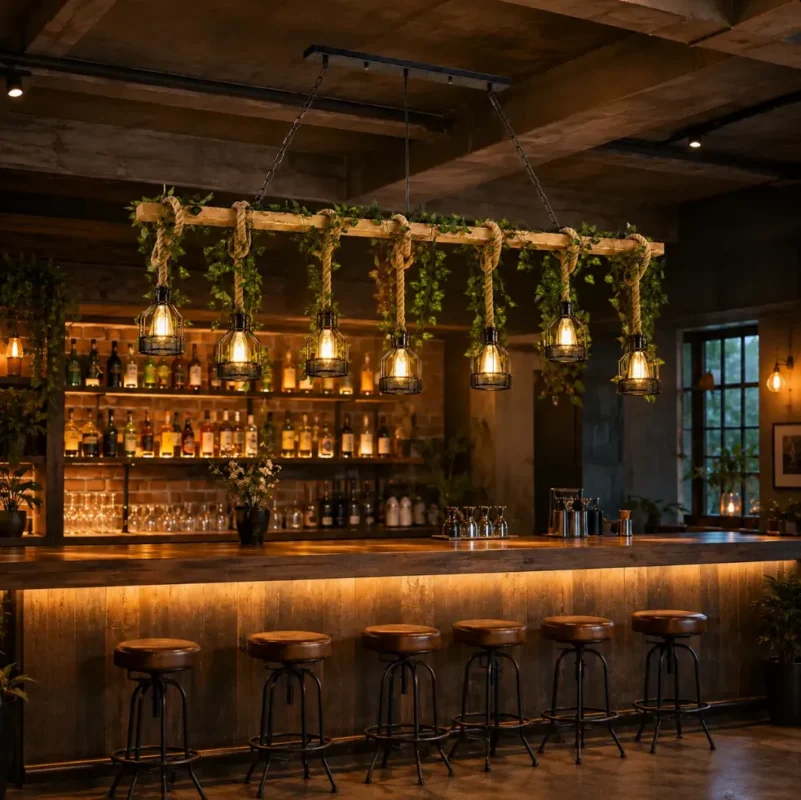
Hospitality application: a long beam pendant can define a bar zone while warm lamps complement darker wood and metal finishes.
The fixture becomes especially expressive in hospitality spaces because it provides both light and identity. A row of warm pendant points can help guests read the bar or table as a destination, while the timber and rope introduce material warmth into spaces that may otherwise contain hard finishes such as concrete, brick, steel or stone.
For restaurants and bars, dimming is more than a decorative option. Daytime service, cleaning, early evening and late-night ambience can require very different light levels. A compatible dimming system lets the same visual fixture support several operating modes. DOE guidance on color-tunable and dimming systems also emphasizes that compatibility between LED lamps, drivers and controls matters for smooth, predictable performance. [7]
Where guests sit directly beneath or beside the luminaire, test the actual lamp rather than selecting by lumen number alone. Clear decorative LED filaments can appear brighter to the eye than diffused sources because the luminous area is small and high-contrast. In hospitality lighting, visual comfort often improves when the visible decorative source is modest and additional concealed or shielded sources do some of the functional work.
6. Material Palette: Why Wood, Rope and Black Metal Feel Balanced
Material balance is one reason this style remains versatile. Timber carries natural variation and visual weight. Rope adds a softer, fibrous texture. Black metal cages and suspension hardware add crisp edges and contrast. Each material contributes something the others do not, so the fixture feels layered without requiring ornate shapes.
The palette works particularly well with warm neutrals, limewash or textured plaster, brick, stone, matte black window frames, leather, linen and greenery. It can also work in cleaner modern rooms if the rest of the furniture is simple. The key is to avoid turning every object into a rustic motif. One strong beam chandelier is usually more convincing than repeating rope, lantern cages and reclaimed wood everywhere.
The photography also shows how foliage can soften the long beam and make it feel almost architectural. In styling terms, greenery introduces a different line quality: leaves fall irregularly against the straight timber, helping the fixture feel less rigid. In a real installation, artificial or live plant material must be positioned with electrical and heat safety in mind and should never obstruct ventilation or service access.
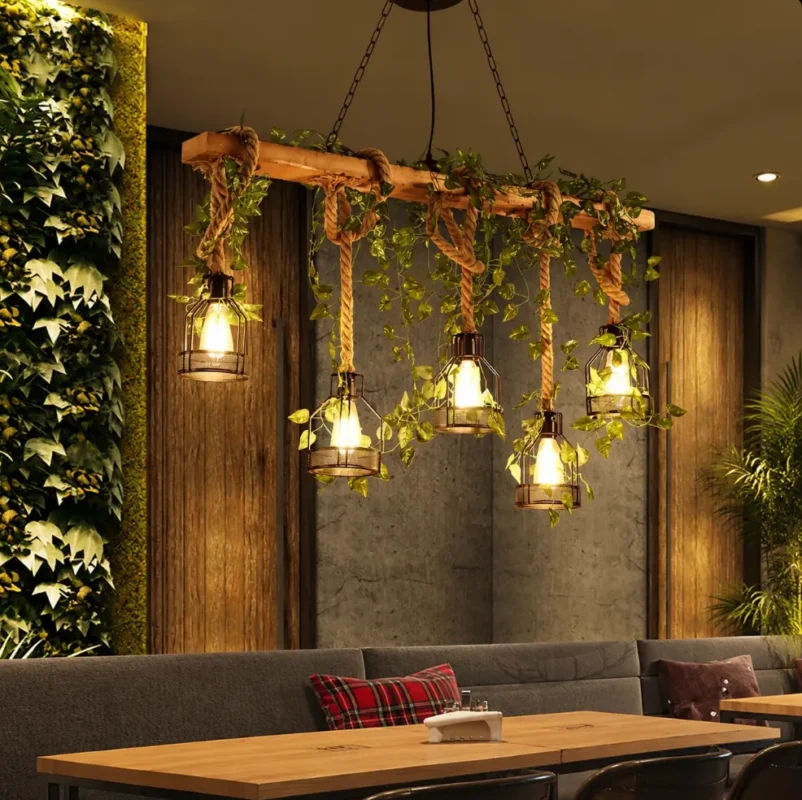
Restaurant-style setting: warm light, greenery and the linear timber form create a strong focal point without relying on ornate crystal or polished metal.
7. Choosing LED Lamps for the Chandelier
Because the lamp is visibly part of the design, lamp selection affects both the photometric result and the fixture’s appearance. For most interiors, LED lamps are the practical choice because they can provide good efficacy, long service life and a wide range of color qualities. DOE guidance notes that LED sources can readily achieve CRI 80 and can also reach 90+ when higher fidelity is desired.
Look beyond decorative appearance. Check the lamp’s lumen output, CCT, CRI or Rf data if available, dimming compatibility, beam or distribution, rated operating position, and whether the lamp is approved for the enclosure conditions created by the cage. If a dimmer will be used, verify the dimmer and lamp compatibility rather than assuming all products will dim smoothly.
A clear filament-style LED can preserve the vintage aesthetic, but the visible bright lines may be more noticeable than a frosted lamp. If glare is an issue, reduce lumen output, select a more diffuse lamp, increase mounting height, or use other room lighting to reduce contrast. The most effective solution is usually a combination of these measures rather than a single change.
A simple illuminance reality check
Illuminance is measured in lux, where 1 lux equals 1 lumen per square meter. In an idealized calculation, lumens divided by area gives average lux. Real rooms are more complex because light is lost or redirected by lamp optics, cages, mounting height, surface reflectance and geometry. Use the simple formula only as an early estimate; a finished project should be checked with a light meter or photometric calculation if consistent task lighting is important.
8. Layered Lighting: The Best Way to Make Rustic Lighting Feel Modern
A room can have a beautiful chandelier and still feel visually flat if every surface is lit from the same direction. Layered lighting solves this by distributing functions across several source types. The wood-beam chandelier can serve as the decorative focal layer. Recessed or track lighting can provide targeted task or accent light. Wall lights can brighten vertical surfaces. Concealed cove or cabinet lighting can add low-glare background illumination.
This hierarchy gives the room depth. It also reduces glare because the chandelier no longer needs to be bright enough to illuminate the entire room alone. For evening use, dim the chandelier and retain a small amount of vertical or accent light so that the room does not collapse into a bright table surrounded by darkness.
In hospitality, the same strategy helps direct attention. A bar front, bottle display, artwork or textured wall can be brighter than surrounding surfaces, while the chandelier remains a warm decorative anchor. Good lighting is therefore not just a question of how much light is present; it is the composition of brightness, color and direction across the scene.
9. Installation Planning and Safety
A long multi-point chandelier creates mechanical and electrical considerations that should be resolved before mounting. The ceiling support must be appropriate for the fixture weight and the installation surface. The canopy, chain or suspension points should be secured according to the manufacturer’s instructions, and all wiring should comply with the electrical code applicable to the project location. Where required, installation should be completed by a qualified electrician.
Before finalizing the drop, confirm door swings, tall furniture, standing sightlines and the table or counter position. In hospitality spaces, also consider cleaning access and the possibility that furniture layouts may change. If the pendants can be adjusted individually, keep the visual rhythm intentional; random heights can look dynamic, but they should still appear composed.
For decorative greenery, use only materials and placements that do not contact hot lamp surfaces or interfere with wiring, sockets, cage ventilation or servicing. Even with LED lamps, temperatures can rise around electrical components. The luminaire and lamp manufacturers’ clearance and enclosure instructions take precedence over styling preferences.
10. Maintenance: Keep the Material Contrast Crisp
The fixture’s appeal depends on the contrast between natural and dark materials, so light dust can be more visible than on a uniform fixture. Switch off power and allow lamps to cool before cleaning. Dust timber and rope gently with a dry microfiber cloth or soft brush. Avoid soaking natural rope or unfinished wood, because moisture can stain fibers or raise the grain.
Metal cages can be wiped with a slightly damp cloth if the finish permits, then dried immediately. Clean LED lamps only as recommended by the lamp manufacturer. In commercial settings, add the chandelier to the regular cleaning schedule; a thin film of dust on visible lamps and cages can noticeably reduce sparkle and make warm light look duller.
If one lamp changes color, flickers, dims irregularly or fails early, inspect the lamp and control compatibility before assuming the fixture is at fault. Replacing all lamps with the same model and production specification helps maintain consistent color and brightness across a multi-light composition.
11. Interior Styles That Pair Naturally with This Chandelier
Modern farmhouse: Use the wood beam as the warm focal point against off-white walls, black-framed windows, linen upholstery and simple dining furniture.
Industrial rustic: Pair with brick, dark steel, concrete, leather and deeper timber tones. Keep lamp color warm to prevent the scheme from becoming visually cold.
Modern lodge: Combine with stone, broad timber surfaces, wool textures and restrained black details. The linear form keeps the room from feeling overly traditional.
Boutique restaurant: Use the chandelier above communal tables, bars or banquettes, then add accent lighting for menus, artwork and display shelving.
Biophilic rustic: Introduce greenery and natural textures, but treat plants as a separate styling layer and maintain safe clearances from electrical components.
12. Why the Fixture Can Work Beyond “Farmhouse”
Rustic lighting often becomes overly thematic when every detail refers to the past. This design avoids that problem because its primary geometry is simple: one long beam and repeated vertical drops. The materials may be rustic, but the composition is modern. That makes it possible to use the chandelier in spaces with contemporary seating, minimalist cabinetry or architectural plaster as long as the color and scale relationships are controlled.
The most successful installations usually let the chandelier be the main handcrafted element in the sightline. Surround it with quieter materials, repeat one or two of its tones elsewhere in the room, and use warm, high-quality lamps. The fixture then reads as an intentional contrast rather than a decorative theme.
Conclusion: Use Material, Light and Proportion as One Design System
The Rustic Wooden Beam Linear Pendant Chandelier with Rope is effective because its lighting function and material character reinforce each other. The horizontal beam creates spatial order, the pendants distribute light along a useful axis, rope introduces craft and texture, and black metal gives the composition definition. Warm, high-fidelity LED lamps can then bring out the same natural surfaces that make the fixture visually distinctive.
For residential use, the priority is comfortable dining light, proportion and control. For hospitality, add durability, dimming flexibility and glare testing. In both cases, the best result comes from treating the chandelier as one layer in a broader lighting plan rather than as the only source in the room.
When the fixture is centered to the furniture, specified with appropriate lamp color and color quality, dimmed to suit the activity, and supported by complementary ambient or accent lighting, it can deliver the quality that rustic interiors need most: warmth without visual heaviness and character without sacrificing functional light.
Rustic Wooden Beam Linear Pendant Chandelier with Rope | Click to view product