

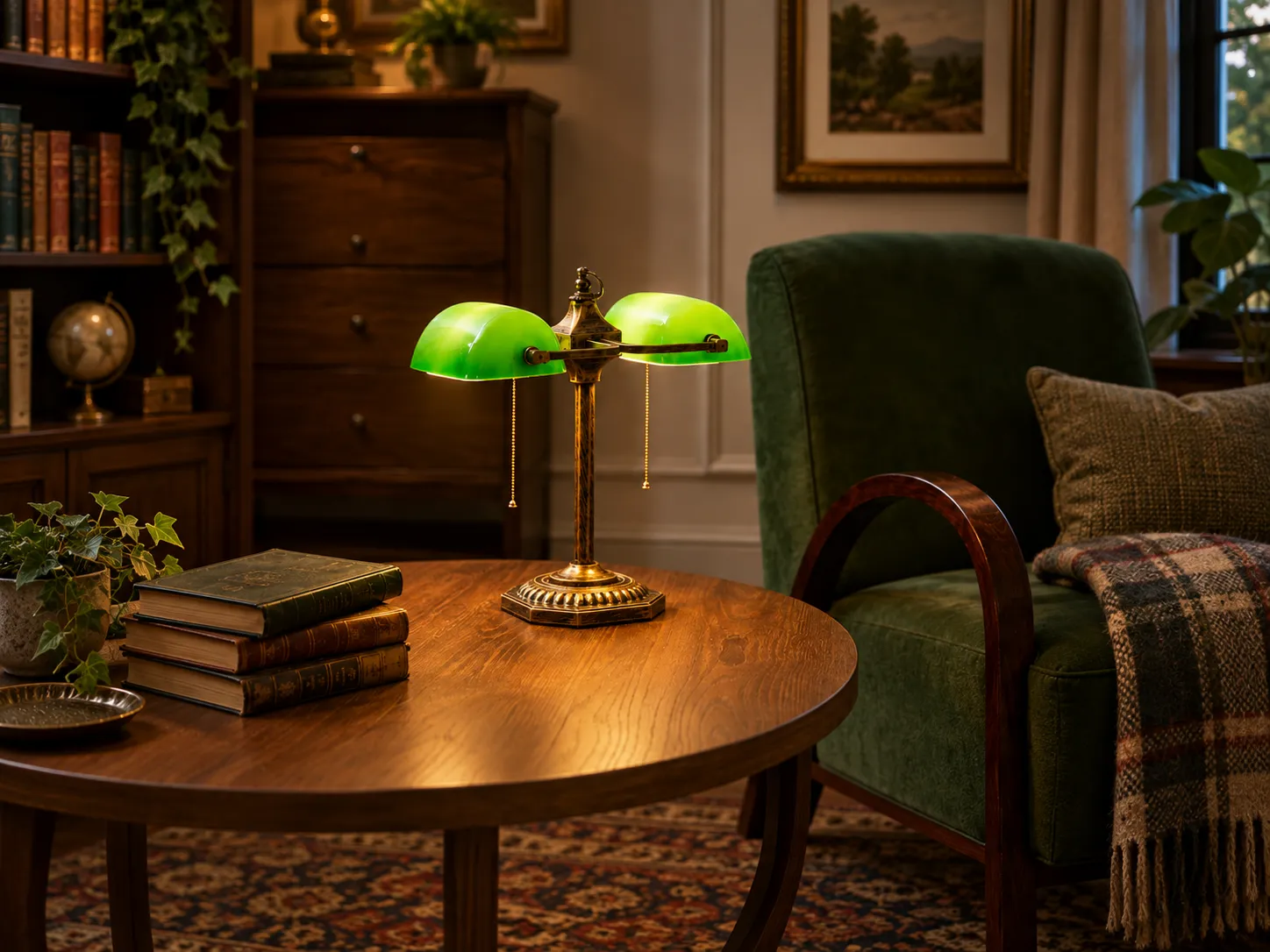

A design and lighting-science guide to task illumination, glare control, evening ambience, and timeless interiors
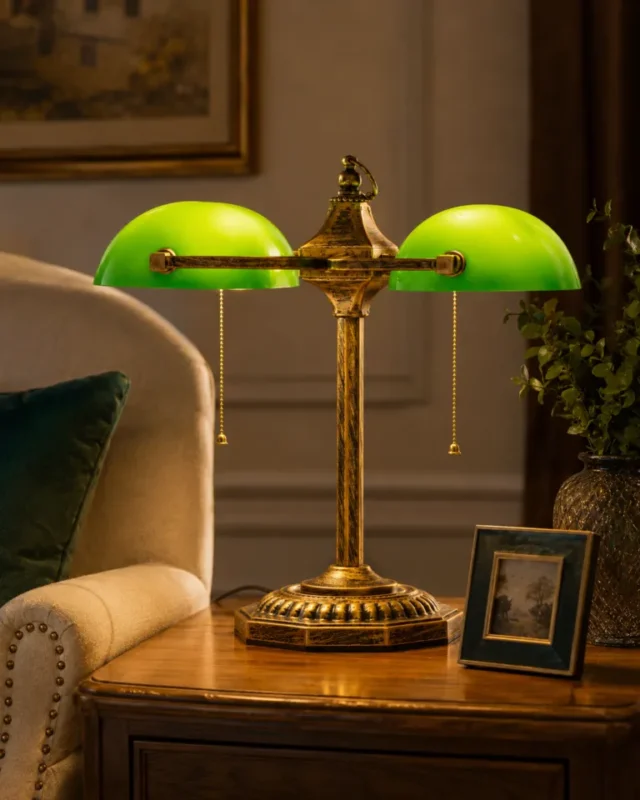
Why the Banker Lamp Still Works in Modern Homes
The banker lamp is one of the rare lighting designs that remains useful even when its visual language is intentionally traditional. Its value comes from a clear functional idea: place light close to the task, shield the bright source from direct view, and use a broad shade to create a controlled pool of illumination across a desk, book, or bedside surface.
This double-shade version updates that familiar idea with two green glass shades, a brass-tone iron structure, two E27 lamp holders, and a symmetrical form that spreads light across a wider work zone than a single-shade lamp. The result is both decorative and practical: a recognizable vintage silhouette with enough presence for a study, reading corner, bedroom, library-inspired interior, or hotel-style lounge.
1. Task Lighting Is About the Surface, Not the Whole Room
Reading and desk work are localized visual tasks. Instead of raising the brightness of an entire room, a task lamp concentrates useful light on the page or work surface. This is more efficient visually and often more comfortable because the user can achieve a higher level of illumination where it is needed without turning the surrounding room into a brightly lit environment.
Professional lighting guidance commonly places reading and office-like tasks in the few-hundred-lux range at the task plane. A published IES discussion of office lighting describes 500 lux on the task area and 300 lux in the surrounding space as a standard-compliant lighting setting, while also emphasizing personalized control because users differ in visual needs and comfort. For a home study, those values are best treated as a useful reference range rather than a rigid prescription.
Practical setup: Place the lamp so the shades illuminate the page from the side or slightly forward of the user. Avoid aiming exposed bulbs directly toward the eyes, and adjust bulb output if the page looks dramatically brighter than the surrounding room.
2. Why Green Glass Can Feel Comfortable
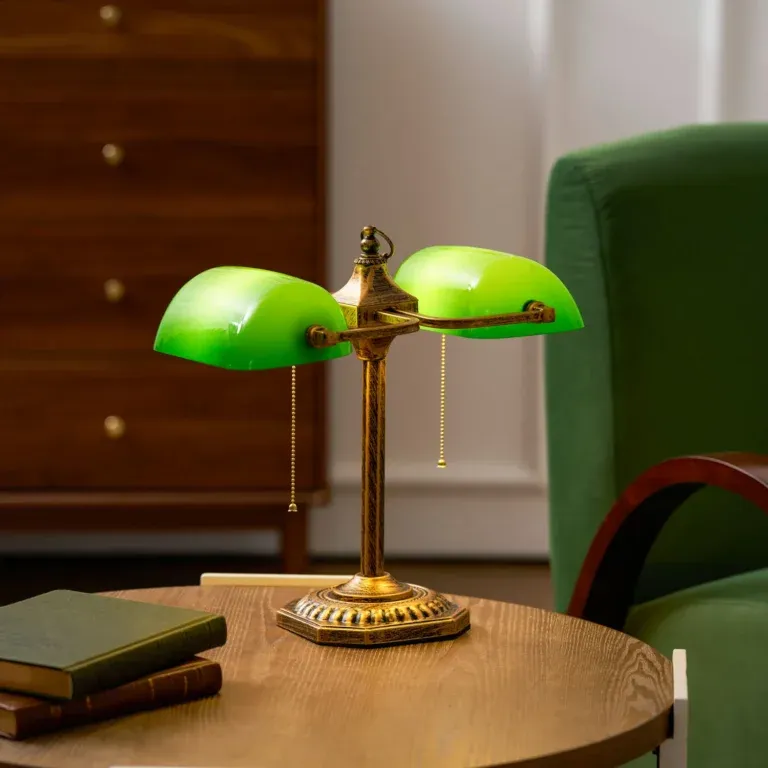
The classic green shade is not merely decorative. An opaque or semi-opaque upper shade limits direct upward and sideways view of the bulb, while the underside remains the primary path for task light. This shielding can reduce direct glare and keep the user’s attention on the illuminated surface rather than on the light source itself.
The visible green glass also introduces a lower-luminance colored surface into the field of view. That can make the lamp feel calmer than an exposed bare bulb, especially in darker libraries, bedrooms, or traditional offices. The actual visual comfort, however, still depends on bulb brightness, shade transmission, eye position, and the brightness of the surrounding room.
3. Two Shades, Two Bulbs, Wider Coverage
A single banker lamp usually creates a relatively narrow pool of task light. This model uses two E27 bulbs and two shades, widening the useful illuminated area. That makes it a better match for a large writing desk, a shared reading table, a console used as a work surface, or a bedside table where the user wants both task light and decorative balance.
The product page lists an approximate total luminous output of 800–1200 lumens. Actual light reaching the desk will be lower because the shades redirect and absorb part of the output. That is normal: lumen output describes total light produced, while illuminance in lux describes how much light actually reaches a specific surface. Distance, shade geometry, bulb beam distribution, and surface reflectance all affect the final reading level.
4. Choosing the Right Color Temperature
The lamp is compatible with 3000 K, 4000 K, and 6000 K light sources. For most homes, 3000 K warm white is the most natural match for the brass finish, wood furniture, warm wall colors, and traditional green glass. Around 4000 K creates a more neutral study environment and can make white paper appear visually crisper. A 6000 K source looks distinctly cooler and more clinical, which may suit some workspaces but is less consistent with the lamp’s vintage character.
Color temperature also changes the biological context of evening light. Expert consensus recommendations for healthy adults advise keeping melanopic light exposure low in the hours before sleep. Warm-white domestic LEDs around 2700–3000 K can make it easier to achieve lower melanopic stimulation than many cooler sources at a similar visual light level, although brightness, spectrum, duration, timing, and distance from the eyes all matter.
A Simple CCT Guide
| Use case | Suggested CCT | Visual effect |
|---|---|---|
| Bedroom or evening reading | 2700–3000 K | Warm, relaxed, visually compatible with brass and wood |
| Study or desk work | 3000–4000 K | Balanced clarity without looking extremely cool |
| Cool contemporary workspace | 5000–6000 K | Crisp, high-contrast appearance; less traditional in character |
5. Evening Light and Circadian Considerations
Lighting for late-night reading should be bright enough for vision but restrained enough that the entire room does not become intensely illuminated. A 2022 expert consensus recommends no more than 10 lux melanopic equivalent daylight illuminance at the eye during the three hours before bedtime for healthy adults with typical daytime schedules. That target is about biological light exposure at the eye, not the illuminance on the book.
This distinction explains why a localized desk lamp can be useful in the evening. It can provide a brighter reading surface while keeping the wider room dimmer, especially when the shade prevents large amounts of light from entering the eyes directly. A warm, dimmable bulb and careful placement are therefore more important than choosing a warm color temperature alone.
6. Why Brass and Emerald Green Create a Timeless Palette
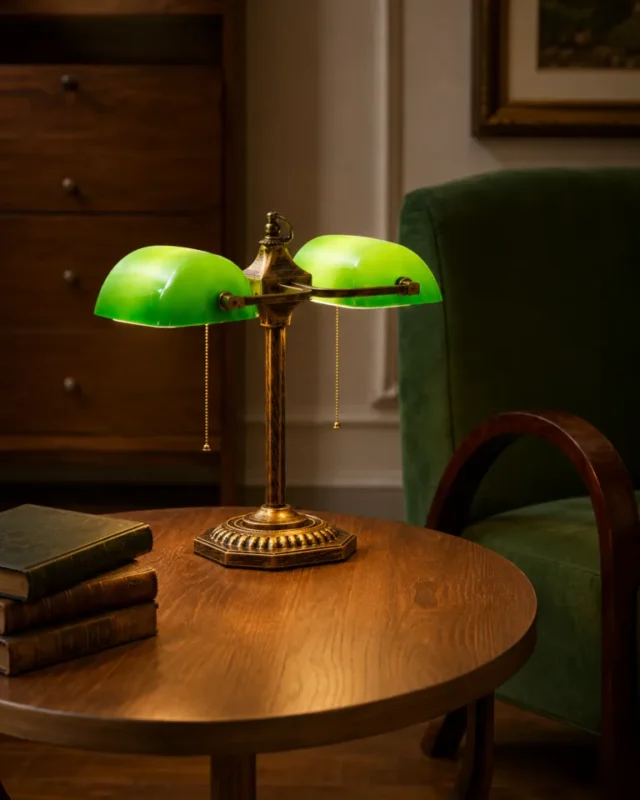
The visual strength of a banker lamp comes from material contrast. Brass-tone metal reads as warm, reflective, and historically familiar; emerald green glass introduces saturated color without requiring a large decorative object. Together they create a compact focal point that works especially well with walnut, oak, dark-stained timber, leather, stone, and neutral fabrics.
The palette can support several interior styles: traditional libraries, dark-academia rooms, Art Deco-inspired spaces, classic offices, boutique-hotel interiors, and even contemporary rooms that need one historical accent. The key is repetition. If the room already contains warm metal hardware, framed art, timber furniture, or green upholstery, the lamp appears intentional rather than themed.
7. Placement for Better Visual Comfort
For desk use, the lamp should sit far enough from the immediate line of sight that the bright lower opening of the shade is not directly visible. Right-handed users often benefit from placing task light slightly to the left, while left-handed users often prefer the opposite side, reducing hand shadows across the page.
For bedside use, keep the lamp close enough that the page is well lit without requiring excessive bulb output. The two-shade design is visually broad, so a larger nightstand, console, or writing table will usually suit it better than a very small bedside surface. Always maintain sufficient clearance from curtains, bedding, paper, and other combustible materials.
8. Use It as One Layer in a Lighting Plan
A good home office or reading room should not rely on one source. The banker lamp should serve as the task layer. Add soft ambient light for circulation and wall or shelf lighting if the room needs depth. When the background is not completely dark, the contrast between the bright desk and the rest of the room is easier on the eyes.
Layered lighting also lets the space change character throughout the day. In daytime, the lamp can supplement window light. In the evening, overhead lighting can be reduced while the banker lamp maintains useful task illumination. For decorative use, the lamp itself can become the warm focal point while other layers remain subtle.
9. Bulb Selection: What Matters Most
The product uses two E27 bulbs, rated up to 40 W each. With modern LED bulbs, electrical wattage should not be confused with brightness. A lower-wattage LED can produce substantial light while consuming much less power than an incandescent lamp.
For reading, prioritize appropriate lumen output, a comfortable color temperature, good color rendering, and dimmability if possible. A high color-rendering bulb can make book pages, wood grain, brass, fabrics, and artwork appear more natural. If the lamp is primarily decorative, choose a lower-output bulb. If it is the main desk task light, use enough output to achieve comfortable page brightness without visible glare.
Best Rooms and Applications
Study or home office: A natural fit for writing desks, reading desks, and classic workspaces.
Bedroom: Useful on a large bedside table where warm, localized evening light is preferred.
Library or reading room: The green-and-brass palette complements bookshelves, wood, and leather.
Living-room reading corner: Adds a focused pool of light beside an armchair or writing table.
Hotel or guest room: Creates a memorable vintage feature while still providing functional task lighting.
Reception or executive office: Works as a decorative desk light where traditional character is desirable.
Product Specification Snapshot
| Product type | Table lamp / decorative and task lighting fixture |
| Design | Vintage banker-style, double shade |
| Material | Iron + glass |
| Shade | Double-layer green glass |
| Finish | Brass gold + emerald green glass |
| Overall size | 41 × 41 cm / 16.14 × 16.14 in |
| Base size | 17 × 17 cm |
| Light source | 2 × E27 bulbs |
| Maximum power | 40 W × 2 |
| Voltage | AC 110–240 V, 50–60 Hz |
| Color temperature options | 3000 K / 4000 K / 6000 K |
| Luminous output | Approx. 800–1200 lm |
| Installation | Plug-in tabletop placement |
| Weight | Approx. 2.5–3.0 kg |
| Package size | 45 × 30 × 25 cm |
10. Styling the Lamp Without Making the Room Feel Like a Theme Set
Vintage lighting works best when it is balanced by contemporary simplicity. Instead of filling the room with many historical objects, let the lamp be one strong reference point. Pair it with a simple wood desk, restrained wall art, a leather or green upholstered chair, and a neutral wall finish.
In a modern interior, the banker lamp can create contrast. In a traditional interior, it can reinforce continuity. In both cases, the green shade becomes more effective when there are one or two subtle echoes of the color elsewhere in the room rather than many matching accessories.
Design Takeaway
The enduring success of the banker lamp comes from a rare combination of visual identity and practical lighting logic. The shade shields the source, the task light is positioned close to the work surface, and the brass-and-green palette gives the fixture a strong decorative presence.
This double-shade model expands that concept by creating wider desk coverage and a more substantial silhouette. With a warm or neutral high-quality E27 LED, thoughtful placement, and layered ambient lighting, it can support comfortable reading while giving a study, bedroom, or reading corner the character of a classic library.
Vintage Banker Table Lamp—Click to view the product:View the product page
