

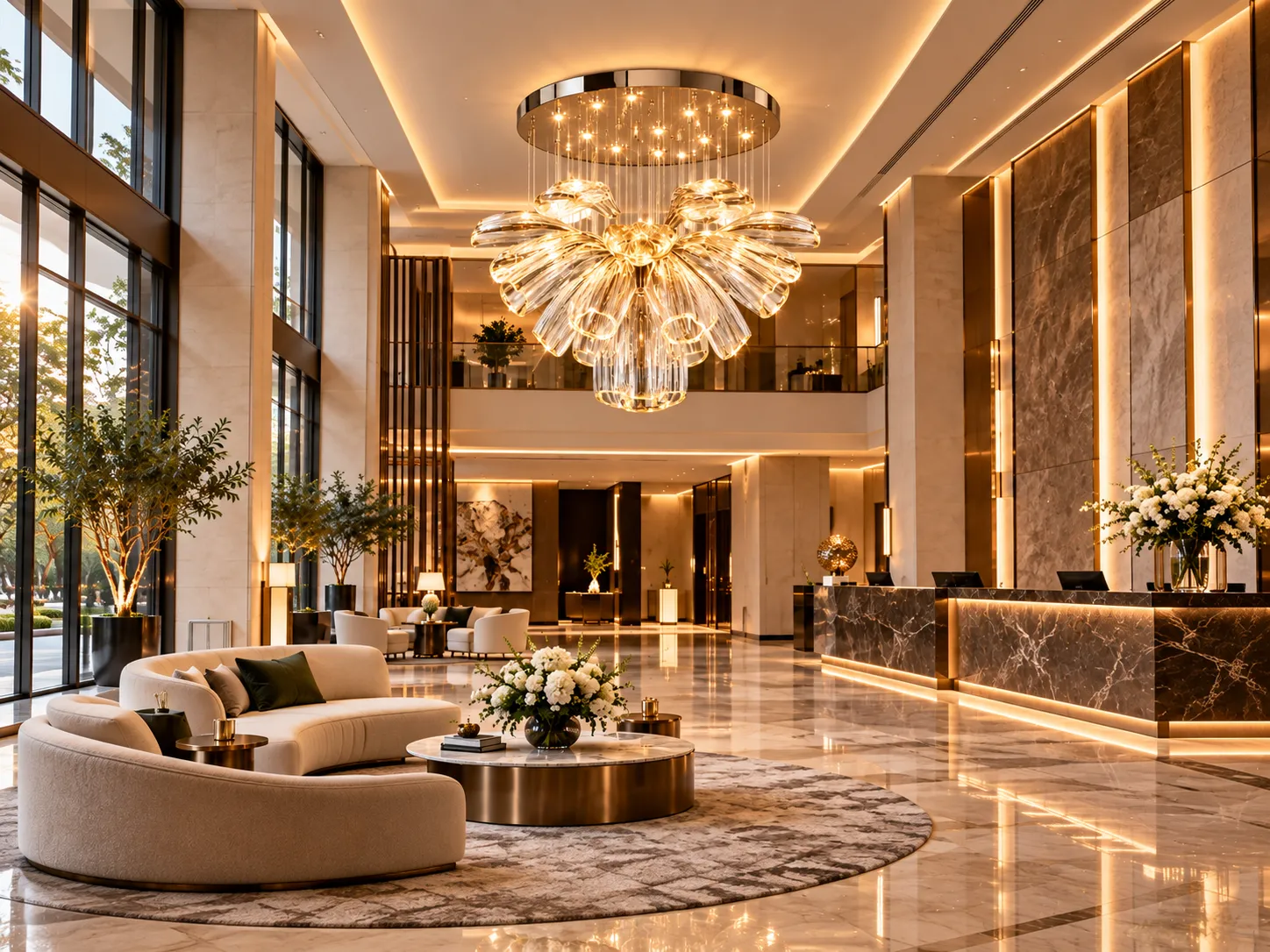

Bloom Glass Petal Chandelier: How Sculptural Glass Lighting Transforms Luxury Interiors
Product Overview
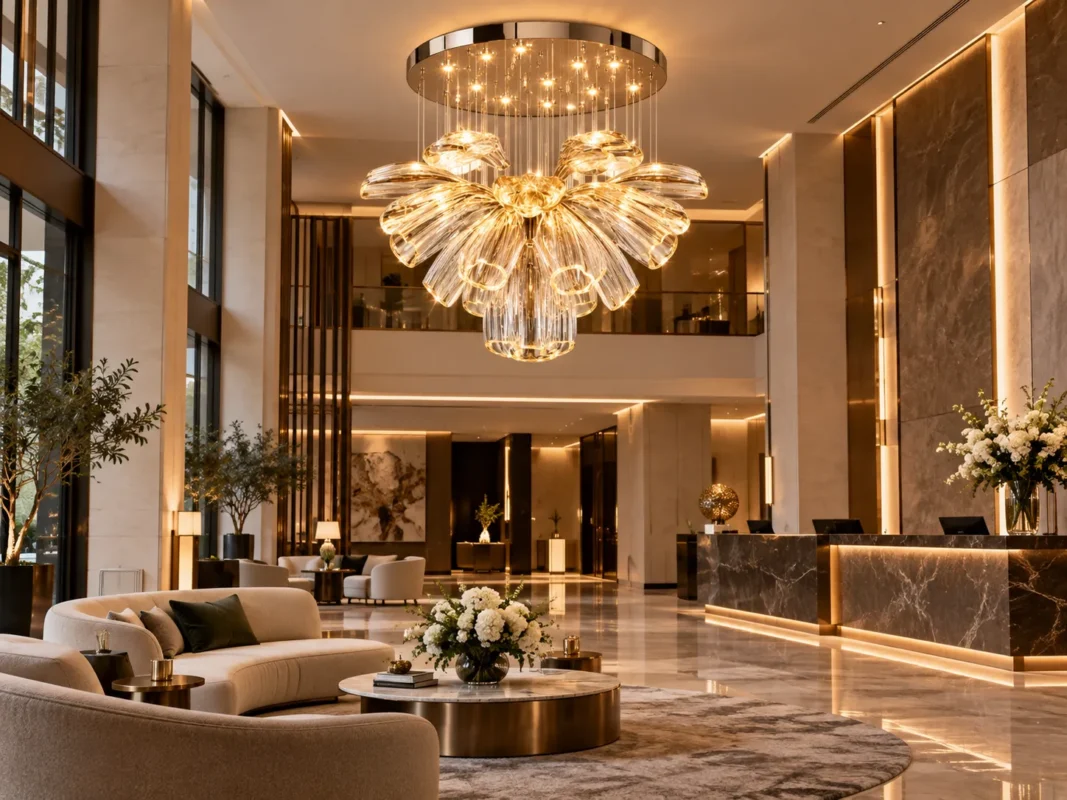
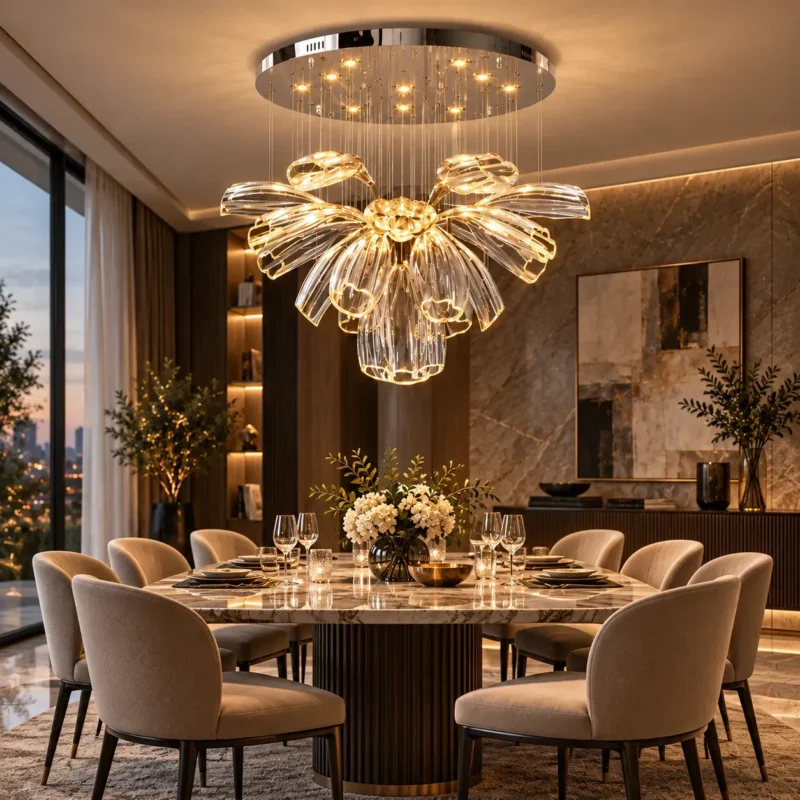
The Bloom Glass Petal Chandelier is designed as both a functional luminaire and a sculptural focal point. Its suspended clear-glass petals create a flower-like volume beneath a polished circular canopy, while integrated COB LED modules produce a warm, luminous core. The result is a fixture that can visually anchor large living rooms, dining rooms, duplex halls, staircases, foyers and hospitality spaces without relying on heavy opaque materials.
| Product Type | Decorative LED chandelier / glass pendant light |
| Primary Materials | Stainless steel with hand-blown clear glass |
| Metal Finish | Polished stainless steel with champagne-gold accents |
| Light Source | COB LED |
| Lighting Modes | Warm white / neutral white / cool white |
| Installation | Ceiling mounted with adjustable suspension wires |
| Available Sizes | 60 cm, 80 cm and 100 cm diameter |
| 60 cm Version | 30 W; estimated 2,100–2,700 lm |
| 80 cm Version | 78 W; estimated 5,460–7,020 lm |
| 100 cm Version | 120 W; estimated 8,400–10,800 lm |
| Recommended Spaces | Living room, dining room, villa, foyer, staircase, duplex hall, hotel lobby |
Why the Petal Form Works as an Architectural Focal Point
Large decorative chandeliers succeed when they contribute more than brightness. They must establish visual hierarchy. The petal composition creates a strong center of attention because the eye naturally reads the repeated curved forms as one coherent object. At the same time, the transparent glass keeps the chandelier from appearing excessively heavy, which is especially useful in open-plan living areas and tall entrance spaces.
The layered floral silhouette also changes as the viewer moves through the room. From below it reads as a radial bloom; from the side it becomes a three-dimensional suspended sculpture. This changing profile is one reason sculptural chandeliers work well in spaces with multiple sightlines, such as duplex halls, staircases and hotel lobbies.
How Clear Glass Shapes Light
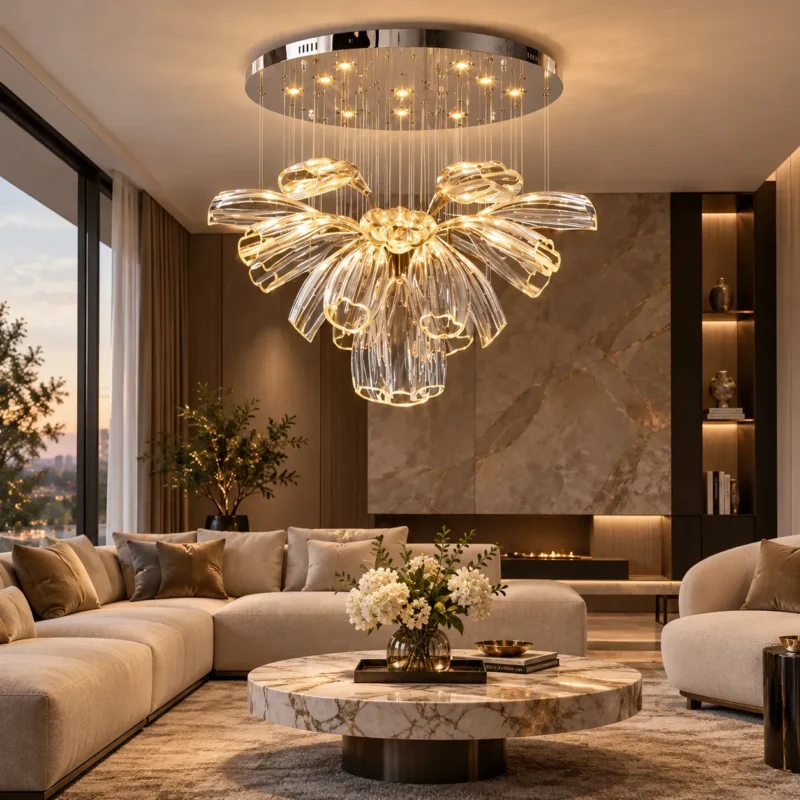
Clear glass does not simply transmit light. Its curved surfaces refract, reflect and redirect it. In a chandelier made from many glass petals, each element acts as a small optical surface, producing highlights and bright edges while allowing parts of the room behind the fixture to remain visible. This creates visual depth without the solid mass of an opaque shade.
Because many small reflections are created across the petals, the chandelier can appear brighter and more animated than a similarly sized opaque fixture. However, this effect also means that direct-view brightness needs to be controlled. The most comfortable result usually comes from balancing the chandelier with ambient architectural lighting so the eye is not adapting between a very bright centerpiece and a dark background.
COB LED Technology and Why It Suits Sculptural Chandeliers
Chip-on-board (COB) LED technology places multiple LED dies closely together on a single substrate, allowing a compact source with relatively high luminous output. For decorative chandeliers, this is useful because the light source can remain visually small while the surrounding glass performs much of the optical and decorative work. The U.S. Department of Energy notes that overall LED performance depends not only on the LED package itself, but also on luminaire optics, driver efficiency and thermal management.
Understanding Power, Luminous Flux and Scale
The listed outputs increase substantially across the three sizes. The 60 cm version is specified at 30 W and about 2,100–2,700 lumens, the 80 cm version at 78 W and about 5,460–7,020 lumens, and the 100 cm version at 120 W and about 8,400–10,800 lumens. These figures are useful for comparing models, but lumen output alone should not determine which size is appropriate.
Room volume, ceiling height, surface reflectance and surrounding light sources all affect perceived brightness. A chandelier in a double-height foyer may need a much larger visual and luminous presence than one above a dining table, even if both rooms have similar floor areas. The larger sizes are therefore most effective where the architecture can support their scale.
Choosing the Right Size for the Room
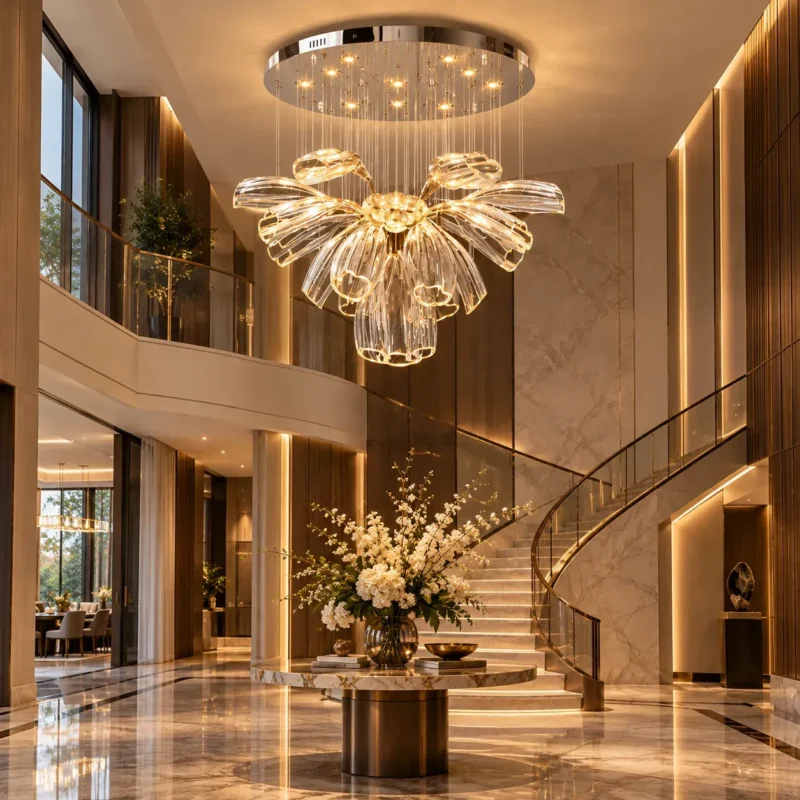
The 60 cm model is best suited to smaller living rooms, intimate dining areas or bedrooms where a decorative centerpiece is desired without dominating the room. The 80 cm version has enough presence for generous living rooms, villas and larger dining spaces. The 100 cm chandelier is most appropriate for double-height halls, large foyers, hotel reception areas and other spaces where the fixture needs to be read from a distance.
Scale should also be considered vertically. In a standard-height room, a low-hanging sculptural chandelier can reduce visual openness and create a collision risk. In a tall space, adjustable suspension wires allow the bloom to be positioned lower so it remains visually connected to the occupied zone instead of appearing lost near the ceiling.
Color Temperature and Atmosphere
The chandelier offers warm, neutral and cool white lighting modes. Correlated color temperature (CCT) describes the apparent warmth or coolness of white light. Warm-white settings support relaxed residential environments and complement wood, bronze, champagne-gold and cream stone. Neutral white can make glass details appear crisper and is often useful for mixed-use living spaces. Cooler white settings may feel brighter and more energetic, but can look visually harsher in rooms dominated by warm materials.
Color temperature should be selected together with the rest of the lighting scheme. A chandelier set to warm white will appear more coherent when nearby cove lights, wall lights and table lamps use a similar tone. Mixing very warm and very cool sources in the same field of view can make an otherwise luxurious room feel visually fragmented.
Color Rendering: Why CRI and TM-30 Still Matter
A dramatic chandelier is often used in interiors with high-quality materials, artwork, flowers and textiles, so color rendering matters. The Department of Energy notes that CRI is still widely used as a basic fidelity measure and that CRI 80 is a common minimum for interior lighting, while CRI 90 or higher indicates stronger color fidelity. For premium interiors, verifying the LED module’s actual color-rendering performance is worthwhile.
IES TM-30 provides a broader method for evaluating color rendition by considering both fidelity and gamut behavior. This matters in design-led spaces because a source can render neutral colors reasonably well while still making saturated reds, greens or decorative finishes look different from expectations.
Layered Lighting: Let the Chandelier Be the Star, Not the Only Light
A statement chandelier is most effective when it is part of a layered lighting scheme. Recessed ceiling lights can provide general visibility, wall washers can reveal stone or wood surfaces, cove lighting can soften ceiling transitions, and decorative table lamps can add lower-level brightness. The chandelier then becomes the visual centerpiece rather than carrying the entire room’s lighting load.
This strategy also improves visual comfort. If a bright chandelier is the only illuminated object in a dark room, the contrast can feel severe. Raising the background brightness with concealed or indirect lighting allows the glass petals to sparkle while keeping the overall scene comfortable.
Applications in Luxury Residential and Hospitality Interiors
In a living room, the chandelier works best when centered over a conversation zone rather than simply centered in the ceiling. In a dining room, it should relate directly to the table so the composition feels intentional. In a foyer or staircase, the chandelier can occupy vertical space and be viewed from several levels, which is one of the strongest uses of a sculptural suspended fixture.
Hospitality spaces benefit from the same qualities at a larger scale. In a boutique hotel lobby or reception area, the fixture can create an immediate visual identity and make the entrance feel more memorable. The transparent glass helps maintain openness while the repeated reflections support a high-end atmosphere.
Installation and Safety Considerations
Large glass chandeliers require careful installation. Ceiling structure, canopy attachment, suspension hardware and final load must be verified before installation. The published estimated weights for the collection are substantial, so the fixture should never be treated like a lightweight decorative pendant. A qualified installer should confirm that the ceiling and fixing system are appropriate for the selected size.
The product page does not specify an IP rating, so the chandelier should be treated as an interior dry-location decorative fixture unless the final certified documentation states otherwise. Electrical connections, driver compatibility and voltage requirements should also be confirmed before installation.
Final Thoughts
The Bloom Glass Petal Chandelier is most successful when it is used as part of the architecture rather than added as an afterthought. Its clear sculptural petals create movement and visual depth, while the integrated LED system provides enough output to support both atmosphere and general illumination depending on size.
The key design decisions are scale, suspension height, color temperature and the relationship to surrounding light. When these elements are coordinated, the chandelier can transform a large room into a more memorable, layered and luxurious environment without making the ceiling feel visually heavy.
Bloom Glass Petal Chandelier | Modern Luxury Lighting | Click to View Product