

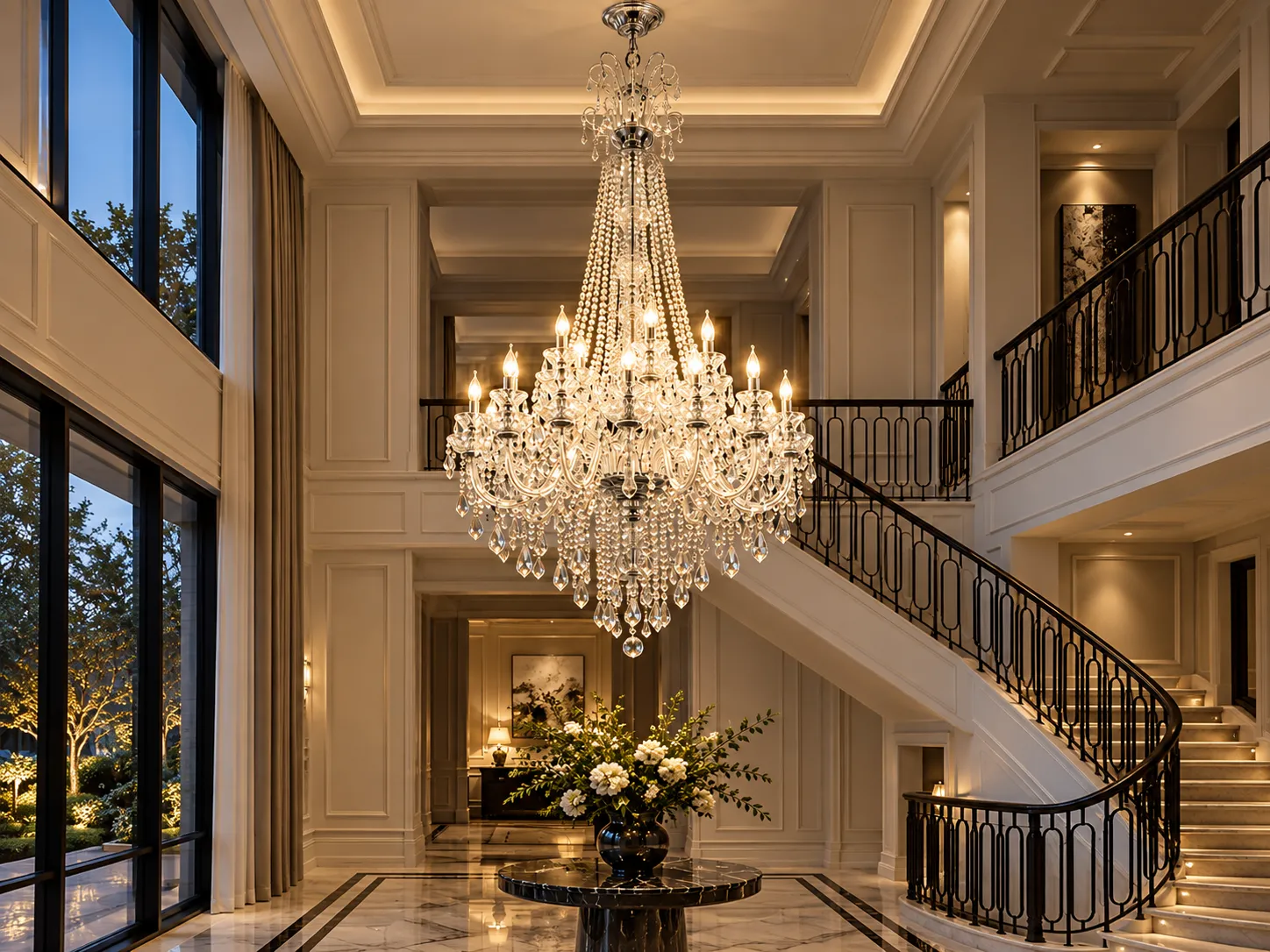

A practical guide to chandelier scale, layered lighting, warm LEDs, safe installation and long-term care.
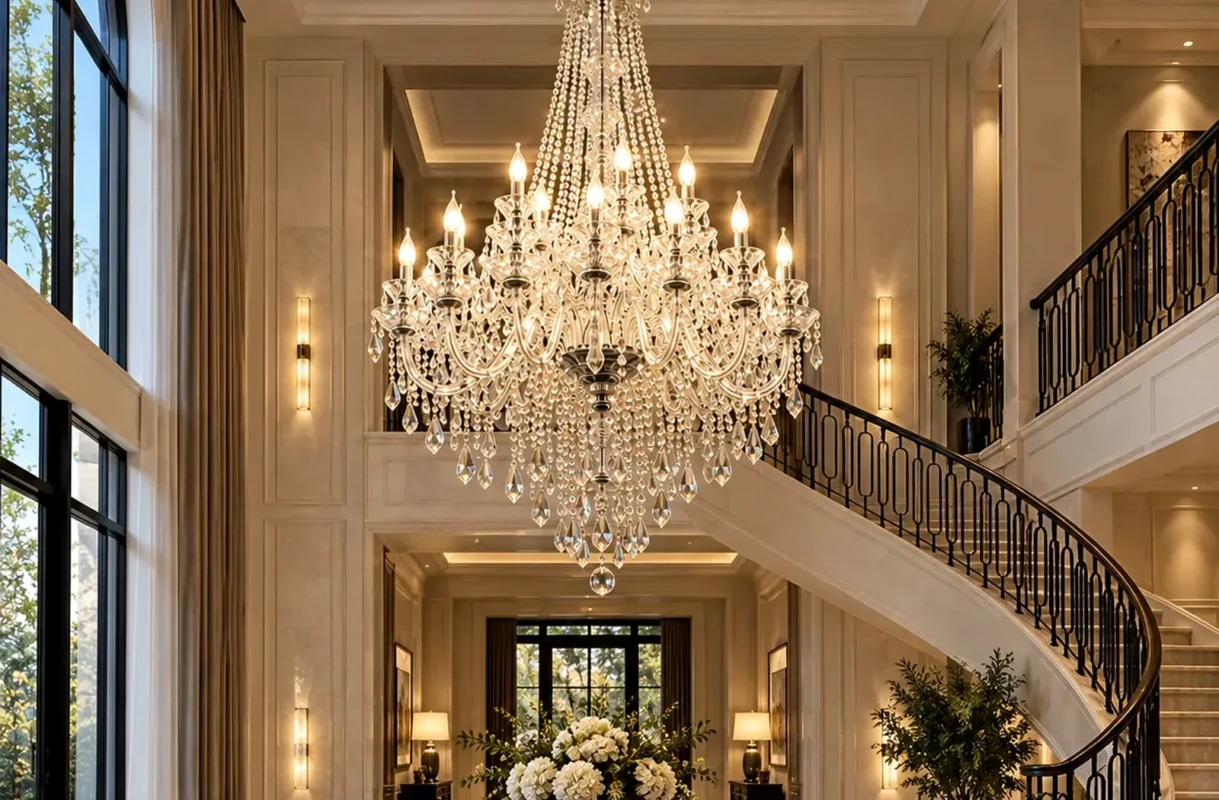
A large staircase chandelier can do more than fill vertical space. Positioned thoughtfully, it establishes visual hierarchy, links two architectural levels and creates a welcoming evening atmosphere. Yet an impressive fixture is not automatically a well-designed lighting scheme: proportions, glare, circulation clearances and structural support all matter.
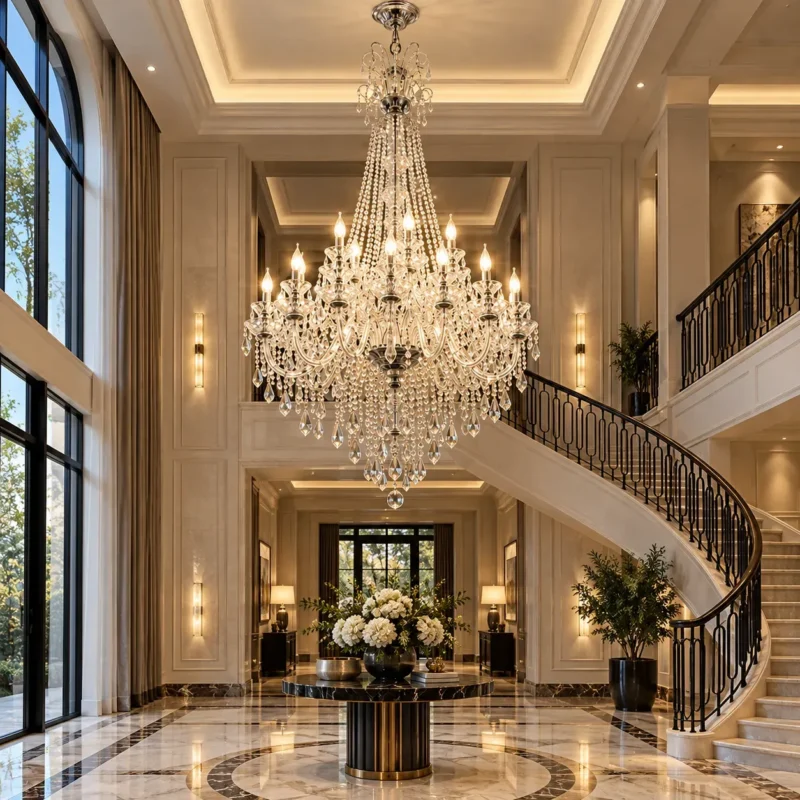
The Luxury K9 Crystal Staircase Chandelier from xunlulighting combines clear K9 crystal pendants, draped crystal-bead chains, a polished chrome finish and candle-style E14 LED lamps. Its traditional silhouette works particularly well in European-inspired, French-classic and transitional homes. [1]
1. Why crystal works so well in tall interiors
Transparent, faceted crystal elements create multiple reflected and refracted highlights. The effect is especially noticeable when small light sources illuminate many facets from different directions. In a double-height foyer, a suspended chandelier also provides an important vertical reference point: it makes a room feel intentionally composed rather than simply tall.
For an elegant result, coordinate the fixture with other surfaces. Chrome can echo polished handrails, door hardware or mirror frames; warm wall finishes and stone flooring can soften the visual contrast. Avoid adding too many competing decorative focal points directly around the chandelier.
2. Choose the right size before selecting the number of lamps
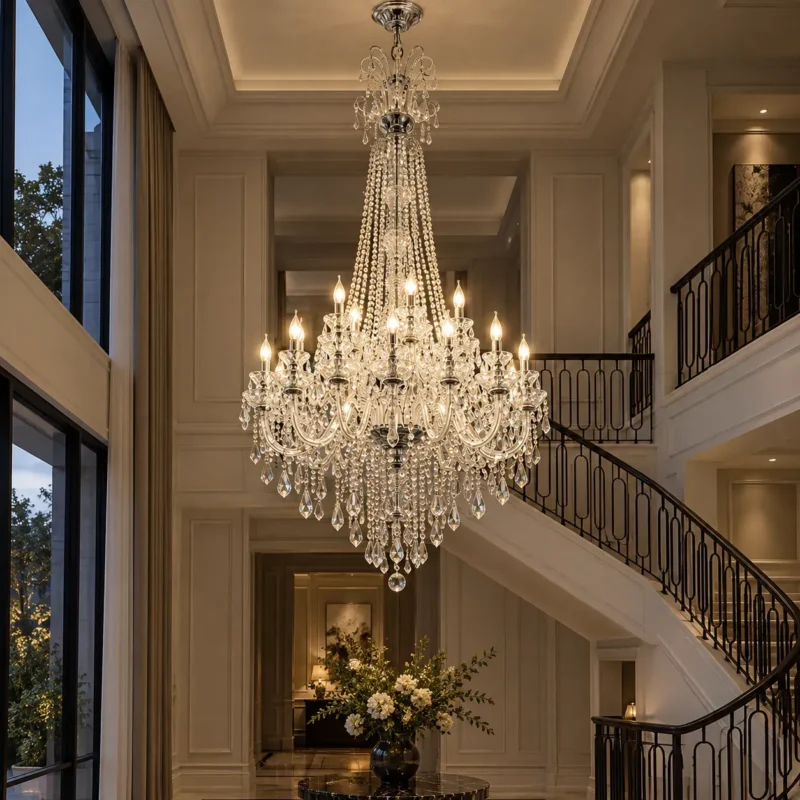
Start with three measurements: the finished ceiling height, the width of the visible void and the finished floor or stair landing below. Draw the chandelier at scale in an elevation before ordering. The decorative chandelier should feel substantial without obscuring sightlines, stair movement or access for cleaning.The product page currently lists the following selectable size options. Measurements are nominal; confirm the final overall drop, canopy, suspension length and packed weight before installation.
| Configuration | Diameter | Listed Body Height |
|---|---|---|
| 10 lights | 85 cm / 33.46 in | 100 cm / 39.37 in |
| 10 + 5 lights | 95 cm / 37.40 in | 100 cm / 39.37 in |
| 30 lights | 120 cm / 47.24 in | 180 cm / 70.87 in |
| 36 lights | 130 cm / 51.18 in | 180 cm / 70.87 in |
| 48 lights | 150 cm / 59.06 in | 200 cm / 78.74 in |
Specification note: some dimensions in the product page’s detailed description differ from the option selector. Request a current dimensional drawing for the exact variant rather than treating either list as a certified installation drawing. [1]
A simple visual sizing test
When viewed from the principal entrance, allow negative space around the silhouette so the fixture reads as a complete object. Check views from the upper landing and from the lower floor: a chandelier that appears balanced from the entrance may look oversized at eye level upstairs. There is no universal “right” chandelier diameter for all foyers; use the room geometry and actual elevation drawings.
3. Layer the lighting: the chandelier should not do every job
The Illuminating Engineering Society’s residential lighting guidance considers illumination quantity and quality, light distribution, controls, energy use and the needs of different areas. That is a better framework than judging a room solely by the wattage or number of bulbs in its chandelier. [2]
- Ambient layer: use architectural ceiling lighting or indirect cove lighting to provide an even visual base.
- Circulation layer: illuminate treads, landings and changes in level so edges remain visible and shadows do not hide hazards.
- Accent layer: add carefully aimed lighting for a feature wall, artwork or textured surface without competing with the chandelier.
- Decorative layer: let the crystal fixture provide sparkle and identity, with its light output balanced against the other layers.
Lux (lx) measures illuminance on a surface, while lumens (lm) describe the light emitted by a source. The right target depends on the location, activity, users and room finishes. If the project needs documented illumination levels, ask a lighting designer to calculate maintained illuminance and uniformity rather than estimating lux from fixture wattage.
4. Select light color and lamp quality with care
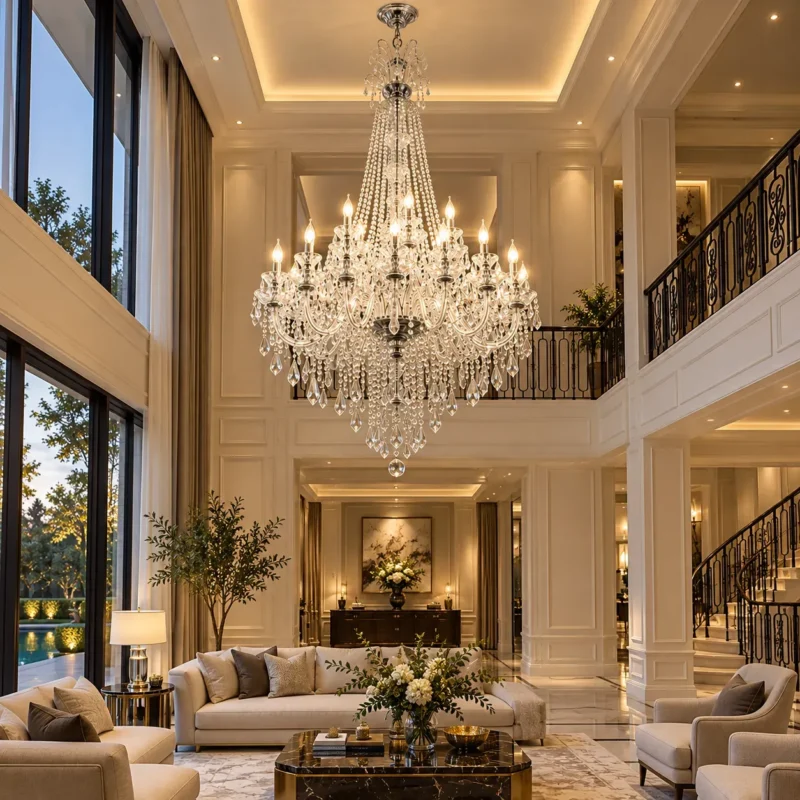
For a relaxed residential atmosphere, 2700 K to 3000 K is a useful starting point. The U.S. Department of Energy describes 2700 K as a warm, personal appearance and 3000 K as a warm, pleasing appearance commonly used in homes and lobbies. These are design preferences, not mandatory performance specifications. [4]
Check E14 lamp dimensions, allowed wattage, rated voltage and fixture compatibility before purchasing replacement bulbs. The product listing describes E14 candle LEDs and warm/neutral/cool-white options, but exact control behavior and dimming compatibility should be confirmed for the specific configuration. [1]
A realistic energy example
Suppose a 30-lamp chandelier uses 4 W LED lamps instead of 25 W incandescent lamps that give a broadly comparable lighting effect. Lamp load would be 120 W versus 750 W, an illustrative 84% reduction. Actual savings depend on matching useful light output, driver losses, hours of use and lamp selection. DOE reports that LEDs generally consume substantially less energy and last longer than incandescent alternatives. [5]
5. Prioritize safe support and accessible maintenance
Large crystal chandeliers can be heavy and require more than an attractive ceiling medallion. Before installation, a qualified electrician or installer should verify the load path to the building structure, the approved support hardware, grounding, wiring compatibility, suspension method and local electrical requirements. Do not assume a standard ceiling box is rated for a large decorative chandelier. UL guidance distinguishes support products by their investigated weight limits and markings. [6]
Also plan how the fixture will be serviced. A high suspended chandelier may require a lift or professional access method for lamp replacement and cleaning. Keep sufficient separation from railings, stair circulation and moving doors; verify clearances against local code and the actual suspended position rather than relying on a generic rule of thumb.
6. How to keep crystal looking brilliant
- Turn off power, let lamps cool and work from a stable, approved access platform.
- Dust gently with a clean, soft microfiber cloth to reduce buildup on reflective surfaces.
- For deeper cleaning, use a method approved by the supplier; apply any appropriate cleaner to the cloth rather than spraying into lamp holders or electrical parts.
- Support delicate pendants while wiping and inspect connections for loosening or damage.
- Arrange professional maintenance for high installations or fixtures that cannot be safely reached.
Cleaning intervals depend on local dust, air movement and room use. Regular gentle cleaning is preferable to abrasive products, which may damage coatings and decorative components.
7. A quick buying checklist
- Confirm the exact light count and product diameter/height in centimetres and inches.
- Request final overall suspension drop, chain adjustment range, canopy dimensions and net weight.
- Check lamp base, maximum permitted wattage, voltage, light-color switching and any dimmer compatibility.
- Supply the floor plan and ceiling elevation to your installer before finalizing the model.
- Plan structural anchorage, delivery handling, installation equipment and future cleaning access.
The finishing touch: luxurious, but designed for everyday life
The most successful staircase chandeliers combine craftsmanship with restraint. The crystal fixture supplies sparkle and presence, but the wider lighting plan ensures comfortable circulation, appropriate task visibility and easy control. With thoughtful proportions, a warm light palette and verified structural support, a chandelier can remain a sophisticated focal point for years.
Explore the Luxury K9 Crystal Staircase Chandelier at xunlulighting
Click to view the product