

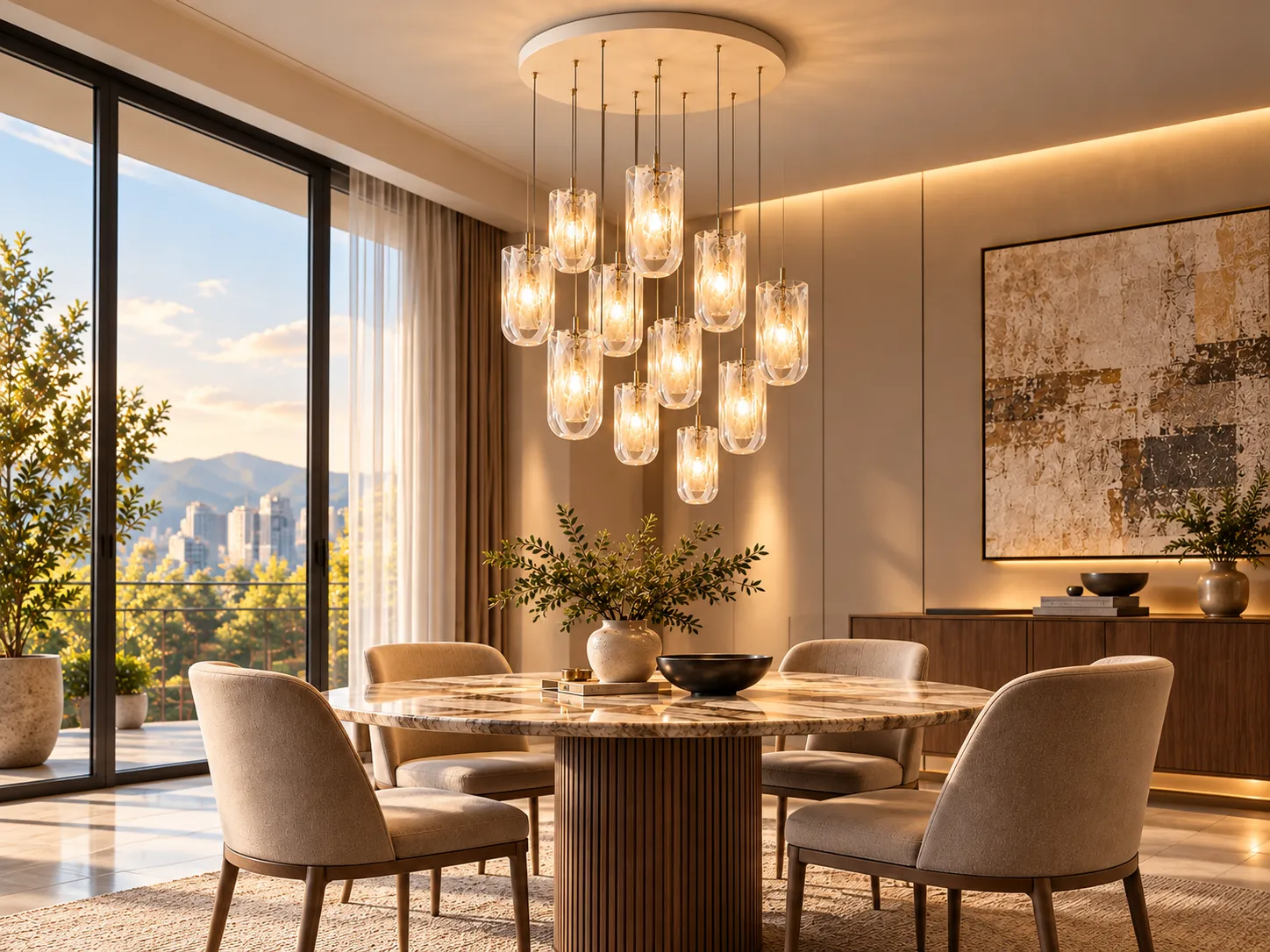

An evidence-informed guide to sculptural glass pendants, warm light, room-by-room placement, fixture sizing, and safe installation.
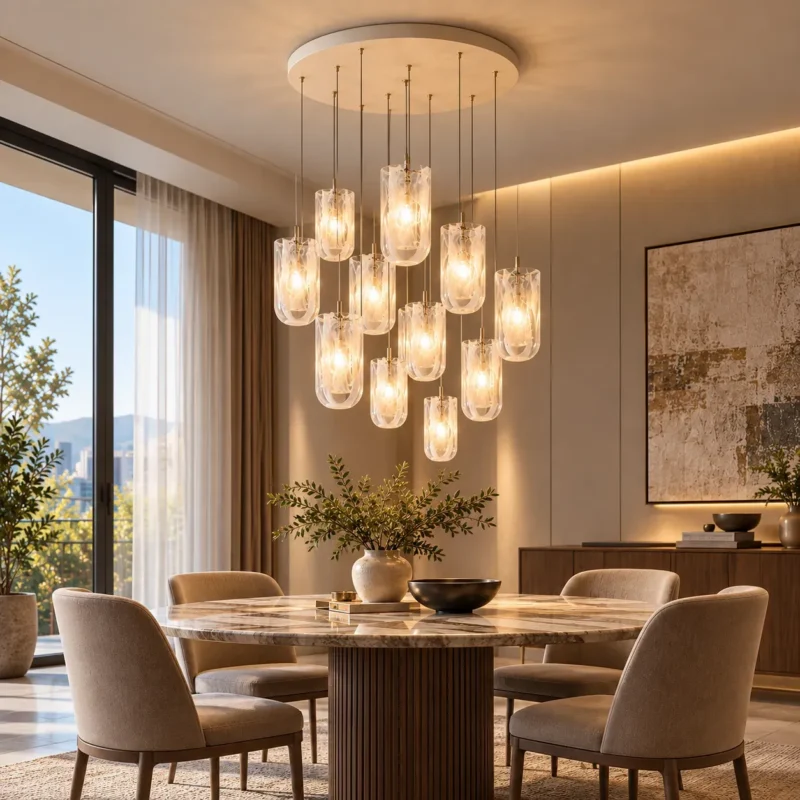
Few lighting elements change a room as immediately as a pendant light. Beyond providing illumination, a well-proportioned chandelier shapes where the eye travels, introduces texture and creates a visual link between the ceiling and the furnishings below. The Modern Cloud Glass Chandelier by xunlulighting turns that practical object into a sculptural focal point: individually suspended, softly textured glass shades appear to float at different heights beneath a circular ceiling canopy.
Its clear, cloud-like glass and champagne-gold accents suit interiors where the goal is elegance without visual heaviness. But the best result depends on more than appearance. Scale, glare control, color temperature, surrounding light and installation details all matter.
1. Why cloud-textured glass works in modern homes
A clear or patterned glass shade allows the luminous source and its reflections to become part of the design. The subtle variations in cloud-textured glass break up an otherwise uniform silhouette, creating detail that remains visible even when the light is switched off. In a neutral room, this adds visual interest without introducing a competing color.
Glass can scatter and redirect light, although the degree of diffusion depends on the precise texture, thickness, LED source position and viewing angle. It is therefore more accurate to describe a textured shade as capable of softening the visual impression of a light source—not as a guarantee of glare-free illumination. Check the fixture in the intended room and from seated eye level.
The suspended arrangement has another advantage: it emphasizes vertical volume. Several glass pendants staggered at different heights can visually fill a high ceiling while leaving sightlines through the space comparatively open.
2. Three ways to style the chandelier
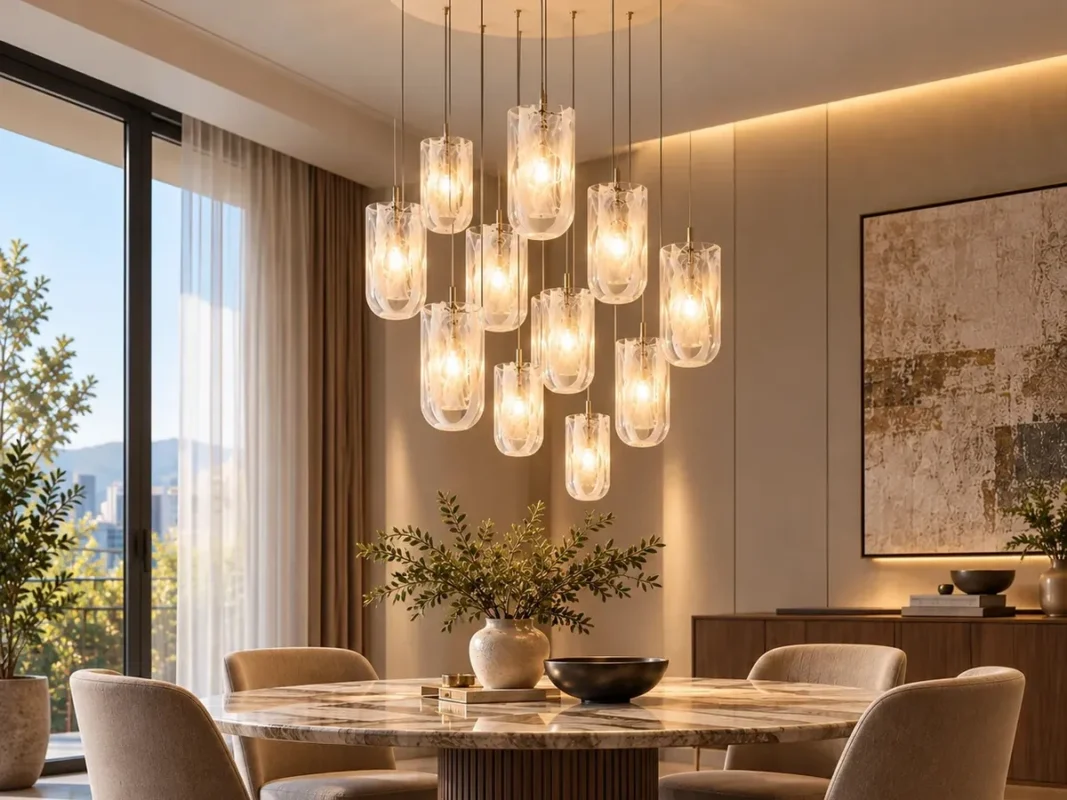
In the dining room: establish a comfortable centerpiece
Over a dining table, the chandelier should feel connected to the tabletop rather than lost in the ceiling. A multi-pendant arrangement works especially well above a round dining table because it creates a centralized composition. The appearance of the glowing glass complements stone, wood, upholstered dining chairs and warm neutral walls.
As a starting point for many standard-height dining rooms, designers often place the lowest part of a pendant roughly 30–36 inches (76–91 cm) above the table. This is a practical planning range, not a universal safety requirement; consider ceiling height, sightlines, occupants and fixture dimensions. Check that the lowest glass shade does not obstruct views across the table.
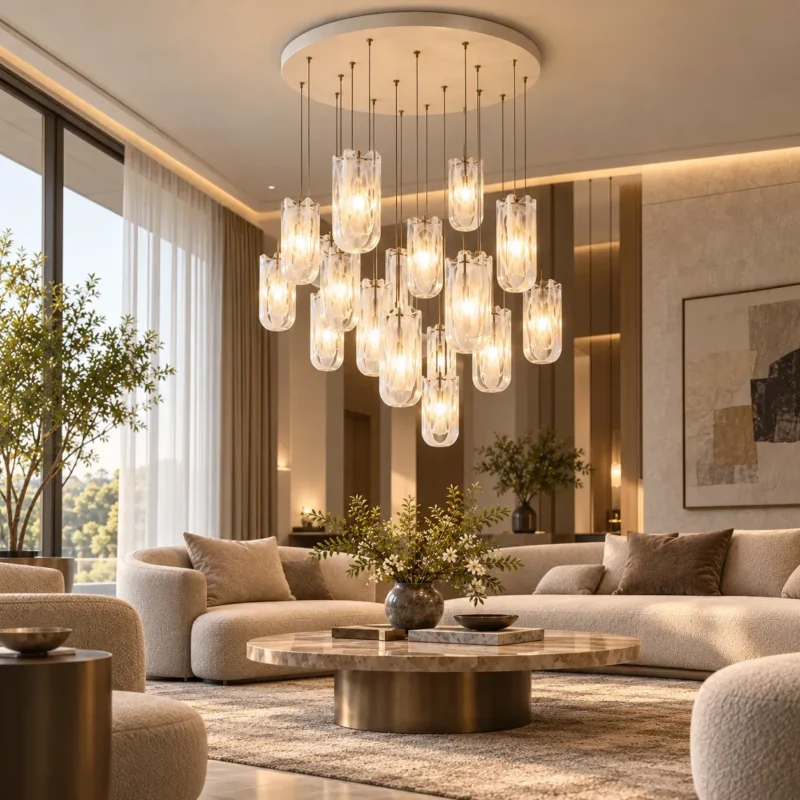
In the living room: give layered lighting a focal point
A living room serves multiple activities: conversation, reading, watching television and relaxing. A chandelier can provide a beautiful ambient or decorative layer, but it should not be expected to perform every lighting task on its own. Pair it with a reading lamp beside the sofa, discreet wall lighting or indirect cove lighting where appropriate. This approach helps avoid making the chandelier excessively bright simply to illuminate every corner.
The Illuminating Engineering Society distinguishes ambient, task and accent light as complementary layers. Thinking in layers is useful because the fixture that makes a room feel welcoming is not always the same fixture that provides focused light for reading or detailed work.
Beside the bed: choose one pendant for visual calm
A single cloud-glass pendant can free space on a bedside table and create a gentler visual effect than a large chandelier. Place it so that it does not interfere with getting in and out of bed, opening drawers or reaching across the table. For bedside reading, assess the actual direction and distribution of light: a decorative pendant may require a separate, adjustable reading light.
Use a convenient bedside switch and, where supported by the light source and driver, a compatible dimmer. Avoid assuming that all LED products are dimmable; compatibility must be confirmed before installation.
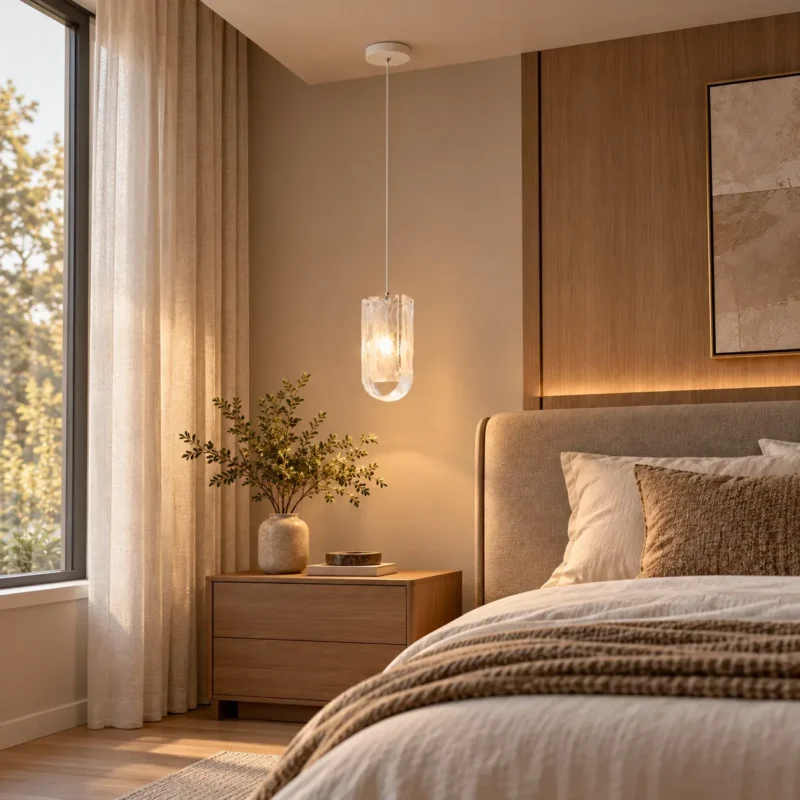
3. Choosing the right number of pendants
The product is offered in three configurations. The dimensions below are taken from the current xunlulighting product listing; the stated 200 cm value is the listed suspension height, not a requirement to hang every fixture that low.
| Configuration | Listed Width | Listed Height / Cable | Typical Design Use |
|---|---|---|---|
| Single head | 13 cm / 5.12 in | 200 cm / 78.74 in | Bedside or small accent |
| 13 heads | 60 cm / 23.62 in | 200 cm / 78.74 in | Dining room / lounge |
| 19 heads | 80 cm / 31.50 in | 200 cm / 78.74 in | Larger living room / villa |
Treat dimensions as the first filter, not the only one. A dense cluster can feel visually substantial even when its overall width is modest. Tape out the proposed canopy size on the ceiling, compare it with nearby furniture and confirm the finished drop of the lowest glass shade. For a stairwell or walkway, maintain sufficient head clearance and follow locally applicable electrical and building codes.
4. Color temperature: a small choice with a big visual effect
Correlated color temperature (CCT), measured in kelvin (K), describes whether white light appears warmer or cooler. The U.S. Department of Energy describes 2700K as warm and 3000K as a soft, welcoming choice commonly used in homes and hospitality interiors. The xunlulighting product page lists 3000K, 4000K and 5700K options.
| Listed CCT | Visual Character | Consider For |
|---|---|---|
| 3000K | Warm white; relaxed and inviting | Dining, living and bedrooms |
| 4000K | Neutral white; clearer, less golden | Multipurpose spaces |
| 5700K | Cooler daylight-like white | Spaces seeking a crisp appearance |
These are design choices rather than universal rules. The surrounding daylight, finishes and personal preference influence the final impression. For living and sleeping areas, 3000K is often a strong starting point; if the space needs accurate evaluation of materials or detailed tasks, color rendering and actual illumination are also important.
The listing states a manufacturer-rated color rendering index (CRI) of at least 97. CRI describes how faithfully a light source renders a standardized set of colors relative to a reference source. Treat this value as a manufacturer claim until backed by test documentation, and remember that high CRI does not by itself establish sufficient brightness or low glare.
5. Lumens, watts and the reality of room brightness
Watts tell us how much electrical power a fixture consumes; lumens represent how much visible light it emits. Illuminance, measured in lux, tells us how much light reaches a surface. They are related but not interchangeable. A chandelier with a high total lumen estimate may deliver substantially less light to a tabletop once shade losses, beam direction, mounting height and the room geometry are accounted for.
The current listing estimates 7W per head, with 490–630 lumens per head. Its total figures for the 13- and 19-head versions are estimates obtained by multiplication, not independently verified photometric measurements. Use them to understand the approximate product class—not to promise a specific lux level in a room. For detailed projects, request measured luminaire lumens or an IES/LDT photometric file and prepare a lighting calculation.
LED technology can deliver substantial energy savings compared with traditional incandescent lamps, but actual operating cost depends on total fixture wattage, hours of use, local tariffs and driver efficiency. A higher-head-count chandelier also consumes more power than a single pendant when operated at its rated output.
6. Plan the installation before ordering
- Check the ceiling structure. The support system must be rated for the full installed weight, including canopy, suspension parts and glass shades.
- Confirm final dimensions, canopy size, cable-adjustment range and the maximum drop required for the space.
- Verify the actual supply voltage and compatible LED driver. The product lists AC 110–240V, with driver compatibility still requiring confirmation.
- Have a qualified electrician install and connect the fixture in accordance with local requirements; do not rely on a decorative ceiling finish for structural support.
- Ask whether dimming is supported by the supplied LED driver before specifying a dimmer.
- Confirm the installation environment. An IP rating is not specified on the listing, so do not assume suitability for bathrooms or damp locations.
For large multi-pendant compositions, it is helpful to make a simple hanging plan before the installer arrives: number each pendant, set its intended drop and review the pattern from multiple viewing positions.
7. Cleaning and caring for textured glass
Turn the light off and allow it to cool before cleaning. Dust regularly with a clean, soft microfiber cloth. For removable glass pieces, follow the manufacturer’s instructions; avoid spraying liquid directly into the socket, canopy or electrical components. Do not use abrasive pads or harsh chemicals on glass or metal finishes. Always support the pendant so that cleaning does not strain the cable or connection.
Periodic visual checks for loosened hardware, damaged cables and changes in light output can help identify issues before they become serious. If a driver or integrated light source needs replacement, use parts approved for the fixture and seek qualified service.
8. Frequently asked questions
Is a cloud-glass chandelier enough to light a room?
It may contribute meaningfully to ambient lighting, but adequacy depends on room area, mounting height, reflectances and the actual delivered lumens. A layered scheme is usually more flexible.
Which version is best for a dining table?
The 13-head version can create a centered composition above a medium dining area, while the 19-head version can serve larger spaces. Choose by measured proportions and hanging clearance, not head count alone.
Can I use the single-head option in a bedroom?
Yes, as a decorative bedside pendant when installed with appropriate clearance. Add targeted reading light if needed.
Can I change the color temperature after installation?
The listing provides multiple CCT options, but it does not establish whether they are selectable on the installed fixture or fixed at ordering. Confirm the specific control method and selected option with the seller.
Final thoughts: design for atmosphere and everyday comfort
The most successful chandelier is not necessarily the brightest or largest. It is the one that balances visual character with comfortable light, appropriate proportions and dependable installation. With its cloud-textured glass, champagne-gold details and single- or multi-pendant configurations, the Modern Cloud Glass Chandelier offers an appealing starting point for contemporary dining rooms, living rooms and bedrooms.
Explore the Modern Cloud Glass Chandelier at https://xunlulighting.com/product/modern-cloud-glass-chandelier-luxury-led-pendant-light/ and confirm the final electrical and installation specifications before purchase.
Modern Cloud Glass Chandelier-Click to view the product