

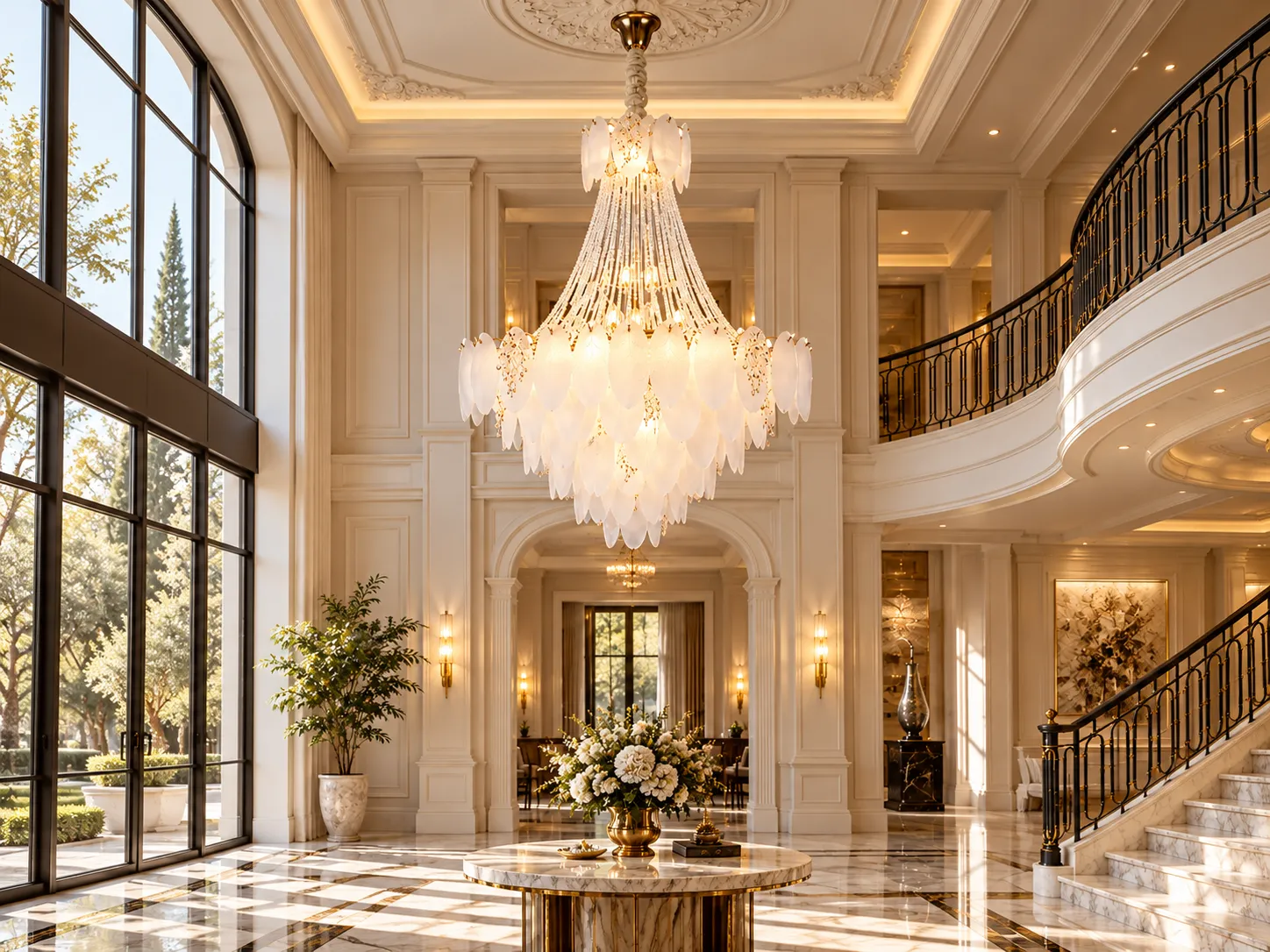

A sculptural approach to lighting double-height foyers, villa living rooms, grand staircases and formal dining spaces.
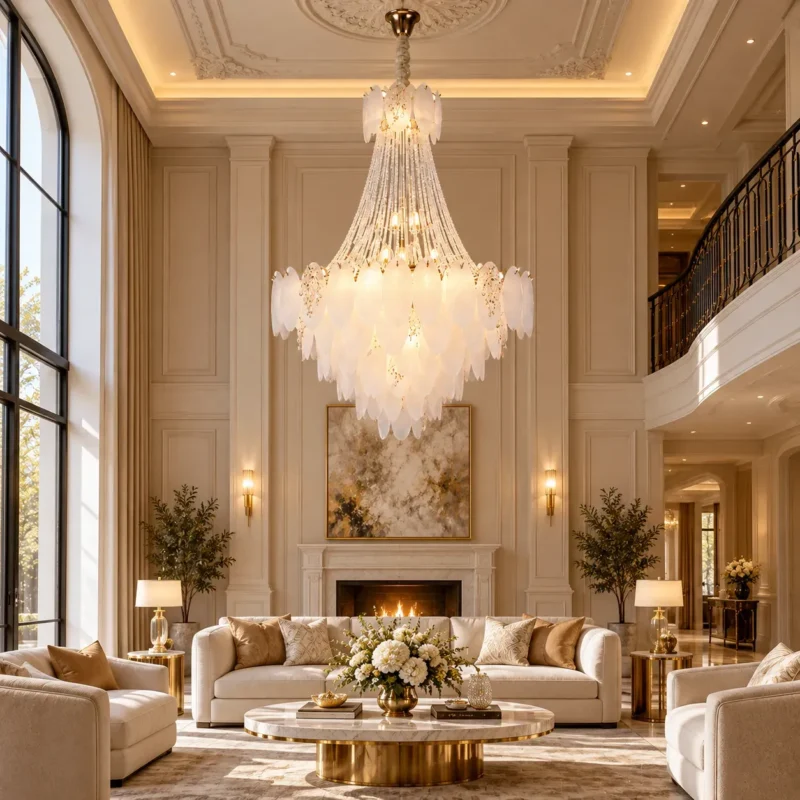
Published by xunlulighting | Interior Lighting & Design | October 2026
The right chandelier can do more than brighten a room: it can reinforce architectural scale, give a large interior a clear focal point, and establish an inviting atmosphere. The Luxury Glass Leaf Crystal Chandelier brings together frosted white glass leaves, delicate crystal-bead strands and a warm-toned metal framework in a layered, French-inspired silhouette. This guide explains how to select, position and illuminate such a statement fixture without confusing decorative impact with verified lighting performance.
1. What makes a glass-leaf chandelier visually distinctive?
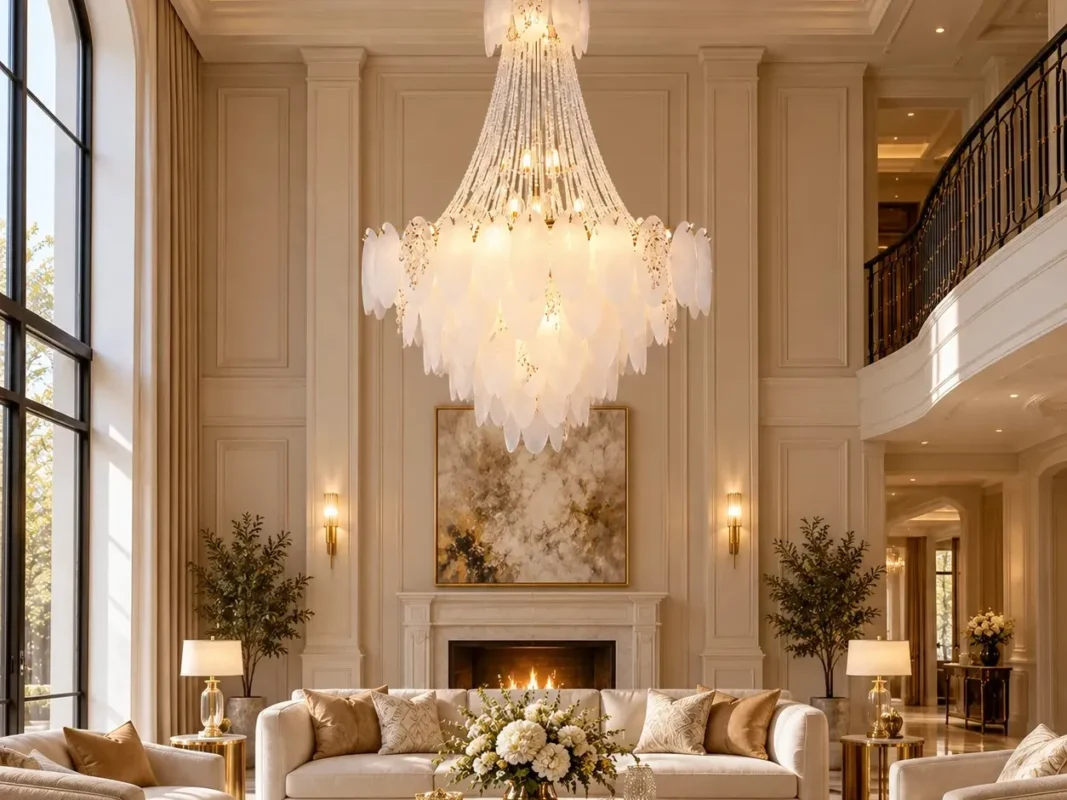
The leaf-shaped elements form a translucent outer composition that softens the direct view of the lamps while revealing changing highlights and shadows. Crystal strands add smaller points of sparkle, and the tiered profile draws the eye upward. In a tall room, this vertical arrangement makes use of space that a compact ceiling light cannot engage as effectively.
Frosted glass scatters transmitted light, but the actual distribution, glare and illumination at the floor depend on bulb selection, geometry, glass thickness and placement. A diffused appearance alone does not guarantee uniform room lighting; photometric testing would be needed to quantify these properties.
2. Where does this statement chandelier work best?
Double-height foyers and staircases
In an entrance hall, a suspended feature helps connect upper and lower architectural levels. Plan the bottom of the chandelier around circulation paths, balcony sightlines, doors and the stairwell footprint. In stair areas, safety and access for cleaning matter just as much as the look of the fixture. An installer should verify all required clearances against local codes.
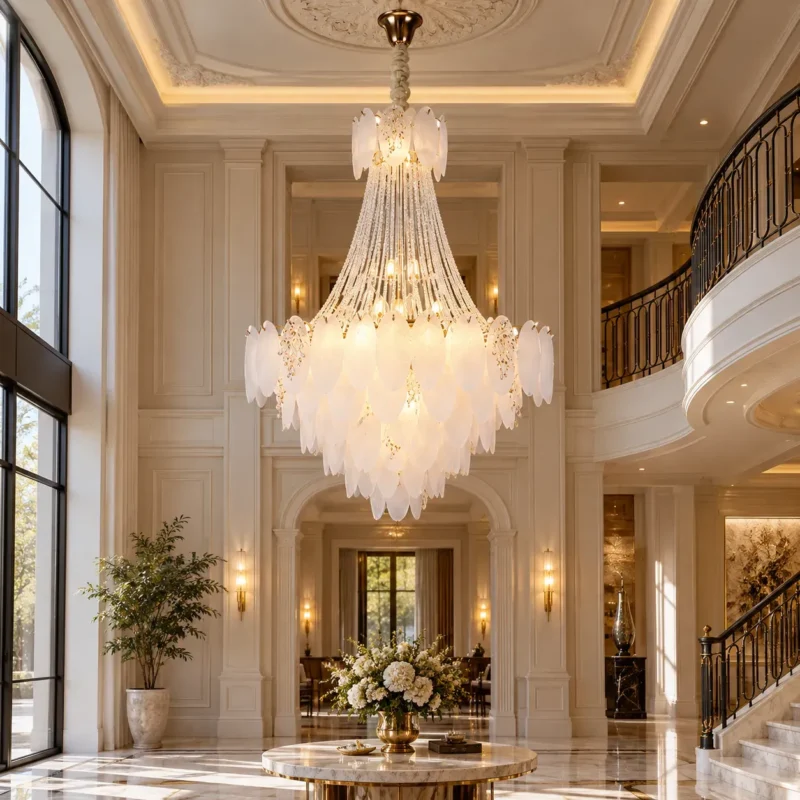
Grand living rooms
In a tall living room, the chandelier can establish the center of the seating arrangement. Position it with awareness of the coffee table and main views into the room, rather than simply centering it on the ceiling. Pair the decorative fixture with concealed cove lighting, wall sconces or adjustable downlights so the room remains functional even when the chandelier is dimmed.
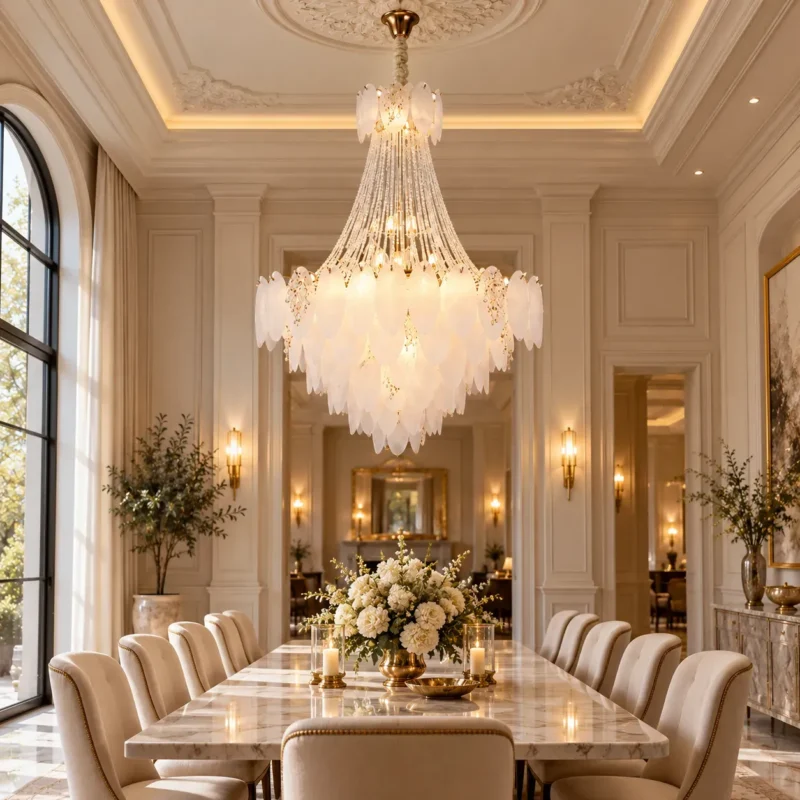
Formal dining rooms
A chandelier over a dining table can feel intimate and ceremonial. As a preliminary design starting point, many designers place the bottom of a pendant around 76–91 cm (30–36 in) above a table in a conventional room; tall ceilings, wide fixtures and sightline needs may justify a different drop. This is a practical convention, not a universal safety standard. Confirm the final position on site.
3. Choose the scale using the room, not just the ceiling
According to the current xunlulighting product page, the chandelier is offered in four nominal diameter-and-height sizes. The dimensional listing is a product description; verify the selected variant and suspension details before ordering or installing.
| Listed Size (cm) | Equivalent (in) | Suggested Visual Context* |
|---|---|---|
| Ø60 × H80 | Ø23.62 × H31.50 | Moderately sized focal zone |
| Ø80 × H120 | Ø31.50 × H47.24 | Tall living room or foyer |
| Ø100 × H150 | Ø39.37 × H59.06 | Generous double-height space |
| Ø120 × H180 | Ø47.24 × H70.87 | Grand lobby or wide atrium |
Design contexts are illustrative recommendations, not manufacturer-certified room-size limits. The product page also contains a conflicting detailed 60 cm height (H86 cm), so confirm exact drawings before manufacture or installation.
For a reliable fit, measure ceiling height, visible hanging height, suspension length, fixture diameter and any nearby handrails or doors. A mock-up or scaled elevation is particularly useful in a double-height room.
4. The science of warm light, diffusion and layered illumination
Correlated color temperature (CCT)
CCT describes whether white light appears warmer or cooler; it does not by itself measure brightness. The product listing recommends 3000K warm white and mentions three-color lighting. Warm white is often selected for lounges and dining areas because it pairs naturally with beige stone, timber and gold finishes. If a three-color or adjustable version is needed, confirm its actual operating modes, switching method and compatible light sources with the supplier.
Lumens versus lux
Lumens describe the total visible-light output of a lamp or luminaire, whereas lux describes the luminous flux received per unit area (1 lux = 1 lumen/m²). A large chandelier with many bulbs may produce substantial lumens yet still leave some working surfaces insufficiently illuminated. Fixture efficiency, light distribution, reflectances and room geometry all affect the result.
The product page presents recommended wattage and lumen ranges for variants, but it explicitly labels several values as approximate. They should not be treated as independently tested measurements. Request bulb specifications or a photometric file when precise illuminance or glare performance matters.
Use layers rather than a single bright source
The Illuminating Engineering Society distinguishes ambient light from task and accent lighting. In a large home, the chandelier can act as a decorative and general-light component, while task lighting supports reading, dining preparation and circulation, and accent lighting highlights architecture or artwork. Separate controls can provide more useful scenes than simply increasing chandelier power.
5. Installation planning and electrical safety
- Confirm the load-bearing capacity of the ceiling structure, anchor hardware and mounting box with a qualified installer; the fixture is not supported by decorative plaster alone.
- Check delivered product weight, canopy dimensions, suspension hardware, voltage and bulb compatibility before installation. The website notes that several listed figures are estimates.
- Confirm that the assembled fixture will clear stairs, walkways, door swings and balcony-level sightlines; local electrical and building codes take precedence over decorative guidelines.
- Plan safe cleaning and lamp-replacement access, particularly for tall foyers where scaffolding or specialist lifting equipment might be required.
- Use the manufacturer-approved lamps and dimming controls only; a three-color listing does not necessarily imply universal dimmer compatibility.
6. Care and maintenance for glass and crystal
Switch the light off and let all components cool before cleaning. Use a clean microfiber cloth for routine dusting. For removable glass elements, follow the manufacturer’s instructions and avoid abrasive pads or aggressive chemicals that might damage coatings or metal plating. Do not spray cleaner into bulb holders, wiring or electrical joints. Inspect hanging connections periodically during professional servicing.
7. Frequently asked questions
Is a glass-leaf chandelier suitable for a modern home?
Yes. Its sculptural profile can provide contrast in a restrained contemporary interior, especially when other finishes remain simple. It also complements French-classic architecture, decorative plasterwork and gold-toned details.
Can it illuminate a large living room on its own?
That depends on the actual lamp output, fixture distribution and room geometry. For comfort and flexibility, combine a chandelier with additional ambient, task and accent lighting rather than assuming a nominal lumen total guarantees sufficient lux everywhere.
Is 3000K better than daylight white?
Neither is universally better. 3000K creates a warm-white appearance commonly preferred for relaxed interiors, while cooler white light may support a different aesthetic or activity. Personal preference, finishes, time of day and other lighting all matter.
What should I confirm before placing an order?
Request the latest dimensional drawing, actual weight, packing details, ceiling fixing requirements, E14 lamp specification, voltage configuration and any dimming or CCT-switching details. These are more dependable than relying on staging photography alone.
Conclusion: An investment in proportion and atmosphere
The appeal of a glass-leaf chandelier lies in the meeting of material texture, architectural scale and controlled light. Choose the dimensions around the room, coordinate the fixture with a layered lighting plan, and make installation verification part of the design process. When these elements work together, the chandelier feels integral to the home rather than simply added to it.
Luxury Glass Leaf Crystal-Click to view the product