

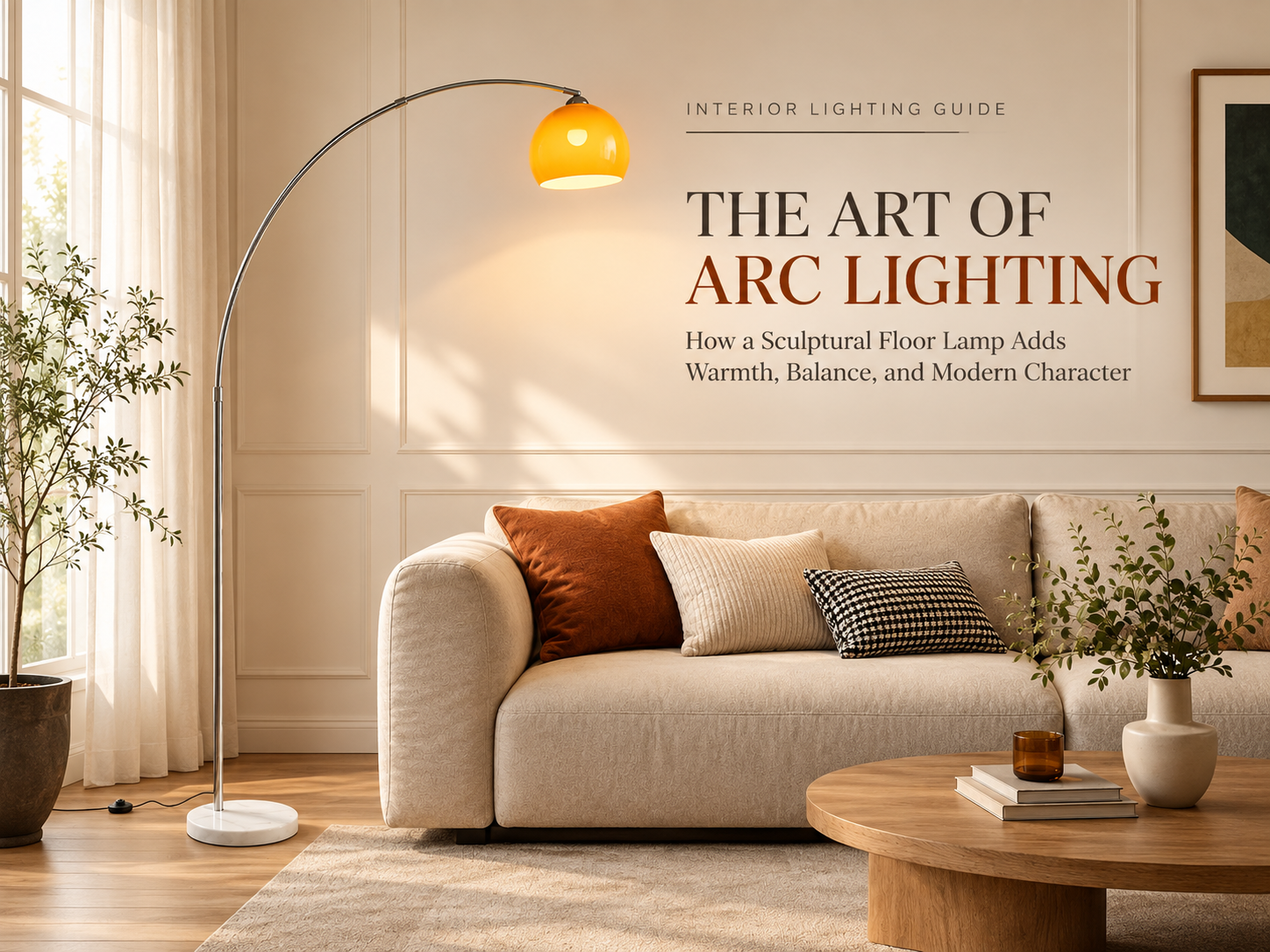

A practical, science-informed guide to placement, color temperature, layered lighting, and interior styling
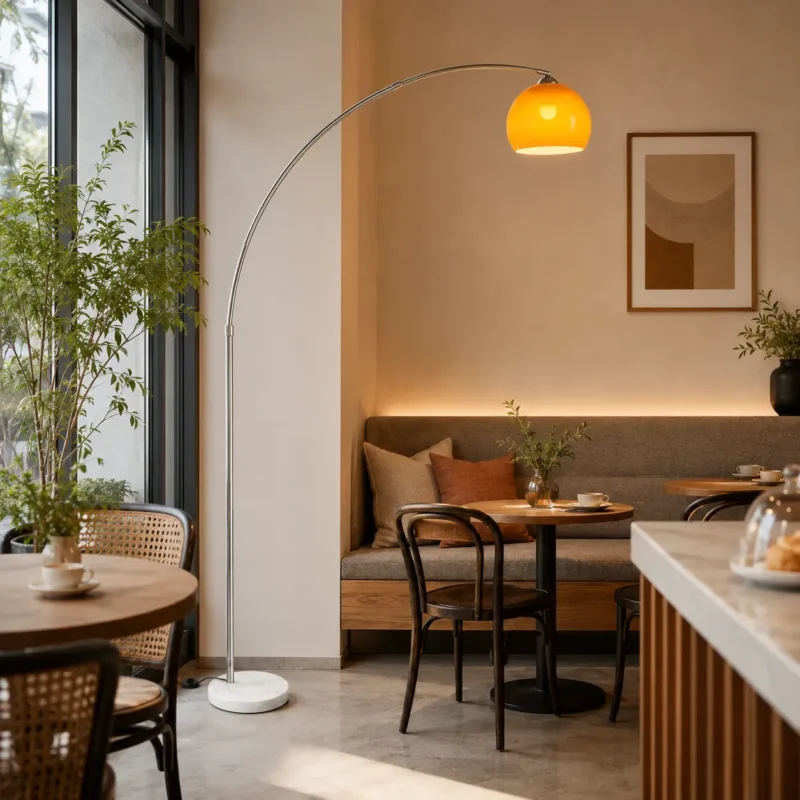
A floor lamp can do more than fill an empty corner. A well-placed arc lamp can bring light over a sofa, reading chair, café table, or kitchen-adjacent seating area without requiring ceiling wiring. The curved metal arm also adds a strong architectural line, while an amber-toned shade softens the visual character of the light and gives neutral interiors a warmer focal point.
This guide explains how to use this kind of lamp effectively, why warm light often feels natural in residential and hospitality spaces, and how to balance atmosphere with practical visibility. The recommendations below are grounded in established lighting principles from the Illuminating Engineering Society (IES) and the U.S. Department of Energy (DOE), while product-specific observations are based on the supplied product imagery.
At a Glance
| Best role | Ambient + accent lighting beside sofas, lounge seating, café corners, and open-plan living areas. |
| Visual effect | Amber shade + warm-white lamp creates a softer, more intimate appearance than cool-white task lighting. |
| Placement advantage | The arc projects light inward from the room edge, helping illuminate a seating zone without a ceiling pendant. |
| Lighting strategy | Use it as one layer in a room: combine with ceiling, wall, or task lighting instead of relying on a single source. |
1. Why the Arc Form Works So Well in Modern Interiors
The defining feature of an arc floor lamp is reach. Instead of placing the light directly above its base, the long curved arm extends the shade over the area where illumination is needed. This makes it especially useful when a room has no junction box in the ideal position or when you want to avoid adding another pendant light.
Visually, the arc also creates a sense of movement. In a room dominated by horizontal furniture — sofas, credenzas, countertops, dining benches — the curve adds height and rhythm without feeling as rigid as a straight pole lamp. The polished metal stem in this design keeps the silhouette light, while the compact amber dome becomes the focal point.
2. Amber Shade + Warm-White Light: What the Science Says
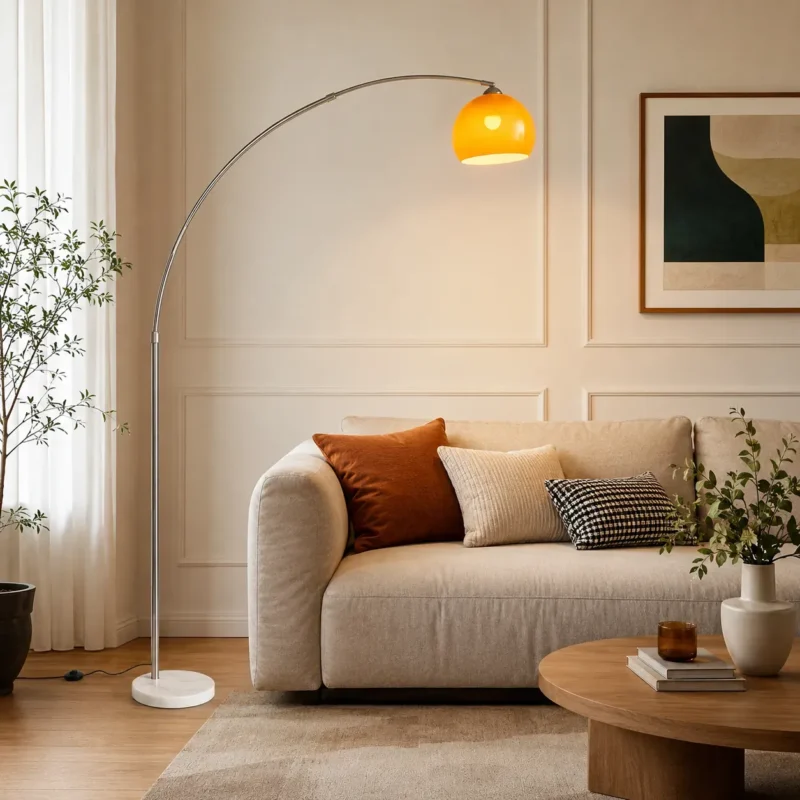
Lighting color is commonly described using correlated color temperature (CCT), measured in kelvin (K). Lower values appear warmer and more yellow/amber; higher values appear cooler and more bluish. The U.S. Department of Energy lists 2700 K as a typical “warm” residential color appearance and 3000 K as “warm, pleasing,” with common applications including homes, restaurants, and lobbies. That makes the 2700–3000 K range a practical starting point for this style of ambient floor lamp.
The amber shade further modifies the visual impression by filtering and reflecting warmer wavelengths into the room. The result is not simply “more orange”; it can also reduce the starkness of exposed white light and make wood, beige textiles, terracotta accents, and warm neutrals feel more cohesive.
Practical bulb recommendation: Start with a warm-white LED around 2700–3000 K. If the fixture accepts a replaceable bulb, prioritize good color quality (for example, CRI 80+ as a basic benchmark, with higher values preferred when accurate color rendering matters). Always follow the fixture’s rated wattage, socket type, and manufacturer instructions.
3. Use It as Part of a Layered Lighting Plan
Good residential lighting is rarely created by one bright source. A more flexible approach is to combine several layers: general light for moving through the room, task light for reading or food preparation, and accent/ambient light for visual comfort and atmosphere. The IES publishes application-specific illuminance criteria because appropriate light levels depend on the activity, the surface being viewed, age, contrast, and many other factors. In other words, there is no single “correct brightness” for every room.
An arc floor lamp fits best into the ambient/accent layer. It can brighten the vertical field of view, draw attention to a seating zone, and provide localized light without making the entire room equally bright. In the evening, this can help create a calmer visual hierarchy than using only strong overhead lighting.
4. Best Placements by Room
| Space | How to place it |
|---|---|
| Living room | Place the base just outside the sofa edge and let the shade project over the side table or seating zone. Keep the shade high enough to avoid head contact when standing up. |
| Reading corner | Aim the light near the reading plane rather than directly into the eyes. Pair with a brighter task lamp if you need sustained reading illumination. |
| Dining / café nook | Use the arc to visually “borrow” the role of a pendant over a small table when ceiling wiring is unavailable. |
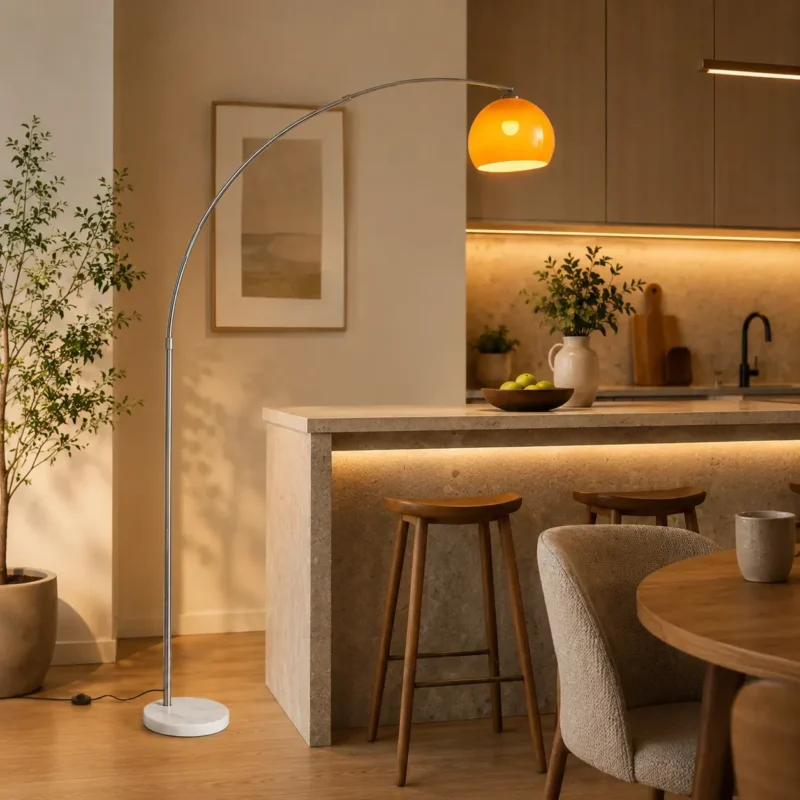
| Open-plan kitchen | Place it near the lounge or breakfast zone, not over food-preparation surfaces. Kitchen worktops usually need dedicated task lighting with higher, more uniform illumination. |
| Bedroom | Use it beside a lounge chair or in a corner where soft indirect light is more important than intense reading light. |
| Hospitality / reception | The amber shade works naturally with warm materials and can help define intimate seating islands within a larger space. |
5. Visual Comfort: Avoid Glare and Over-Brightness
A beautiful fixture can still be uncomfortable if the bright lamp is visible from normal seated eye level. Glare is strongly influenced by source brightness, viewing angle, contrast with the surrounding room, and adaptation. The dome shade helps shield the lamp from some directions, but placement still matters.
- Position the shade so the brightest part of the lamp is not directly in the main line of sight from the sofa or chair.
- Use dimming if the bulb and fixture are compatible; lower output is often more comfortable late in the evening.
- Avoid placing the lamp directly in front of a dark television screen, where reflections and contrast can become distracting.
- For reading, make sure the page is adequately illuminated; a warm decorative lamp can supplement but may not replace a focused task light.
6. Styling the Amber Shade
The amber shade is easiest to integrate when the room already contains one or two related warm elements. You do not need to match the color exactly. Instead, repeat the temperature: walnut or oak, cognac leather, rust cushions, bronze details, natural stone, cream upholstery, or warm art tones can all create a coherent palette.
In cooler minimalist spaces, the lamp can work as the single warm accent. The polished metal arc prevents the design from becoming visually heavy, so it pairs well with contemporary, mid-century-inspired, soft-modern, Japandi, and hospitality-style interiors.
7. Choosing the Right Light Source
Because the shade is colored, the quality of the light source matters. A very cool lamp can fight against the amber shade and create an odd mixed appearance. A warm-white LED is the safer match. If the bulb is visible from below, choose a lamp shape and diffuser that avoids an overly harsh point source.
| CCT | 2700–3000 K is a sensible starting range for warm ambient use. |
| Color rendering | CRI 80+ is a basic benchmark; higher can improve the appearance of skin tones, textiles, wood, and art. |
| Dimming | Useful for evening atmosphere, but only if both the fixture and bulb are dimmer-compatible. |
| Brightness | Choose by room size and purpose; decorative ambient light should complement, not overpower other lighting. |
| Safety | Do not exceed the fixture’s rated wattage or use an incompatible base/socket. |
8. Why This Type of Lamp Is Especially Useful in Flexible Homes
One of the strongest advantages of a floor lamp is reversibility. You can move it as furniture layouts change, take it to a new home, or reposition it seasonally. That flexibility is valuable in rentals, apartments, staged properties, and rooms where you do not want to commit to additional electrical work.
The arc design is particularly helpful because it can deliver light farther from the wall than a conventional vertical floor lamp. In practical terms, it gives you some of the visual effect of a suspended light while keeping installation simple.
9. Care and Maintenance
- Dust the shade and metal arm regularly with a soft, dry microfiber cloth.
- Clean the metal only with products suitable for the fixture finish; avoid abrasive pads that can scratch polished surfaces.
- Keep the base fully flat on a stable floor and route the cord away from walkways.
- After moving the lamp, check that all adjustable joints and fittings are secure before use.
- Turn off and allow the lamp to cool before replacing a bulb or cleaning near the socket.
Final Thoughts
A modern arc floor lamp with an amber shade succeeds because it combines three useful qualities: reach, atmosphere, and sculptural presence. The arc places light where a standard floor lamp cannot easily reach; the warm-toned shade adds a welcoming visual temperature; and the slender metal frame keeps the overall form elegant rather than bulky.
For the best result, treat it as one layer in a complete lighting plan. Use warm-white light for a cohesive appearance, protect seated sightlines from glare, and place the shade over the area you want to visually define. With those details right, the lamp can make a living room, café corner, bedroom lounge, or open-plan space feel warmer and more intentional without major renovation.
Explore the featured lamp at Xunlu Lighting:
| Explore the featured lamp at Xunlu Lighting → View Product |
