

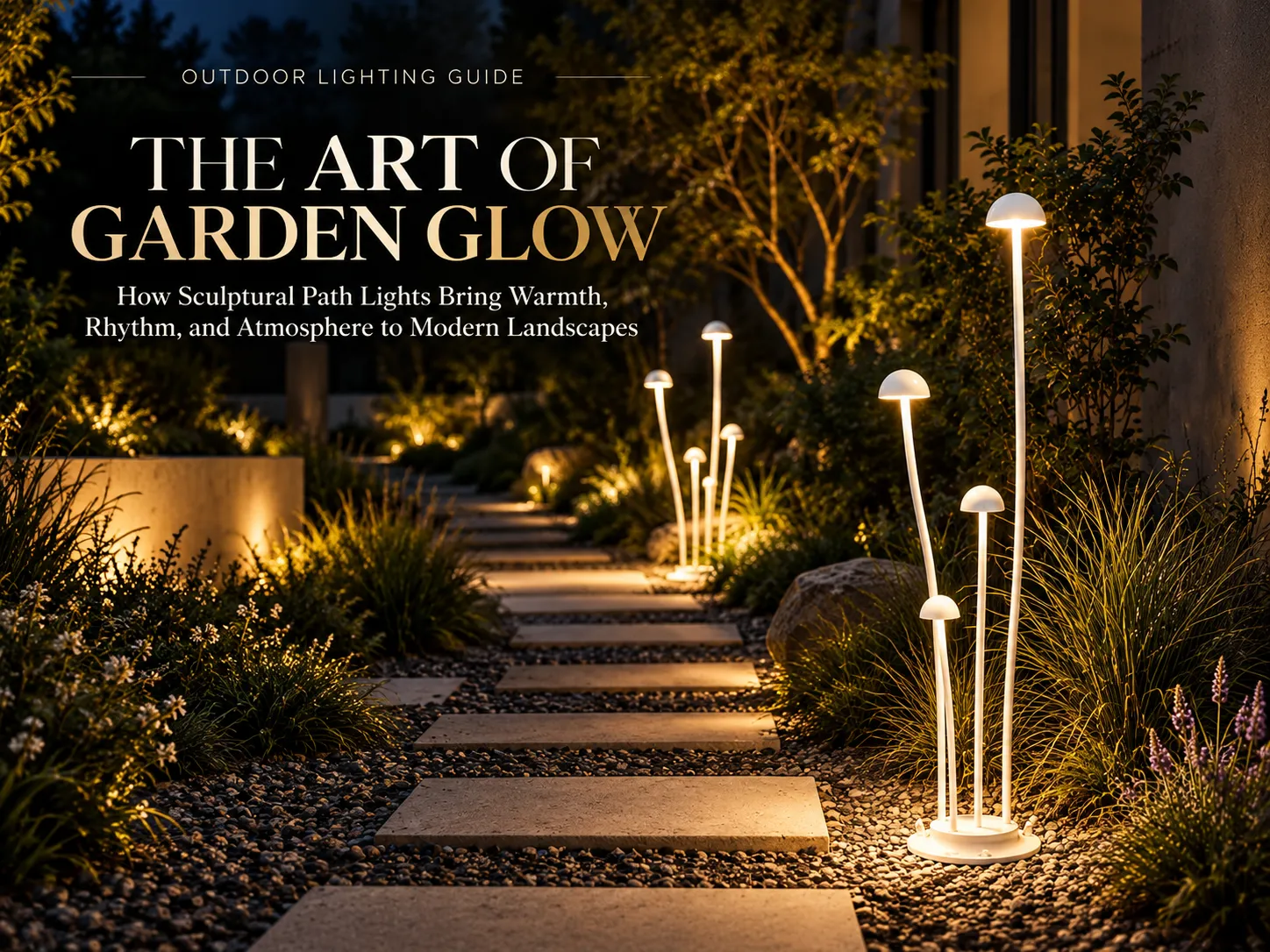

How low-voltage, warm-white pathway lighting can improve visual comfort, spatial rhythm, and nighttime atmosphere
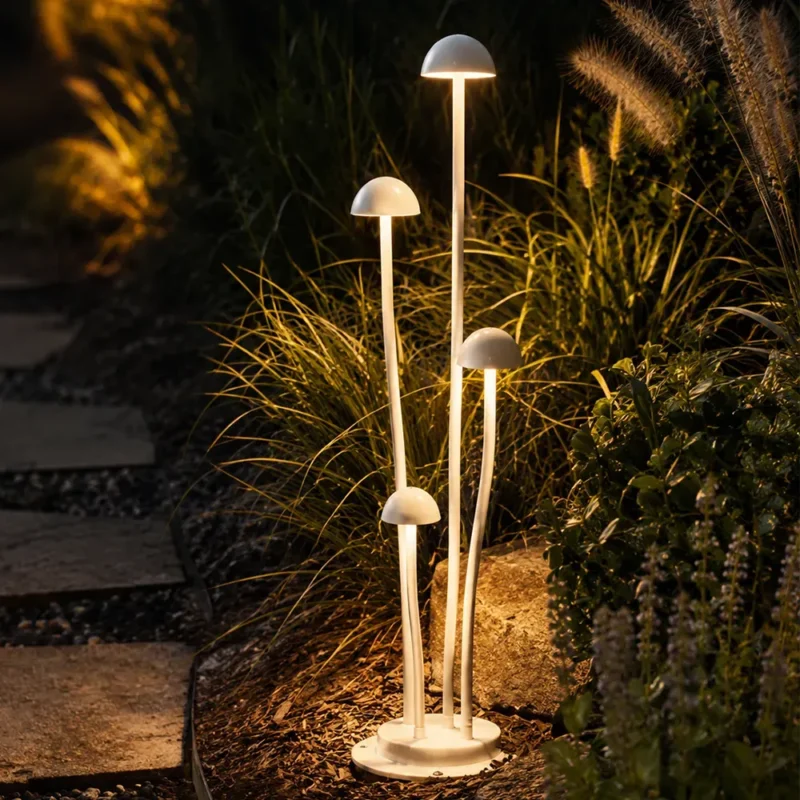
Outdoor lighting works best when it does more than make a garden brighter. A successful scheme helps people understand routes, reveals planting, controls glare, and preserves the calm character of the night. This mushroom-inspired light combines a sculptural silhouette with gentle warm illumination for paths, gardens, villas, and hospitality landscapes.
Why This Fixture Works in Modern Landscapes
A familiar natural silhouette
The mushroom-inspired canopy gives the fixture a recognizable organic shape. Rounded geometry tends to read as softer than exposed linear or angular hardware, which helps the light sit comfortably among grasses, shrubs, stone, gravel, and timber. The matte-white finish also makes the fixture visible as a sculptural object in daylight without visually competing with planting.
Light that stays close to the landscape
The diffuser and dome geometry visually concentrate the luminous effect around the fixture rather than turning the entire garden into a bright field. This is valuable because outdoor visual comfort depends strongly on contrast. A very bright source in an otherwise dark scene can create discomfort glare and reduce the eye’s ability to perceive nearby details.
Multiple heights create visual rhythm
The product is offered in 60 cm, 80 cm, 100 cm, and 120 cm heights. Mixing heights can create a layered rhythm similar to planting design: lower elements support the foreground while taller elements provide vertical punctuation. Repetition is especially effective along garden paths, around specimen planting, or near villa entrances.
Product Snapshot
| Specification | Product Information |
|---|---|
| Material | Stainless steel + aluminum + acrylic/PC diffuser |
| Finish | Matte white / combination white |
| Light source | Integrated LED, 5W per unit |
| Voltage | DC 24V low voltage |
| Color temperature | 3000K warm white |
| Light output | Approx. 350 lm |
| Height options | 60 / 80 / 100 / 120 cm |
| Base diameter | Ø15 cm |
| Suggested applications | Gardens, villas, resorts, parks, pathways, courtyards and landscaped leisure areas |
Specification note: The product page lists outdoor use but does not state an IP rating. For exposed locations, confirm the required ingress-protection rating and installation method for the specific site before purchase or installation.
Design Principle 1: Guide the Eye, Not Just the Feet
Pathway lighting is often described as “safety lighting,” but the design goal is broader: support orientation while preserving darkness and visual hierarchy. The IES emphasizes outdoor lighting considerations such as visibility, glare, contrast, light trespass, and sky glow. In residential landscapes, that usually means using enough light to understand the route while avoiding unnecessarily high brightness or direct views of intense sources.
Use rhythm instead of uniform brightness
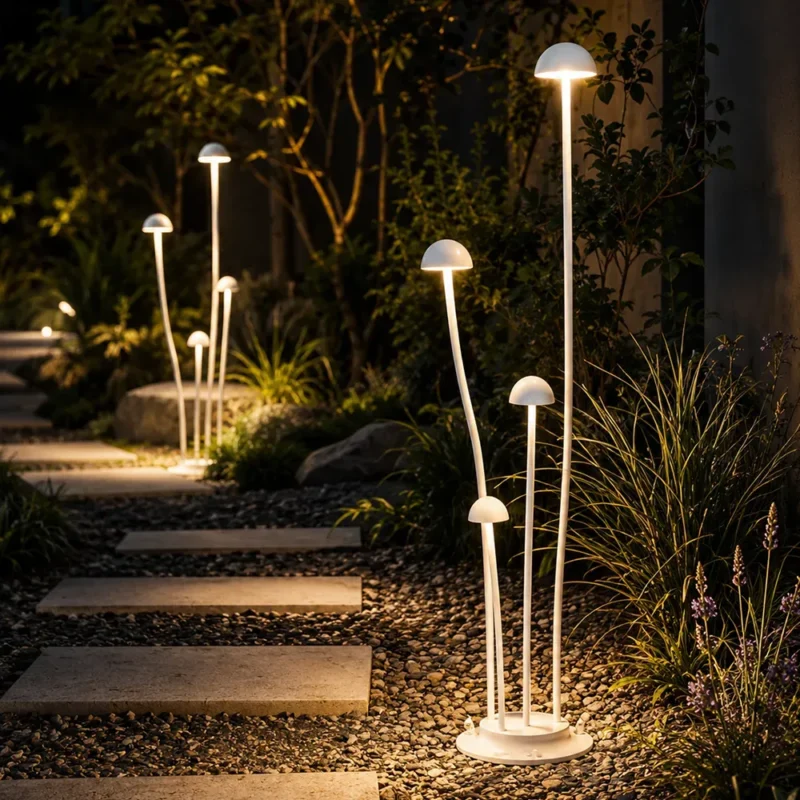
Rather than flooding every square meter, place lights where people need spatial information: changes of direction, path edges, planting transitions, steps, entrances, and focal points. A repeated mushroom form can become a visual “breadcrumb trail” that makes the route legible without flattening the scene.
Keep high contrast under control
At night the eye adapts to lower luminance levels. A bright point source near the line of sight can dominate the scene and make darker areas feel even darker. Diffusion, shielding, sensible spacing, and moderate output help reduce this effect. The product’s approximately 350-lumen output and diffused canopy make it better suited to intimate landscape accents and pathway guidance than to broad-area floodlighting.
Think in layers
A refined outdoor scheme often combines several layers: low pathway light for movement, architectural light near entries, and selective accent light for trees or textured surfaces. The mushroom fixture can occupy the low-to-mid decorative layer, giving depth without asking one luminaire to do every job.
Lighting science in practice
IES guidance for outdoor environments treats glare, light trespass, sky glow, optical control, luminance, and context as interrelated design issues. The practical takeaway for a garden is simple: direct light where it is useful, limit excessive brightness, and preserve contrast so the night scene remains comfortable and legible.
Design Principle 2: Why 3000K Works Well Outdoors
The fixture is specified at 3000K, a warm-white correlated color temperature. CCT describes the apparent warmth or coolness of white light; it does not by itself define spectral quality, color rendering, or ecological impact. Still, in residential and hospitality landscapes, 3000K is widely used because it visually complements wood, stone, warm masonry, earth-toned planting, and evening environments.
IES positions on outdoor light at night emphasize that CCT is only one factor. Lumen output, spectrum, optical control, orientation, dimming, and the surrounding environmental context all matter. That means a lower-CCT lamp is not automatically “good” if it is over-bright, poorly shielded, or aimed where light is not needed.
What 3000K can contribute
- Creates a warmer visual relationship with natural materials and foliage than many cooler white sources.
- Helps maintain a relaxed, hospitality-oriented mood around patios, garden paths, courtyards and villa entrances.
- Pairs naturally with warm architectural lighting at doors, steps and facade details, making the landscape feel cohesive.
What CCT cannot tell you
A 3000K label does not specify CRI, TM-30 color fidelity/gamut, flicker performance, photometric distribution, or glare rating. For projects where color appearance or strict lighting performance matters, request those additional data from the supplier.
Design Principle 3: Low Voltage and Practical Landscape Planning
The fixture operates on DC 24V low voltage. Low-voltage systems are common in landscape lighting because they allow multiple fixtures to be planned around a dedicated power supply and can be practical for distributed garden installations. The transformer/driver, cable sizing, voltage drop, switching, and waterproof connections still need to be designed correctly.
For a multi-light installation, calculate the total connected wattage and include reasonable driver headroom according to the driver manufacturer’s instructions. Cable length and conductor size can influence voltage drop, so long runs and large fixture groups should be checked by a qualified installer rather than treated as plug-and-play wiring.
Design Principle 4: Use Height Variation Like Landscape Architecture
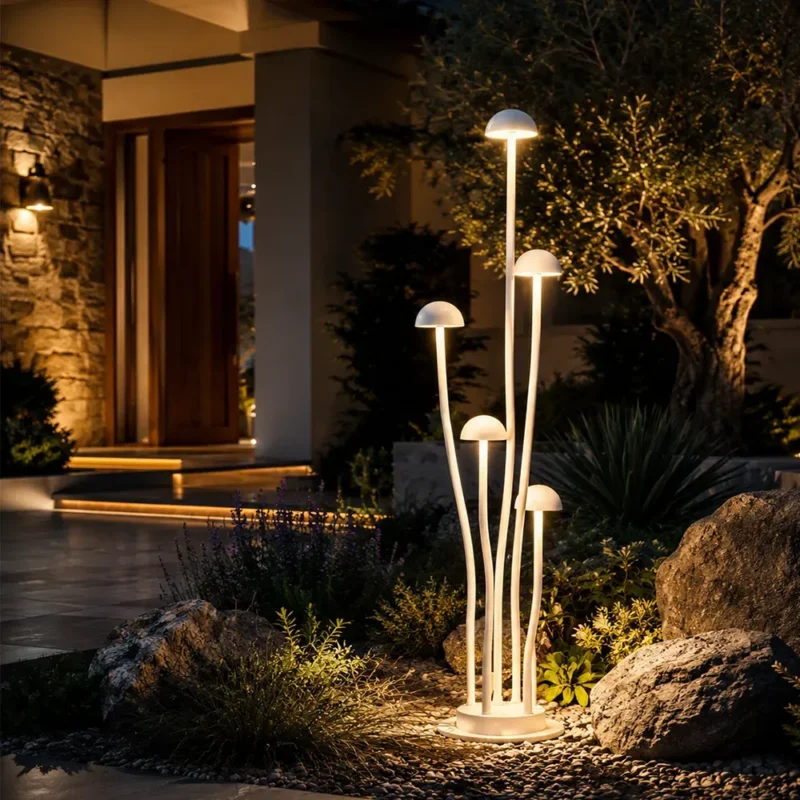
The four available heights give designers a useful compositional tool. A group of identical heights feels formal and rhythmic; a mixed-height group feels more organic and sculptural. The best choice depends on the architecture and planting style.
Three layout strategies
1. Path rhythm — Use repeated units at visually important intervals rather than mechanically equal spacing everywhere. Increase density near turns, steps or entrances, and allow longer dark intervals where the route is obvious.
2. Sculptural cluster — Combine several heights beside ornamental grasses, boulders or a feature tree. This makes the lights read as an intentional installation rather than isolated hardware.
3. Architecture-to-landscape transition — Place a cluster near an entry terrace or facade, then use smaller groups to lead toward the garden. This gradually reduces visual brightness as users move away from the building.
Where this lamp is especially effective
| Villa entrances | Creates a welcoming visual cue without relying on a bright overhead source. |
| Garden paths | Supports route finding while adding a decorative vertical rhythm. |
| Courtyards | Works as a soft sculptural layer beside seating and planting. |
| Resorts and boutique hospitality | The recognizable form helps build a memorable nighttime identity. |
| Feature planting | Mixed heights can highlight the silhouette and texture of ornamental grasses and low shrubs. |
| Rock gardens and gravel landscapes | The white finish and rounded caps contrast cleanly with dark stone and textured ground cover. |
Installation and Specification Checklist
- Confirm the site’s required IP rating and whether the exact product configuration is rated for rain, irrigation splash, snow, or other exposure conditions.
- Use a compatible 24V DC power supply sized for the total connected load and installation environment.
- Plan waterproof cable joints and suitable burial/protection methods in accordance with local electrical requirements.
- Keep bright source surfaces out of common seated and walking sightlines where possible.
- Use the minimum practical light level; add fixtures or adjust spacing based on actual visual needs rather than making the entire landscape uniformly bright.
- Coordinate the mushroom lights with step lights, wall lights, and architectural lighting so they share a coherent color appearance.
- Consider timers, photocells, occupancy control, or dimming so light is reduced when it is no longer needed.
- After installation, evaluate the scene from inside the house and from neighboring viewpoints to identify glare or light trespass.
A Note on Responsible Outdoor Lighting
Outdoor lighting can improve usability and atmosphere, but more light is not always better. IES publications discuss environmental considerations including glare, sky glow, light trespass, and impacts on flora and fauna. A responsible landscape design limits unnecessary uplight, avoids lighting beyond the intended area, reduces output when spaces are unoccupied, and uses shielding or orientation to keep bright sources out of direct view.
Final Thoughts
The Modern Mushroom Outdoor Garden Light is most compelling when treated as part of the landscape composition rather than simply as a utility fixture. Its 3000K warm-white light, low-voltage 24V platform, 5W integrated LED source, approximately 350-lumen output, and four available heights support both decorative and functional applications. Used in clusters or rhythmic path arrangements, it can create a distinctive visual identity while keeping the lighting intimate and human-scaled.
For the strongest result, pair the fixture with thoughtful spacing, glare control, appropriate electrical design, and a broader strategy that respects the surrounding darkness. That combination turns pathway lighting into landscape architecture after sunset.
Explore the product: Modern Mushroom Outdoor Garden Light | Landscape Pathway LED Lamp
